 Learn Quranic Arabic
Many Muslims recite the Quran daily without fully grasping the letters forming its words. That gap between recitation and understanding begins at the most foundational level — the individual Arabic letter, its articulation point, and its behavior within Quranic text.
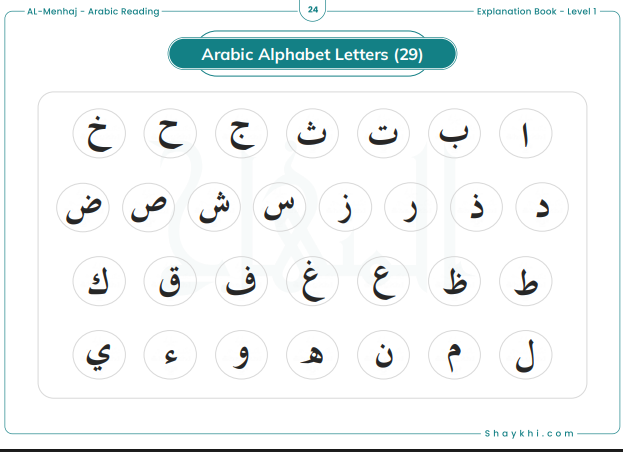
The Quranic Arabic alphabet consists of 28 letters, each with unique pronunciation rules, tajweed characteristics, and morphological roles. Mastering these quranic letters transforms passive recitation into conscious comprehension, opening the door to understanding Allah’s words directly.
The Structure of the Quranic Arabic Alphabet at a Glance
Before examining each letter individually, understanding the overall architecture of the quranic arabic alphabet helps learners orient themselves correctly from the start.
Arabic is written right to left. Letters are consonantal — short vowels are indicated by diacritical marks (harakat) placed above or below the letter. Most letters connect to neighboring letters; six do not connect on their left side.
The table below provides a foundational overview before the detailed letter-by-letter breakdown begins.
| # | Arabic Letter | Name | Transliteration | Connects Both Sides |
| 1 | ا | Alif | ā / glottal | No |
| 2 | ب | Baa | B | Yes |
| 3 | ت | Taa | T | Yes |
| 4 | ث | Thaa | Th | Yes |
| 5 | ج | Jeem | J | Yes |
| 6 | ح | Haa | Ḥ | Yes |
| 7 | خ | Khaa | Kh | Yes |
| 8 | د | Daal | D | No |
| 9 | ذ | Dhaal | Dh | No |
| 10 | ر | Raa | R | No |
| 11 | ز | Zayn | Z | No |
| 12 | س | Seen | S | Yes |
| 13 | ش | Sheen | Sh | Yes |
| 14 | ص | Saad | Ṣ | Yes |
| 15 | ض | Daad | Ḍ | Yes |
| 16 | ط | Taa (emphatic) | Ṭ | Yes |
| 17 | ظ | Dhaa (emphatic) | Ẓ | Yes |
| 18 | ع | Ayn | ‘ | Yes |
| 19 | غ | Ghayn | Gh | Yes |
| 20 | ف | Faa | F | Yes |
| 21 | ق | Qaaf | Q | Yes |
| 22 | ك | Kaaf | K | Yes |
| 23 | ل | Laam | L | Yes |
| 24 | م | Meem | M | Yes |
| 25 | ن | Noon | N | Yes |
| 26 | و | Waaw | W / ū | No |
| 27 | ه | Haa | H | Yes |
| 28 | ي | Yaa | Y / ī | Yes |
At The Quranic Arabic Academy, beginners start precisely here — with structured, letter-by-letter instruction through the Al-Menhaj Book, a foundational curriculum designed specifically for non-native Arabic speakers learning to read the Quran from scratch.
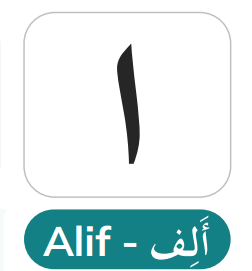
1. Alif (ا) — The First Letter of the Quranic Arabic Alphabet
Alif is unique among quranic letters. It functions both as a consonant carrying a glottal stop (Hamza) and as a long vowel extension (Madd) when preceded by a Fatha.
In Quranic script, Alif appears frequently as a Madd letter, elongating the vowel sound for two counts. Understanding this dual role prevents one of the most common mispronunciation errors among beginners.
اللَّهُ لَا إِلَٰهَ إِلَّا هُوَ
Allahu laa ilaaha illaa Huwa
“Allah — there is no deity except Him.” (Al-Baqarah 2:255)
The Alif in لَا here functions as a Madd letter, requiring a full two-count elongation — a rule governed by tajweed, not optional recitation style.
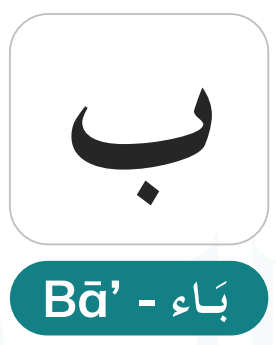
2. Baa (ب) — Special Quranic Alphabet Tajweed Rules
Baa is a bilabial stop, formed by completely closing both lips and releasing air. Its articulation point (makhraj) is the inner lips pressed together firmly.
In tajweed, Baa carries the characteristic of Qalqala (echo/bounce) according to some scholars’ classifications, though its primary Qalqala association is debated.
More critically, Baa triggers Iqlaab and Ikhfaa rules when Noon Sakinah or Tanween precede it.
| Rule | Trigger | Example | Application |
| Iqlaab | Noon Sakinah + Baa | مِنْ بَعْدِ | Noon converts to Meem sound |
| Ikhfaa Shafawi | Meem Sakinah + Baa | هُمْ بِهِ | Meem held with slight nasal resonance |
3. Taa (ت) — Distinguishing It from Its Emphatic Counterpart
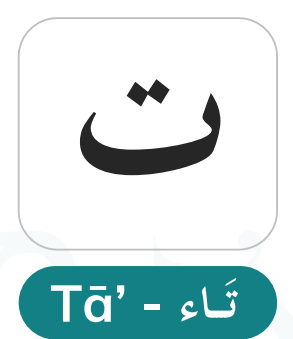
Taa is a dental stop produced at the tip of the tongue against the upper front teeth. It is a light (non-emphatic) letter, meaning surrounding vowels remain unaffected in their natural front-vowel quality.
Students frequently confuse Taa (ت) with Taa Marbuta (ة), which appears only at the end of words and is pronounced as either “T” (in pause) or “H” sound (in continuation). These are functionally different, and mixing them distorts Quranic meaning.
Shots Videos from Our Courses
Ready to Begin Your Quranic Journey?
Start learning with professional instructors through our structured curriculum.
Book Your Free Trial4. Thaa (ث) — The Interdental Sound Non-Arabic Speakers Must Train
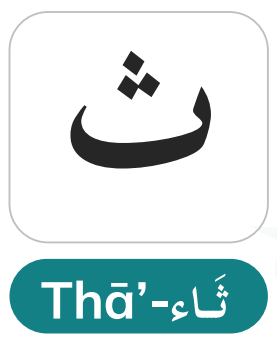
Thaa requires placing the tongue tip gently between or just behind the upper and lower front teeth, allowing air to flow around it. This sound does not exist in most European or Asian languages.
Non-Arabic speakers habitually substitute Thaa with “S” or “T,” which causes meaning errors in Quranic recitation. For example, ثَلَاثَة (three) mispronounced as “Salatha” changes the word entirely. Deliberate, patient training of this sound is essential.
5. Jeem (ج) — Regional Variation and the Tajweed Standard
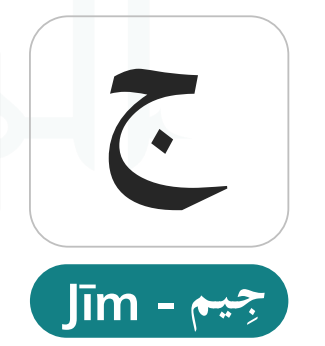
Jeem is a palato-alveolar affricate in Classical Arabic — the sound produced when the middle of the tongue contacts the hard palate. This is the standard adopted in Quranic recitation (tajweed).
Regional Arabic dialects pronounce Jeem differently: Egyptians use a hard “G,” while Levantine speakers use a soft “Zh” sound.
For Quranic alphabet Tajweed purposes, the classical “J” pronunciation almost as in “jump” is the correct standard to follow.
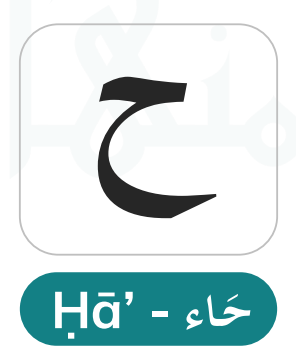
6. Haa (ح) — The Pharyngeal Letter That Requires Breath Control
Haa (ح) is produced deep in the throat at the pharynx, requiring a strong, breathy exhalation. It must not be confused with the softer Haa (ه) produced at the glottis or the Khaa (خ) produced at the velum.
الرَّحْمَٰنِ الرَّحِيمِ
Ar-Rahmaani Ar-Raheem
“The Entirely Merciful, the Especially Merciful.” (Al-Fatihah 1:3)
Both occurrences of ح here demand full pharyngeal production. Softening it into an “H” sound misrepresents one of Allah’s most frequently recited names.
7. Khaa (خ) — The Velar Fricative and Its Role in Quranic Words
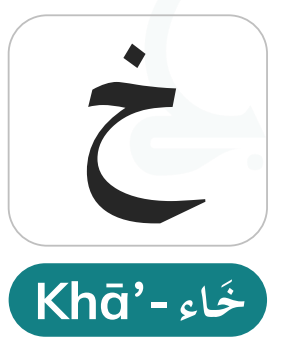
Khaa is produced at the back of the mouth where the tongue contacts or approaches the soft palate (velum), creating a friction sound. It resembles the “Ch” in Scottish “loch.”
In Quranic vocabulary, Khaa appears in high-frequency words like خَيْر (goodness/better) and خَلَقَ (He created). Mispronouncing Khaa as “K” or “H” distorts these words, which appear hundreds of times across Quranic text.
8. Daal (د) — A Non-Connecting Quranic Letter
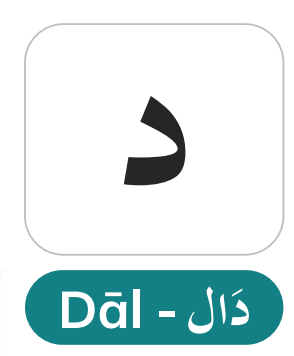
Daal is a dental stop like Taa but voiced — the vocal cords vibrate during its production. It is one of six non-connecting letters in Arabic, meaning it never joins to the letter following it on its left side.
In morphology, Daal appears in the trilateral root د-ي-ن (deen — religion/way of life), foundational to understanding an entire conceptual family of Quranic terms related to faith, judgment, and recompense.
9. Dhaal (ذ) — The Voiced Interdental and Its Semantic Weight
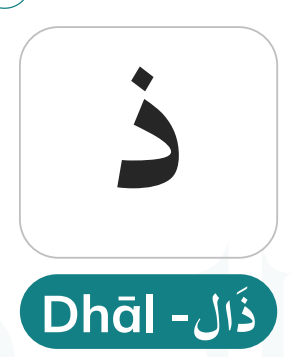
Dhaal is the voiced counterpart of Thaa — same tongue position between the teeth, but with vocal cord vibration added. The distinction between Thaa and Dhaal is therefore purely about voicing.
ذَٰلِكَ الْكِتَابُ لَا رَيْبَ فِيهِ
Dhaalika Al-Kitaabu laa rayba feeh
“This is the Book about which there is no doubt.” (Al-Baqarah 2:2)
ذَٰلِكَ (this) opens this pivotal verse. Pronouncing Dhaal correctly with its voiced interdental quality is foundational to proper recitation from Surah Al-Baqarah onward.
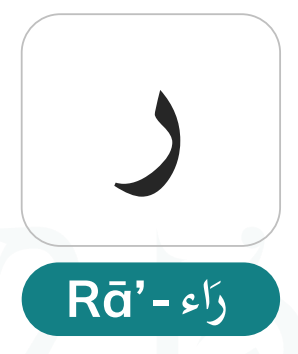
10. Raa (ر) — Tafkheem and Tarqeeq Rules That Define Quranic Recitation
Raa is one of the most rule-governed letters in quranic alphabet tajweed. It can be pronounced thick (Tafkheem) or thin (Tarqeeq) depending on surrounding vowels, adjacent letters, and its position in the word.
| Raa Condition | Pronunciation | Example |
| With Fatha or Damma | Thick (Tafkheem) | رَبِّ ، رُزِقَ |
| With Kasra | Thin (Tarqeeq) | رِجَال ، كَرِيم |
| Sukoon after Fatha/Damma | Thick | مَرْيَم ، قُرْآن |
| Sukoon after Kasra (non-emphatic) | Thin | فِرْعَوْن (debated) |
Mastering Raa’s Tafkheem and Tarqeeq rules is a significant milestone in Quranic recitation accuracy — one where working with a qualified instructor prevents deeply ingrained errors.
11. Zay (ز) — The Voiced Sibilant in Quranic Morphology
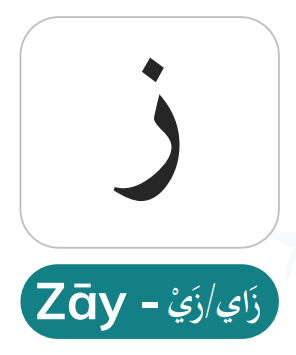
Zay is the voiced counterpart of Seen — same place of articulation, different voicing. Both are produced at the alveolar ridge behind the upper front teeth, with air creating a hissing or buzzing quality.
In Quranic morphology, Zay appears in roots connected to increase, adornment, and scales of justice: زَكَاة (purification/charity), زَيَّنَ (He adorned), مِيزَان (scales of balance). Recognizing Zay within root structures accelerates vocabulary acquisition.
12. Seen (س) — The Voiceless Sibilant and Ikhfaa Applications
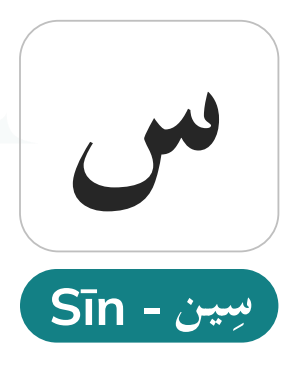
Seen is a light, voiceless sibilant that must remain thin and sharp, never drifting toward the emphatic quality of Saad (ص). The distinction is one of the most tested in tajweed instruction.
When Noon Sakinah or Tanween precede Seen, the rule of Ikhfaa applies — the Noon is held in a nasal resonance for approximately two counts before Seen is articulated. This rule applies to fifteen letters including Seen.
13. Sheen (ش) — The Palato-Alveolar Fricative in Quranic Roots
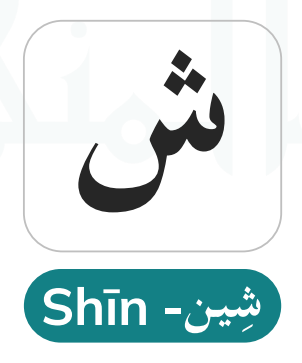
Sheen produces a “Sh” sound, created when the tongue blade approaches the hard palate, spreading air sideways. It is a light letter and must not be thickened.
In Quranic vocabulary, Sheen roots carry spiritually significant meanings: شَكَرَ (to be grateful), شَهِدَ (to witness/testify), شَرِيعَة (divine law). Recognizing Sheen within these roots builds both pronunciation accuracy and vocabulary comprehension simultaneously.
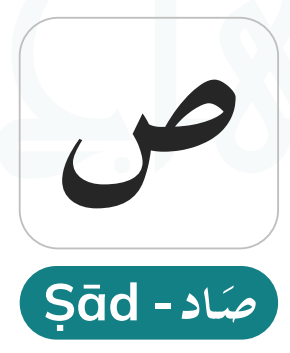
14. Saad (ص) — An Emphatic Letter That Affects Surrounding Vowels
Saad is one of the four emphatic (Isti’la) letters that cause surrounding vowels to shift toward a deeper, back-of-mouth quality. Its place of articulation is the same as Seen, but with the tongue root raised toward the pharynx.
The practical impact: the short vowel “A” (Fatha) near Saad sounds like “AW” rather than the open “AH.” This is not an optional stylistic choice — it is a tajweed requirement governing accurate pronunciation of quranic letters.
15. Daad (ض) — The Letter That Defines the Arabic Language Itself
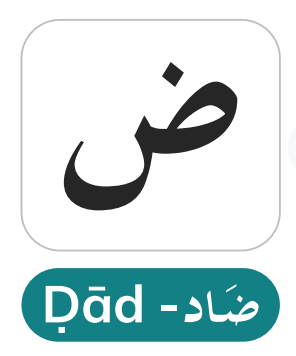
Arabic is historically called “Lughat Al-Daad” (the language of Daad) because this letter is unique to Arabic among world languages. It is an emphatic lateral fricative, produced with the sides of the tongue against the upper molars.
Daad is among the most challenging letters for non-native speakers to master. Its emphatic quality affects surrounding vowels, and its lateral production feels entirely unfamiliar. Consistent, guided practice with a native-trained instructor is the most reliable path to correct articulation.
16. Taa Emphatic (ط) — Distinguishing It from Regular Taa in Quranic Text
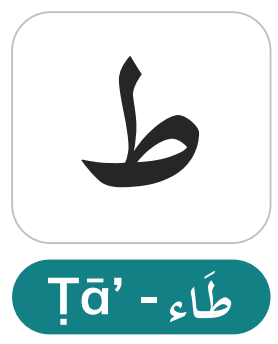
Taa (ط) shares its place of articulation with regular Taa (ت) — the tongue tip at the upper teeth — but adds the tongue root raising that creates emphasis. The surrounding vowels thicken accordingly.
17. Dhaa Emphatic (ظ) — The Rarest Letter in the Quranic Arabic Alphabet
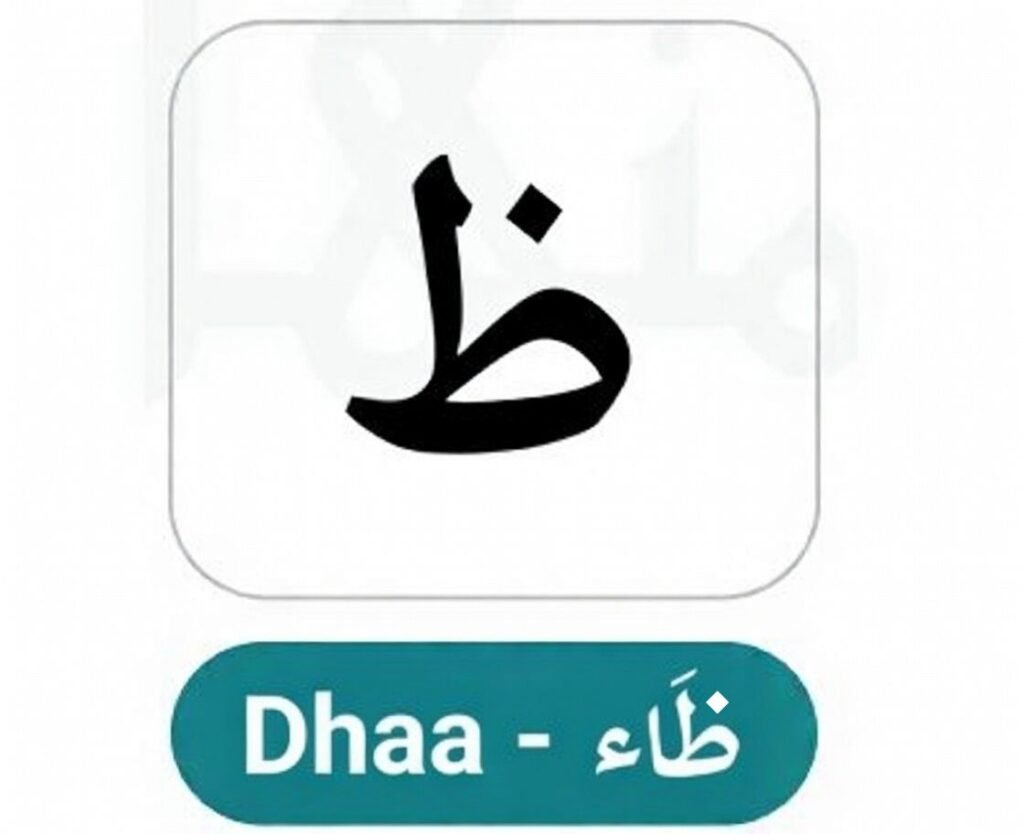
Dhaa (ظ) is statistically the least frequent letter in the Quran. It combines the interdental position of Dhaal (ذ) with the emphatic tongue-root raising that characterizes all Isti’la letters.
The voiced, emphatic, interdental combination makes Dhaa uniquely difficult. Students who confuse Dhaa with Dhaal (ذ) or Daad (ض) introduce errors into Quranic words carrying weighty meanings — such as ظُلْم (injustice) and ظَنّ (assumption/suspicion).
18. Ayn (ع) — The Pharyngeal Letter Central to Quranic Comprehension
Ayn is a voiced pharyngeal fricative — produced by constricting the lower pharynx while vibrating the vocal cords. It has no equivalent in English or most European languages.
Ayn appears in some of the most central Quranic vocabulary: عِلْم (knowledge), عَبْد (servant/worshiper), عَمَل (deed/action). Mispronouncing or omitting Ayn fundamentally alters these words and their meanings within Quranic text.
Working with qualified instructors at The Quranic Arabic Academy through Arabic Courses for Understanding the Quran gives students the 1-on-1 feedback essential for mastering pharyngeal sounds like Ayn — feedback impossible to receive from recorded lessons alone.
Ready to Begin Your Quranic Journey?
Start learning with professional instructors through our structured curriculum.
Book Your Free TrialJoin our Arabic courses for understanding the Quran and get a free lesson
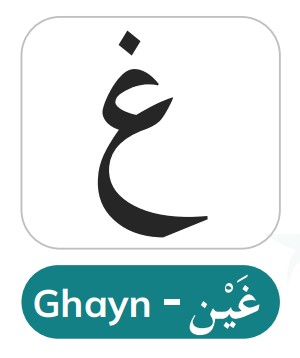
19. Ghayn (غ) — The Voiced Velar Fricative and Its Tajweed Classification
Ghayn is the voiced counterpart of Khaa — same place of articulation at the velum, but with voicing added. It is an Isti’la (emphatic) letter, causing surrounding vowels to deepen.
Ghayn appears prominently in Al-Fatihah:
غَيْرِ الْمَغْضُوبِ عَلَيْهِمْ — “not those upon whom anger has been brought down.”
Every Muslim recites this multiple times daily, making accurate Ghayn production a practical priority for all learners.
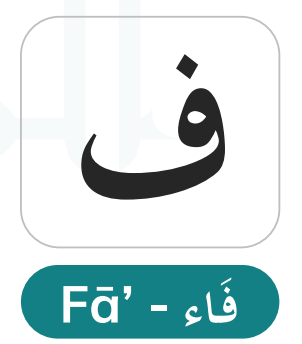
20. Faa (ف) — The Labiodental Fricative and Its Quranic Morphological Role
Faa is produced by the upper front teeth lightly touching the inner lower lip, allowing air to escape with friction. It is a light, non-emphatic letter.
In Quranic grammar, Faa frequently serves as a connective particle meaning “so,” “then,” or “therefore,” signaling logical consequence:
فَاتَّقُوا اللَّهَ (“So fear Allah”).
Recognizing Faa both as a sound and as a grammatical connector deepens Quranic comprehension.
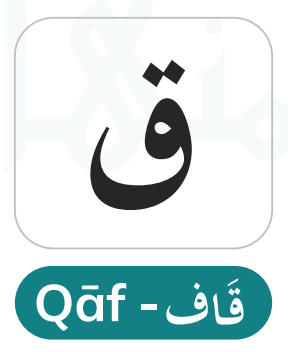
21. Qaaf (ق) — The Deep Velar Stop and Its Distinctive Quranic Sound
Qaaf is produced at the back of the tongue contacting the uvula — deeper than Kaaf. It is an emphatic letter that carries a distinctly deep, resonant quality absent from any sound in English.
ق ۚ وَالْقُرْآنِ الْمَجِيدِ
Qaaf. Wal-Qur’aani Al-Majeed
“Qaaf. By the honored Quran.” (Qaaf 50:1)
Qaaf opens this Surah as one of the disconnected letters (Huroof Al-Muqatta’at). Its deep articulation must be preserved — softening it toward a “K” sound misrepresents both the letter and its Quranic context.
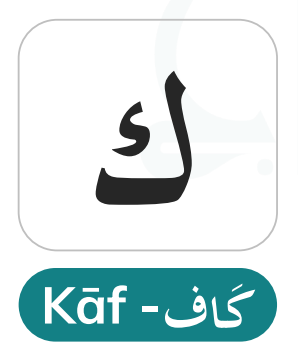
22. Kaaf (ك) — The Voiceless Velar Stop
Kaaf is produced at the back of the tongue touching the soft palate — higher than Qaaf, lighter in quality. It is one of the most frequent letters in Quranic Arabic and appears in grammatical suffixes like -كَ (you/your, masculine singular).
Understanding Kaaf as both a root letter and a grammatical suffix accelerates Quranic comprehension significantly.
When students recognize رَبِّكَ as “your Lord” (Rabb + Kaaf), they begin reading Quranic sentences rather than isolated sounds.
23. Laam (ل) — Tafkheem in Allah’s Name and Standard Tarqeeq Elsewhere
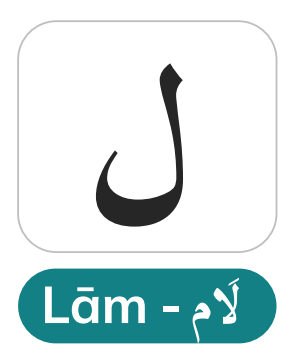
Laam is generally a light letter produced at the sides of the tongue tip against the upper alveolar ridge. However, Laam in the name اللَّه follows a unique rule: it is pronounced thick (Tafkheem) when preceded by a Fatha or Damma, and thin (Tarqeeq) when preceded by a Kasra.
قُلْ هُوَ اللَّهُ أَحَدٌ
Qul Huwa Allaahu Ahad
“Say: He is Allah, the One.” (Al-Ikhlas 112:1)
The Laam in اللَّهُ here, preceded by Damma, is thick — a rule specific to Allah’s name and foundational to accurate recitation.
24. Meem (م) — Ghunnah, Idghaam Shafawi, and Its Morphological Significance
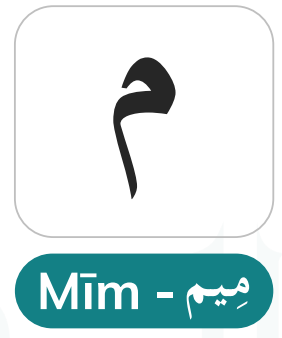
Meem is a bilabial nasal stop — both lips close completely while air flows through the nasal passage. When Meem carries Sukoon and is followed by another Meem, a full Idghaam (merging) occurs with Ghunnah (nasal resonance for two counts).
In Quranic morphology, Meem serves as a prefix in pattern words called مَصْدَر Meemi (verbal nouns beginning with Meem) — such as مَسْجِد (place of prostration) and مَكْتَب (place of writing).
Recognizing this pattern unlocks hundreds of Quranic vocabulary items.
25. Noon (ن) — The Letter with the Most Tajweed Rules Attached
Noon Sakinah (Noon with Sukoon) and Tanween trigger four distinct tajweed rules depending on the following letter: Idghaam (merging), Ikhfaa (concealment), Iqlaab (conversion), and Idhhaar (clear pronunciation).
| Following Letter Category | Rule | Description |
| ي ن م و ل ر | Idghaam | Noon merges into following letter |
| ب | Iqlaab | Noon converts to Meem sound |
| أ ه ع ح غ خ | Idhhaar | Noon pronounced clearly |
| 15 remaining letters | Ikhfaa | Noon held in nasal resonance |
No single letter in the quranic arabic alphabet carries more tajweed weight than Noon. The Quranic Arabic Academy’s Quranic Arabic Grammar Course dedicates significant instruction specifically to Noon’s rules, as errors here affect the majority of Quranic verses.
Your First class is free. Join our Quranic Arabic Grammar Course now

Read Also: Learn Quranic Arabic Free
26. Waaw (و) — Consonant, Long Vowel, and Madd Letter
Waaw functions in three distinct ways in Quranic Arabic: as a consonant producing a “W” sound, as a long vowel (Damma + Waaw = “oo” sound), and as a Madd letter requiring elongation.
Distinguishing these three functions requires understanding the diacritical context surrounding each Waaw. This is why learning the pronunciation of quranic letters cannot be separated from learning their vowel markings — the two systems are inseparable in Quranic text.
Read Also: Quranic Arabic Books
27. Haa (ه) — The Glottal Fricative and Its Role in Pronoun Suffixes
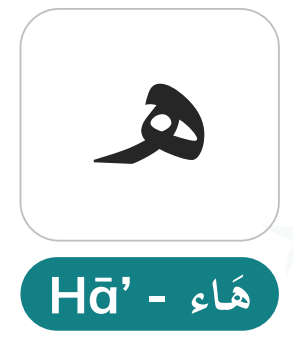
Haa (ه) is produced at the glottis with a soft, breathy exhalation — lighter and higher than Haa (ح). It is non-emphatic and frequently appears as a pronoun suffix meaning “him/his/it.”
إِنَّهُ هُوَ الْغَفُورُ الرَّحِيمُ
Innahu Huwa Al-Ghafoor Ar-Raheem
“Indeed, He is the Forgiving, the Merciful.” (Al-Hijr 15:49)
The -هُ suffix in إِنَّهُ is a pronoun meaning “He/Him.” Recognizing Haa as a pronoun suffix rather than a root letter is a fundamental step in grammatical analysis of Quranic verses.
Read Also: Benefits of Learning Quranic Arabic
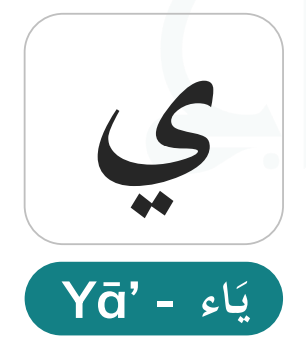
28. Yaa (ي) — Consonant, Long Vowel, and the Final Letter of the Alphabet
Yaa mirrors Waaw in its triple function: consonant (“Y” sound), long vowel (Kasra + Yaa = “ee” sound), and Madd letter requiring elongation. Together, Alif, Waaw, and Yaa form the three Madd letters central to tajweed elongation rules.
In Quranic grammar, Yaa also appears as a prefix of second-person feminine address (يَا + feminine verb) and within pattern-based vocabulary.
Recognizing Yaa’s role across consonantal, vocalic, and grammatical functions completes a student’s understanding of the full quranic arabic alphabet.
Our Students Reviews
Ready to Begin Your Quranic Journey?
Start learning with professional instructors through our structured curriculum.
Book Your Free TrialRead Also: How to Learn Quranic Arabic?
Begin Learning Every Quranic Arabic Letter at The Quranic Arabic Academy
Every letter covered here requires trained ears, patient correction, and structured progression — not just reading descriptions. The Al-Menhaj Book Course at The Quranic Arabic Academy was authored by Luqman ElKasabany and developed by instructors with 25+ years of experience, specifically for non-native speakers learning to read the Quran.
- Structured letter-by-letter progression
- 1-on-1 sessions with certified Quranic Arabic instructors
- Flexible scheduling available 24/7
- Specialized courses for sisters, kids, adults, and advanced learners
- Curriculum built exclusively for English-speaking Muslims
Book your free trial lesson today and take your first step toward reading the Quran with confidence, clarity, and correct pronunciation.
Check out our top courses to start learning Quranic Arabic today:
- Quranic Arabic Grammar Course
- Arabic Courses for Understanding the Quran
- Quranic Arabic for Beginners
- Online Quranic Arabic Classes for Adults
- Quranic Arabic Course for Kids
- Quranic Arabic Course for Sisters
- Online Quranic Arabic Courses for Advanced Learners
Your first class is completely free. Start Learning Quranic Arabic courses Today.
Conclusion
Mastering the Quranic Arabic alphabet is not about memorizing 28 shapes — it is about understanding 28 distinct articulation points, each with its own tajweed behavior and grammatical function in Quranic text.
The pronunciation of quranic letters directly determines the accuracy of your recitation. Errors at the letter level compound across every word, verse, and Surah — making early correction far more valuable than late correction.
Quranic Arabic instruction, approached letter by letter with proper makhraj training and tajweed awareness, transforms recitation from habitual repetition into genuine engagement with Allah’s speech. That transformation begins with a single, correctly pronounced letter.
Related Articles
Learn Quranic Arabic






Leave a Reply