 Quranic Resources & Apps

| Key Takeaways |
| Online Quranic studies cover Arabic reading, grammar, vocabulary, Tafseer, and ‘Ulum Al-Quran — not Tajweed recitation alone. |
| Tafseer study requires a functional Quranic Arabic foundation first — grammar and vocabulary must precede interpretive analysis. |
| ‘Ulum Al-Quran (Quranic Sciences) covers revelation context, abrogation, and variant readings — essential for accurate Quranic understanding. |
| The most common mistake in online Quranic studies is choosing platforms that teach Modern Standard Arabic instead of Quranic Arabic specifically. |
For many Muslims living in the West, the Friday khutbah ends and the Quran is recited — yet the words pass through without meaning.
You hear the Arabic, you feel its weight, but you cannot access its message directly. That gap is exactly what well-structured online Quranic studies are designed to close.
Online Quranic studies give non-Arabic speakers a clear, systematic path to understanding the Quran in its original language — covering Arabic reading fundamentals, vocabulary, and grammar through live, personalized instruction. Choosing the right program makes the difference between genuine progress and years of frustration.
What Are Online Quranic Studies?
Online Quranic studies are structured educational programs delivered via the internet that teach non-Arabic speakers to read, understand, and analyze the Quran in its original Arabic language. A sound online Quranic studies program covers three essential layers: Arabic script and reading, Quranic vocabulary, and Quranic grammar (Nahw). Any program missing one of these layers will produce incomplete results.
Many students arrive at The Quranic Arabic Academy having previously enrolled in programs they describe as “Quran classes” — only to discover those programs focused entirely on Tajweed (recitation rules) without building any grammatical or vocabulary foundation. Tajweed is valuable, but it is not the same as Quranic studies.
Understanding what Quranic Arabic actually is — its structure, its classical register, and how it differs from everyday speech — is what separates surface-level recitation from genuine Quran comprehension.
A well-designed online Quranic studies curriculum teaches:
- Arabic alphabet and reading fundamentals (Harakaat, letter forms, connected script)
- Core Quranic vocabulary (the most frequent words that cover a large percentage of Quranic text)
- Quranic grammar — Mubtada’ and Khabar, Idafa constructions, verb conjugation (Fi’l Madhi, Mudari’, Amr), and I’rab (case endings)
- Tafseer — the scholarly discipline of interpreting and explaining the meaning of Quranic verses
- ‘Ulum Al-Quran (Quranic Sciences) — the study of revelation context (Asbab Al-Nuzul), abrogation (Naskh), Makki and Madani classifications, and the transmission of the Quran
At The Quranic Arabic Academy, our Quranic Arabic for Beginners course builds all three layers sequentially, using the proprietary Al-Menhaj Book curriculum developed specifically for non-native speakers.
Enroll in Our Quranic Arabic for Beginners with a Free Trial

Why Online Quranic Studies Work for Non-Arabic Speakers?
Online Quranic studies give non-Arabic speaking Muslims around the world access to qualified Quranic Arabic instructors they would never otherwise reach. Live 1-on-1 instruction with a certified Arabic linguist is available on-demand, scheduled around work, family, and time zone — something no local mosque class can replicate.
The advantages are not merely logistical. Online instruction allows instructors to observe each student’s specific error patterns in real time and respond with targeted correction — something pre-recorded video courses cannot do.
There is a well-established reason why learning Quranic Arabic matters: direct access to the Quran’s meaning transforms the prayer experience, deepens reflection during recitation, and builds a relationship with the text that translation alone cannot provide.
The table below compares common online learning formats so you can identify which structure best supports genuine progress:
| Format | Instructor Interaction | Personalization | Suitable For |
| Pre-recorded video course | None | None | Supplementary review only |
| Group live sessions | Limited | Low | Budget-conscious beginners |
| 1-on-1 live sessions | Full | High | All levels — optimal |
| Hybrid (1-on-1 + materials) | Full | Highest | Structured long-term progress |
The Quranic Arabic Academy operates exclusively on the 1-on-1 live session model, with instructors holding 25+ years of Arabic teaching experience and flexible scheduling available 24/7 for global students.
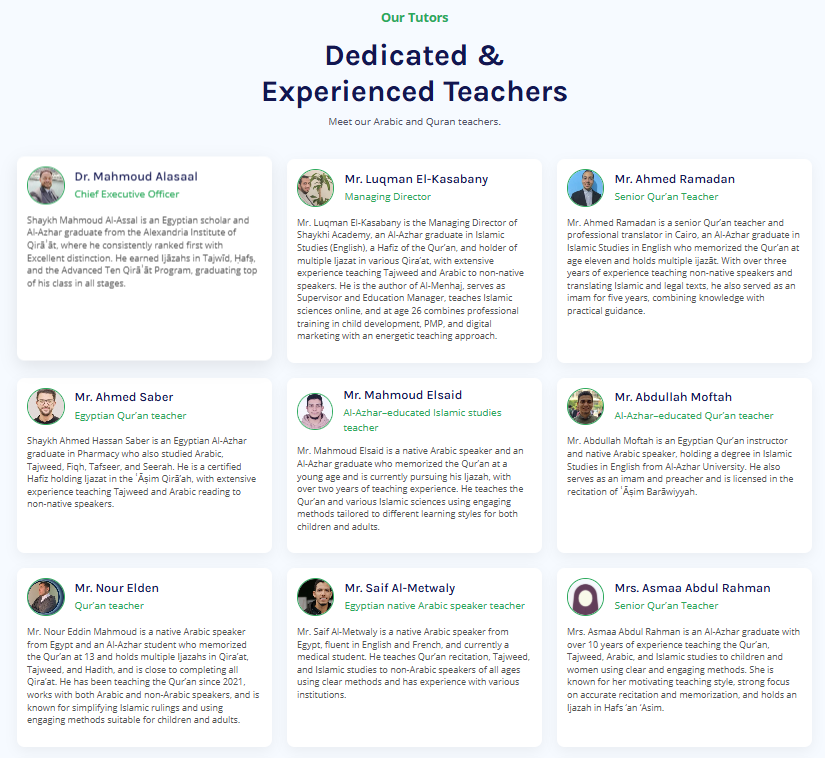
Meet our certified Quranic Arabic teachers
Shots Videos from Our Courses
Ready to Begin Your Quranic Journey?
Start learning with professional instructors through our structured curriculum.
Book Your Free TrialHow Are Online Quranic Studies Different from Learning Modern Standard Arabic?
Online Quranic studies focus on Classical Quranic Arabic — the specific linguistic register in which the Quran was revealed — not Modern Standard Arabic (MSA), which is used in contemporary news media and formal writing. These are distinct registers with meaningful grammatical and lexical differences.
Quranic Arabic is meaningfully different from Modern Standard Arabic in vocabulary, grammatical structures, and stylistic features. A student who spends two years on MSA courses may still struggle significantly with Quranic comprehension — because they trained for the wrong target.
Our instructors at The Quranic Arabic Academy observe this pattern consistently: students who transfer from MSA programs arrive with strong conversational instincts but routinely misparse classical grammatical constructions like the accusative shift triggered by حروف النصب (Harf Nasb) — particles such as إِنَّ — because MSA instruction handles these forms differently.
If your goal is to understand the Quran directly, your studies must be designed around Quranic Arabic — not adapted from a general Arabic program.
What Do Online Quranic Studies for Children Look Like?
Quranic studies for children online should combine Arabic reading instruction, age-appropriate vocabulary building, and short Quranic verse comprehension — delivered by instructors trained in child-centered pedagogy, not adult instruction methods.
Children learn Quranic Arabic differently than adults. They absorb patterns through repetition and oral drilling faster than adults do, but they disengage quickly when sessions lack visual variety and interactive engagement. At The Quranic Arabic Academy, our instructors who teach children are specifically selected and trained for this demographic.
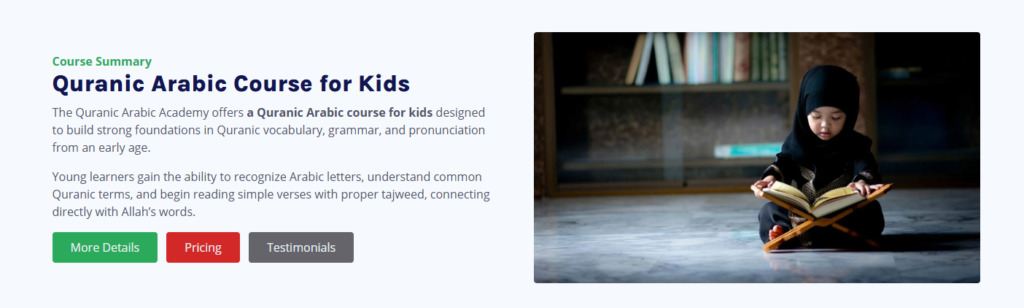
Our Quranic Arabic Course for Kids follows the Al-Menhaj Book progression adapted for younger learners, beginning with the Arabic alphabet and building toward short verse comprehension in a structured, encouraging environment.
Enroll Your Kid in Our Quranic Arabic Course for Kids with a Free Trial
Key features of effective Quranic studies for children online:
- Live 1-on-1 instruction — children need direct instructor attention, not group anonymity
- Age-appropriate pacing — shorter sessions (25–30 minutes) with higher interactivity
- Arabic alphabet mastery first — before vocabulary or grammar is introduced
- Progress tracking — parents should receive regular updates on their child’s advancement
The Quranic Arabic alphabet is the non-negotiable starting point for all children’s programs. A child who cannot read Arabic script fluently cannot engage meaningfully with Quranic text — regardless of how much vocabulary they hear.
What Quranic Grammar Topics Do Online Quranic Studies Cover?
A sound online Quranic studies program covers the core Nahw (grammar) structures that govern the meaning of Quranic sentences — including nominal sentences (Mubtada’ and Khabar), verbal sentences (Fi’l and Fa’il), Idafa constructions, pronouns, and the I’rab system that assigns case endings to nouns.
Quranic grammar is not an optional add-on to Quranic studies — it is the analytical tool that determines why a verse means what it means. Without Nahw training, a student can only understand individual words, not the relationships between them.
Before systematic Nahw training, most students parse إِنَّ as a simple emphasis particle. After two weeks of case-ending study, they begin to see the accusative (Nasb) shift it triggers on the Ism of إِنَّ — and the comprehension change is immediate and irreversible.
Consider this verse:
إِنَّا أَنزَلْنَاهُ قُرْآنًا عَرَبِيًّا لَّعَلَّكُمْ تَعْقِلُونَ
Inna anzalnahu Qur’anan ‘Arabiyyan la’allakum ta’qiloon
“Indeed, We have sent it down as an Arabic Qur’an that you might understand.” (Yusuf 12:2)
A grammar-trained student reads this verse and immediately identifies: إِنَّا (Harf Nasb + attached pronoun), أَنزَلْنَا (Fi’l Madhi with a Fa’il embedded), قُرْآنًا (Maf’ul bihi in Nasb). These are not academic labels — they are the levers that reveal meaning.
Our Quranic Arabic Grammar Course at The Quranic Arabic Academy walks students through these constructions systematically using Quranic verse examples in every lesson.
Your First class is free. Join our Quranic Arabic Grammar Course now

Online Quranic Studies Include Tafseer and ‘Ulum Al-Quran
Tafseer and ‘Ulum Al-Quran are not advanced electives — they are the destinations that Quranic Arabic grammar and vocabulary are building toward. A student who learns Arabic to read the Quran but never studies Tafseer has acquired the key without ever opening the door.
Tafseer is the scholarly discipline of explaining the meaning of Quranic verses — drawing on Arabic language, hadith, the statements of the Companions, and the principles of Islamic jurisprudence.
‘Ulum Al-Quran (Quranic Sciences) is the broader study of the Quran’s historical and textual context — covering Asbab Al-Nuzul (occasions of revelation), Naskh (abrogation), the distinction between Makki and Madani revelations, and the science of Quranic transmission.
Both disciplines require a functional Arabic foundation first. This is a sequencing principle our instructors at The Quranic Arabic Academy apply consistently: a student cannot meaningfully engage with classical Tafseer works — such as those of Ibn Katheer or Al-Tabari — without first being able to parse the Arabic sentence structures those scholars are analyzing.
The table below shows how Tafseer and ‘Ulum Al-Quran fit within the full Quranic studies progression:
| Discipline | What It Covers | Prerequisites |
| Arabic Reading | Alphabet, Harakaat, script fluency | None |
| Quranic Vocabulary | High-frequency Quranic words in context | Basic reading |
| Quranic Grammar (Nahw) | Sentence structure, case endings, verb analysis | Reading fluency |
| Tafseer | Verse-level meaning, scholarly interpretation | Arabic + Grammar foundation |
| ‘Ulum Al-Quran | Revelation context, abrogation, transmission | Tafseer entry-level |
What Does Tafseer Study Actually Involve?
Tafseer study in an online Quranic studies context means learning to read and understand the explanations that classical and contemporary scholars have given for Quranic verses — and, over time, developing the analytical tools to engage with those explanations directly in Arabic.
Students begin with well-known Tafseer selections in accessible language, then progress toward classical Arabic texts as their language proficiency grows.
A key insight from years of live instruction: students who have studied Quranic grammar before approaching Tafseer engage with the scholarly commentary on a qualitatively different level.
They are not simply reading what a verse means — they are reading why a scholar parsed the Arabic in a particular way. That distinction is profound.
Ready to Begin Your Quranic Journey?
Start learning with professional instructors through our structured curriculum.
Book Your Free TrialWhat Does ‘Ulum Al-Quran Cover in an Online Program?
‘Ulum Al-Quran introduces students to the historical and textual framework within which the Quran must be read accurately.
Understanding whether a verse was revealed in Makkah or Madinah, the circumstances of its revelation, and its relationship to other verses through the principle of Naskh — all of these inform correct interpretation. Without this framework, a student can misapply a verse simply by ignoring its revelatory context.
How Do You Choose the Right Online Quranic Studies Program?
The right online Quranic studies program teaches Quranic Arabic specifically (not MSA), uses live 1-on-1 instruction with qualified instructors, follows a structured curriculum from reading fundamentals through grammar, and offers a free trial so you can assess fit before committing.
There are several important questions to ask before enrolling:
- Does the instructor hold a credential in Arabic linguistics or Quranic Arabic specifically?
- Is the curriculum built around Quranic text or generic Arabic materials?
- Are sessions live and 1-on-1, or pre-recorded and group-based?
- Is there a structured progression — not just “we cover whatever you want”?
- Is a free trial available before financial commitment?
Students who have tried to learn how to learn Quranic Arabic through self-study alone consistently report the same bottleneck: without an instructor who can diagnose and correct errors in real time, incorrect reading habits and grammatical misunderstandings solidify quickly and become difficult to undo later.
At The Quranic Arabic Academy, our Online Quranic Arabic Classes for Adults are structured around this exact diagnosis-and-correction model, with instructors who have taught hundreds of non-Arabic speaking students across varying first-language backgrounds.
Join our Quranic Arabic Courses for Advanced Learners with a Free Trial

Read Also: Quranic Scientific Miracles
How Long Does It Take to Progress Through Online Quranic Studies?
Most students in structured online Quranic studies programs begin reading Quranic Arabic fluently within 3–6 months of consistent instruction, and develop functional grammar comprehension within 12–18 months. Progress depends directly on session frequency, study consistency between lessons, and instructor quality.
Understanding how long it takes to learn Quranic Arabic is one of the most common concerns prospective students raise. The honest answer is: faster than most people expect, with the right structure.
In our instructors’ experience at The Quranic Arabic Academy, students who read the most common words in the Quran in context — inside actual Quranic verses — retain vocabulary three times longer than those who memorize isolated word lists. This is why our curriculum anchors vocabulary acquisition to Quranic text from the earliest lessons.
Typical progression stages in a structured program:
| Stage | Focus Area | Approximate Duration |
| Foundation | Arabic alphabet, reading fluency, Harakaat | 2–4 months |
| Core Vocabulary | High-frequency Quranic words in context | 3–5 months |
| Basic Grammar | Nominal/verbal sentences, Idafa, pronouns | 4–6 months |
| Intermediate Nahw | I’rab, verb forms, case ending analysis | 6–12 months |
| Tafseer Introduction | Verse meaning, scholarly interpretation, classical commentary | 12–18 months |
| ‘Ulum Al-Quran | Asbab Al-Nuzul, Naskh, Makki/Madani, transmission sciences | 18 months+ |
The benefits of learning Quranic Arabic accumulate at every stage — even partial vocabulary knowledge meaningfully enriches the Salah experience before grammar study begins.
Read Also: Fulfilled Quranic Prophecies
Our Students Reviews
Ready to Begin Your Quranic Journey?
Start learning with professional instructors through our structured curriculum.
Book Your Free TrialRead Also: Quranic Stories in English
Begin Your Online Quranic Studies with The Quranic Arabic Academy
Understanding the Quran in Arabic is not a distant goal — it is a structured, achievable path.
The Quranic Arabic Academy offers:
- Certified instructors with 25+ years of Quranic Arabic teaching experience
- Specialization in Quranic Arabic for non-native speakers — not generic Arabic instruction
- Personalized 1-on-1 sessions tailored to your level and pace
- Flexible scheduling available 24/7 for students worldwide
- Proprietary Al-Menhaj Book curriculum for absolute beginners
- Tailored programs for kids, adults, beginners, and advanced learners
Book your free trial lesson today and meet a qualified instructor who will assess your current level and map a clear path forward — insha’Allah.
Check out our top courses to start learning Quranic Arabic today:
- Quranic Arabic Grammar Course
- Arabic Courses for Understanding the Quran
- Quranic Arabic for Beginners
- Online Quranic Arabic Classes for Adults
- Quranic Arabic Course for Kids
- Quranic Arabic Course for Sisters
- Online Quranic Arabic Courses for Advanced Learners
Your first class is completely free. Start Learning Quranic Arabic courses Today.
Conclusion
The Quran was revealed in Arabic so that it could be understood — not merely recited. Every Muslim who engages with its language directly, even at a foundational level, opens a door that translation can only partially approximate.
Structured online Quranic studies make that engagement accessible regardless of where you live, what your schedule looks like, or what your current Arabic level is. The entry point is always the same: a single first lesson.
The rewards of reading the Quran are well established in Islamic tradition — but the reward of reading it with understanding carries a depth that is qualitatively different. That difference is what structured Quranic Arabic study produces.
Read Also: Quranic Learning with Peers
Frequently Asked Questions About Online Quranic Studies
Can I Start Online Quranic Studies with Zero Arabic Knowledge?
Yes — absolute beginners are the primary audience for structured online Quranic studies programs. A sound curriculum begins with the Arabic alphabet and Harakaat before introducing vocabulary or grammar. At The Quranic Arabic Academy, the Al-Menhaj Book course is built specifically for students with no prior Arabic background, guiding them from the first letter through Quranic reading fluency.
How Are Online Quranic Studies for Children Different from Adult Programs?
Children’s programs use shorter sessions, higher visual interactivity, more oral drilling, and age-appropriate pacing — whereas adult programs move faster through reading fundamentals and allocate more time to grammatical analysis. Both begin with the Arabic alphabet. Instructors who teach children at The Quranic Arabic Academy are specifically trained in child-centered pedagogy, not adapted from adult instruction methods.
What Is the Difference Between Quranic Studies and Tajweed Classes?
Tajweed classes teach correct recitation — pronunciation, elongation rules, and articulation points. Quranic studies teach comprehension — vocabulary, grammar, and meaning. Both are valuable, but they serve different goals. A student who wants to understand what they recite needs Quranic Arabic instruction, not Tajweed rules alone. Many students benefit from both, sequenced appropriately.
How Do I Know If an Online Quranic Studies Instructor Is Qualified?
Look for instructors who hold credentials in Arabic linguistics or Quranic Arabic specifically — not general Arabic teachers. Ask whether they specialize in teaching non-native speakers, whether they use structured curricula, and whether they can explain Nahw concepts clearly in English. At The Quranic Arabic Academy, you can meet our teachers before enrolling and assess their qualifications directly.
Do Online Quranic Studies Programs Teach Tafseer and ‘Ulum Al-Quran?
The strongest programs include both — but sequence them correctly. Tafseer and ‘Ulum Al-Quran require an Arabic and grammar foundation to engage with meaningfully. Programs that introduce Tafseer too early — before grammar and vocabulary are established — produce surface-level engagement with translated summaries, not real scholarly interaction. At The Quranic Arabic Academy, Tafseer is integrated after the grammar foundation is in place.
What Are the Benefits of Reading the Quran Daily Alongside Quranic Arabic Study?
Daily Quran recitation, practiced alongside structured Quranic Arabic study, reinforces vocabulary and grammatical patterns in their natural context — accelerating retention significantly. The benefits of reading the Quran daily include spiritual consistency and increased familiarity with Quranic structures, which makes classroom learning faster and more intuitive over time.
Related Articles
Quranic Resources & Apps





Leave a Reply