Quranic Cosmology – What the Quran Reveals About the Universe?
Most people who explore Quranic cosmology come with a genuine question: does the Quran actually say anything specific and verifiable about the universe, or are its descriptions too vague to be meaningful? This question deserves a serious, evidence-based answer grounded entirely in authentic Quranic verses and confirmed hadiths.
The Quran was revealed in the 7th century CE into a world dominated by Aristotelian cosmology, which insisted the universe was eternal, static, and without beginning or end. The Quran directly contradicted that worldview on multiple specific points — and this article examines exactly what Quranic cosmology states.
What Does Quranic Cosmology Mean?
Quranic cosmology is the study of how the Quran describes the universe — its origin, structure, ongoing state, and eventual end — based strictly on authenticated Quranic verses and confirmed hadiths, without speculation or reliance on external scientific frameworks.
Quranic Cosmology Begins with the Origin of the Heavens and Earth
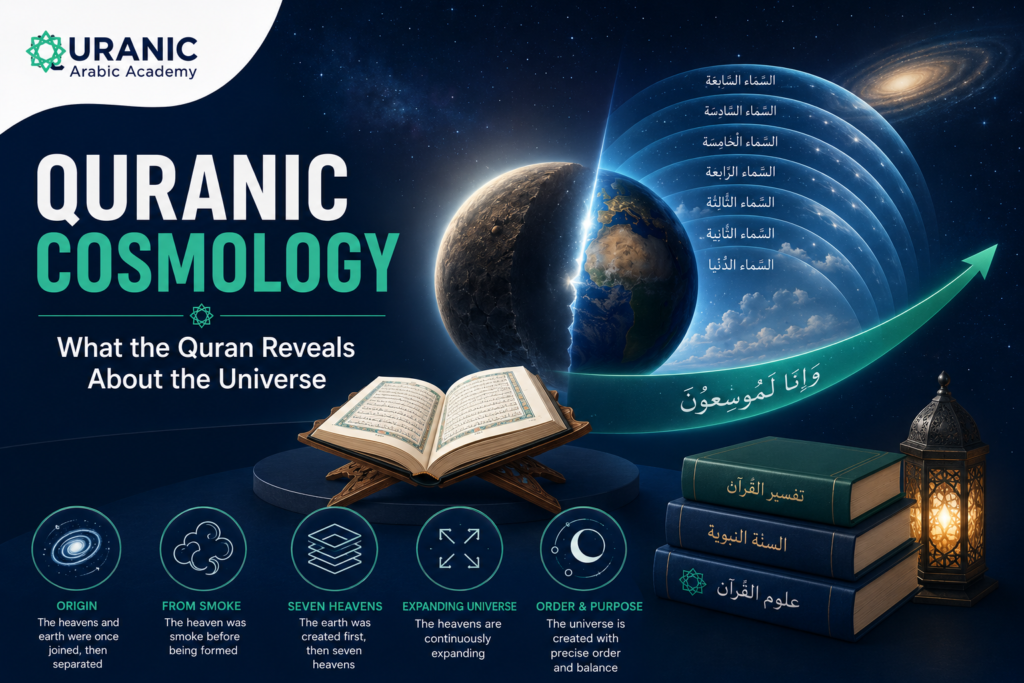
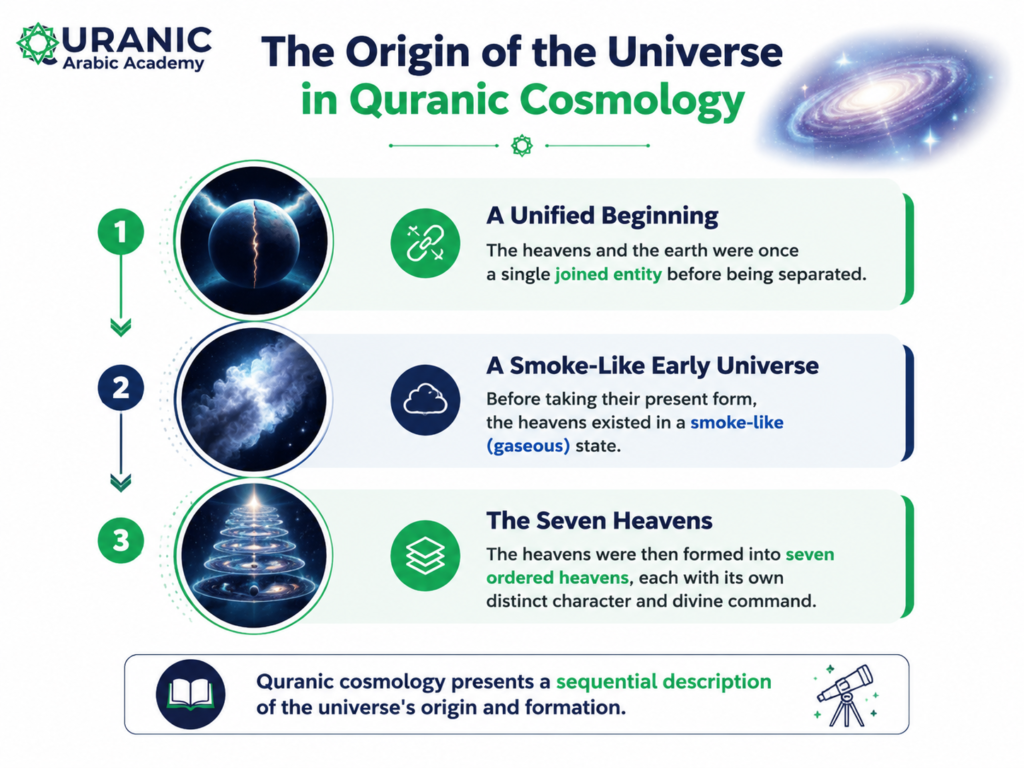
The most foundational question in any cosmological system is how everything began. Quranic cosmology addresses this with a precise description that modern readers find striking in its specificity. The Quran states that the heavens and earth were once a single joined entity before being separated.
Awa lam yara alladhīna kafarū anna al-samāwāti wal-arḍa kānatā ratqan fafataqnāhumā wa jaʿalnā mina al-māʾi kulla shayʾin ḥayyin afalā yuʾminūn
“Have those who disbelieved not considered that the heavens and the earth were a joined entity, and We separated them and made from water every living thing? Then will they not believe? (30)” Surah Al-Anbiya: 21:30
This verse describes the primordial state of the universe using the Arabic word “ratqan,” meaning a sealed or joined mass, and “fataqnāhumā,” meaning We split or separated them.
This description of an original unified state followed by separation is foundational to Quranic cosmology and stands in direct opposition to the Aristotelian assumption of an eternal and unchanging cosmos.
The Quran Describes the Universe Originating from Smoke
Quranic cosmology provides an additional detail about the condition of the heavens before they took their current form. This description goes beyond the fact of separation and addresses what the primordial heavens consisted of.
Thumma stawā ilā al-samāʾi wa hiya dukhānun faqāla lahā wa lil-arḍi ʾitiyā ṭawʿan aw karhan qālatā ataynā ṭāʾiʿīn
“Then He directed Himself to the heaven while it was smoke and said to it and to the earth, “Come [into being], willingly or by compulsion.” They said, “We have come willingly.” (11).”
The Arabic word “dukhān” means smoke or a gaseous vapor-like state. Quranic cosmology here presents the early heavens as existing in a diffuse, smoke-like condition before being formed into their current structure.
This stands as a Quranic description of the pre-structural state of the heavens that no human scientific tradition of the 7th century had articulated.
The Creation of the Seven Heavens Followed the Earth
The sequence of creation in Quranic cosmology is clearly described. The earth was created first, and then Allah directed His creative act toward the heaven, forming the seven heavens.
Huwa alladhī khalaqa lakum mā fī al-arḍi jamīʿan thumma stawā ilā al-samāʾi fasawwāhunna sabʿa samāwāt wa huwa bikulli shayʾin ʿalīm
“It is He who created for you all of that which is on the earth. Then He directed Himself to the heaven, [His being above all creation], and made them seven heavens, and He is Knowing of all things. (29).”
The seven heavens in Quranic cosmology are described as stacked layers, each with its own distinct character and divine command revealed to it, as stated in Surah Fussilat 41:12.
Those who want to engage with these descriptions in their original Arabic rather than relying on translations will find that the precise meanings of words like “ratqan,” “dukhān,” and “samāwāt” carry cosmological weight that English cannot fully capture.
The Best Quranic Arabic Classes at The Quranic Arabic Academy give students direct access to the Quranic text through one-on-one sessions with certified Arab tutors, building the vocabulary and comprehension needed to read these verses with full understanding.
Quranic Cosmology Explicitly Describes the Expansion of the Universe
Among all the cosmological statements in the Quran, the description of the universe’s ongoing expansion is perhaps the most discussed. Quranic cosmology does not merely imply movement or change. It uses a specific Arabic construction that describes the active, continuing expansion of the heavens.
“And the heaven We constructed with strength, and indeed, We are [its] expander. (47)” Surah Adh-Dhariyat: 51:47
The Arabic phrase “innā laмūsiʿūn” uses the active participle form, indicating an ongoing and continuous action. The word “mūsiʿūn” comes from the root “wasi’a,” meaning to expand or to make wide.
This is not a past-tense statement about a completed act. Quranic cosmology here describes the expansion of the heavens as a present, continuing reality. Modern astronomy confirmed the expansion of the universe beginning with the observation of galactic redshift, announced to the scientific community in 1924, more than thirteen centuries after this verse was revealed.
The Heavens Are Raised Without Visible Pillars
Quranic cosmology describes the heavens as being raised and sustained without any visible supports, a description that appears in two separate surahs with consistent language.
The phrase “bighayri ʿamadin tarawnahā” is grammatically significant in Quranic cosmology. Classical scholars held two positions on this phrase: either that no pillars exist at all, or that pillars exist but are invisible to human perception. Both positions affirm the same theological point: the heavens are sustained by divine power rather than any visible physical support, and the forces that hold the cosmic structure in place are beyond ordinary human observation.
The Stars Adorn the Lowest Heaven
Quranic cosmology places the stars we observe in the nearest of the seven heavens, a consistent detail repeated in multiple verses.
Wondering what our interactive sessions look like? Click below to peek inside a live session and watch how our expert instructors make learning Quranic Arabic accessible and engaging.
Ready to Begin Your Quranic Journey?
Start learning with professional instructors through our structured curriculum.
Sun and Moon Are Presented as Precisely Governed by Quranic Cosmology
The Quran gives specific attention to the movements of the sun and moon within Quranic cosmology. Their orbits are described not as random or self-directed but as precisely calculated and subject to divine governance.
The Arabic word “falak” refers to a rounded or orbital path, and “yasbaḥūn” means swimming or moving through a medium with smooth, continuous motion.
Quranic cosmology here presents each celestial body as moving within its own designated path. This is not a description of random movement but of ordered, purposeful orbital motion sustained by divine decree.
Each Celestial Body Moves to an Appointed Term
Quranic cosmology further specifies that the sun and moon each travel toward a fixed term, suggesting a designed endpoint to their current courses rather than eternal, unending motion.
” It is Allah who erected the heavens without pillars that you [can] see; then He established Himself above the Throne and made subject the sun and the moon, each running [its course] for a specified term.”
The Quran also states that the sun travels toward a determined stopping place, which classical scholars understood as a real appointed term established by Allah.
Students who find Quranic Arabic grammar challenging but want to understand how these precise cosmological expressions function in the original text will benefit from structured grammatical study. The Quranic Arabic Grammar Course at The Quranic Arabic Academy teaches Nahw and Sarf directly through Quranic ayat, meaning students learn grammar by analyzing real verses like those above, building comprehension that translates immediately into deeper understanding of Quranic cosmology.
Quranic cosmology is not only concerned with origins and present structure. It also describes the final state of the heavens and earth in terms that are specific and consistent across multiple verses.
The Arabic verb “naṭwī” means to fold or roll up. Quranic cosmology describes the heavens being folded at the end of time in the same way a scroll is rolled up, returning the universe to its origin in a reversal of the original creative act.
The Earth Will Be Replaced at the Day of Judgment
Alongside the folding of the heavens, Quranic cosmology describes a complete replacement of the earth and heavens on the Day of Judgment.
The Mountains Will Be Removed and the Earth Leveled
Quranic cosmology also addresses the geological transformation of the earth at the end of time. The mountains, which the Quran elsewhere describes as stabilizers placed in the earth, will be removed entirely.
Wa yasʾalūnaka ʿani al-jibāli faqul yansifuhā rabbī nasfan fayodharuhā qāʿan ṣafṣafan lā tarā fīhā ʿiwajan wa lā amtā
“And they ask you about the mountains, so say, “My Lord will blow them away with a blast. (105) And He will leave the earth a level plain; (106) You will not see therein a depression or an elevation.” (107)
Quranic Cosmology and the Role of Mountains as Stabilizers
Within the current created order described by Quranic cosmology, the mountains occupy a specific functional role. The Quran consistently describes them as being placed in the earth to prevent it from shaking or becoming unstable.
The Arabic word “rawāsī” refers to firmly anchored mountains, and the purpose stated is “an tamīda bikum,” meaning so that the earth does not shift or shake with you. This functional description of mountains within Quranic cosmology presents them not merely as geological features but as purposefully placed stabilizing elements within the divine design of the earth.
The Quran Pairs Mountain Stability with Water Provision
Immediately after describing the stabilizing function of mountains, the Quran in the same verse connects this to the provision of rivers and pathways for human navigation, showing how Quranic cosmology integrates physical geography with divine purpose.
Presentation of the Pair Principle Across All Creation In the Quranic Cosmology
One of the most consistent principles running through Quranic cosmology is the pairing of all created things. This principle is stated as a universal law applying across the entire scope of creation, not limited to biological life.
The Quran Invites Reflection on the Signs in Creation
Quranic cosmology throughout repeatedly issues a direct invitation to reflect on the signs present in the observable universe. This invitation is addressed to “those who think” and “those who reason.”
Adult learners who want to read these cosmological verses in Arabic and understand them without depending on translations will find that structured learning makes a decisive difference.
The Online Quranic Arabic Classes for Adults at The Quranic Arabic Academy are designed specifically for adult learners with busy schedules, offering flexible one-on-one sessions covering vocabulary, grammar, and comprehension drawn directly from Quranic text.
Quranic Cosmology Challenges the Aristotelian Eternal Universe Directly
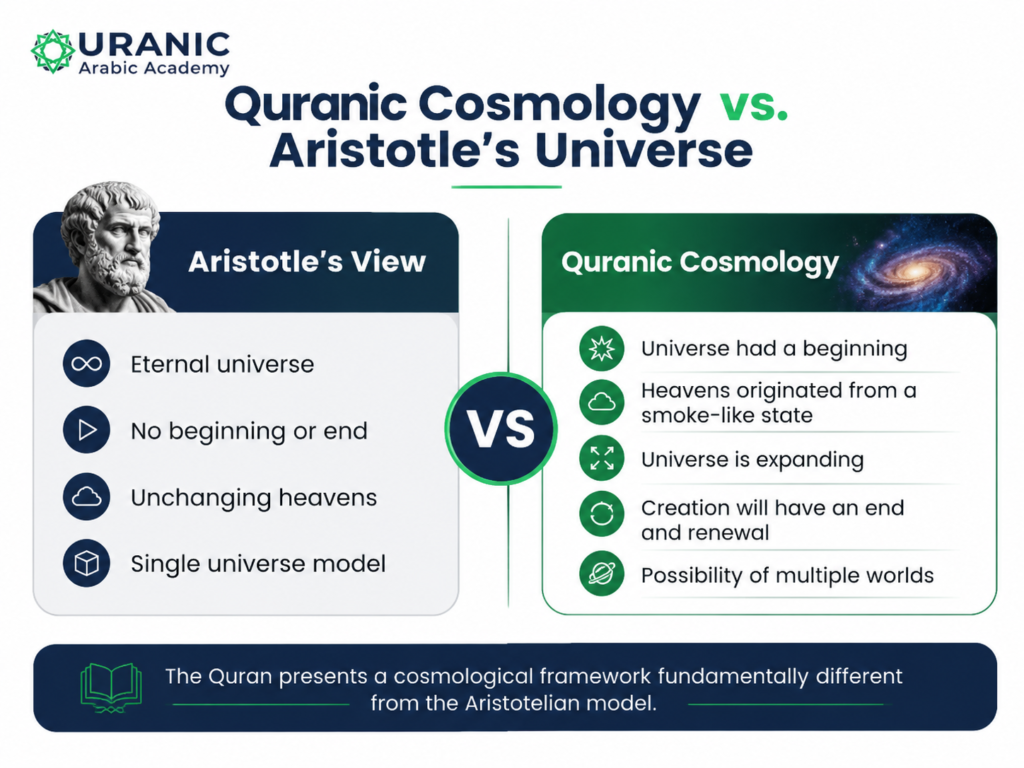
Aristotle’s cosmological model, dominant for nearly nineteen centuries, insisted that the universe had no beginning, no end, and was composed of an eternal unchanging substance called aether in its upper regions.
Quranic cosmology contradicts each of these claims with specific, verifiable statements. The universe had a beginning from a joined state. The heavens were once smoke-like before taking their current form.
The universe is actively expanding. The heavens will eventually be folded and the entire creation replaced. Each of these statements from Quranic cosmology is the direct opposite of what Aristotelian physics claimed.
The Islamic scholarly tradition engaged with this contrast early. Fakhr al-Din al-Razi, writing in the twelfth century, drew from Quranic cosmology to reject Aristotle’s single-universe model and argued for the possibility of multiple worlds beyond this one, reasoning from the Quranic phrase “Lord of the worlds” in plural.
We believe in clarity and engagement. Watch these short highlights from our actual classes to see our teachers’ methodology and student interactions in real-time.
Ready to Begin Your Quranic Journey?
Start learning with professional instructors through our structured curriculum.
Study Quranic Cosmology in Its Original Language at The Quranic Arabic Academy
Reading about Quranic cosmology in English is a starting point. Reading the actual Quranic text in Arabic and understanding what Allah said in His own words is a completely different level of engagement.
Most learners who study Quranic cosmology through translations alone miss the grammatical precision, the specific word choices, and the active versus passive verb forms that carry the cosmological meaning.
The Quranic Arabic Academy provides the complete framework to reach that level:
Certified Arab tutors holding Ijazah in Quranic recitation or degrees in Islamic studies from recognized institutions.
One-on-one live sessions tailored specifically to each student’s individual challenges and learning pace.
Real-time Makharij correction using audio-visual feedback during every session.
Tafseer-integrated learning, with Nahw and Sarf taught through actual ayat analysis.
Flexible scheduling covering all global time zones including EST, PST, GMT, CET, IST, and GST.
Monthly progress reports and written feedback provided to keep learning on track.
Affordable pricing with transparent packages and family enrollment discounts.
Whether you are a complete beginner or an advanced student, the right course exists for your current level.
The Arabic Courses for Understanding the Quran at The Quranic Arabic Academy are designed for learners who want comprehension, not just recitation, building the skills to understand what Quranic cosmology actually says in the words Allah chose to say it.
The Quranic Arabic for Beginners course is available for those who are starting from zero and want a structured path that reaches Quranic comprehension without previous Arabic background.
Quranic cosmology is a detailed, consistent description of the universe’s origin, structure, and eventual end — covering creation from a unified state, the smoke-like heavens, ongoing expansion, orbital movement, and the final folding of the heavens. Every statement comes from verified Quranic verses and authentic hadiths. Engaging with these descriptions in the original Arabic remains the most complete way to understand what the Quran actually says about the universe.
What Does Quranic Cosmology Say About the Origin of the Universe?
Surah Al-Anbiya 21:30 describes the heavens and earth as one joined entity that Allah separated. Surah Fussilat 41:11 adds that the heavens were initially in a smoke-like state before taking their current form.
Does the Quran Describe the Expansion of the Universe?
Yes. Surah Adh-Dhariyat 51:47 uses “mūsiʿūn,” an active participle indicating the heavens are continuously expanding — an ongoing process, not a completed past event.
How Does Quranic Cosmology Describe the End of the Universe?
Surah Al-Anbiya 21:104 states Allah will fold the heavens like a scroll. Surah Ibrahim 14:48 confirms the earth will be entirely replaced, reversing the original creation before judgment.
Is It Necessary to Know Arabic to Study Quranic Cosmology Properly?
Translations simplify precise Arabic terms like “ratqan,” “dukhān,” and “rawāsī” that carry specific cosmological meaning. Direct Arabic comprehension gives access to the exact language Allah used.
What Did Classical Islamic Scholars Say About Quranic Cosmology?
Fakhr al-Din al-Razi rejected Aristotle’s eternal universe model using Quranic evidence. Ibn Kathir affirmed that all cosmic descriptions in the Quran demonstrate Allah’s sole creative power and governance.
 Quran
Quran




Leave a Reply