 Quran
Quran
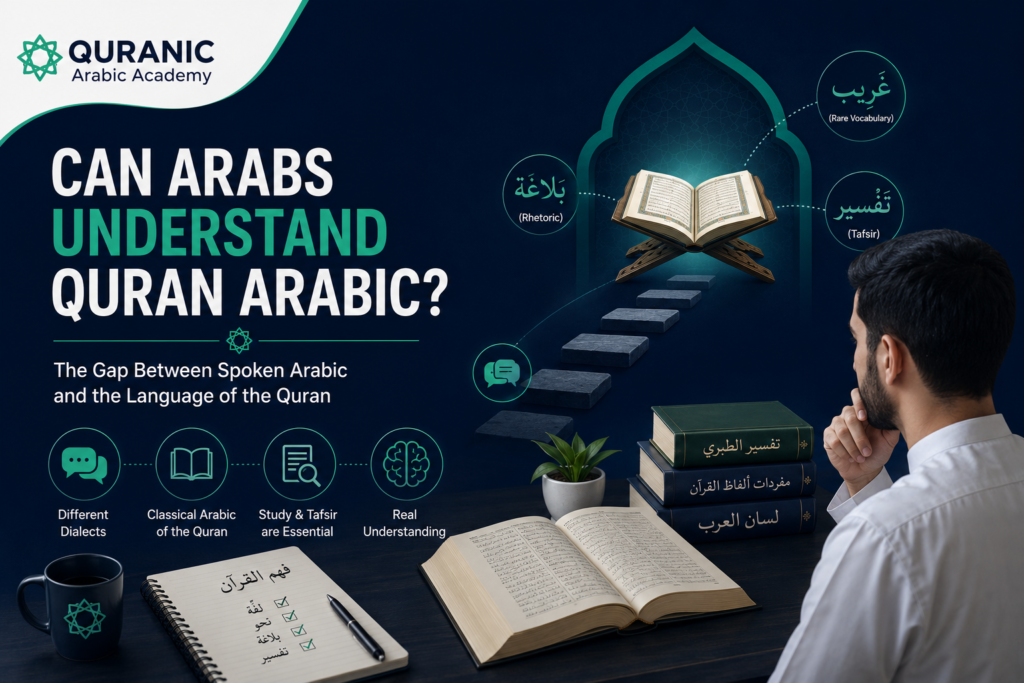
Many non-Arab Muslims assume that anyone who speaks Arabic automatically understands the Quran. This assumption leads to a harmful conclusion: if Arabs understand it naturally, then serious structured study becomes unnecessary. That reasoning is built on a false premise that linguists, Islamic scholars, and Arabic teachers consistently correct.
The gap between modern spoken Arabic and the Classical Arabic of the Quran is wider than most people realize. It affects Arab and non-Arab learners in different ways, but it affects both equally. Understanding where that gap comes from gives every Muslim learner a clearer picture of what genuine Quranic comprehension actually requires, regardless of background or mother tongue.
Can Arabs Understand Quran Arabic?
The short answer is no, native Arabic speakers do not fully or naturally understand the Quran without dedicated study. While Arabs have a head start with basic root words, daily regional dialects (Ammiyya) and Modern Standard Arabic (MSA) differ significantly in grammar, rare vocabulary (Gharib al-Quran), and classical rhetoric (Balagha) from 7th-century Quranic Arabic.
Consequently, Arabs naturally grasp only general context and basic meanings (~40–60%), relying heavily on classical exegesis (Tafsir) and structured study to achieve deep comprehension, proving that mastering Quranic Arabic is necessary for Arabs and non-Arabs alike.
Classical Arabic and Modern Arabic Are Two Distinct Linguistic Systems
The Arabic language is over 1,600 years old and has evolved significantly across centuries. What most people call “Arabic” today refers to Modern Standard Arabic (MSA), which developed primarily during the 19th and 20th centuries. The Quran was revealed in Classical Arabic during the 7th century CE.
These two forms share the same grammatical foundation but differ substantially in vocabulary, rhetorical style, and depth of expression. The table below shows the core differences every learner must understand:
| Feature | Classical / Quranic Arabic | Modern Standard Arabic |
| Time Period | 7th century CE and earlier | 19th century onward |
| Primary Use | Quran, early Islamic scholarship | Education, media, government |
| Vocabulary | Rich, layered, rhetorically dense | Simplified and contemporary |
| Spoken Today | No country or community | Formal settings only |
| Rhetorical Depth | Exceptionally high | Standard formal register |
Classical Arabic is no longer spoken anywhere, surviving only through the Quran, early Islamic scholarship, and pre-Islamic poetry. Today, native Arabs speak regional dialects at home and use Modern Standard Arabic (MSA) in education, media, and legal systems. Consequently, even educated professionals live in a language steps removed from the Quranic text.
While Classical Arabic and MSA share a grammatical skeleton that allows readers to follow sentence structure, this similarity creates a false sense of security. Because specific vocabulary and complex rhetorical layers require formal Tafsir study, native fluency in MSA does not equal true Quranic comprehension.
Many learners who recognize this gap early seek structured help to close it properly. The Arabic Courses for Understanding the Quran at The Quranic Arabic Academy are built specifically around Quranic vocabulary and rhetorical comprehension, progressing from foundational word recognition through to full verse understanding with grammatical analysis integrated into every session.
Enroll in the Arabic Courses for Understanding the Quran at The Quranic Arabic Academy
Regional Dialects Widen the Comprehension Gap Even Further for Arab Speakers
The situation becomes significantly more complex when you consider that most Arabs do not speak Modern Standard Arabic at home. Daily communication across the Arab world happens in regional dialects that differ substantially from one country to the next, and none of these dialects resemble Classical Arabic in vocabulary or expression.
Do people speak Quranic Arabic in conversation anywhere? Absolutely not. Even MSA is reserved for formal contexts. The dialects Arabs grow up speaking create a two-layer gap between their mother tongue and the language of the Quran.
Every Arab Country Uses a Distinct Regional Dialect With Its Own Vocabulary
Arabic has four main dialect groups: Levantine, Egyptian, Gulf, and Maghrebi. Within these groups, there are over 25 to 30 local varieties. The differences between them are significant enough that speakers from different regions sometimes struggle to understand each other without switching to MSA as a bridge:
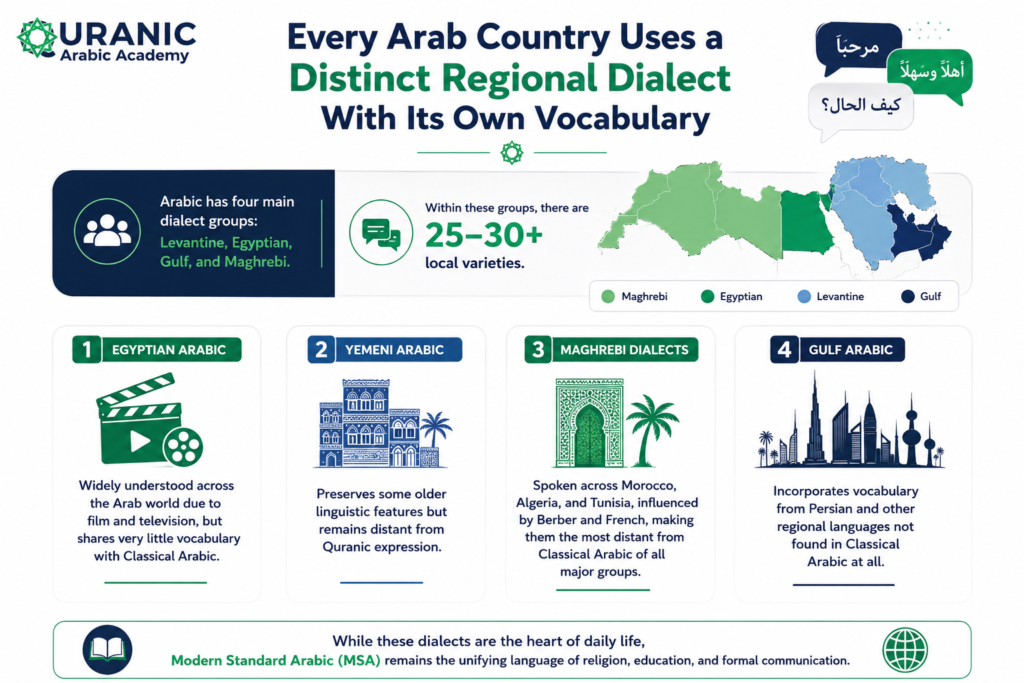
- Egyptian Arabic is widely understood across the Arab world due to film and television, but shares very little vocabulary with Classical Arabic.
- Yemeni Arabic preserves some older linguistic features but remains distant from Quranic expression.
- Maghrebi dialects spoken across Morocco, Algeria, and Tunisia are influenced by Berber and French, making them the most distant from Classical Arabic of all major groups.
- Gulf Arabic incorporates vocabulary from Persian and other regional languages not found in Classical Arabic at all.
Arab Speakers Regularly Consult Dictionaries and Scholars to Read the Quran
A reality that surprises most non-Arabs is that Arab Muslims routinely use dictionaries and Tafsir books when studying the Quran. Many Quranic words have either changed meaning entirely in modern usage, fallen out of daily use, or carry rhetorical layers that contemporary Arabic does not prepare a speaker to recognize automatically.
The Overconfidence of Arab Learners Produces Shallow Quranic Understanding
Many Arab learners assume their language background gives them full comprehension when it provides only partial comprehension. This overconfidence leads to reading the Quran with a general sense of meaning while missing the precise theological, legal, or spiritual implication of specific word choices.
A non-Arab learner who studies Quranic Arabic formally often develops sharper comprehension than an Arab who relies on linguistic intuition alone.
Experience Our Teaching Style:
We believe in clarity and engagement. Watch these short highlights from our actual classes to see our teachers’ methodology and student interactions in real-time.
Ready to Begin Your Quranic Journey?
Start learning with professional instructors through our structured curriculum.
Book Your Free TrialNo Country in the World Uses Quranic Arabic as a Daily Spoken Language
Which country speaks Quranic Arabic as its language of daily life? The answer is unambiguous: none. No country on earth uses Classical Arabic in everyday conversation. This applies to Saudi Arabia, Egypt, the UAE, and every other member of the Arab League without exception.
| Country | Official Language | Daily Spoken Language | Quranic Arabic Used |
| Saudi Arabia | Modern Standard Arabic | Gulf dialect | Religious contexts only |
| Egypt | Modern Standard Arabic | Egyptian dialect | Religious contexts only |
| Morocco | Modern Standard Arabic | Maghrebi dialect | Religious contexts only |
| UAE | Modern Standard Arabic | Gulf dialect | Religious contexts only |
| Iraq | Modern Standard Arabic | Iraqi dialect | Religious contexts only |
Classical Arabic Survives Only Through Religious and Scholarly Transmission
Across every Arabic-speaking country, Classical Arabic appears in three specific contexts: Quranic recitation, Islamic scholarship, and formal religious education. It does not appear in conversation, entertainment, casual writing, or professional communication anywhere in the world. When Arabs encounter Classical Arabic outside these religious contexts, they treat it as a formal literary register rather than a living spoken language.
The Quran Itself Preserved Classical Arabic for Over 1,400 Years
The reason Classical Arabic survived at all for over fourteen centuries is the Quran’s precise memorization and recitation tradition. When spoken Arabic was evolving in every direction across the expanding Muslim world, the oral transmission of the Quran preserved the language in its original form with extraordinary accuracy. Allah described the nature of this preserved language directly:
“إِنَّا أَنزَلْنَاهُ قُرْآنًا عَرَبِيًّا لَّعَلَّكُمْ تَعْقِلُونَ ﴿٢﴾”
Innā anzalnāhu qurʾānan ʿarabiyyan laʿallakum taʿqilūn
“Indeed, We have sent it down as an Arabic Qur’an that you might understand. (2)”
Non-Arab Muslims Represent the Majority of the Quran’s Global Learners
Only about 20% of the world’s 1.8 billion Muslims are Arab. Countries with the largest Muslim populations, including Indonesia, Pakistan, Bangladesh, and Nigeria, are entirely non-Arabic-speaking. Yet Muslims across all these countries learn Quranic Arabic for prayer, recitation, and religious study. This means the Quran has always been primarily studied as a second language, making structured learning the normal path rather than the exception.
The Quranic Arabic Grammar Course at The Quranic Arabic Academy teaches Nahw and Sarf through actual Quranic verses, building grammatical precision directly from the text rather than teaching grammar in the abstract and applying it later. Every session connects a grammatical rule to a verse the student is actively reading.
Enroll in the Quranic Arabic Grammar Course at The Quranic Arabic Academy
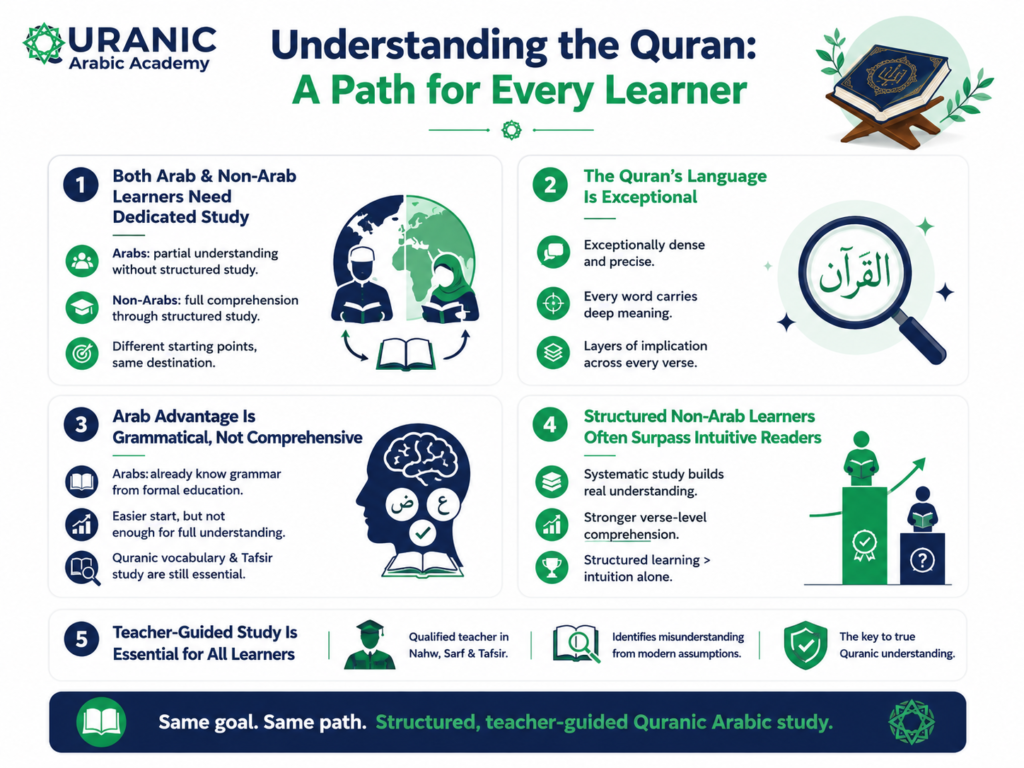
Arab and Non-Arab Learners Both Require Dedicated Quranic Arabic Study
Can arabs understand quran arabic language texts without structured study? Partially. Can non-Arabs reach full comprehension through structured study? Absolutely. The path differs in starting point but converges at the same destination: deliberate, teacher-guided study of Quranic Arabic specifically, not general Arabic fluency.
The conclusion from every serious Islamic scholar and Arabic linguist is consistent: understanding the Quran requires intentional study of Quranic Arabic specifically. The language is exceptional in its rhetorical density, precision of meaning, and depth of layered implication across every verse.
The Advantage Arab Learners Carry Is Grammatical, Not Comprehensive
An Arab learner approaching the Quran starts with one real advantage: they do not need to learn Arabic grammar from scratch. Verb conjugations, noun cases, and sentence structures are already familiar from formal education in MSA. This reduces the initial learning curve but does not eliminate the need for dedicated Quranic vocabulary study or Tafsir-based comprehension training.
Non-Arab Learners Who Study Formally Often Surpass Intuitive Arab Readers
A non-Arab learner who works through Quranic Arabic systematically, building vocabulary root by root and studying grammatical structures in the context of actual Quranic verses, frequently develops stronger verse-level comprehension than an Arab speaker who reads with linguistic intuition but without formal Quranic study. Structured learning consistently produces comprehension that intuition alone cannot reach.
Both Arab and Non-Arab Learners Benefit From Teacher-Guided Quranic Arabic Study
The shared requirement for every learner is a qualified teacher who understands Quranic Arabic specifically, not just Modern Standard Arabic. A teacher trained in Nahw, Sarf, and Tafsir integration identifies where a student is reading meaning into a verse based on modern Arabic assumptions rather than Classical Arabic precision. This distinction defines the difference between surface-level familiarity and genuine understanding.
Understanding the Quran Transforms Every Prayer Into Direct Engagement With Allah
Beyond the linguistic reality, understanding why Quranic Arabic study matters spiritually reframes the entire effort. Can Arabs understand Quran Arabic speakers reciting in prayer without comprehension? They can recite.
But comprehension transforms recitation into a direct, conscious engagement with the words of Allah. This distinction changes the spiritual quality of every prayer a Muslim performs.
Allah connected the sending down of the Quran directly to the capacity for understanding:
“كِتَابٌ أَنزَلْنَاهُ إِلَيْكَ مُبَارَكٌ لِّيَدَّبَّرُوا آيَاتِهِ وَلِيَتَذَكَّرَ أُولُو الْأَلْبَابِ ﴿٢٩﴾”
Kitābun anzalnāhu ilayka mubārakun liyaddabbarū āyātihi waliyatadhakkara ulū al-albāb
“[This is] a blessed Book which We have revealed to you, [O Muhammad], that they might reflect upon its verses and that those of understanding would be reminded. (29)”
Tadabbur—the deep reflection commanded by Allah—is impossible without understanding the Quran’s words; reciting without comprehension misses this reflection. For example, knowing “Al-Samad” means “the One upon whom all creation depends” transforms prayer recitation—a precision achievable only through Quranic Arabic study, beyond translations or standard Arabic.
The Quran’s universal message led historical Persian, Turkish, South Asian, and African scholars to master Quranic Arabic, proving structured study overcomes any linguistic background.
The Online Quranic Arabic Classes for Adults at The Quranic Arabic Academy supports global students via 1-on-1 live sessions with certified Arab tutors, offering personalized Makharij correction and structured progression from basic vocabulary to advanced comprehension.
Enroll in the Online Quranic Arabic Classes for Adults at The Quranic Arabic Academy
See It in Action:
Wondering what our interactive sessions look like? Click below to peek inside a live session and watch how our expert instructors make learning Quranic Arabic accessible and engaging.
Ready to Begin Your Quranic Journey?
Start learning with professional instructors through our structured curriculum.
Book Your Free TrialStart Your Quranic Arabic Journey With The Quranic Arabic Academy
Most learners who struggle to understand the Quran are not lacking motivation. They are lacking a structured system, a qualified teacher, and a curriculum built specifically around Quranic Arabic rather than general Modern Standard Arabic. The Quranic Arabic Academy provides all three through a complete range of programs designed for every level and background.
Every program at The Quranic Arabic Academy includes:
- One-on-one live sessions with certified Arab tutors holding Ijazah in recitation or degrees in Islamic studies from recognized institutions
- Real-time Makharij correction using audio-visual feedback during every session
- Structured progression from Noorani Qaida through to Ijazah certification
- Flexible scheduling covering all global time zones including EST, PST, GMT, CET, IST, and GST
- Monthly progress reports and written feedback provided after every session
- Tafseer-integrated learning with Nahw and Sarf taught through actual ayat analysis
- Affordable pricing with transparent packages and family enrollment discounts
Book Your Free Trial at The Quranic Arabic Academy
Our Arabic Courses
- Quranic Arabic Course UK
- Quranic Arabic Course London
- Quranic Arabic Course USA
- Quranic Arabic Course Canada
- Quranic Arabic Course Australia
- Quranic Arabic Course UAE
- Quranic Arabic Course Germany
Ready to Begin Your Quranic Journey?
Start learning with professional instructors through our structured curriculum.
Book Your Free TrialConclusion
Can Arabs understand Quran Arabic without dedicated study? Most cannot for structural reasons: Classical Arabic and Modern Standard Arabic are distinct systems, regional dialects widen the gap, and no country speaks Quranic Arabic daily. Furthermore, the Quran’s rhetorical depth exceeds what general Arabic fluency can unlock without formal study.
The path to genuine Quranic comprehension is identical for every learner: structured study of Quranic Arabic, guided by a qualified teacher around the actual text. Whether an Arab speaker moving beyond intuition or a non-Arab building from scratch, the destination and tools are the same.
FAQ
Is Arabic fluency enough to understand the Quran fully?
No. Modern or spoken Arabic alone is insufficient. Quranic Arabic requires dedicated study of Classical Arabic vocabulary, grammar, and style.
Do people speak Quranic Arabic anywhere in the world today?
No. Quranic Arabic is used only in the Quran, Islamic scholarship, and recitation, not as a daily spoken language.
Which country speaks Quranic Arabic as its official spoken language?
No country speaks Quranic Arabic officially. Arab countries use Modern Standard Arabic formally and regional dialects in everyday conversation.
Can a non-Arab reach full Quranic comprehension through structured study?
Yes. With a qualified teacher, structured lessons, and consistent practice, non-Arab learners can achieve strong Quranic comprehension.
How long does it take to understand Quranic Arabic from scratch?
With consistent study and qualified instruction, many learners begin understanding Quranic verses within months, while advanced mastery takes years.





Leave a Reply