 Quranic Verses
Millions of Muslims worldwide read descriptions of human development in the Quran every day without realizing that those descriptions were unknown to the greatest physicians of their era. The stages of human creation in Quran were recorded in the 7th century, at a time when scholars in Greece, Persia, and Arabia were still debating whether a child formed from menstrual blood or from a miniature figure hidden inside the sperm. The Quran settled none of their debates. It simply stated the truth.
This article examines what Quranic embryology actually says, what each Quranic term means, how the stages align with what modern science has confirmed, and why understanding this topic strengthens a Muslim’s connection to the Quran as the preserved word of Allah.
1- Reading the primary verse is key to understanding Quranic embryology
The foundation of quranic embryology rests on a single passage in Surah Al-Mu’minun. This is the most complete and sequential description of human development found anywhere in the Quran, and every serious study of this topic begins here.
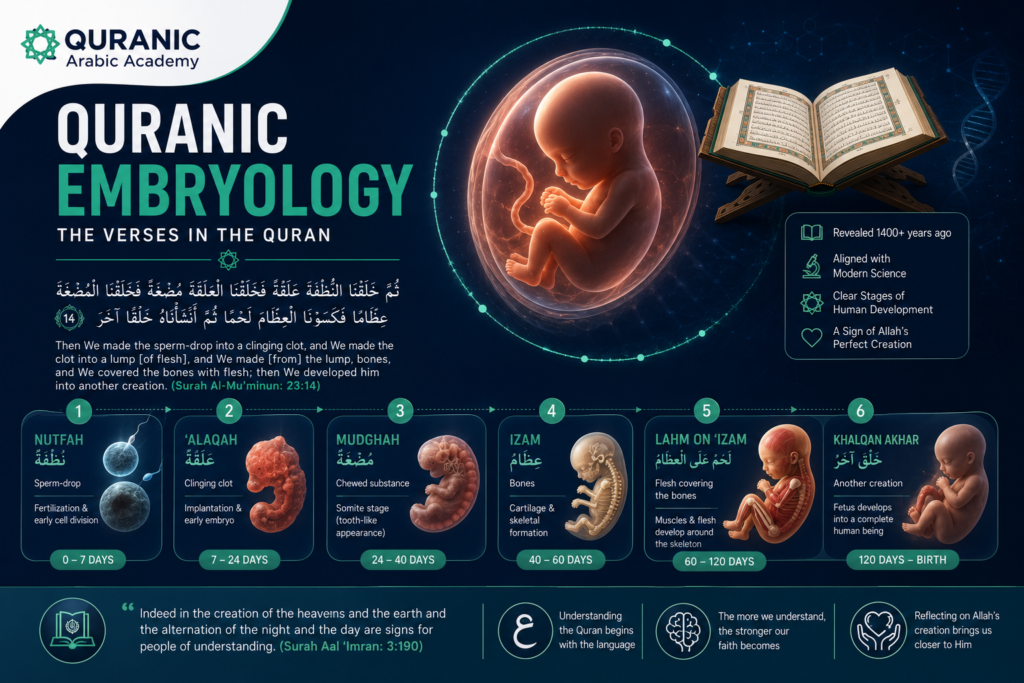
“وَلَقَدْ خَلَقْنَا الْإِنسَانَ مِن سُلَالَةٍ مِّن طِينٍ ﴿١٢﴾ ثُمَّ جَعَلْنَاهُ نُطْفَةً فِي قَرَارٍ مَّكِينٍ ﴿١٣﴾ ثُمَّ خَلَقْنَا النُّطْفَةَ عَلَقَةً فَخَلَقْنَا الْعَلَقَةَ مُضْغَةً فَخَلَقْنَا الْمُضْغَةَ عِظَامًا فَكَسَوْنَا الْعِظَامَ لَحْمًا ثُمَّ أَنشَأْنَاهُ خَلْقًا آخَرَ ۚ فَتَبَارَكَ اللَّهُ أَحْسَنُ الْخَالِقِينَ ﴿١٤﴾”
Wa laqad khalaqna al-insana min sulalatin min teen. Thumma ja’alnahu nutfatan fee qararin makeen. Thumma khalaqna an-nutfata ‘alaqatan fakhalaqna al-‘alaqata mudghatan fakhalaqna al-mudghata ‘izaman fakasawna al-‘ithama lahman thumma ansha’nahu khalqan akhar. Fatabaraka Allahu ahsanu al-khaliqeen.
“And certainly did We create man from an extract of clay. (12) Then We placed him as a sperm-drop in a firm lodging. (13) Then We made the sperm-drop into a clinging clot, and We made the clot into a lump [of flesh], and We made [from] the lump, bones, and We covered the bones with flesh; then We developed him into another creation. So blessed is Allah, the best of creators. (14).”
This quran embryology verse names six sequential stages: the nutfah, the ‘alaqah, the mudghah, the ‘izam, the covering of bones with lahm, and finally a new creation. Each stage corresponds to a distinct biological event, and each was described with a specific Arabic term that carries precise meaning.
The Quran Uses Distinct Arabic Terms for Each Stage
The six stages named in this verse are not vague poetic metaphors. They are technical descriptions:
| Arabic Term | Literal Meaning | Developmental Phase |
| Nutfah | Small drop of fluid | Fertilized egg / early cell division |
| Alaqah | Clinging thing / blood clot / leech-like | Implantation and early embryo (days 7-24) |
| Mudghah | Chewed substance | Somite stage (days 24-26 onward) |
| Izam | Bones | Cartilage and skeletal formation |
| Lahm on ‘Izam | Flesh clothing bones | Muscle development around skeletal models |
| Khalqan akhar | Another creation | Fetal stage and beyond |
The verse uses two different Arabic conjunctions: “fa” and “thumma.” The conjunction “fa” indicates rapid succession, while “thumma” indicates a longer interval between stages. This grammatical distinction is not decorative.
It reflects actual embryological timing, where some transitions happen quickly and others involve extended development.
If students of Arabic and the Quran want to understand this precision at a deeper level, the Quranic Arabic Grammar Course at The Quranic Arabic Academy teaches Nahw and Sarf through actual Quranic ayat analysis, building the grammatical awareness that makes these distinctions clear and meaningful in every verse a student reads.
Enroll in the Quranic Arabic Grammar Course at The Quranic Arabic Academy
2- Examining the Nutfah stage is essential to understanding Quranic embryology
The word nutfah appears in approximately eleven verses across the Quran. Its core meaning is a small amount of fluid, often described by classical Arabic dictionaries as the final drop remaining in a vessel after it has been emptied. The Quran applies this term to the beginning of human existence.
“إِنَّا خَلَقْنَا الْإِنسَانَ مِن نُّطْفَةٍ أَمْشَاجٍ نَّبْتَلِيهِ فَجَعَلْنَاهُ سَمِيعًا بَصِيرًا ﴿٢﴾”
Inna khalaqna al-insana min nutfatin amshaajin nabtaleehi faja’alnahu samee’an baseera.
“Indeed, We created man from a sperm-drop mixture that We may try him; and We made him hearing and seeing. (2).”
The Word Amshaaj Describes a Mixture of Two Fluids
The term nutfah amshaaj means a mixed or blended drop. Classical scholars of Quran understood from this that the human being is created from both the fluid of the man and the fluid of the woman.
This was stated in the Quran centuries before European scientists confirmed that both the sperm and the egg are necessary for fertilization. Ibn al-Qayyim, the great scholar of Islam, stated clearly that the offspring forms from the combination of both fluids, and that neither alone produces a child.
The Jewish scholar confirmed this was consistent with what had been revealed to previous prophets, demonstrating that this knowledge did not come from the surrounding culture of 7th-century Arabia, which still held Aristotelian theories about the dominant role of the male alone.
The Nutfah Passes Through Three Phases
According to scholars who studied the stages of human creation in Quran alongside medical knowledge, the nutfah stage encompasses three internal phases:
- Khalq: The initial formation of the zygote when sperm and egg unite, creating a single cell carrying 46 chromosomes.
- Taqdir: The genetic programming that determines inherited characteristics, including sex, appearance, and traits that may appear in future generations. The Quran refers to this in Surah ‘Abasa (80:19).
- Harth: The implantation of the fertilized egg into the wall of the uterus, described in the Quran using the imagery of a seed planted in soil (Surah Al-Baqarah 2:223).
3- Grasping the ‘Alaqah stage opens the door to Quranic embryology
The word ‘alaqah is one of the most discussed terms in quranic embryology. It carries three distinct meanings in classical Arabic, and scholars and researchers have noted that all three meanings apply accurately to the embryo during this period.
The three meanings are:
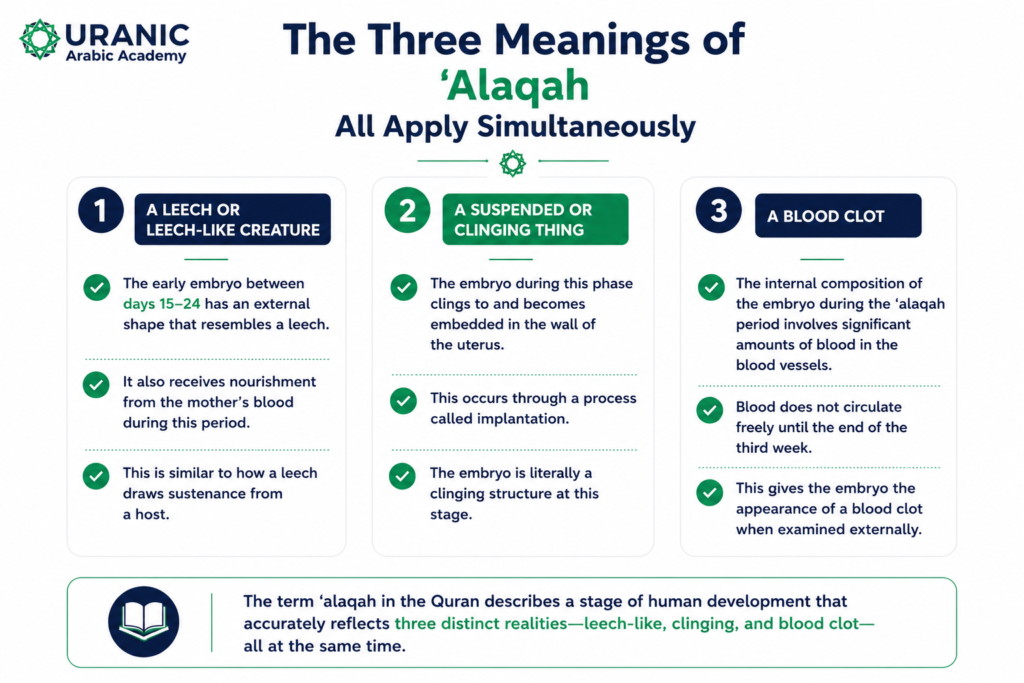
A leech or leech-like creature:
The early embryo between days 15 and 24 has an external shape that resembles a leech. It also receives nourishment from the mother’s blood during this period, similar to how a leech draws sustenance from a host.
A suspended or clinging thing:
The embryo during this phase clings to and becomes embedded in the wall of the uterus through a process called implantation. The embryo is literally a clinging structure at this stage.
A blood clot:
The internal composition of the embryo during the ‘alaqah period involves significant amounts of blood in the blood vessels, and blood does not circulate freely until the end of the third week. This gives the embryo the appearance of a blood clot when examined externally.
Professor Keith Moore, one of the world’s most recognized authorities in embryology, examined the Arabic term ‘alaqah in the context of modern embryological knowledge and stated that the description is remarkably accurate for the embryo at this stage of development.
Beyond the primary quran embryology verse in Al-Mu’minun, the ‘alaqah stage is also mentioned in Surah Al-‘Alaq, the very first surah to be revealed:
“خَلَقَ الْإِنسَانَ مِنْ عَلَقٍ ﴿٢﴾”
Khalaqa al-insana min ‘alaq.
“Created man from a clinging substance. (2) .”
The fact that the first revealed words of the Quran include a reference to human creation from ‘alaq is not incidental. It establishes the origin of humanity as the opening subject of divine revelation.
For students who want to read these verses with correct pronunciation and understand their meaning directly from the Arabic, the Best Quranic Arabic Classes at The Quranic Arabic Academy provide structured instruction that moves from foundational vocabulary through to Quranic text comprehension in live, one-on-one sessions.
Enroll in the Best Quranic Arabic Classes at The Quranic Arabic Academy
See It in Action:
Wondering what our interactive sessions look like? Click below to peek inside a live session and watch how our expert instructors make learning Quranic Arabic accessible and engaging.
Ready to Begin Your Quranic Journey?
Start learning with professional instructors through our structured curriculum.
Book Your Free Trial4- Mudghah.IsThe Chewed Lump Stage in Quranic Embryology
The word mudghah means a chewed substance, or a piece of flesh of a size suitable for chewing. This is the term the Quran uses for the embryo after the ‘alaqah stage, and the accuracy of this description depends on understanding what the embryo looks like at this point in its development.
During the mudghah stage, which begins around days 24 to 26 after fertilization, the embryo develops structures called somites along its back. These somites appear as a series of paired ridges that run along the surface of the embryo.
When researchers have compared the appearance of the embryo at this stage to a piece of chewed substance, the somites strongly resemble teeth marks left in gum or soft material that has been bitten.
The Quran’s choice of the term mudghah is thus not simply a size comparison. It is a description of the visible surface texture of the embryo at this specific stage of development.
A related verse in Surah Al-Hajj adds an important detail:
“ثُمَّ مِن مُّضْغَةٍ مُّخَلَّقَةٍ وَغَيْرِ مُخَلَّقَةٍ”
Thumma min mudghatin mukhallaqatin wa ghayri mukhallaqah.
“then from a clinging clot, and then from a lump of flesh, formed and unformed.”
This distinction between a formed mudghah and an unformed one corresponds to the biological reality that during this period, some areas of the embryo have differentiated into recognizable structures while other areas remain undifferentiated tissue. This level of descriptive precision is remarkable for a text from the 7th century.
5- Bone And Flesh Stages Represent The Structural Formation In Quranic Embryology
The quran embryology verse in Al-Mu’minun states that bones are formed, and then the bones are clothed with flesh. This sequencing has been examined closely by researchers in anatomy and embryology.
The Arabic text uses the verb “kasawna” which means “We clothed” when describing the covering of bones with flesh. This implies that the skeletal structure exists first, and the muscle tissue then covers it. This corresponds to the embryological process in which cartilage models of bones form first, and muscle tissue develops around them.
The Prophet Muhammad, peace be upon him, provided additional detail about this stage in an authentic narration:
” إِذَا مَرَّ بِالنُّطْفَةِ ثِنْتَانِ وَأَرْبَعُونَ لَيْلَةً بَعَثَ اللَّهُ إِلَيْهَا مَلَكًا فَصَوَّرَهَا وَخَلَقَ سَمْعَهَا وَبَصَرَهَا وَجِلْدَهَا وَلَحْمَهَا وَعِظَامَهَا”
“When forty-two nights pass after the semen gets into the womb, Allah sends the angel and gives him shape. Then he creates his sense of hearing, sense of sight, his skin, his flesh, his bones.”
Scholars studying quranic embryology alongside this hadith have identified that the narration accurately specifies:
- The embryo forms from the nutfah, not from menstrual blood as ancient physicians believed.
- A specific number of nights passes before the appearance of distinctly human form.
- The human shape appears after the 42nd night, corresponding to the end of the sixth week.
- Hearing structures, sight structures, skin, flesh, and bones all begin forming in this same period.
- The distinction between male and female becomes determinable externally during this same window.
Modern embryology confirms that the gonads and external sex organs begin to differentiate in weeks 7 and 8, precisely after the 42-night threshold mentioned in the hadith.
For students outside the Arab world who want to access this body of knowledge directly in Arabic, without depending entirely on translations, the Arabic Courses for Understanding the Quran at The Quranic Arabic Academy build the vocabulary and grammatical tools needed to engage with Quranic text and hadith literature at a meaningful level.
Enroll in Arabic Courses for Understanding the Quran at The Quranic Arabic Academy
6- Aristotle’s Errors Highlight Differences In Early Embryological Concepts
The significance of quranic embryology becomes fully clear only when compared against the prevailing scientific beliefs of the 7th century. The surrounding intellectual tradition was not silent on human development. It was simply wrong. The dominant theories at the time of revelation fell into two main groups:
| Ancient Theory | What It Claimed | Why It Was Wrong |
| Aristotle’s blood theory | Menstrual blood forms the embryo; sperm only coagulates it | Both sperm and egg are necessary; neither alone produces offspring |
| Preformationist theory | A fully formed miniature human exists inside the sperm or egg | No miniature human exists; the embryo develops through progressive stages |
| Greek two-fluid theory | Two fluids mix, with the male fluid dominant | Both fluids contribute equally through chromosomal combination |
The Quran stated that the human being forms from a mixed nutfah, from both fluids combined, at a time when the most educated scholars in the known world were debating whether women contributed anything biological to the offspring at all.
This discrepancy between the Quran and its surrounding intellectual environment is one of the strongest arguments for the divine origin of quranic embryology.
Classical Muslim scholars, including Ibn Hajar al-‘Asqalani in his commentary Fath al-Bari, noted that the hadith about the nutfah refuted the claim of anatomists that the child forms from menstrual blood alone. This refutation was made in 1448 CE, based on Quranic and hadith evidence, long before the invention of the microscope in 1677.
7. to Understanding Quranic Embryology Is Reflecting on the Three Layers of Darkness
A separate verse in the Quran describes the environment in which the embryo develops. This verse has drawn significant attention in the context of quranic embryology.
“يَخْلُقُكُمْ فِي بُطُونِ أُمَّهَاتِكُمْ خَلْقًا مِّن بَعْدِ خَلْقٍ فِي ظُلُمَاتٍ ثَلَاثٍ”
Yakhluqukum fee butooni ummahatikum khalqan min ba’di khalqin fee thulumathin thalath.
“He creates you in the wombs of your mothers, creation after creation, within three darknesses..”
Classical Quranic commentators understood the three darknesses as the layers surrounding the developing child. Researchers studying the stages of human creation in Quran in relation to anatomy have identified these three layers as:
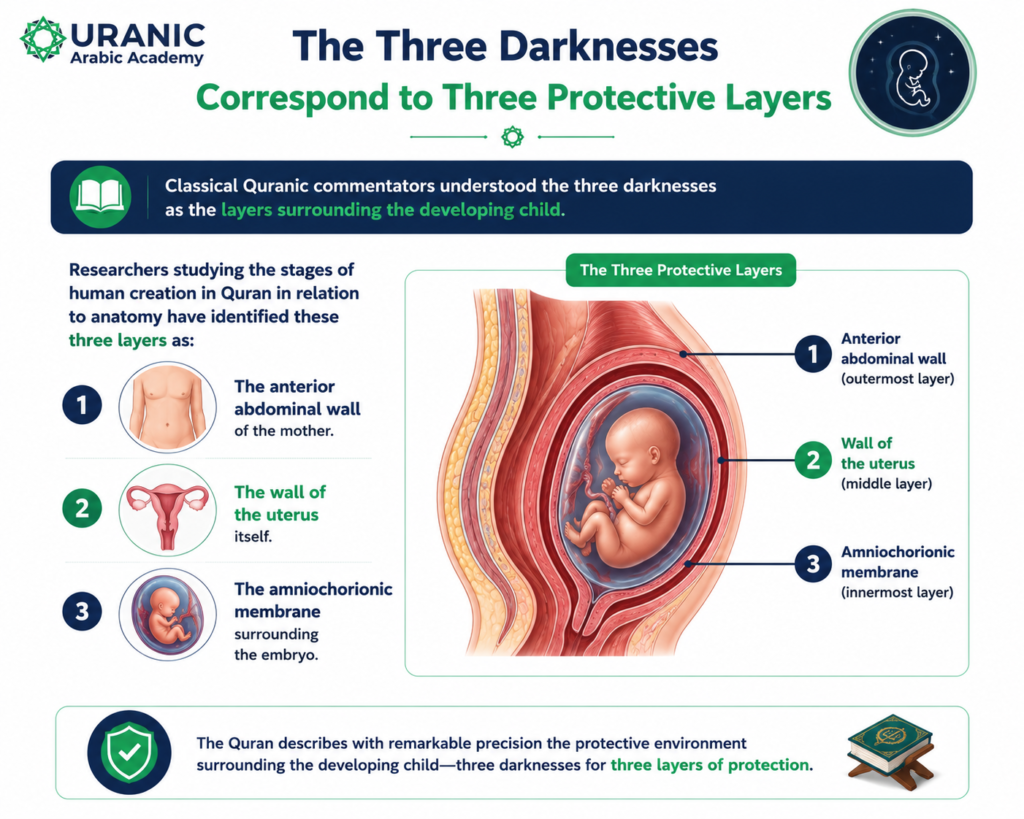
- The anterior abdominal wall of the mother.
- The wall of the uterus itself.
- The amniochorionic membrane surrounding the embryo.
Each layer constitutes a distinct zone of protection and darkness for the developing human. The phrase “creation after creation” in the same verse aligns with the sequential stages described in Al-Mu’minun, confirming that human development is a progressive process of successive creations, not a single event.
8. to Understanding Quranic Embryology Is Knowing the Scholars Who Affirmed It
Scholars of embryology, both Muslim and non‑Muslim, have recognized the accuracy of the Qur’an’s descriptions of human development.
Professor Keith Moore of the University of Toronto stated at a medical conference in Dammam (1981) that the Qur’anic accounts align with modern knowledge and could not have come from Muhammad naturally.
He even suggested using Qur’anic terminology to classify embryos because it is simple and comprehensive.
Islamweb scholars noted that Aristotle relied on speculation and erred in claiming the embryo formed from menstrual blood, whereas the Qur’an accurately describes the mixed nutfah as the origin of human beings — a detail later confirmed by modern science.
Experience Our Teaching Style:
We believe in clarity and engagement. Watch these short highlights from our actual classes to see our teachers’ methodology and student interactions in real-time.
Ready to Begin Your Quranic Journey?
Start learning with professional instructors through our structured curriculum.
Book Your Free TrialStart Learning Quranic Arabic to Access These Verses Directly
Most English-speaking Muslims who read about quranic embryology do so entirely through translation. Translations are valuable, but they cannot fully convey the precision of terms like nutfah, ‘alaqah, mudghah, or the grammatical distinction between “fa” and “thumma” that marks rapid versus gradual transitions between stages of human creation in Quran.
The Quranic Arabic Academy offers every Muslim the tools to access these verses in their original language, with programs designed for learners at every level across all time zones.
Every program at The Quranic Arabic Academy includes:
- One-on-one live sessions with certified Arab tutors holding Ijazah or degrees in Islamic studies from recognized institutions.
- Real-time Makharij correction using audio-visual feedback during every session.
- Tafseer-integrated learning, where Nahw and Sarf are taught through actual ayat analysis.
- Flexible scheduling covering EST, PST, GMT, CET, IST, GST, and MYT time zones.
- Monthly progress reports and written feedback provided after every session.
- Structured progression from foundational Arabic through to Quranic comprehension.
Whether you are a complete beginner reading about quranic embryology for the first time, or an advanced student who wants to examine these verses with grammatical depth, there is a program at The Quranic Arabic Academy that matches your level and your goals.
Book Your Free Trial at The Quranic Arabic Academy
Our Arabic Courses
- Quranic Arabic Classes
- Quranic Arabic Course for Beginners
- Online Quranic Arabic Courses for Advanced Learners
- Quranic Arabic Grammar Course
- Arabic Courses for Understanding the Quran
Ready to Begin Your Quranic Journey?
Start learning with professional instructors through our structured curriculum.
Book Your Free TrialConclusion
The Quranic description of the embryo is not vague poetry but a precise, sequential account using specific Arabic terms. Nutfah describes the fertilized drop from both parents. ’Alaqah refers to the clinging embryo, leech-like and containing unconsolidated blood. Mudghah describes the embryo’s surface marked by somites. ’Izam and lahm denote formation of skeletal cartilage then muscle.
Khalqan akhar marks the emergence of a distinctly human form. This knowledge was recorded in the 7th century, when common beliefs held that children came from menstrual blood or tiny preformed figures in semen. The Quran presented a different, accurate account; for every Muslim who reads these verses, Quranic embryology is evidence.
Frequently Asked Questions
What Is Quranic Embryology and Why Does It Matter?
Quranic embryology describes human development in the Quran. It remains significant because its stages are compared with findings in modern embryology.
Which Quran Embryology Verse Is Considered the Most Complete?
Surah Al-Mu’minun (23:12–14) is the most complete passage, describing the main stages of human development in sequence.
How Do the Stages of Human Creation in Quran Compare to What Aristotle Believed?
The Quran describes human creation differently from Aristotle, presenting a developmental process that differs from his embryological theory.
Did Classical Muslim Scholars Understand These Verses Before Modern Science?
Yes. Classical scholars explained these verses through the Quran, hadith, and linguistic analysis long before modern embryology developed.
Can a Non-Arabic Speaker Fully Understand Quranic Embryology from Translations Alone?
No. Translations provide the general meaning, but studying Quranic Arabic reveals the full linguistic and grammatical precision.
Related Articles
Quranic Verses






Leave a Reply