 Quran
Quran
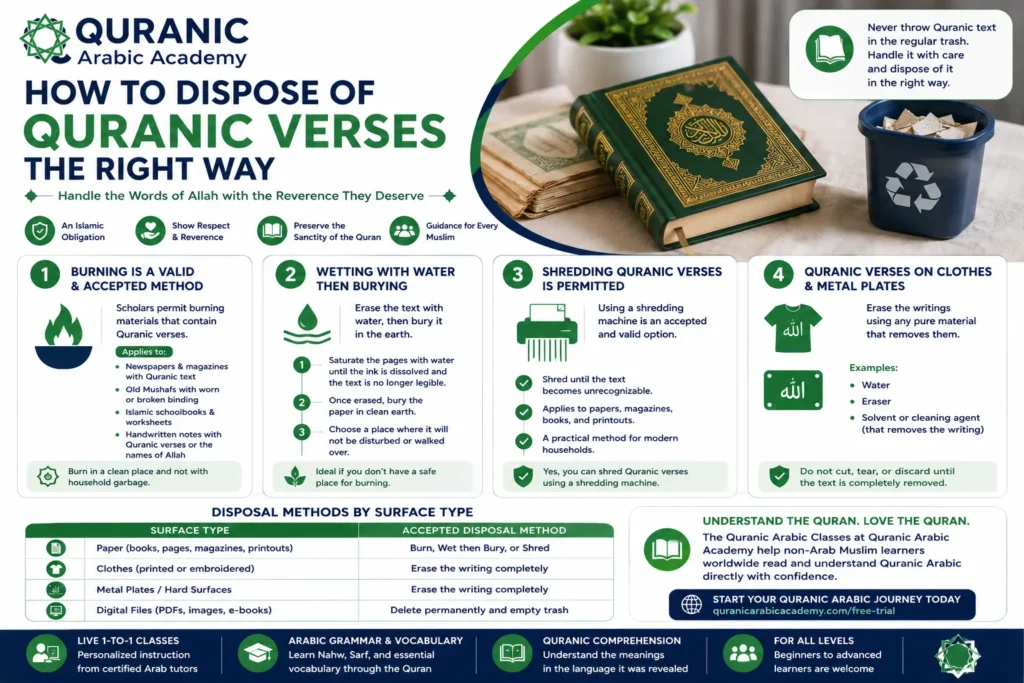
Muslims regularly encounter Quranic verses on printed pages, magazines, children’s schoolbooks, and old Mushafs with worn binding. The question of how to dispose of Quranic verses is not a matter of personal preference but of Islamic obligation. Throwing the words of Allah into regular trash is impermissible, and scholars are unanimous that sacred text must be handled with reverence.
This guide presents the accepted methods of disposal drawn from authenticated scholarly opinions, covering burning, burial, wetting, shredding, and the specific rulings on translations and digital files. Each method is explained fully so that non-Arab Muslim learners worldwide face no uncertainty about the correct course of action.
1- Burning Quranic Verses Is a Valid and Accepted Disposal Method
Burning is one of the accepted methods scholars have established for how to dispose of Quranic verses. There is nothing wrong with burning papers, magazines, and publications that contain Quranic verses or words of remembrance of Allah as a means of disposal.
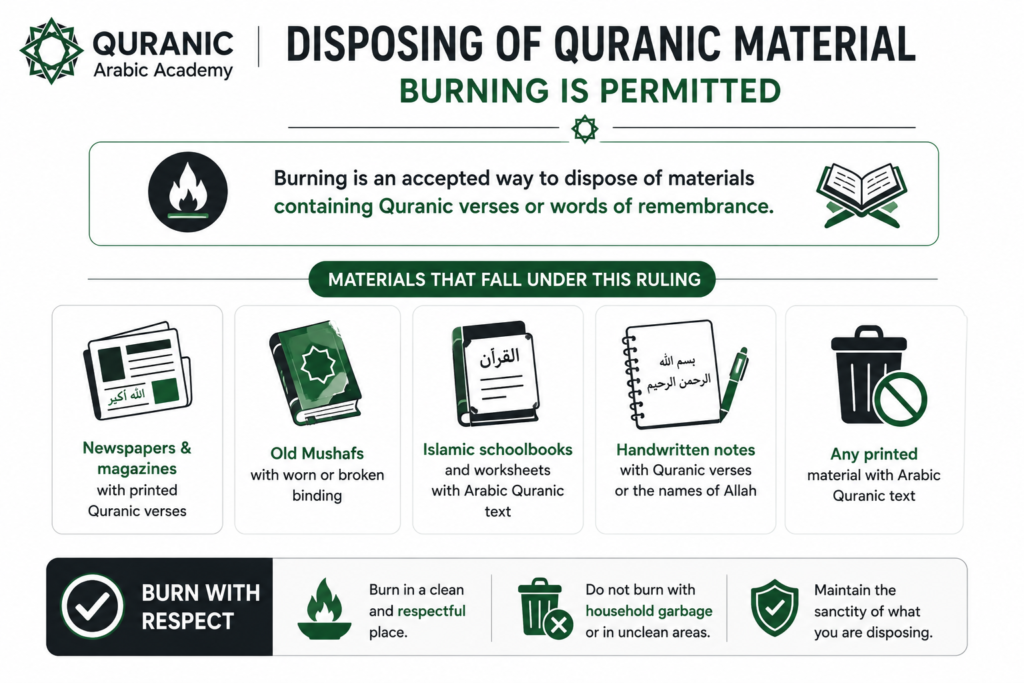
This ruling applies to any printed material carrying Arabic Quranic text, regardless of the format it appears in. The following materials fall under this ruling:
- Newspapers and magazines containing printed Quranic verses.
- Old Mushafs with worn or broken binding that can no longer be used.
- Islamic schoolbooks and worksheets carrying Arabic Quranic text.
- Handwritten notes containing Quranic verses or the names of Allah.
Burning must be performed in a manner that reflects the sanctity of what is being disposed of. The material should not be burned alongside household garbage or in an unclean setting.
Understanding what you recite begins with understanding the Arabic in which it was revealed. The Best Quranic Arabic Classes at The Quranic Arabic Academy equip non-Arab Muslim learners worldwide to read and comprehend Quranic Arabic directly, building a personal connection to the text that makes its proper treatment a deeply felt act of faith.
Read also: History of the Quranic Text: From the First Revelation to the Standard Mushaf
[Start Your Quranic Arabic Journey Today]
2- Wetting with Water Then Burying Is a Complete Method of Disposal
A second accepted method is wetting the papers with water in a way that erases the written text, then burying them in the earth so that they vanish completely. This method combines the erasure of the sacred text through water with the return of the material to the ground, and scholars have confirmed it as a valid means of how to dispose of Quranic verses.
The method works as follows:
- Saturate the pages thoroughly with water until the ink is dissolved and the text is no longer legible.
- Once the writing has been erased by the water, bury the remaining material in clean earth.
- Choose a location where the buried material will not be disturbed or walked over.
This approach is particularly practical for Muslims who may not have easy access to an outdoor space for burning but can bury material in a garden or at a mosque. The two steps together achieve the same goal: ensuring that the words of Allah are not left in a state where they could be desecrated or handled disrespectfully.
Read also: Quranic Hermeneutics – How Do Scholars Interpret the Quran?
3- Shredding Quranic Verses Is Permitted Using a Shredding Machine
Scholars have confirmed that using a paper shredding machine to dispose of material containing Quranic verses is a valid method. Papers, magazines, and publications carrying Quranic text or words of remembrance of Allah may be placed in a shredder as a means of respectful disposal.
The condition that governs this method is that the shredding must render the text unrecognizable. A shredder that produces fine enough cuts to destroy all readable letter forms fulfills this requirement. Muslims who regularly print Quranic material for study or reference will find this the most practical method available in a modern household setting.
The question of can we shred Quranic verses is therefore answered clearly by scholars: yes, using a shredding machine is an accepted and valid option alongside burning and wetting with water.
The Arabic Courses for Understanding the Quran at The Quranic Arabic Academy reduce dependence on printed translations by teaching non-Arab learners to engage with Quranic Arabic directly. One-on-one live sessions with certified Arab instructors cover vocabulary, grammar, and comprehension through actual Quranic ayat.
[Explore the Arabic Comprehension Course]
4- Quranic Verses on Clothes and Metal Plates Follow a Separate Ruling
When Quranic verses or the names of Allah appear on clothing, metal plates, or similar non-paper surfaces, the disposal ruling differs from that of printed pages. Scholars have specified that such items should be handled by erasing the writings using any pure material capable of removing them.
The following table summarizes how to dispose of Quranic verses and sacred text across different surfaces:
| Surface Type | Accepted Disposal Method |
| Paper, magazines, books | Burning, wetting then burying, or shredding |
| Old Mushaf with worn binding | Burning, wetting then burying, or shredding |
| Clothing with Quranic text | Erase with any pure material that removes the writing |
| Metal plates with Quranic text | Erase with any pure material that removes the writing |
For clothing and metal items, once the sacred text has been fully erased, the item may be disposed of normally. The obligation to treat the material with reverence applies specifically to the written text itself, not to the object that carries it once the text has been removed.
5- How to Dispose of Paper with Allah’s Name Follows the Same Ruling
The ruling on how to dispose of paper with Allah’s name is consistent with the ruling on Quranic verses. Any paper carrying words of remembrance of Allah, including His names and the supplications associated with them, must be disposed of in the same accepted ways: burning, wetting with water then burying, or shredding.
This ruling applies in practice to a wide range of materials that Muslims encounter regularly:
- Government documents or letters that open with the Basmala.
- Printed du’a cards and supplication booklets.
- Islamic calendars carrying the names of Allah or Quranic verses.
- Printed receipts or certificates from Islamic institutions carrying sacred text.
Throwing any of these materials into a regular trash bin where they may be mixed with impure waste or stepped on is impermissible. Scholars are clear that the words of Allah and His remembrance must be treated with honor regardless of the format or document type they appear in.
The Quranic Arabic Grammar Course at The Quranic Arabic Academy teaches the grammatical structures of Quranic Arabic through direct analysis of Quranic ayat, giving non-Arab Muslims worldwide the tools to understand every name, attribute, and description of Allah as it appears in the Quran.
Read also: Quranic Ethics – What the Quran Teaches About Akhlaq and Behaviour?
See It in Action:
Wondering what our interactive sessions look like? Click below to peek inside a live session and watch how our expert instructors make learning Quranic Arabic accessible and engaging.
Ready to Begin Your Quranic Journey?
Start learning with professional instructors through our structured curriculum.
Book Your Free Trial
[Begin the Quranic Grammar Course]
6- Translated Quranic Verses Are Not Considered the Quran Itself
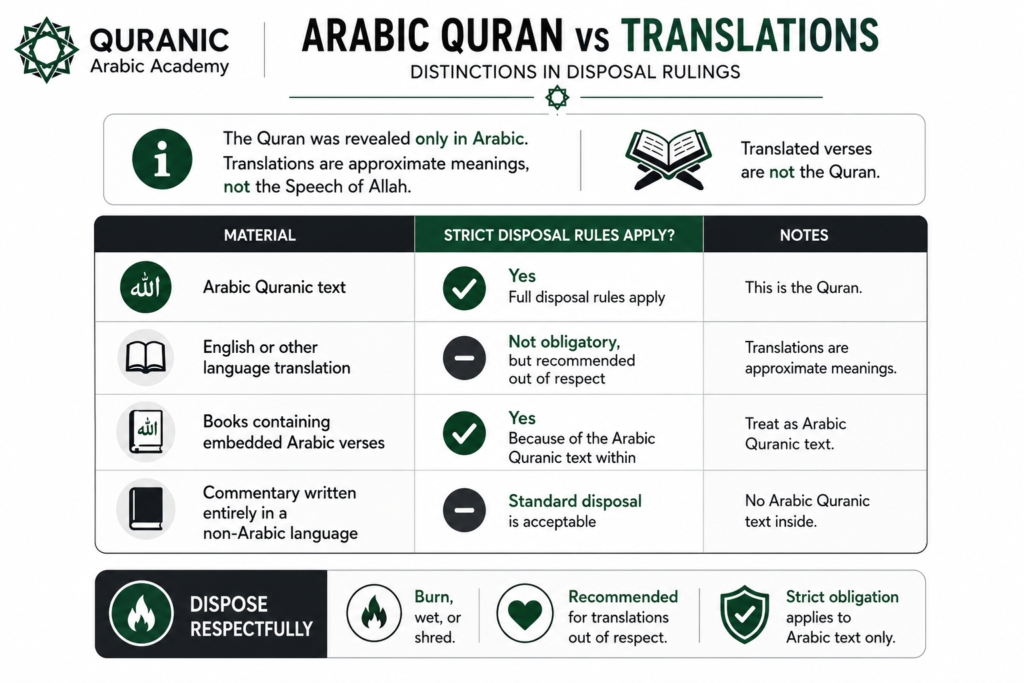
A ruling that many non-Arab Muslims are unaware of is the distinction scholars draw between the Arabic Quran and its translations into other languages. Scholars confirm that translated Quranic verses are not the Quran.
The Quran was revealed only in Arabic, and all available translations are no more than approximate renderings of meaning. They are not considered the Speech of Allah in the same sense as the Arabic text. This produces the following practical distinctions:
| Material | Strict Disposal Rules Apply? |
| Arabic Quranic text | Yes, full disposal rules apply |
| English or other language translation | Not obligatory, but recommended out of respect |
| Books containing embedded Arabic verses | Yes, because of the Arabic Quranic text within |
| Commentary written entirely in a non-Arabic language | Standard disposal is acceptable |
A person who wishes to dispose of translated Quranic material respectfully may follow the same burning, wetting, or shredding methods. Scholars confirm this is not obligatory for translations, but doing so constitutes an expression of honor for the remembrance of Allah. The strict obligation applies to the Arabic text alone.
Read also: Quranic Reflections – The Complete Guide to Tadabbur and Its Daily Practice
7- Throwing Quranic Verses in the Trash Is Impermissible Under All Circumstances
Every scholarly opinion on this question reaches the same prohibition: it is impermissible to throw Quranic verses, papers bearing the names of Allah, or old Mushafs into regular household trash.
The words of Allah must be disposed of in a way that shows reverence for the holiness of the text, not discarded as ordinary waste. The following actions are specifically prohibited:
- Placing a worn Mushaf in a household bin alongside food waste and ordinary garbage.
- Discarding Islamic schoolbooks containing Quranic verses directly into recycling without prior shredding.
- Leaving pages carrying Quranic text on the floor or in public spaces where they may be stepped on.
- Burning Quranic pages alongside household trash without the reverence the material requires.
Muslims who are unsure how to manage worn copies of the Quran should contact their local mosque. Many mosques collect old Mushafs and arrange for their proper disposal on behalf of the community, removing the logistical difficulty for those living in urban environments.
The Quranic Arabic Course for Sisters at The Quranic Arabic Academy provides female learners with a dedicated learning environment led by certified Arab female instructors. Sessions cover Quranic reading, grammar, and comprehension through structured one-on-one classes scheduled across all global time zones.
[Join the Sisters’ Quranic Arabic Course]
Experience Our Teaching Style:
We believe in clarity and engagement. Watch these short highlights from our actual classes to see our teachers’ methodology and student interactions in real-time.
Ready to Begin Your Quranic Journey?
Start learning with professional instructors through our structured curriculum.
Book Your Free TrialStart Learning the Quran in Its Original Arabic with The Quranic Arabic Academy
Knowing how to dispose of Quranic verses is one expression of the reverence every Muslim owes to the words of Allah. Understanding those words directly in the Arabic they were revealed in deepens that reverence into something lived and felt in every recitation.
The Quranic Arabic Academy serves non-Arab Muslim learners across North America, Europe, Asia, and the Middle East through one-on-one live sessions with certified Arab instructors holding Ijazah in recitation or recognized degrees in Islamic studies. Every program includes:
- Real-time Makharij correction using audio-visual feedback during every session.
- Structured progression from foundational reading through to advanced Quranic grammar.
- Nahw and Sarf taught directly through Quranic ayat analysis.
- Flexible scheduling covering EST, PST, GMT, CET, IST, GST, and MYT time zones.
- Monthly progress reports and written feedback provided after every session.
- Affordable packages with family enrollment discounts available globally.
Our Arabic Courses
- Quranic Arabic Classes
- Quranic Arabic Course for Beginners
- Online Quranic Arabic Courses for Advanced Learners
- Quranic Arabic Grammar Course
- Arabic Courses for Understanding the Quran
- Quranic Arabic Course for Sisters (Female)
- Quranic Arabic Course for Kids
- Online Quranic Arabic Classes for Adults
- Quranic Arabic Course UK
- Quranic Arabic Course London
- Quranic Arabic Course USA
- Quranic Arabic Course Canada
- Quranic Arabic Course Australia
- Quranic Arabic Course UAE
- Quranic Arabic Course Germany
Ready to Begin Your Quranic Journey?
Start learning with professional instructors through our structured curriculum.
Book Your Free TrialConclusion
How to dispose of Quranic verses correctly is an obligation grounded in the sanctity of the Speech of Allah. Burning, wetting with water then burying, and shredding are all valid accepted methods. The same ruling applies to any paper carrying the names of Allah or words of His remembrance. Translations carry a lighter ruling, though respectful disposal remains recommended. No Quranic material should ever be placed in regular trash under any circumstance.
Frequently Asked Questions
Is it permissible to throw old Quran pages into a recycling bin?
No. Recycling bins are public waste streams where Quranic pages may be handled disrespectfully. Burning, wetting with water then burying, or shredding are the only accepted methods.
Can you burn the Quran to dispose of it if no other option is available?
Yes. Scholars confirm that burning papers and publications containing Quranic verses is a valid and accepted method of disposal.
How to dispose of paper with Allah’s name if I cannot access a suitable location for burial?
Shred the material using a paper shredding machine, which scholars have confirmed is a valid disposal method equivalent to burning.
Can we shred Quranic verses using a regular office shredder?
Yes. Scholars have confirmed that using a shredding machine is an accepted method, provided the shredding renders all text unrecognizable.
Does the same disposal ruling apply to Hadith books and Islamic literature?
Yes. Any material carrying the words of remembrance of Allah must be treated with the same reverence as Quranic pages and disposed of through the accepted methods.
Is disposing of translated Quranic verses in the trash permissible?
Translations are not considered the Quran itself, so the obligation is less strict. However, disposing of them respectfully through the same methods is recommended as an expression of honoring the remembrance of Allah.



Leave a Reply