 Quran
Quran

Quranic knowledge is the deep understanding and guidance derived from the verses of the Holy Quran, meant to direct a person’s life, shape their thinking, and reform their reality.
It is not simply information to be memorized, it is a complete framework connecting the mind, the heart, and behavior. Many Muslims and those interested in Islam search for a clearer understanding of this concept: What are its foundations? And how can a Muslim build it in daily life?
What You Will Learn
- An accurate definition of Quranic knowledge and its origin.
- The three foundations on which this knowledge is built.
- Evidence from the Quran and Sunnah on the status of knowledge.
- Practical steps to develop your Quranic knowledge, including the role of Arabic.
- Answers to the most common questions on this topic.
What Is Quranic Knowledge and Why Does It Matter?
Quranic knowledge is the deep understanding and guidance derived from the verses of the Holy Quran, such that it directs a person’s behavior, shapes their intellectual outlook, and contributes to reforming their individual and social reality.
It differs from mere “Quranic information” in that it is translated into understanding and action, not just memorization and recitation.
This knowledge rests on the premise that the Quran is a comprehensive book of guidance — its impact is not limited to worship alone, but extends to shaping the mind, thought, and society.
The Three Main Foundations of Quranic Knowledge
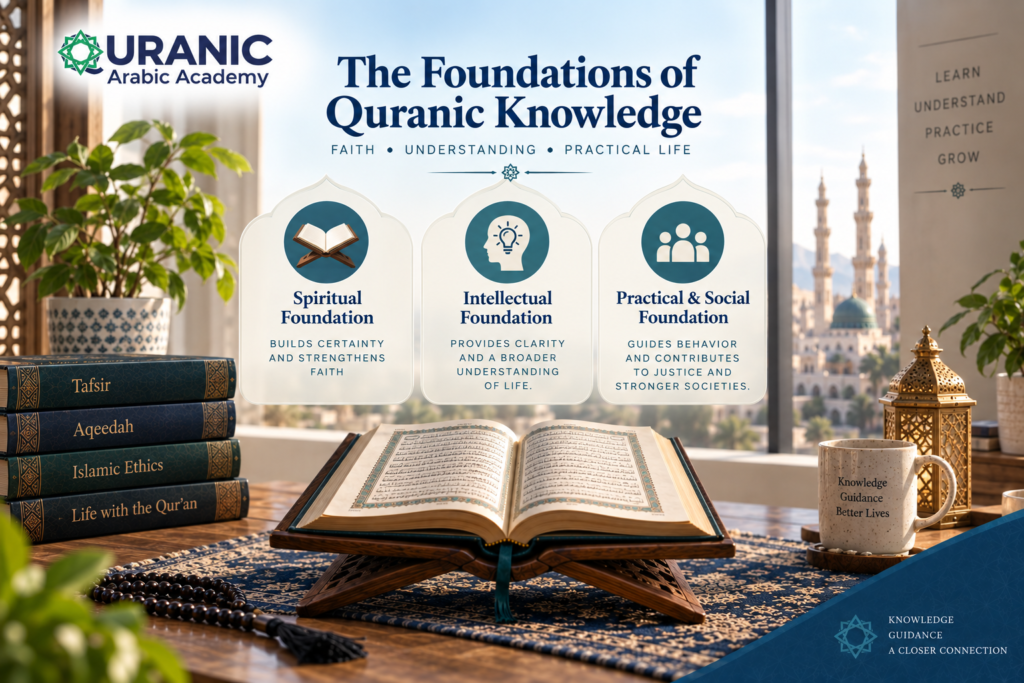
Quranic knowledge is built upon a comprehensive framework that connects faith, human understanding, and practical life. It does not present knowledge as a collection of isolated facts, but as guidance that shapes the way people understand their Creator, themselves, the world around them, and their responsibilities toward others.
Through the Quran, knowledge becomes a means of developing certainty, strengthening moral awareness, establishing balanced relationships, and building societies upon justice and truth.
These dimensions of Quranic knowledge can be understood through three main foundations. Together, they demonstrate how the Quran provides spiritual and intellectual clarity, offers guidance relevant to different aspects of human life, and establishes principles that can contribute to ethical social and civilizational development.
See It in Action:
Wondering what our interactive sessions look like? Click below to peek inside a live session and watch how our expert instructors make learning Quranic Arabic accessible and engaging.
Ready to Begin Your Quranic Journey?
Start learning with professional instructors through our structured curriculum.
Book Your Free Trial1. Quranic Knowledge as a Source of Guidance and Certainty
The Quran provides clear guidance concerning the greatest questions of human existence, including knowledge of the Creator, the purpose of life, moral responsibility, and humanity’s ultimate destiny. Through its teachings, a person develops a worldview based on revelation rather than uncertainty or speculation.
This Quranic guidance brings tranquility to the heart, strengthens faith, and helps remove intellectual and spiritual confusion by giving human beings a clear framework through which they can understand themselves, their Creator, and the world around them.
Read Also: history of the Quranic text
2. How Quranic Guidance Applies to Every Area of Life
Quranic knowledge is not limited to matters of worship or religious rituals. Its guidance extends to the intellectual, educational, psychological, moral, and social dimensions of human life.
The Quran teaches principles that help individuals develop sound character, manage their responsibilities, build healthy relationships, and contribute positively to their communities. It also establishes values such as compassion, honesty, cooperation, patience, and accountability, creating a balanced relationship between individual development and the wellbeing of society.
3. Quranic Knowledge as a Foundation for Building Just Societies
Quranic knowledge also provides principles that contribute to the development of just, ethical, and stable societies. It emphasizes justice, objectivity, responsibility, consultation, and respect for truth while encouraging people to approach differences with fairness and wisdom.
These principles support constructive dialogue and discourage prejudice, oppression, and blind judgment. In this way, Quranic knowledge becomes more than personal guidance; it offers an ethical foundation for building communities and civilizations in which knowledge, justice, human dignity, and responsible interaction can flourish.
How the Quran Encourages Seeking Knowledge and Understanding
The Holy Quran consistently encourages believers to value knowledge, reflection, and understanding as essential parts of a meaningful life of faith. Knowledge in the Quranic perspective is not presented merely as the accumulation of information, but as a means of recognizing truth, strengthening faith, developing sound judgment, and understanding one’s responsibilities before Allah.
The Quran repeatedly invites people to think, observe, reflect upon creation, and consider the lessons found in revelation and human experience.
This emphasis also highlights the distinction between knowledge and ignorance. A person who possesses genuine knowledge is expected to see matters with greater clarity, recognize evidence, and respond to guidance with awareness rather than following assumptions or habits without reflection.
The Quran therefore connects true understanding with people of intellect who are willing to contemplate, learn, and benefit from what they know.
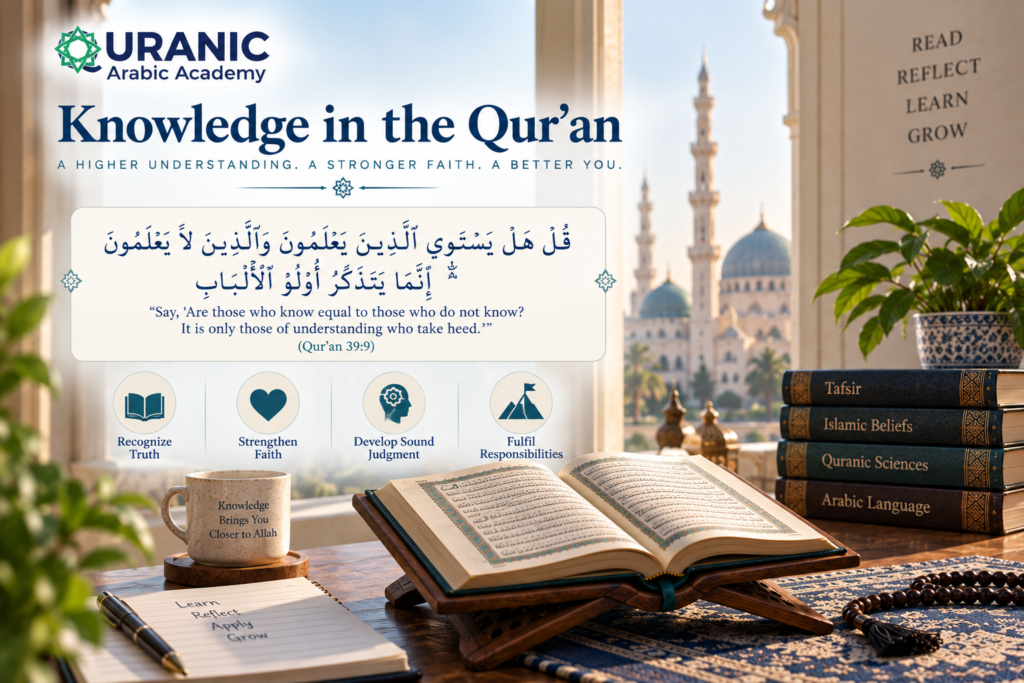
This principle is expressed clearly in the following verse, which asks whether those who possess knowledge can truly be considered equal to those who lack it:
قُلْ هَلْ يَسْتَوِي الَّذِينَ يَعْلَمُونَ وَالَّذِينَ لَا يَعْلَمُونَ ۗ إِنَّمَا يَتَذَكَّرُ أُولُ الْأَلْبَابِ
“Say, ‘Are those who know equal to those who do not know?’ Only they will remember [who are] people of understanding.”
This verse confirms that knowledge is not merely a matter of status, it is the very basis of remembrance and correct understanding, which makes seeking Quranic knowledge a daily obligation rather than an occasional pursuit.
| Deepen Your Islamic KnowledgeJoin our comprehensive online courses and learn from qualified scholars today.Book Your Free Trial |
The Virtue and Reward of Seeking Knowledge in the Sunnah
Just as the Quran encourages seeking knowledge and praises those who possess understanding, the Sunnah of the Prophet ﷺ strongly reinforces the value of learning and its importance in the life of a Muslim.
Seeking beneficial knowledge is not simply an intellectual pursuit; it is a path through which a believer can strengthen faith, understand religious responsibilities, distinguish between right and wrong, and worship Allah with greater awareness and sincerity.
The Prophetic teachings also show that the effort involved in learning carries great spiritual significance. Attending lessons, studying the teachings of Islam, asking knowledgeable people, reading beneficial works, and dedicating time to understanding the religion are all part of a journey that can bring a person closer to Allah.
Knowledge becomes especially valuable when it leads to righteous action, improved character, and a deeper commitment to living according to divine guidance.
The Prophet ﷺ expressed the virtue of this journey in a well-known hadith, connecting the sincere pursuit of knowledge with one of the greatest rewards a believer can hope for:
“مَنْ سَلَكَ طَرِيقًا يَلْتَمِسُ فِيهِ عِلْمًا سَهَّلَ اللَّهُ لَهُ بِهِ طَرِيقًا إِلَى الْجَنَّةِ”
“Whoever takes a path in search of knowledge, Allah will make easy for him a path to Paradise.”
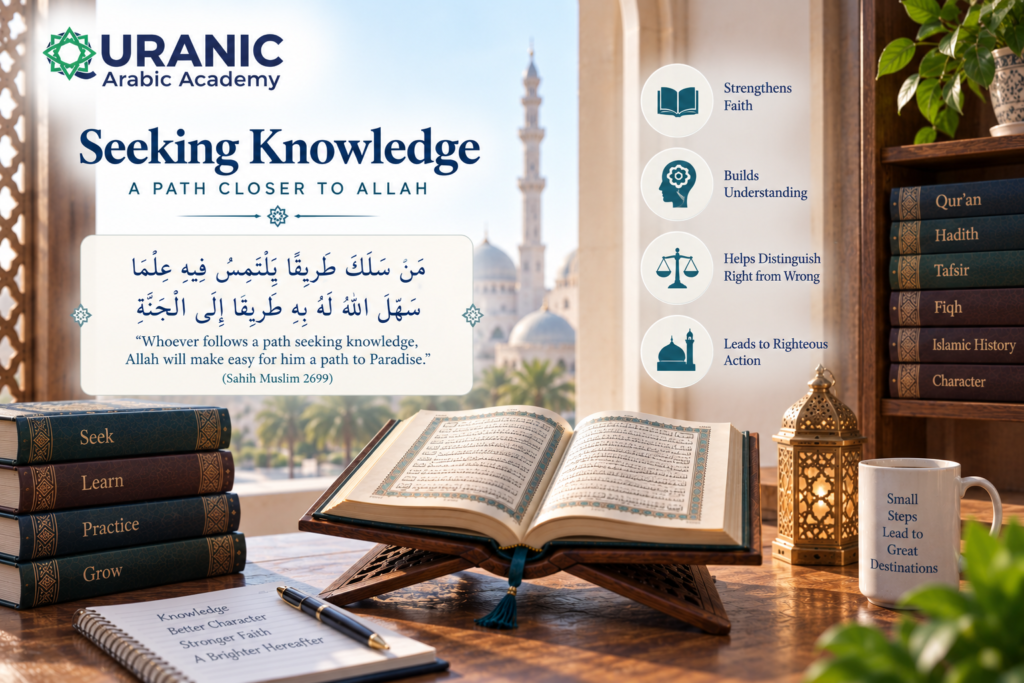
This hadith shows that seeking knowledge in general and Quranic knowledge in particular is an act of worship in itself, with consequences in this life and the Hereafter.
Read Also: Quranic ethics
How to Build Your Quranic Knowledge Step by Step
Building Quranic knowledge is a gradual and continuous process that requires more than simply reading the Quran regularly. True understanding develops when recitation is combined with reflection, language study, reliable interpretation, and practical application.
Each of these elements helps the learner move from recognizing the words of the Quran to understanding its meanings, appreciating its guidance, and applying its teachings in everyday life.
Building Quranic knowledge therefore involves several important aspects:
- Reflective recitation (tadabbur): reading the Quran while pausing to consider its meanings, not just reciting it correctly.
- Understanding Arabic: grasping the Quran in its original language requires familiarity with Arabic and its grammar, since translation alone cannot convey all its meanings.
- Studying tafsir: consulting reliable exegesis to understand the context and circumstances of revelation.
- Connecting to daily life: applying Quranic concepts in daily interactions, relationships, and decision-making.
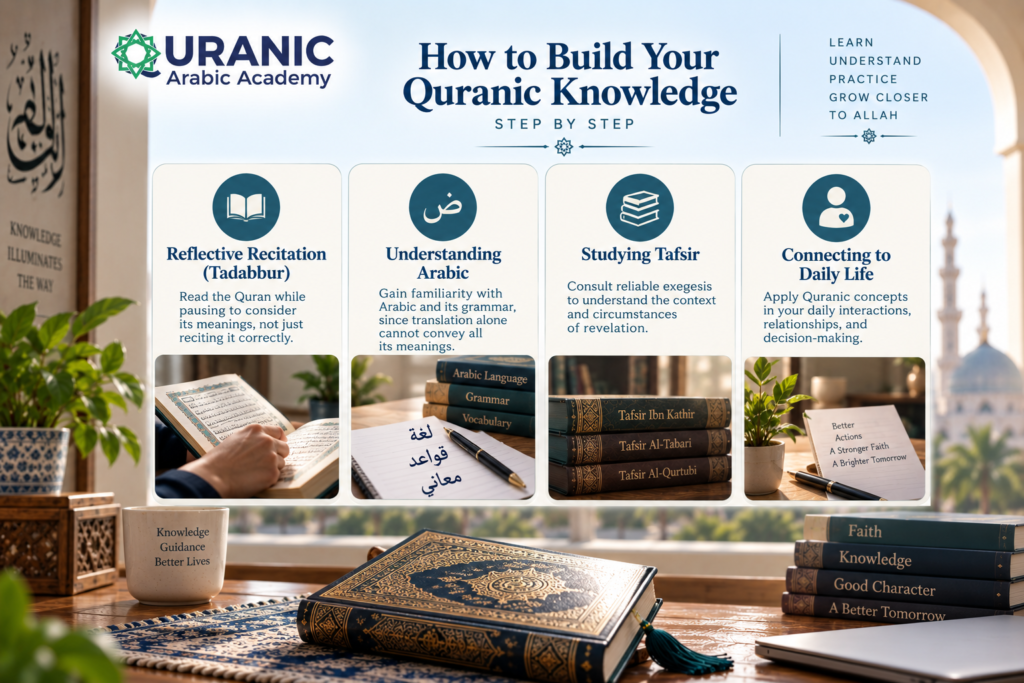
Because Arabic is the true key to understanding the Quran as it was revealed, many students turn to specialized programs that teach Quranic Arabic in a systematic, gradual way, rather than relying on translations alone.
Essential Terms for Understanding Quranic Knowledge
Understanding Quranic knowledge becomes easier when you are familiar with the key terms used in Quran study. The following terms describe important aspects of understanding, interpreting, reciting, and applying the guidance of the Quran.
| Arabic Term | English Meaning |
| Tadabbur (تدبر) | Reflective contemplation of the Quran |
| Tafsir (تفسير) | Quranic exegesis / explanation |
| Tajweed (تجويد) | Rules of proper Quranic recitation |
| Asbab al-Nuzul (أسباب النزول) | Context / occasion of a verse’s revelation |
| Hidayah (هداية) | Divine guidance |
Experience Our Teaching Style:
We believe in clarity and engagement. Watch these short highlights from our actual classes to see our teachers’ methodology and student interactions in real-time.
Ready to Begin Your Quranic Journey?
Start learning with professional instructors through our structured curriculum.
Book Your Free TrialDeepen Your Understanding of the Quran at Its Source
Since Arabic is the gateway to correctly understanding the Quran, learning it systematically is a practical step toward deepening one’s Quranic knowledge. Specialized platforms such as The Quranic Arabic Academy offer structured programs that focus on understanding the Quran from its original text, rather than relying solely on translation.
| Deepen Your Islamic KnowledgeJoin our comprehensive online courses and learn from qualified scholars today.Book Your Free Trial |
Our Arabic Courses
- Quranic Arabic Classes
- Quranic Arabic Course for Beginners
- Online Quranic Arabic Courses for Advanced Learners
- Quranic Arabic Grammar Course
- Arabic Courses for Understanding the Quran
- Quranic Arabic Course for Sisters (Female)
- Quranic Arabic Course for Kids
- Online Quranic Arabic Classes for Adults
- Quranic Arabic Course UK
- Quranic Arabic Course London
- Quranic Arabic Course USA
- Quranic Arabic Course Canada
- Quranic Arabic Course Australia
- Quranic Arabic Course UAE
- Quranic Arabic Course Germany
Conclusion
Quranic knowledge is the deep understanding and guidance derived from the verses of the Holy Quran. It rests on three foundations: being a source of light and certainty, encompassing every aspect of human life, and contributing to civilizational building grounded in justice.
The Quran and Sunnah both clarify the status of knowledge and its pursuit, and building this knowledge requires reflection, understanding of Arabic, study of tafsir, and a constant connection to real life.
Frequently Asked Questions
What is the difference between Quranic knowledge and Quranic information?
Quranic knowledge is understanding translated into behavior and intellectual outlook, while Quranic information may simply be memorized or transmitted without reflection or application.
Is learning Arabic required to understand the Quran?
Learning Arabic is not a condition for valid faith, but it is an important means of understanding the Quran in its original text and grasping subtle meanings that translation may not fully convey.
How can a beginner start developing their Quranic knowledge?
One can start with daily recitation combined with reflection, then refer to a simple and reliable tafsir, while gradually trying to apply what is understood in daily life.
Is there a difference between tafsir and tadabbur?
Yes. Tafsir is a scholarly explanation of the meanings and context of the verses, while tadabbur is personal reflection on the verses to draw out lessons and guidance.





Leave a Reply