 Quranic Arabic
Have you ever wondered what is Quranic Arabic and why the Muslim Ummah gives great importance to learning and teaching the Arabic language? What is the History of Quranic Arabic and what makes Quranic Arabic one of the subjects that is still being studied by thousands of Muslim students worldwide?
Arabic is the language of the Quran. It is the language that Allah the Almighty chose to reveal his words upon the messenger Muhammad peace and blessings be upon him. Here is a complete guide to Quranic Arabic, with a comprehensive answer to all these questions.
What is Quranic Arabic?
Quranic Arabic, also known as classical Arabic is the language of the holy Quran and old Arabic literature.
The Arabic language held a very special place and was one of the most characteristic features of the Arab community at the time of the revelation of the holy Quran. The thing which made the Quranic script a challenging miracle for those who disbelieved the prophet Muhammad peace and blessings be upon him; as it was unique and superior to any other Arabic text known at that time.
It is the form of Arabic used in the Holy Quran so when we want to learn the perfect reading of the Quran, this means that we want to learn Quranic Arabic, including its branches, terminology, Arabic reading, and a grammatical aspect, etc.
It is also called “classical Arabic” because its age is associated with the age of the Holy Quran, which is approximately 15 centuries.
Quranic Arabic retains most of the consistency of Modern Standard Arabic, but there are some essential differences in some of the wording, and these differences are which distinguish it.
It is characterized by the presence of a rhythmic direction in the sentences and rhetorical expressions that sometimes attract attention, sometimes warn, and sometimes desire.
At The Quranic Arabic Academy, our Arabic Courses for Understanding the Quran are built precisely around this goal, guiding non-Arabic speakers from foundational reading to genuine Quranic comprehension through certified, qualified instructors.
Join our Arabic courses for understanding the Quran and get a free lesson
The Historical Background of Quranic Arabic
Quranic Arabic did not emerge in isolation. It descended from a rich oral and literary tradition among the Arabian tribes of the 6th and 7th centuries CE, particularly the Quraysh of Mecca, whose dialect was considered the most eloquent.
Pre-Islamic Arabic poetry — known as the Mu’allaqat — demonstrates the linguistic sophistication already present before revelation. The Quran arrived within this tradition, then surpassed it entirely, producing what Arab linguists called I’jaz Al-Quran (the linguistic inimitability of the Quran).
This inimitability is not merely theological claim. Linguistically, the Quran employs grammatical structures, morphological precision, and rhetorical devices that remain unmatched in Arabic literature across fourteen centuries.
The language was then meticulously preserved through three primary mechanisms: oral transmission by the Companions, the codification of the Mushaf during Uthman ibn Affan’s era (RA), and later the formal development of Arabic grammar by scholars like Sibawayhi.
Quranic Arabic Divisions
The study of Quranic Arabic is divided into the study of a number of sections, and they are:
1. Terminology
It is one of the important divisions of the Quranic language, as it needs a deep study, given that the Holy Qur’an uses different connotations and certain rhetorical meanings for some terms.
2. Arabic Reading
The language of the Quran is Arabic as we know, so learning to read the Quran means that we learn to read the Arabic language by extension, but learning Arabic alone does not make you read the Quran fluently.
You must learn Tajweed alongside Arabic letters and words so that you can learn Quranic Arabic.
3. Grammatical Aspect
The Noble Quran is the main source of Arabic grammar, and it includes easy rules that require you to understand and apply, and this is what will be provided to you by our online Quranic Arabic course, God willing.
What is the Quranic Arabic Alphabet?
The Arabic language consists of 28 letters in addition to Hamzah (ء). These letters are either consonants or long vowels, while short vowels are represented by diacritical marks that accompany the Quranic script.
Unlike English Arabic texts are written from right to left. Arabic letters are connected and have different shapes according to their position in the word.

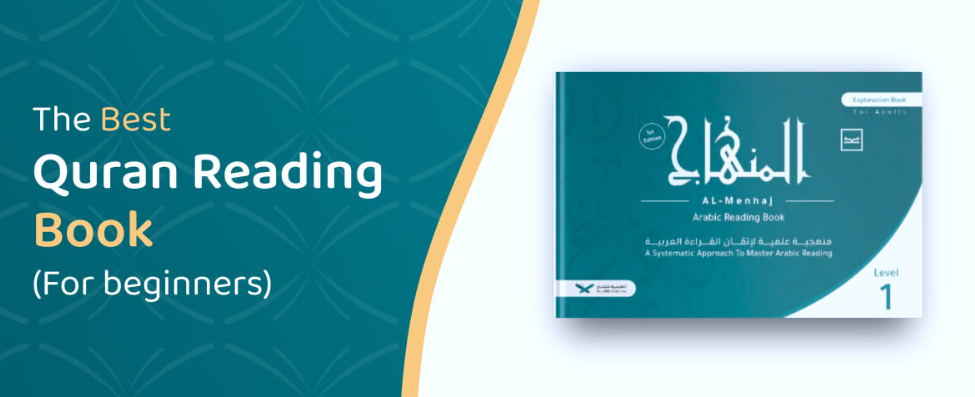
For absolute beginners, The Quranic Arabic Academy’s Al-Menhaj Book Course provides a systematic, step-by-step approach to Arabic reading fundamentals. Authored by Luqman ElKasabany and designed specifically for non-native English-speaking Muslims, this curriculum teaches letter recognition, connection rules, vowel application, and basic reading fluency before advancing into grammar.
Why Learn Quranic Arabic?
There are many benefits you gain from joining an online Quranic Arabic course such as:
Read The Quran Properly
This is the most prominent goal and the most important reason for having an online Quranic Arabic course.
In order to read the Noble Quran correctly, you must learn the letters in addition to the Tajweed. The way of reading and pronouncing the sentence can be completely different if you make a mistake in the exit of one of the letters or ignore a rule of intonation rules.
The rules of Tajweed are not only important for proper reading, but also important for understanding and writing, and this is what we will discuss shortly…
Writing Quranic Verses Properly
Writing the verses of the Noble Quran is different from the regular Arabic sentences, so the Quranic Arabic online course will give you the method and rules upon which the Holy Quran is written.
For example, the letters that are pronounced and not written, we express them in writing with a small tidal sign above the word.
Contemplate this verse
مَا كَانَ إِبْرَٰهِيمُ يَهُودِيًّا وَلَا نَصْرَانِيًّا وَلَٰكِن كَانَ حَنِيفًا مُّسْلِمًا
Abraham was neither a Jew nor a Christian, but he was a Hanif Muslim.
Note the small mark above this letter (رَٰ), as it is among the signs that adjust the word and that you will learn through the online Quranic Arabic for Beginners so that you can master the correct writing of verses.
Enroll in Our Quranic Arabic for Beginners with a Free Trial

Is Quranic Arabic Different from Normal Arabic
Yes, there is a difference between modern standard Arabic and classical or Quranic Arabic; since modern standard Arabic is considered a simplified form of the Quranic Arabic that was derived to accommodate the recently introduced vocabulary. Now, let us discuss the differences between classical Arabic in modern Arabic.
Is Quranic Arabic the Same as Fusha?
The word Fusha refers to the more eloquent forms of the Arabic language whether it is classical Arabic or modern standard Arabic. In other words, Fusha is any form of Arabic other than the slang or colloquial Arabic used by Arab speakers in everyday conversations and on social media platforms.
Differences between Modern Standard Arabic And Quranic Arabic?
Modern Standard Arabic is so similar to Quranic Arabic that it is used by many Arabs interchangeably.
In light of this similarity, there are some minor points of difference, which are summarized in 3 points:
1. The Form in Which They Are Presented
The Quranic (Classical) Arabic is more common in literature and writing. As for speaking, classical Arabic is more common than classical Arabic because it is more modern and consistent with emerging terms.
2. Usage
The Quranic Arabic language is mainly used to read, write or gain a deeper understanding of the Quran, but if you want to learn Arabic for the purpose of speaking it, getting a job, or traveling to one of the Arab countries, for example, Modern Standard Arabic will be the most useful.
3. Grammar, Sentences, And Words
Grammar is the backbone of the language. When it comes to the Quran, it is not something that you can skip. Let me point out that Classical Arabic derives its grammatical rules and eloquent expressions from the Holy Quran.
So If we were to compare them on the basis of rules, words and the formation of sentences, the Quranic Arabic language in terms of words is more generous and heavier, while Modern Standard Arabic includes emerging terms, while sentences are eloquent sentences that carry meanings that need to be understood and studied in contrast to the classical Arabic language, which is characterized by some ease and clarity of meaning. Grammar, as we mentioned, the basis and its richness in it is due to the Quranic Arabic language.
Through this, you can determine whether you want to learn Modern Standard Arabic or Quranic Arabic, and in general, both of them, as we mentioned, are very similar, and if you master one of them, you can learn the other easily, but you must specify what you aim to learn to know why you learn it…
Ready to Begin Your Quranic Journey?
Start learning with professional instructors through our structured curriculum.
Book Your Free TrialDo People Still Speak Quranic Arabic?
As a non-Arab speaker, you might be asking, is Quranic Arabic still speaking? Quranic Arabic is mainly studied with the purpose of understanding Islamic literature and Quranic script. However, it is not used for communication in any of the Arab countries nowadays.
On the contrary, modern standard Arabic (A modern derivative of classical Arabic) is still used In the Arab world within formal contexts such as newspapers, broadcasts, and official documents.
Various Local dialects are spoken In Arab-speaking countries. there are six main Arabic dialects depending on the region in which these dialects are spoken:
1- Egyptian Arabic dialect.
2- Sudanese dialect.
3- Gulf region dialect: (KSA, Bahrain, UAE, Oman, Qatar, Kuwait, and Yemen:
4- Iraqi dialect
5- Levant dialect: Spoken in Lebanon, Syria, Jordan, and Palestine
6- Maghrib dialect: Spoken in Tunisia, Algeria and Morocco.
Which Arabic is Closest to the Quran?
As we have mentioned before, Quranic Arabic, or classical Arabic is the closest to the Quran. It is the form of Arabic language used in old Arabic literature and poetry as well as Islamic texts.
Classical Arabic vs Modern Arabic, which Arabic should I learn?
The answer to this question depends mainly on the purpose and the reason why you want to learn Arabic. In case you want to become an Islamic scholar or learn Islamic literature then your go-to option is classical or Quranic Arabic.
However, if you are planning to travel to an Arab country and communicate with others in Arabic then you should choose to learn the specific dialect of the country you are targeting.
Modern standard Arabic is your best choice if you want to work in journalism or just want to follow Arabic media, broadcasts, and newspapers.
The Core of Quranic Arabic Grammar
Quranic grammar — known as Nahw (النحو) — governs how words relate to one another within a sentence. It is one of the most systematic and logical grammatical frameworks in any language, which actually works in the learner’s favor once the core concepts are internalized.
The Three-Case System That Shapes Meaning
Arabic nouns carry three grammatical cases, each marked by a specific vowel ending. These cases are not optional stylistic choices — they signal the function of every word in the sentence.
| Case | Arabic Name | Vowel Marker | Function |
| Nominative | الرفع (Al-Raf’) | Damma (ُ) | Subject of the sentence |
| Accusative | النصب (Al-Nasb) | Fatha (َ) | Object, predicate, adverbial |
| Genitive | الجر (Al-Jarr) | Kasra (ِ) | After prepositions, in Idafa |
Consider this example:
ٱللَّهُ رَبُّ ٱلْعَٰلَمِينَ
Allahu Rabbu Al-‘Alameen
Allah, Lord of the worlds.
Here, Allahu carries Damma (Nominative), Rabbu also Nominative as a predicate, and Al-‘Alameen carries Kasra (Genitive) because it follows the construct Idafa. Three words — three grammatical cases — all working precisely together.
Verbal Morphology and the Root System
Arabic is a root-based language. Every Quranic word — in virtually all cases — derives from a three-letter root (Jidhr Thulathi). Mastering root recognition is arguably the single highest-leverage skill in Quranic vocabulary acquisition.
The root ع-ل-م (ʿ-L-M), for example, gives the Quran words like: ‘Ilm (knowledge), ‘Alim (scholar), ‘Allama (He taught), Ma’loom (known), ‘Alam (world).
One root. Multiple meanings. Systematic derivation.
At The Quranic Arabic Academy, our Quranic Arabic Grammar Course trains students to identify root patterns, apply case endings correctly, and analyze Quranic sentences with the precision of a trained linguist — through personalized 1-on-1 sessions with certified instructors.
Your First class is free. Join our Quranic Arabic Grammar Course now

What Is the Best Way to Learn Quranic Arabic Online? (Gradual Approach)
The gradual approach means to do things gradually, step by step, adding or omitting, until the objective is assured.
This is the method we follow in our online Quranic Arabic course, as you pass through this stage according to your progress, level, and age as well. That’s why we say that we’ll provide you with a very professional online Quranic Arabic course.
So what is offered to a novice or young student is, of course, different from what is offered to an average or older student.
The Quranic Arabic academy is going on a gradual strategy in its online Quranic Arabic course, where it begins by giving the student what makes him cross the starting stage to the intermediate level stage, then the rhythm begins to rise and the difficulty increases, and the amount of information provided to him gradually, and this method is one of the most effective methods in the educational field in general and language teaching The Quran online in particular.
Learning Quranic Arabic, in general, is divided into two main parts, one part related to reading the Quran in itself and related to the rules of intonation and letter exits in a large way, and another part related to learning the terminology and each of them complements the other.
Learning Quranic Arabic goes through three main steps:
1. Focus on Relevant Words (Using Frequency Lists)
Learning common words in a field is often an important key to learning.
If you want to read a book that talks about medicine, for example, you need to know the common terms and words in this field, and the Holy Qur’an as well.
There are many lists that include common words in the Holy Quran.
For example:
The verb (say) is repeated 1618 times in the Quran.
Verb (to be) repeated 1358 times.
Verb (to believe) repeated 537 times.
So this is the first step, to start learning the most frequently used words.
2. Choose Your Online Teacher
We know that it is often difficult to learn Quranic Arabic, especially if you live in a foreign country that does not have access to an Arabic-speaking teacher, so joining an online Quranic Arabic course is an ideal alternative.
Teachers are the most important element in this course, so you must choose them carefully, and The Quranic Arabic Academy helps you a lot in this matter. Read on and you will know what I mean.
As for the job of this teacher, he is concerned with implementing the second step in this journey, which is to explain the grammatical rules so that you can assimilate them and understand the details and formations of sentences.
3. Practice with Your Teacher Or Muslim Friends If any
The third and final step is practice, which is the most important step without it being impossible to learn Quranic Arabic.
It is always said if you want to learn a new thing, practice, practice, and practice again!
The Quranic Arabic Academy provides you with professional teachers, with whom you can try reading the Quran and practice what you have learned during the online Quranic Arabic course.
You can also practice Quranic Arabic reading with your Muslim colleagues and friends outside the lesson.
And while you join an online Quranic Arabic course, you are supported by books that help you implement this gradual scheme. So what are these books?
What Are the Features of The Perfect Quranic Arabic Classes?
In order for the course to achieve the desired benefit, it must be:
1. Inclusive
That is, it should include sufficient information about everything it includes, including information from different sources, so that all information on the subject is known.
2. The Information Is Clear
Its information should be clear and far from ambiguity so that it is easily understood.
3. Practice at The End of The Lesson
It is an important step that must be included in the lesson, as the application has an effective role in fixing the information and keeping it in the memory for as long as possible.
4. It’s Should Be short
It is preferable that the session is of short duration – no more than an hour, for example – so as not to cause boredom and confusion in the information.
5. There Should Be Breaks During The Lesson
It is a necessary condition to achieve understanding and maintain the extent of assimilation, so all psychologists advise that there be short breaks in the folds of one session.
6. The Class Should Contain Information That Is Graded and Arranged
That is, the information mentioned during the lesson is arranged in a logical order so that the student’s mind accepts and understands it.
After we talked about how important it is to start an online Quranic Arabic course and learn how to read Quran correctly, and the important features should be in the online Quranic Arabic course, let us introduce you how to receive this through The Quranic Arabic Academy…
The Quranic Arabic Academy offers distinguished courses containing all features above in this field through its website, and you can choose the right course for you.
Ready to Begin Your Quranic Journey?
Start learning with professional instructors through our structured curriculum.
Book Your Free TrialIs there Any Difference between Learning Quranic Arabic for Adults and Kids?
Yes, definitely. Teaching kids in any field differs from teaching adults.
For kids to learn Quranic Arabic online, special methods must be used that help them achieve a better understanding and overcome obstacles, as well as help them to increase attention.
And The Quranic Arabic Academy did not miss that either, as it provided special educational methods for kids such as gamification, which means using games for the purpose of learning, and a reward policy that makes the child seek to increase focus to obtain good grades that enable him to compete for the prize presented to the distinguished!
As for adults, it is easier to teach them, because they are aware of the responsibility and have the desire themselves to learn, in addition to having more endurance than children.
But what is similar in education between children and adults is the reliance of The Quranic Arabic Academy on a gradual approach with each of them.
I think that now, dear reader, you have become familiar with everything you wanted to know when you decided to learn Quranic Arabic online, but there is an important question that I know it has been in your head since the beginning of the article, but I left it to the conclusion so that you can understand what I’ll say.
The question is how difficult is it to learn Quranic Arabic online and how long does it take?
Is It Difficult to Learn Quranic Arabic?
Honestly, learning languages, in general, is not easy. You seek to learn something that an individual acquires during his life, but let’s say that it is not impossible and that as long as you seek and strive, the difficult will turn into an easy one by God’s command.
Also, the extent of the difficulty depends on your goal of learning, is it mastering the language or just literacy, or is all your goal the ability to read the Qur’an properly, for every goal that is difficult to reach is different from the other.
The Goals of Learning Quranic Arabic
Understanding why you’re learning shapes how effectively you learn. Quranic Arabic study typically progresses through four distinct, hierarchical goals.
1. Reading Quranic Text Accurately
The first goal is Tarteel — precise, accurate oral recitation. This requires correct letter pronunciation, vowel application, and basic reading fluency. This is achievable within weeks of consistent study using the right foundational materials.
2. Understanding Quranic Vocabulary Independently
The second goal is vocabulary comprehension. Research indicates that understanding approximately 300 high-frequency Quranic roots covers roughly 70% of the Quran’s total word occurrences. Targeted vocabulary work accelerates comprehension dramatically.
3. Analyzing Quranic Sentences Grammatically
The third goal is I’rab — grammatical parsing. A learner at this stage can identify the subject, predicate, verb, object, and all grammatical relationships within a verse. This is where Nahw and Sarf (morphology) become fully active tools.
Read Also: Best 12 Apps to Learn Quranic Arabic
4. Reflecting on Meaning
The fourth goal is Tadabbur — deep contemplative reflection on meaning. This level integrates grammar, vocabulary, rhetoric (Balagha), and Tafsir into a unified understanding. It represents the ultimate purpose of Quranic Arabic study.
Working with qualified Arabic instructors through The Quranic Arabic Academy’s Arabic Courses for Understanding the Quran provides individualized attention needed to progress through each of these stages systematically, with flexible scheduling available 24/7.
Join our Arabic courses for understanding the Quran and get a free lesson
Read Also: How Long to Learn Quranic Arabic?
The Relationship Between Quranic Arabic and Tajweed
Tajweed and Quranic Arabic grammar are frequently taught as separate subjects, but they are deeply interconnected. Understanding this relationship prevents a very common learner mistake.
Tajweed governs the phonetic rules of recitation — how each letter is pronounced, when to elongate vowels (Madd), where to merge sounds (Idgham), and how to apply nasalization (Ghunna).
Quranic Arabic grammar governs the semantic and syntactic rules — what words mean and how they function within sentences.
The connection point is the Harakat (vowel markings). The grammatical case of a word directly determines its vowel ending, which then directly determines how it is recited according to Tajweed rules. A word that is Nominative (Damma) is recited differently at sentence endings than an Accusative (Fatha) word — and both Tajweed and grammar must align for correct recitation.
Read Also: Why Learn Quranic Arabic?
Ready to Begin Your Quranic Journey?
Start learning with professional instructors through our structured curriculum.
Book Your Free TrialRead Also: Is Quranic Arabic Different from Normal Arabic?
Begin Your Quranic Arabic Learning with The Quranic Arabic Academy
Understanding Quranic Arabic transforms your relationship with the Quran — from recitation to genuine comprehension.
The Quranic Arabic Academy offers:
- Expert-certified instructors with verified Arabic linguistics qualifications
- Personalized 1-on-1 sessions tailored to your current level and goals
- Flexible scheduling available 24/7 to fit any time zone
- Structured curriculum from the Al-Menhaj Book Course for beginners to the Online Quranic Arabic Courses for Advanced Learners
- Specialized programs including the Quranic Arabic Course for Sisters, Quranic Arabic Course for Kids, and Online Quranic Arabic Classes for Adults
Book your free trial lesson today and take the first real step toward understanding the Quran in its original language — the way it was meant to be understood.
Check out our top courses to start learning Quranic Arabic today:
- Quranic Arabic Grammar Course
- Arabic Courses for Understanding the Quran
- Quranic Arabic for Beginners
- Online Quranic Arabic Classes for Adults
- Quranic Arabic Course for Kids
- Quranic Arabic Course for Sisters
- Online Quranic Arabic Courses for Advanced Learners
Your first class is completely free. Start Learning Quranic Arabic courses Today.

Conclusion
Quranic Arabic or classical Arabic is the language of the holy Quran. It is characterized by its precision, conciseness, and strength.
However, Quranic Arabic is not spoken in any of the Arab countries nowadays and is only studied for educational purposes such as Islamic studies and the study of ancient Arabic literature.
Modern standard Arabic is a simplified version of classical Arabic that was derived to accommodate the needs of the Arab communities nowadays. It is used in formal contexts in schools, newspapers, official documents, and in governmental organizations.
Learning Quranic Arabic is crucial for whoever is interested in exploring the Islamic heritage and culture and reflecting on the verses of the holy Quran and the prophetic hadiths. Hence, it is recommended to join Quranic Arabic classes that are now available on various online Arabic teaching platforms.
Related Articles
Quranic Arabic



Leave a Reply