 Quran
Quran
| Key Takeaways |
| Quranic apps like Kalaam and QuranicVocab use spaced repetition to help non-Arabic speakers retain vocabulary long-term. |
| Al Quran (Tafsir & by Word) offers word-by-word grammatical analysis in 15+ languages, making it uniquely valuable for grammar study. |
| No app replaces structured instruction — apps work best alongside a qualified teacher who addresses individual learning gaps. |
| Learning the most frequent Quranic words first is the fastest evidence-based path to Quran comprehension for non-Arabic speakers. |
| Combining a strong vocabulary app with a grammar-focused course accelerates comprehension far beyond either approach alone. |
You open the Quran. You recognise the script. You even know the pronunciation. But the meaning — the actual Arabic meaning — remains just out of reach. For millions of non-Arabic speaking Muslims, this is a daily reality in Salah and in private recitation.
The best Quranic apps address this gap directly by teaching vocabulary, grammar, and word-by-word analysis in structured, daily sessions. This guide reviews six of the strongest options available, with honest assessments of what each one genuinely offers — and where each one stops short.
1. Quranic: Learn Quran and Arabic
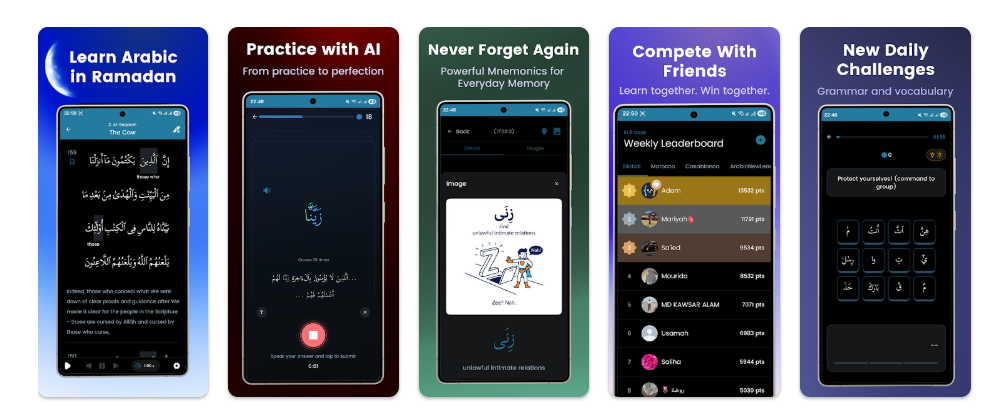
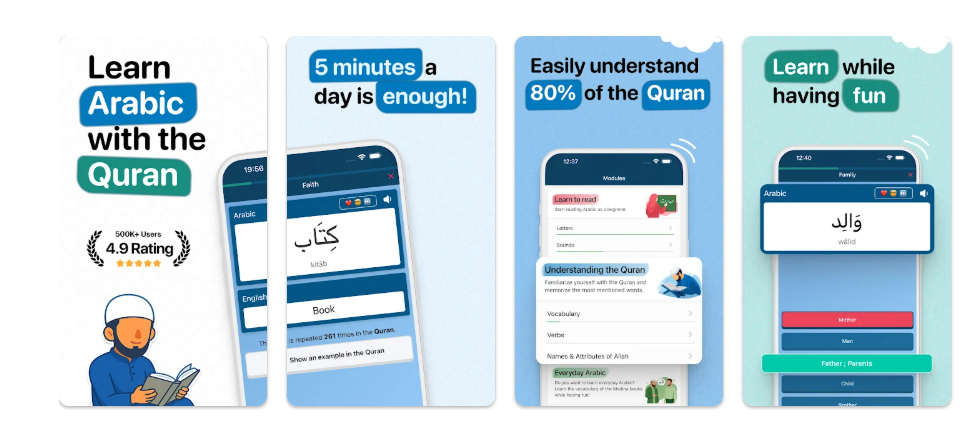
Quranic: Learn Quran and Arabic is one of the most downloaded Quranic Arabic vocabulary apps, and for good reason. It teaches high-frequency Quranic words through short daily lessons, audio recitation, and visual reinforcement — making it accessible for complete beginners who have no prior exposure to Quranic Arabic.
The app’s recent update introduced Quranic Profiles, allowing learners to track badges, connect with other users, and join leaderboards. These social features add a layer of accountability that many self-study learners genuinely need to stay consistent.
What works well:
- Clean, intuitive interface suitable for all age groups
- High-frequency vocabulary approach prioritises the words that appear most in the Quran
- Audio by qualified reciters supports correct pronunciation
What it does not cover:
- No systematic Quranic grammar instruction
- Vocabulary without grammatical context limits reading comprehension depth
- Social features, while motivating, do not substitute for structured feedback
At The Quranic Arabic Academy, students who use this app as a supplementary vocabulary tool alongside their online Quranic Arabic classes for adults consistently report faster retention — because they encounter the same words in live lessons with grammatical context attached.
Join our Quranic Arabic Courses for Advanced Learners with a Free Trial

2. Kalaam — Learn Quranic Arabic
Kalaam – Learn Quranic Arabic stands apart from most Quranic apps because it attempts to address both vocabulary acquisition and Arabic grammar patterns — two dimensions that most competing apps treat as separate concerns.
For any learner serious about understanding why learning Quranic Arabic matters, Kalaam provides one of the strongest mobile starting points available today.
The app claims learners can understand 40% of the Quran in one week, 70% in one month, and 95% in one year.
These figures refer specifically to word frequency coverage — meaning you will recognise those words when they appear, not that you will fully comprehend the grammatical relationships between them. That distinction matters enormously in practice.
Standout features:
| Feature | What It Does | Pedagogical Value |
| Spaced Repetition System | Reviews words before you forget them | High — mirrors medical school retention methodology |
| 92 Grammar Patterns Module | Covers patterns accounting for 95% of Quranic grammar | High — rare in mobile apps |
| Colour-Coded Quran Reader | Words change colour as you learn them | Medium — visual progress motivator |
| Friends & Leaderboards | Social competition and activity feed | Medium — accountability tool |
| 80+ Language Support | Interface and translations in 80+ languages | High — accessibility for global learners |
The grammar module is genuinely ambitious. Teaching the 92 morphological patterns (Sarf patterns) that account for the majority of Quranic structures is the right pedagogical instinct.
In our instructors’ experience at The Quranic Arabic Academy, students who grasp even the core triliteral root system begin to decode unfamiliar Quranic words independently — and Kalaam makes a credible attempt at introducing this concept through a mobile format.
Where it has limits
The grammar module simplifies considerably to fit a mobile format. The Mubtada’ and Khabar relationship, the I’rab case-ending system, and the Harf Nasb function cannot be absorbed through pattern drills alone. These require explanation, correction, and dialogue with a qualified instructor.
For learners who want to complement this app with real grammatical depth, The Quranic Arabic Academy’s Quranic Arabic Grammar Course provides exactly that — with certified linguists who address the specific gaps that app-based grammar instruction inevitably leaves behind.
Your First class is free. Join our Quranic Arabic Grammar Course now

Shots Videos from Our Courses
Ready to Begin Your Quranic Journey?
Start learning with professional instructors through our structured curriculum.
Book Your Free Trial3. Learn Arabic with the Quran (Quran Progress)
Learn Arabic with the Quran, known as Quran Progress, positions itself as the number-one Quranic Arabic learning app — a claim that reflects its strong user base rather than a comparative academic assessment.
Its core value is making vocabulary review genuinely enjoyable through varied exercise formats, which is no small achievement for learners who struggle with consistency.
The app focuses on the most common words in the Quran — a pedagogically sound approach. Mastering the 300–500 highest-frequency Quranic words gives a non-Arabic speaker meaningful comprehension coverage before they have studied a single grammar rule.
Exercise variety includes:
- Multiple choice quizzes
- Writing exercises
- Guessing games
- Audio-based recognition drills
The inclusion of Madinah Arabic Book vocabulary (Volumes 1 and 2) is a useful bonus — it bridges Quranic vocabulary with the most widely used classical Arabic curriculum globally.
What it does not address: Like most vocabulary-focused apps, Quran Progress stops at word recognition. Understanding why a word takes a particular form in a given verse — whether it is in the nominative (Marfu’), accusative (Mansub), or genitive (Majrur) case — requires grammatical training that no flashcard system delivers.
Five minutes a day with this app is a practical, realistic habit. It will not replace knowing how to learn Quranic Arabic systematically, but it serves as an excellent daily warm-up alongside structured study.
4. QuranicVocab
QuranicVocab: Learn Arabic takes a dual-purpose approach that distinguishes it from purely vocabulary-based competitors: it combines high-frequency word learning with a verse-by-verse memorisation system. For learners whose primary goal is to memorise Surahs with understanding — rather than by rote repetition — this combination is genuinely valuable.
The app’s word-by-word breakdown system is particularly well-executed. Each verse is segmented into individual Arabic words with meanings displayed alongside authentic audio recitations.
This mirrors the pedagogical method that qualified instructors use in live Tafsir instruction — and it represents one of the more educationally rigorous approaches available in a mobile format.
Read also: Quranic Quizzes: Test Your Knowledge on Trials and Tribulations
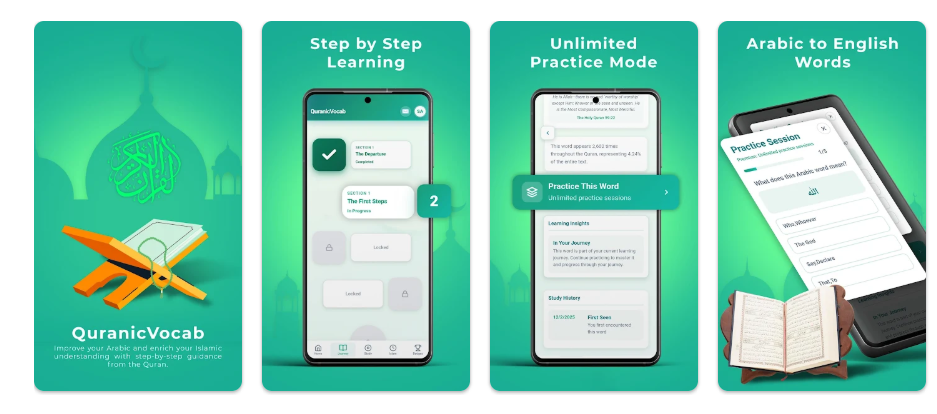
Core feature comparison:
| Feature | QuranicVocab | Typical Vocabulary App |
| Word-by-word verse breakdown | ✅ Every verse | ❌ Isolated word lists |
| Authentic audio recitation | ✅ Multiple well-known Qaris | ✅ Usually available |
| Memorisation with meaning | ✅ Structured system | ❌ Rote repetition only |
| Grammar explanation | ❌ Limited | ❌ Limited |
| Spaced repetition | ✅ Present | ✅ Most apps include |
The app’s stated 40% Quran coverage through frequent-word learning aligns with what linguistic research on Quranic vocabulary distribution genuinely supports — the most frequent words do account for a large proportion of the Quranic text.
One honest limitation: the app describes its method as building “native-level comprehension.” In reality, native-level comprehension of Quranic Arabic requires systematic Nahw and Sarf training that extends well beyond vocabulary frequency lists.
Understanding إِنَّ as a Harf Nasb that shifts the following noun into the accusative case, for example, is not something frequency drilling teaches — it requires grammatical instruction.
For learners beginning their memorisation path, this app pairs naturally with The Quranic Arabic Academy’s Quranic Arabic course for beginners, where the meaning behind each memorised verse is explained with full grammatical context from the first lesson.
Enroll in Our Quranic Arabic for Beginners with a Free Trial
5. Easy Quran and Arabic Learning
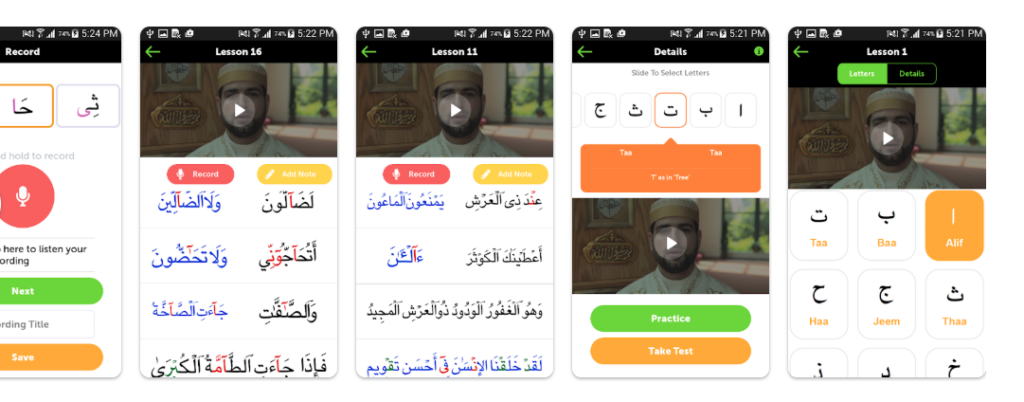
Easy Quran & Arabic Learning occupies a different category from the vocabulary apps above. Its emphasis is on Quranic reading — building correct pronunciation and letter recognition — rather than vocabulary comprehension or grammar. For learners who are still developing their Quranic Arabic alphabet recognition, this focus is well-placed.
The app’s standout feature is its colour-highlighted Mushaf display, which marks every word visually and keeps lines structured as they appear in a printed Quran.
Combined with audio-video pronunciation lessons, this creates a reading experience that is closer to sitting with a physical Quran than most apps achieve.
Notable features:
- Voice recording and comparison tool — learners record their recitation and compare it to the reference audio
- “Listen first, then identify” exercises — trains the ear before the eye
- Screen remains active during recitation sessions — a practical detail many competing apps overlook
- Step-by-step progression from Arabic alphabet to word formation
Honest assessment
This app is best suited for learners who are still at the stage of building reading fluency — those who want to learn how to read Quranic Arabic with correct pronunciation before moving into vocabulary and grammar. It is not designed for comprehension training.
At The Quranic Arabic Academy, we see students at this exact stage regularly. For those who need guided foundational reading instruction, the Al-Menhaj Book Course — our proprietary curriculum for absolute beginners — builds the same reading fundamentals with personalised correction from instructors with 25+ years of experience, which no app can replicate.
6. Al Quran (Tafsir & by Word)
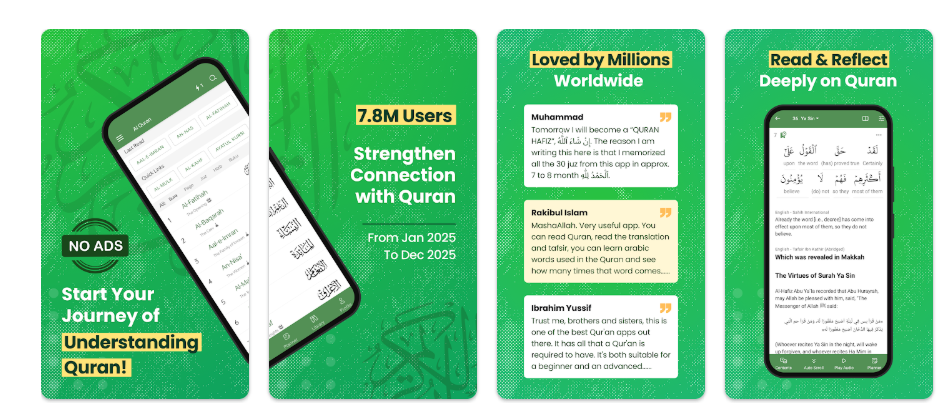
Al Quran (Tafsir & by Word) is the most academically serious app on this list. With over 8 million users, 170+ translations and Tafsirs, word-by-word morphological analysis, and access to classical Tafsirs including Ibn Kathir and Tabari, it functions less as a learning app and more as a portable scholarly reference library.
The word-by-word analysis module — covering Word Root and Lemma, Grammar, Morphology, Verb Forms, and Quranic occurrences — is the most advanced grammatical feature available in any free Quranic app.
For learners who have already built a grammatical foundation and want to apply it directly to the Quranic text, this feature is exceptional.
What makes this app uniquely valuable:
- I’rab analysis — case-ending explanations for individual words in context
- Asbabun Nuzul — the occasions of revelation, providing historical and contextual understanding
- Tajweed colour-coding — visual support for recitation rules
- Quran Planner — structured Khatmah scheduling for consistent completion
- Offline access — all features available without internet connection
One important clarification
The grammatical analysis in this app presents information correctly — but reading morphological data does not automatically produce understanding. Seeing that a word is a “Jama’ Mudhakkar Salim in the Nasb case” is meaningful only to a learner who already understands what Jama’ Mudhakkar Salim means and why the Nasb case appears in that position.
This is precisely why our instructors at The Quranic Arabic Academy recommend this app to intermediate and advanced students — those who have completed a structured online Quranic Arabic course for advanced learners and are now applying their grammatical knowledge to live Quranic text.
إِنَّا أَنزَلْنَاهُ قُرْآنًا عَرَبِيًّا لَّعَلَّكُمْ تَعْقِلُونَ
Inna anzalnahu Qur’anan ‘Arabiyyan la’allakum ta’qiloon
“Indeed, We have sent it down as an Arabic Qur’an that you might understand.” (Yusuf 12:2)
This verse is the reason millions of Muslims seek to understand the Quran in its original language. The Al Quran app, used at the right stage of learning, brings that understanding genuinely within reach.
Join our Quranic Arabic Courses for Advanced Learners with a Free Trial

What These Quranic Apps Cannot Replace?
The best Quranic apps in 2025 are genuinely impressive tools. They use evidence-based techniques — spaced repetition, frequency-first vocabulary, audio reinforcement — that align with how language acquisition actually works. Used consistently, they produce real results.
But every app on this list shares a common limitation: none of them can observe you. No app notices that you are confusing the Arabic dual form with the sound masculine plural because both end in a waw-nun sequence — a pattern our instructors at The Quranic Arabic Academy flag in virtually every student who comes from an English or French language background.
No app adjusts its explanation when you misparse إِنَّ as a simple particle rather than a Harf Nasb that triggers the accusative.
Understanding how long it takes to learn Quranic Arabic depends less on the tools you use and more on whether someone qualified is correcting your specific errors in real time.
The benefits of learning Quranic Arabic — deeper Salah focus, Quran comprehension, connection to the text — are fully realised only when vocabulary knowledge is supported by genuine grammatical understanding. Apps build the vocabulary. Structured instruction builds the grammar. Both together build comprehension.
Read Also: Quranic Games for Kids
Our Students Reviews
Ready to Begin Your Quranic Journey?
Start learning with professional instructors through our structured curriculum.
Book Your Free TrialRead Also: Quranic Stories for Kids
Take Your Quranic Arabic Further with The Quranic Arabic Academy
Apps give you vocabulary. The Quranic Arabic Academy gives you understanding. Our certified Arabic linguists — with 25+ years of teaching experience — specialise exclusively in Quranic Arabic for non-native speakers.
What sets us apart:
- Personalised 1-on-1 sessions tailored to your exact level
- Proprietary Al-Menhaj curriculum — from alphabet to advanced grammar
- Flexible scheduling available 24/7 for global students
- Dedicated courses for kids,adults,beginners, and advanced learners
Book your free trial lesson today — and experience the difference that qualified, personalised Quranic Arabic instruction makes.
Check out our top courses to start learning Quranic Arabic today:
- Quranic Arabic Grammar Course
- Arabic Courses for Understanding the Quran
- Quranic Arabic for Beginners
- Online Quranic Arabic Classes for Adults
- Quranic Arabic Course for Kids
- Quranic Arabic Course for Sisters
- Online Quranic Arabic Courses for Advanced Learners
Your first class is completely free. Start Learning Quranic Arabic courses Today.
Conclusion
The six apps reviewed here represent the strongest options available for mobile Quranic Arabic learning. Each addresses a genuine need — vocabulary acquisition, reading fluency, grammatical reference, or memorisation support.
Used with purpose and consistency, these tools create the daily contact with Quranic Arabic that builds long-term retention. The learner who spends ten minutes daily with a high-quality vocabulary app arrives at their weekly lesson with a richer word bank and stronger recognition.
The goal, always, is the moment a verse you have read a hundred times finally opens — and you understand not just the words, but the meaning Allah intended. Insha’Allah, these tools, used wisely, bring that moment closer.
Ready to Begin Your Quranic Journey?
Start learning with professional instructors through our structured curriculum.
Book Your Free TrialRead Also: The Main Quranic Teachings
Frequently Asked Questions About Quranic Arabic Learning Apps
Can Quranic Apps Alone Teach Me to Understand the Quran?
Quranic apps effectively build vocabulary recognition and reading fluency, but they cannot teach Arabic grammar — Nahw and Sarf — with the depth required for genuine Quran comprehension. Apps are strong supplementary tools. Full comprehension requires structured instruction with a qualified teacher who can correct individual errors in real time.
Which Quranic App Is Best for a Complete Beginner?
For complete beginners, the Quranic app or Easy Quran & Arabic Learning app provides the most accessible entry point — short lessons, clear audio, and a gentle learning curve. Beginners who cannot yet read Arabic script fluently should prioritise reading fundamentals first, ideally through a structured course like The Quranic Arabic Academy’s Al-Menhaj Book Course.
How Many Words Do I Need to Learn to Understand the Quran?
The Quran contains approximately 77,000 words, but only around 2,000 unique root-based vocabulary items. Learning the 300–500 most frequently occurring Quranic words provides coverage of roughly 70% of the text by word count. This is the linguistic basis behind frequency-first apps like Kalaam and QuranicVocab.
Is Quranic Arabic Different from the Arabic Spoken Today?
Yes — Quranic Arabic is meaningfully different from Modern Standard Arabic and spoken dialects. It preserves classical grammatical structures — including the full three-case I’rab system — that modern Arabic has largely simplified or abandoned. This is why general Arabic language apps are far less effective for Quran comprehension than apps specifically designed for Quranic vocabulary.
Should I Use Multiple Quranic Apps at the Same Time?
Using two apps simultaneously can be productive if they serve different functions — for example, a vocabulary app like Kalaam for daily word acquisition and Al Quran (Tafsir & by Word) as a reference tool during Quran reading. Using three or more apps rarely adds value and often fragments focus. One vocabulary app, one reference app, and one structured course represent the most effective combination.






Leave a Reply