 Quran
Quran
Key Takeaways |
| The Quran’s first and most repeated teaching is Tawheed — the absolute oneness of Allah in all creation and worship. |
| Quranic teachings on justice, mercy, and human dignity apply directly to personal conduct, family life, and society. |
| The Quran teaches that every human soul is accountable before Allah on the Day of Judgment without exception. |
| Understanding Quranic teachings in their original Arabic language deepens comprehension beyond what translations alone can convey. |
| Quranic Arabic literacy allows Muslims to engage with these teachings at the level of linguistic precision Allah intended. |
Every Muslim recites the Quran — but not every Muslim has sat with its teachings and felt their weight. The Quran is not simply a book of rituals. It is a complete guidance for human life, covering belief, character, relationships, justice, and the unseen world.
The Quranic teachings form a unified moral and spiritual framework. This article covers the 10 main teachings of the Quran — drawn directly from its verses — so that you understand not just what the Quran says, but why each teaching is central to a Muslim’s life and worldview.
1. The Oneness of Allah Is the Foundation of All Quranic Teachings
Tawheed — the absolute oneness of Allah — is the Quran’s first, most repeated, and most foundational teaching. Every chapter of the Quran, whether it discusses law, history, or ethics, ultimately returns to this single axis: there is no god but Allah, and nothing shares in His divinity, His attributes, or His authority.
This is not a theological abstraction. It is the lens through which every other Quranic teaching is understood.
Allah states in the Quran:
قُلْ هُوَ اللَّهُ أَحَدٌ
Qul Huwa Allahu Ahad
“Say: He is Allah, [who is] One.” (Al-Ikhlas 112:1)
The Arabic word أَحَد (Ahad) carries a stronger meaning than simply “one.” It denotes absolute, unqualified oneness — not oneness as in a first among many, but oneness that admits no partner, no equal, and no rival.
At The Quranic Arabic Academy, our instructors observe that students who study Quranic Arabic begin to appreciate the precision of Tawheed at a new level — because the Quran’s vocabulary of divine attributes is untranslatable in its full depth.
2. The Quran Teaches That Muhammad ﷺ Is the Final Messenger
The Quran establishes prophethood as a divine institution — Allah’s chosen method for guiding humanity through revealed scripture and exemplary human models. The Quran mentions 25 prophets by name and affirms that messengers were sent to every nation before Islam.
The Prophet Muhammad ﷺ is confirmed as the seal of all prophets.
مَّا كَانَ مُحَمَّدٌ أَبَا أَحَدٍ مِّن رِّجَالِكُمْ وَلَٰكِن رَّسُولَ اللَّهِ وَخَاتَمَ النَّبِيِّينَ
Ma kana Muhammadun aba ahadin min rijalikum walakir Rasulallahi wa Khataman-Nabiyyeen
“Muhammad is not the father of [any] one of your men, but [he is] the Messenger of Allah and last of the prophets.” (Al-Ahzab 33:40)
The word خَاتَم (Khatam) — meaning “seal” — is a term with specific linguistic and theological significance in Quranic Arabic. Understanding it in the original language prevents the doctrinal errors that arise from imprecise translation.
Belief in prophethood is not separate from Tawheed. It is its practical expression — Allah’s guidance transmitted through human messengers to human beings.
The Quranic Arabic Academy’s Quranic Arabic for Beginners course offers step-by-step guidance for students who are trying to understand the Quran, ensuring a proper foundation from day one.
Enroll in Our Quranic Arabic for Beginners with a Free Trial
3. Complete Accountability Before Allah
The Quran returns to the Day of Judgment — يَوْمُ الْقِيَامَةِ (Yawm al-Qiyamah) — hundreds of times across its chapters. This repetition is deliberate. The Quran uses the reality of accountability to anchor every ethical and behavioral teaching it contains.
No soul will bear the burden of another. Every action — visible or hidden — is recorded.
فَمَن يَعْمَلْ مِثْقَالَ ذَرَّةٍ خَيْرًا يَرَهُ وَمَن يَعْمَلْ مِثْقَالَ ذَرَّةٍ شَرًّا يَرَهُ
Faman ya’mal mithqala dharratin khayran yarahu. Waman ya’mal mithqala dharratin sharran yarahu
“So whoever does an atom’s weight of good will see it, and whoever does an atom’s weight of evil will see it.” (Az-Zalzalah 99:7-8)
The Arabic مِثْقَالَ ذَرَّة (mithqal dharrah) — “weight of an atom” — is one of the Quran’s most precise expressions of divine justice. This verse was among the most impactful for students at The Quranic Arabic Academy when they encountered it in its original Arabic.
The Quran’s teaching on accountability is not meant to cause despair. It is meant to produce taqwa — God-consciousness — in daily life.
Shots Videos from Our Courses
Ready to Begin Your Quranic Journey?
Start learning with professional instructors through our structured curriculum.
Book Your Free Trial4. The Quran Establishes That Allah’s Mercy Encompasses Everything
One of the most prominent Quranic teachings is that Allah’s mercy is not earned — it is a divine attribute that precedes creation itself. The Quran opens with بِسْمِ اللَّهِ الرَّحْمَٰنِ الرَّحِيمِ — invoking two names of mercy before any instruction begins.
وَرَحْمَتِي وَسِعَتْ كُلَّ شَيْءٍ
Wa rahmati wasi’at kulla shay’
“My mercy encompasses all things.” (Al-A’raf 7:156)
The two names — الرَّحْمَٰن (Ar-Rahman) and الرَّحِيم (Ar-Raheem) — share the root ر-ح-م (rahima), meaning mercy. But they are not synonyms. Ar-Rahman refers to Allah’s vast, all-encompassing mercy that extends to all creation. Ar-Raheem refers to the specific, sustained mercy reserved for the believers.
This distinction — invisible in most translations — is precisely why learning Quranic Arabic transforms how Muslims read their own scripture.
Working with qualified instructors at The Quranic Arabic Academy through our Arabic Courses for Understanding the Quran provides the individualized attention needed to achieve this specific goal of undestanding, with flexible scheduling available 24/7.
Join our Arabic courses for understanding the Quran and get a free lesson
5. The Quran Commands Consistent Connection with Allah
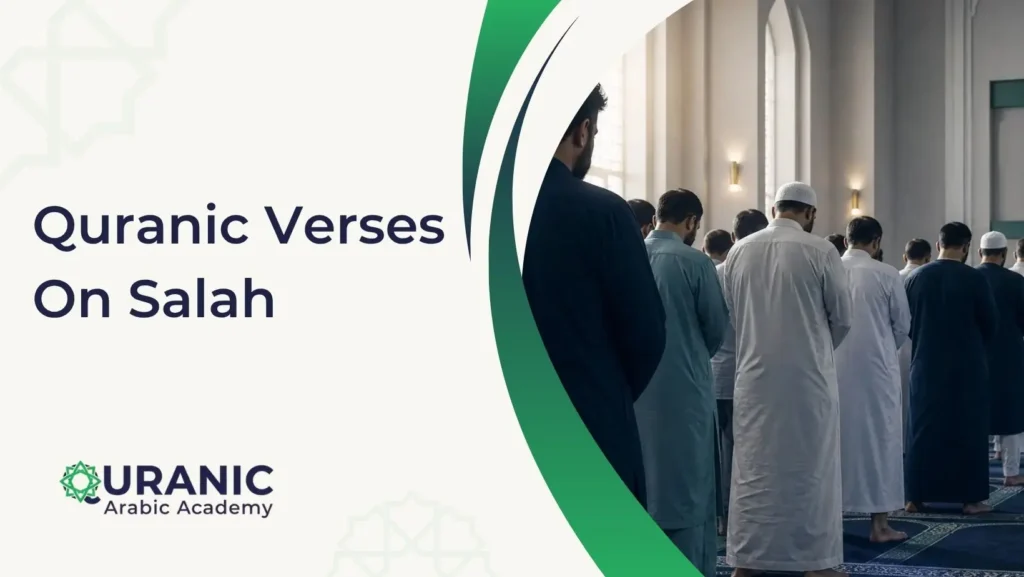
The Quran’s teaching on Salah — the five daily prayers — goes far beyond ritual obligation. Prayer is described as the anchor of the believer’s day, the direct line between the servant and Allah, and the distinguishing mark of a believing community.
إِنَّ الصَّلَاةَ كَانَتْ عَلَى الْمُؤْمِنِينَ كِتَابًا مَّوْقُوتًا
Inna as-salata kanat ‘ala al-mu’mineena kitaban mawqoota
“Indeed, prayer has been decreed upon the believers a decree of specified times.” (An-Nisa 4:103)
The word مَّوْقُوتًا (mawqoota) means “at fixed, specified times” — not merely “regularly.” This precision is characteristic of Quranic Arabic grammar, where a single word carries legislative weight that entire paragraphs of translation cannot fully convey.
Worship in the Quran is broader than prayer alone. It encompasses remembrance (dhikr), fasting (sawm), charity (zakat), and pilgrimage (hajj) — all understood as expressions of Tawheed through action.
At The Quranic Arabic Academy, our Quranic Arabic Grammar Course with certified linguists helps students master this topic through personalized 1-on-1 sessions.
Your First class is free. Join our Quranic Arabic Grammar Course now

6. Equity in All Human Dealings
The Quranic teaching on ‘adl — justice — is one of the most emphatic and repeated commands in the Book. It is not limited to legal contexts. The Quran demands justice in testimony, in commerce, in family matters, and even in dealings with adversaries.
يَا أَيُّهَا الَّذِينَ آمَنُوا كُونُوا قَوَّامِينَ بِالْقِسْطِ شُهَدَاءَ لِلَّهِ
Ya ayyuha alladhina amanu kunu qawwameena bil-qisti shuhadaa’ lillah
“O you who have believed, be persistently standing firm in justice, witnesses for Allah.” (An-Nisa 4:135)
The word قَوَّامِينَ (qawwameen) is not simply “those who stand for justice.” It is an intensive form in Arabic — meaning those who are relentlessly, habitually, structurally committed to justice. This is a linguistic intensity that the English translation can only approximate.
The Quran explicitly states that hatred of a group must not cause you to deviate from justice. This is a moral standard that many communities and individuals still struggle to reach.
7. The Quran Establishes That Every Human Being Is Honoured by Allah
The Quran’s teaching on human dignity is foundational to Islamic ethics and law. Allah honoured the children of Adam as a universal declaration — not restricted to Muslims, not conditional on piety, and not earned through status or lineage.
وَلَقَدْ كَرَّمْنَا بَنِي آدَمَ
Wa laqad karramna Bani Adam
“And We have certainly honored the children of Adam.” (Al-Isra 17:70)
The verb كَرَّمْنَا (karramna) — “We have honoured” — is in the past tense in Arabic, indicating a completed, established divine act. This is not a promise. It is a statement of existing divine reality.
This verse is frequently cited in Islamic bioethics and human rights discussions through platforms such as SeekersGuidance — one of the leading academic Islamic Q&A resources — as foundational to the Islamic position on human dignity.
For students learning Quranic Arabic, understanding the grammatical tense of this verb changes how the verse is understood theologically.
8. Patience and Gratitude
The Quran presents sabr (patience) and shukr (gratitude) as the two essential responses of the believing soul — patience in hardship, and gratitude in ease. Together, they constitute the complete Quranic formula for a spiritually stable life.
إِنَّ فِي ذَٰلِكَ لَآيَاتٍ لِّكُلِّ صَبَّارٍ شَكُورٍ
Inna fi dhalika la-ayatin li-kulli sabbarin shakoor
“Indeed in that are signs for everyone patient and grateful.” (Ibrahim 14:5)
The words صَبَّار (sabbār) and شَكُور (shakūr) are both intensive forms in Arabic — “one who is deeply, consistently patient” and “one who is profoundly, habitually grateful.” This is not patience once. This is patience as a character trait.
At The Quranic Arabic Academy, instructors who teach the most common words in the Quran consistently find that words derived from the roots ص-ب-ر (sabara) and ش-ك-ر (shakara) appear among the highest-frequency vocabulary — a reflection of how central these virtues are to the Quran’s worldview.
Ready to Begin Your Quranic Journey?
Start learning with professional instructors through our structured curriculum.
Book Your Free Trial9. The Quran Teaches That Family and Community Are Sacred Trusts
The Quran devotes extensive instruction to family relationships — marriage, parenting, rights of parents, treatment of relatives, and the structure of a healthy community. These are not peripheral social guidelines. They are core Quranic teachings.
وَاعْبُدُوا اللَّهَ وَلَا تُشْرِكُوا بِهِ شَيْئًا وَبِالْوَالِدَيْنِ إِحْسَانًا
Wa’budu Allaha wa la tushrikoo bihi shay’an wa bil-walidayni ihsana
“Worship Allah and associate nothing with Him, and to parents do good.” (An-Nisa 4:36)
The juxtaposition of Tawheed and parental kindness in the same verse is not accidental. It signals that honouring parents is among the closest obligations to worshipping Allah — in the same breath, in the same verse.
The word إِحْسَانًا (ihsānan) — “excellence, beneficence, doing good” — is the same word used in the famous hadith about worshipping Allah “as if you see Him.” The Quran applies this highest standard of excellence to how we treat the people closest to us.
This teaching extends outward: to relatives, neighbours, orphans, those in need, and the broader Muslim community. The Quran envisions a society knit together by responsibility and care — not individualism.
Read Also: Quranic Games for Kids
10. Complete Guidance for All of Humanity
The Quran is explicit about its own nature and purpose. It is not a book of mythology or cultural heritage. The Quran identifies itself as هُدًى لِّلنَّاسِ — guidance for all of humanity — at a time and in a language chosen by divine wisdom.
إِنَّا أَنزَلْنَاهُ قُرْآنًا عَرَبِيًّا لَّعَلَّكُمْ تَعْقِلُونَ
Inna anzalnahu Qur’anan ‘Arabiyyan la’allakum ta’qiloon
“Indeed, We have sent it down as an Arabic Qur’an that you might understand.” (Yusuf 12:2)
The phrase لَّعَلَّكُمْ تَعْقِلُونَ — “that you might use reason / understand” — contains the Arabic root عَقَلَ (aqala), meaning rational comprehension. The Quran was revealed in Arabic so that its audience could engage with it intellectually, not just emotionally or ritually.
This is precisely why millions of Muslims around the world are now learning Quranic Arabic — because reading the Quran in translation is an approximation of guidance, while reading it in Arabic is guidance itself, as Allah intended. If you want to understand how to read Quranic Arabic and engage with these teachings directly, the path begins with the Arabic language.
Read Also: Quranic Stories for Kids
Our Students Reviews
Begin Engaging with Quranic Teachings in Arabic at The Quranic Arabic Academy
These teachings are powerful in translation. They are transformative in Arabic.
At The Quranic Arabic Academy, our certified instructors with 25+ years of experience teach you to read, understand, and engage with Quranic teachings in the language Allah revealed them — through personalized 1-on-1 sessions, flexible scheduling available 24/7, and a structured curriculum built specifically for non-Arabic speakers.
- Quranic Arabic for Beginners — start from the Arabic alphabet
- Online Quranic Arabic Classes for Adults — structured comprehension at your level
- Quranic Arabic Grammar Course — understand the Quran’s language with precision
- Free Trial Lesson — experience our method at no cost
Your relationship with the Quran deserves more than a translation. Begin with a free trial today.
Your first class is completely free. Start Learning Quranic Arabic courses Today.
Conclusion
The Quran’s teachings are not separate ideas. They are one unified worldview — built on Tawheed, expressed through worship and character, and directed toward accountability before Allah. Each teaching supports and deepens the others.
What makes these teachings enduringly powerful is that they address both the individual soul and the collective society simultaneously. Mercy, justice, dignity, and patience are not personal virtues alone — they are communal obligations.
For any Muslim who wants to engage with these teachings at their source, the Arabic language is the key. And that key is learnable, Insha’Allah, for anyone who is willing to begin.
Ready to Begin Your Quranic Journey?
Start learning with professional instructors through our structured curriculum.
Book Your Free TrialRead Also: Best Quranic Apps
Frequently Asked Questions About Quranic Teachings
What Are the Main Teachings of the Quran?
The main teachings of the Quran include Tawheed (the oneness of Allah), prophethood, the Day of Judgment, divine mercy, prayer and worship, justice, human dignity, patience and gratitude, family responsibility, and the Quran’s own role as complete guidance for humanity. These teachings are interconnected and form a unified moral and spiritual framework.
Why Is It Important to Learn Quranic Teachings in Arabic?
Learning Quranic teachings in Arabic allows Muslims to access the precise vocabulary, grammatical structure, and linguistic depth that translations cannot fully convey. Words like قَوَّامِينَ, إِحْسَان, and صَبَّار carry intensive meanings in Arabic that fundamentally shape how each teaching is understood. Our Quranic Arabic courses for adults are designed specifically to bridge this gap.
How Do Quranic Teachings Apply to Daily Life?
Quranic teachings apply directly to daily life through prayer, honest dealings, treatment of family, patience in hardship, and gratitude in ease. The Quran does not separate spiritual practice from social conduct — every teaching has a practical dimension designed to shape character and community simultaneously.
Can a Non-Arabic Speaker Fully Understand Quranic Teachings?
A non-Arabic speaker can understand the general message of Quranic teachings through translation, but will miss significant layers of meaning embedded in the Arabic vocabulary and grammar. Learning even foundational Quranic Arabic significantly deepens comprehension. Explore how to learn Quranic Arabic as a practical first step toward engaging these teachings directly.
How Many Times Does the Quran Repeat Its Core Teachings?
The Quran repeats its core teachings — particularly Tawheed, accountability, mercy, and prayer — across hundreds of verses in different chapters. This repetition is a deliberate pedagogical method. Each context adds a new dimension to the teaching rather than simply restating the same point.


Leave a Reply