 Quranic Grammar

Most Quranic Arabic learners hit a wall where they recognize words but cannot connect them. The sentence makes no sense because words linking nouns, verbs, and objects are not standard lookup vocabulary—they are Quranic Arabic prepositions operating invisibly throughout every ayah.
When a learner understands the noun and verb, the verse still remains structurally broken if they do not grasp the preposition doing all the relational work between them. This guide directly addresses what Quranic Arabic prepositions are, how they are classified, the full list of Arabic prepositions, and how each major preposition functions with Quranic examples.
Quranic Arabic Prepositions Build the Skeleton of Every Verse
Quranic Arabic prepositions (حروف الجر) connect two nouns or a verb and noun, placing the following noun in the genitive case (جر)—their defining grammatical feature.
For singular nouns, the ending is kasra or tanween kasra, depending on whether the noun is definite or indefinite. Classical Arabic divides words into nouns (أسماء), verbs (أفعال), and particles (حروف), with prepositions belonging to the particles category and requiring a following noun to convey meaning.
A preposition always precedes its governed noun, so Arabic sentences cannot end with a preposition. The genitive case marker changes according to the type of noun, as shown in the table below:
| Noun Type | Genitive Marker | Example |
| Singular / Broken Plural / Sound Feminine Plural | Kasra ( ِ ) | فِي الْبَيْتِ (in the house) |
| Dual / Sound Masculine Plural / Five Unique Nouns | Yaa (يْنِ or يْنَ) | إِلَى الْمَسْجِدَيْنِ (to the two mosques) |
| Diptote Nouns (certain proper names and patterns) | Fatha ( َ ) | سَافَرْتُ إِلَى مِصْرَ (I traveled to Egypt) |
Enrolling in Quranic Arabic for Beginners at The Quranic Arabic Academy gives learners a structured foundation in identifying these genitive markers from the first session, so they can recognize when a preposition is operating in any verse without guessing.
[Register for Quranic Arabic for Beginners at The Quranic Arabic Academy]
The Full Quranic Arabic Prepositions List Reaches Twenty-One Items
Ibn Malik documented the Arabic prepositions in his Alfiya through a set of famous verses that generations of students have memorized:
هاك حروف الجرّ وهي من إلى … حتى خلا حاشا عدا في عن على مذ منذ ربّ اللام كي واو ّ وتا … والكاف والبا ولعلّ ومتى
These verses enumerate the list of Arabic prepositions as follows: مِن، إِلَى، حَتَّى، خَلَا، حَاشَا، عَدَا، فِي، عَنْ، عَلَى، مُذْ، مُنْذُ، رُبَّ، اللَّام، كَيْ، الْوَاو، التَّاء، الْكَاف، الْبَاء، لَعَلَّ، مَتَى.
This totals twenty prepositions, with لَوْلَا sometimes added as a rare twenty-first. Some scholars, excluding the archaic items rarely used in modern recitation, count the active list at seventeen, which is where the question “what are the 17 prepositions in Arabic?” originates.
Detached Prepositions Stand Alone from the Following Noun
The category of detached prepositions includes particles written as separate words from the noun that follows them. These are the items a learner encounters most frequently in the Quran:
| Preposition | Transliteration | Core Meaning |
| مِن | min | from, of |
| إِلَى | ila | to, toward |
| عَنْ | an | about, away from |
| عَلَى | ala | on, upon, over |
| فِي | fi | in, inside, at |
| حَتَّى | hatta | until, even |
| مُنْذُ / مُذْ | mundhu / muth | since |
| عَدَا | ada | except |
Attached Prepositions Fuse Directly onto the Following Noun
Three prepositions in the quranic Arabic prepositions list consist of a single letter and attach directly to the noun that follows. They are never written separately:
| Preposition | Transliteration | Core Meaning |
| بِ | bi | with, by, through |
| كَ | ka | like, as |
| لِ | li | for, to, belonging to |
Three Prepositions Serve as Oath Particles
The letters وَ، بَ، and تَ function as prepositions specifically in oath constructions. They attach to the name of Allah or other sacred nouns in swearing expressions. For example: وَاللَّهِ (By Allah), بِاللَّهِ (By Allah), تَاللَّهِ (By Allah). These three appear throughout the Quran and across classical Arabic speech.
See It in Action:
Wondering what our interactive sessions look like? Click below to peek inside a live session and watch how our expert instructors make learning Quranic Arabic accessible and engaging.
Ready to Begin Your Quranic Journey?
Start learning with professional instructors through our structured curriculum.
Book Your Free TrialQuranic Arabic Prepositions in English Require Context, Not Fixed Translations
The most damaging assumption a learner can bring to quranic Arabic prepositions in English translation is that each Arabic preposition equals one fixed English word. This assumption produces consistent misreadings because every major Quranic Arabic preposition carries multiple meanings that shift based on what surrounds it.
The Preposition فِي Carries at Least Three Distinct Functions
فِي (fi) is the most frequently encountered Quranic Arabic preposition. Its primary meaning is “in” or “inside,” but its application in the Quran extends across several functions. Consider these examples directly from Quranic text:
- فِي قُلُوبِهِمْ مَرَضٌ (Surah Al-Baqarah 2:10): “In their hearts is disease.” Here فِي marks location inside something.
- فِي الصَّبَاحِ: “In the morning.” Here فِي marks a time period.
- دَخَلَتِ امْرَأَةٌ النَّارَ فِي هِرَّةٍ: “A woman entered the Fire because of a cat.” Here فِي carries a causal meaning entirely distinct from location.
A learner who reads فِي as always meaning “in” will misread the third example entirely. The context determines which meaning is active.
The Preposition مِن Functions Across Five Semantic Categories
مِن (min) is among the most versatile items in the quranic Arabic prepositions list. Its meanings in the Quran include:
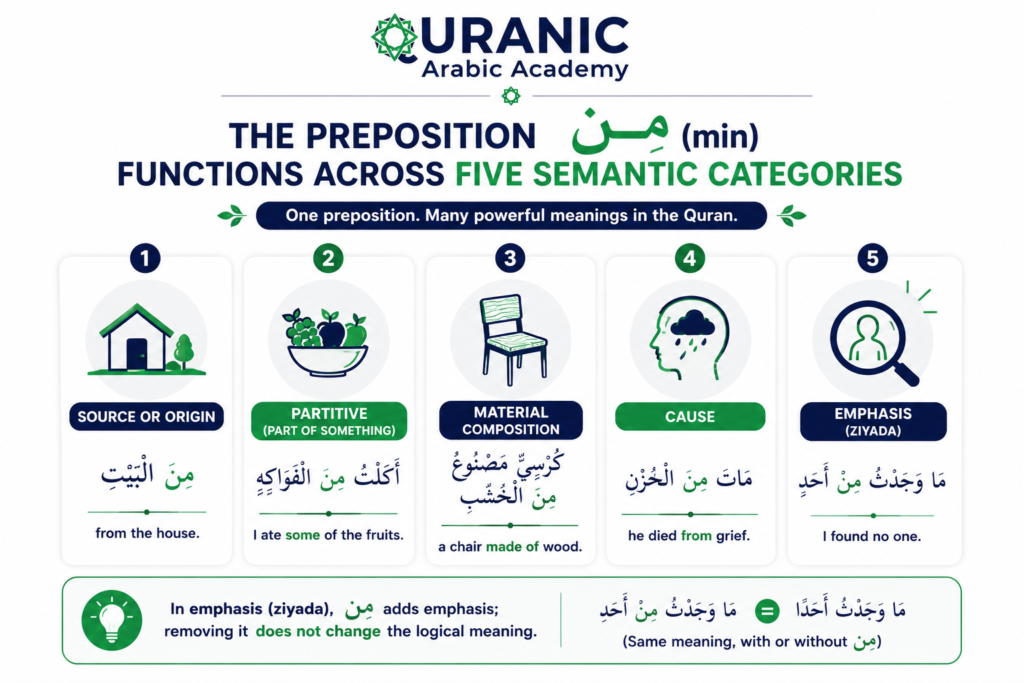
- Source or origin: مِن الْبَيْتِ — from the house.
- Partitive (part of something): أَكَلْتُ مِنَ الْفَوَاكِهِ — I ate some of the fruits.
- Material composition: كُرْسِيٌّ مَصْنُوعٌ مِنَ الْخَشَبِ — a chair made of wood.
- Cause: مَاتَ مِنَ الْحُزْنِ — he died from grief.
- Emphasis (ziyada): مَا وَجَدْتُ مِنْ أَحَدٍ — I found no one. Here مِن adds emphasis; removing it does not change the logical meaning.
Translators Who Manipulate Prepositions Distort Quranic Meaning
One of the most documented problems in Quranic translation is the manipulation of preposition meanings to fit theological assumptions.
When a translator changes فِي to عَلَى without grammatical justification, or renders إِلَى as بَيْنَ to produce a different relational meaning, the resulting translation no longer reflects what the Arabic text says. Preposition meanings in Arabic are stable.
They do not evolve to accommodate interpretive preferences. What changes is which of a preposition’s established meanings applies in a given context, and that is determined by the surrounding words, not by the translator’s prior convictions.
The Best Quranic Arabic Classes at The Quranic Arabic Academy train learners to identify which meaning of each preposition is active in a given verse, working through actual Quranic examples rather than abstract grammar rules. This approach prevents the interpretive errors that arise from treating prepositions as interchangeable.
[Register for The Best Quranic Arabic Classes at The Quranic Arabic Academy]
Quranic Arabic Prepositions with Meaning Shift Based on Three Variables
Understanding quranic Arabic prepositions with meaning requires knowing the three variables that determine which meaning is active in any verse.
1- The Verb or Noun That Precedes the Preposition
Certain Arabic verbs govern specific prepositions that carry specific meanings in combination. These verb-preposition pairs function as fixed expressions. Using the wrong preposition with a given verb is not merely imprecise; it is grammatically incorrect.
| Verb | Required Preposition | Meaning |
| فَكَّرَ (to think) | فِي | thought about something |
| سَأَلَ (to ask) | عَنْ | asked about someone |
| ذَهَبَ (to go) | إِلَى | went toward somewhere |
| خَرَجَ (to go out) | مِن | went out from somewhere |
| تَكَلَّمَ (to speak) | بِ | spoke in/with something |
2- Whether the Meaning Is Literal or Metaphorical
Every major Quranic Arabic preposition can operate either literally (referring to a physical relationship) or metaphorically (referring to an abstract relationship).
عَلَى (ala) in لَكَ فَضْلٌ عَلَيْنَا (“you have favor over us”) does not mean anyone is physically standing on top of anyone else. It expresses a relational superiority that is entirely conceptual.
3- The Type of Noun That Follows
Locative adverbs (ظَرْف الْمَكَان and ظَرْف الْزَّمَان) such as مَعَ (with), عِنْدَ (at), and بَيْنَ (between) also require a following noun in the genitive case. This makes them resemble prepositions, and they are sometimes called semi-prepositions.
The critical difference is grammatical: adverbs are classified as nouns (derived from trilateral roots), while Quranic Arabic prepositions are classified as particles. The noun that follows an adverb enters what is called an idafa construction, not a preposition-governed genitive.
The Preposition عَلَى Operates Across Twelve Distinct Functions
عَلَى (ala) is among the Quranic Arabic prepositions with the widest range of documented meanings. Its foundational meaning is physical elevation or surface contact, but its Quranic usage extends well beyond that.
Physical Elevation and Surface Position
In its primary sense, عَلَى places something on or above something else.
الْكِتَابُ عَلَى الطَّاوِلَةِ means “the book is on the table.” Note that “on” here does not require the book to be sitting on the absolute top of the table; عَلَى can describe surface contact from any angle, including side surfaces. A painter working عَلَى الْجِدَار is working on the wall’s face, not on top of the wall.
Obligation and Duty
عَلَى shifts from spatial to moral-legal meaning when it follows constructions indicating obligation.
عَلَيْهِ دَيْنٌ means “he has a debt due from him” — not that anything is physically on him, but that the obligation rests upon him in a moral sense. This usage appears throughout Quranic legal passages.
Adversarial Meaning
عَلَى can carry an adversarial force in specific constructions.
خَرَجَ عَلَيْهِ means “he went out against him.” This meaning is active when the context involves conflict, challenge, or opposition. A learner reading عَلَى in such passages as a simple “on” will completely misread the verse.
The Four Main Meanings of عَلَى Compared
| Meaning Category | Arabic Example | English Equivalent |
| Physical surface | الْكِتَابُ عَلَى الطَّاوِلَةِ | The book is on the table |
| Obligation/duty | عَلَيْهِ دَيْنٌ | He owes a debt |
| Adversarial | خَرَجَ عَلَيْهِ | He went out against him |
| Standard/basis | عَلَى هَذِهِ الطَّرِيقَةِ | According to this method |
Three Classification Systems Govern Quranic Arabic Prepositions
Classical Arabic grammar classifies Quranic Arabic prepositions through three overlapping systems, each serving a different analytical purpose.
Classification One: Detached vs. Attached
This system divides prepositions based on whether they stand alone as separate words or fuse onto the following noun as single letters. The three attached prepositions (بِ، كَ، لِ) can never be written separately. All other prepositions in the list of Arabic prepositions stand independently.
Classification Two: By Frequency and Restriction
Ibn Malik’s Alfiya distinguishes between prepositions that can precede both explicit nouns and pronouns, and those restricted to explicit nouns only.
مُنْذُ، مُذْ، حَتَّى، الْكَاف، الْوَاو، رُبَّ، and التَّاء are restricted to explicit nouns and cannot govern pronouns directly.
Classification Three: True, Redundant, and Quasi-Redundant
This is the most nuanced classification system:
| Category | Arabic Term | Definition | Example |
| True prepositions | حُرُوفُ الْجَرِّ الْأَصْلِيَّة | Add genuine meaning; cannot be removed without changing the sentence | فِي، مِن، إِلَى |
| Redundant prepositions | حُرُوفُ الْجَرِّ الزَّائِدَة | Added for emphasis only; removing them does not change the core meaning | مِن in مَا وَجَدْتُ مِنْ أَحَدٍ |
| Quasi-redundant prepositions | حُرُوفُ الْجَرِّ شِبْهُ الزَّائِدَة | Add limited meaning such as approximation | رُبَّ |
Arabic Courses for Understanding the Quran at The Quranic Arabic Academy cover all three classification systems through direct application to Quranic text, so learners build a working grammar system rather than memorizing abstract categories in isolation.
Read Also: Which Dialect Is Closest to Quranic Arabic?
[Register for Arabic Courses for Understanding the Quran at The Quranic Arabic Academy]
Common Errors in Quranic Arabic Prepositions Require Structured Correction
Every non-Arab learner encounters a predictable set of errors when working with quranic Arabic prepositions. These errors arise from the same sources and require the same type of correction.
1- Translating Prepositions Literally from English
English and Arabic prepositions do not correspond on a one-to-one basis. Arabic time expressions nearly always use فِي regardless of the specificity of the time reference. English shifts between “at” (at 5 PM), “on” (on Monday), and “in” (in June) based on precision. A learner who applies English preposition logic to Arabic will misidentify the meaning of فِي in time contexts consistently.
2- Ignoring the Genitive Case Marker
The noun following a Quranic Arabic preposition must carry a genitive marker. Learners who ignore vowel endings entirely will fail to identify when a noun is governed by a preposition versus when it is in a nominative or accusative role. The case ending is the grammatical signal, and missing it means missing the sentence structure.
Read Also: Quranic Exegesis (Tafsir)
3- Confusing فِي with عَلَى
This is the most common error among beginners working through quranic Arabic prepositions with meaning. The distinction is consistent: فِي describes containment or enclosure (the book is in the bag), while عَلَى describes surface contact or elevation (the book is on the table). The same object in two different positions requires two different prepositions, and learners who blur the distinction produce structurally incorrect readings of Quranic verses where spatial relationships carry theological weight.
4- Applying One Meaning Across All Contexts
The preposition بِ (bi) can mean “with,” “by,” “through,” “in,” or indicate an oath depending on context. A learner who locks in “with” as the fixed translation of بِ will produce a nonsensical reading every time بِ carries a different function. Quranic Arabic prepositions require contextual reading, not fixed substitution.
Read Also: Quranic Education
The Most Frequently Encountered Quranic Arabic Prepositions Compared
The table below summarizes the eight prepositions that appear most frequently across the Quran, based on the quranic Arabic prepositions list:
| Preposition | Transliteration | Primary Meaning | Secondary Meanings | Type |
| فِي | fi | in, inside | at (time), because of | Detached |
| مِن | min | from, of | partitive, causal, emphasis | Detached |
| إِلَى | ila | to, toward | until, with, more than | Detached |
| عَلَى | ala | on, upon | obligation, against, according to | Detached |
| عَنْ | an | about, from | away from, on behalf of | Detached |
| بِ | bi | with, by | through, in, oath particle | Attached |
| لِ | li | for, to | ownership, cause, dedication | Attached |
| كَ | ka | like, as | similarity, comparison | Attached |
Read Also: Quranic Ethics – What the Quran Teaches About Akhlaq and Behaviour?
Experience Our Teaching Style:
We believe in clarity and engagement. Watch these short highlights from our actual classes to see our teachers’ methodology and student interactions in real-time.
Ready to Begin Your Quranic Journey?
Start learning with professional instructors through our structured curriculum.
Book Your Free TrialStart Building Quranic Arabic Comprehension at The Quranic Arabic Academy
Most learners who struggle with Quranic Arabic prepositions are not failing because of weak memory or insufficient effort. They are failing because they are studying grammar rules in isolation, without a qualified teacher applying those rules to actual Quranic text in real time.
The Quranic Arabic Academy provides the complete framework for moving from grammatical confusion to genuine Quranic comprehension:
- Certified Arab tutors holding Ijazah in recitation or degrees in Islamic studies from recognized institutions.
- One-on-one live sessions tailored specifically to each student’s individual mistakes in preposition identification and case analysis.
- Real-time Makharij correction using audio-visual feedback during every session.
- Tafseer-integrated learning with Nahw and Sarf taught through actual ayah analysis, not textbook examples.
- Flexible scheduling covering all global time zones including EST, PST, GMT, CET, IST, GST, and MYT.
- Monthly progress reports and written feedback provided after every session.
- Affordable pricing with transparent packages and family enrollment discounts.
- Serving students across North America, Europe, Asia, and the Middle East.
Our Arabic Courses
- Quranic Arabic Classes
- Quranic Arabic Course for Beginners
- Online Quranic Arabic Courses for Advanced Learners
- Quranic Arabic Grammar Course
- Arabic Courses for Understanding the Quran
- Quranic Arabic Course for Sisters (Female)
- Quranic Arabic Course for Kids
- Online Quranic Arabic Classes for Adults
- Quranic Arabic Course UK
- Quranic Arabic Course London
- Quranic Arabic Course USA
- Quranic Arabic Course Canada
- Quranic Arabic Course Australia
- Quranic Arabic Course UAE
- Quranic Arabic Course Germany
Register for Online Quranic Arabic Classes at The Quranic Arabic Academy
Ready to Begin Your Quranic Journey?
Start learning with professional instructors through our structured curriculum.
Book Your Free TrialConclusion
Quranic Arabic prepositions are the relational skeleton of every verse, defining relationships between verbs, nouns, objects, time, and place. Without understanding them, a learner misses the Quran’s structure and meaning.
Classical Arabic has 21 prepositions, with 8 used most frequently in the Quran. Their meanings vary by context, verb pairing, and literal or metaphorical usage, making structured Quranic study with a qualified teacher essential rather than simple memorization.
Frequently Asked Questions
What Are Quranic Arabic Prepositions and How Do They Function?
Quranic Arabic prepositions connect nouns or pronouns to a sentence and place the following noun in the genitive case, showing relationships like place, time, direction, and cause.
What Are the 17 Prepositions in Arabic According to Classical Grammar?
The seventeen commonly used prepositions are: مِن، إِلَى، عَنْ، عَلَى، فِي، حَتَّى، مُنْذُ، مُذْ، رُبَّ، لِ، وَ، تَ، كَ، بِ، عَدَا، حَاشَا، خَلَا.
How Do Quranic Arabic Prepositions in English Translation Cause Errors?
Errors occur when one Arabic preposition is translated as one fixed English word. Its meaning changes with context and grammar.
How Can a Learner Master Quranic Arabic Prepositions with Meaning?
Learn each preposition’s meanings, study them in Quranic context, and practice regularly with a qualified teacher for accurate understanding.
What Is the Difference Between Attached and Detached Arabic Prepositions?
Detached prepositions are separate words like فِي and مِن. Attached prepositions are single letters like بِ، كَ، and لِ joined directly to the following noun.






Leave a Reply