 Learn Quranic Arabic
Many non-Arab Muslims recite the Quran daily without understanding what they are reading. Translations provide a basic entry point, but they cannot capture the linguistic precision, rhetorical depth, or historical context of the original Arabic text. Relying on translation alone leads to incomplete or inaccurate understanding.
Quranic exegesis exists precisely to solve this problem. It is the science that preserves the intended meanings of the Quran across generations, connecting every verse to its authentic interpretation through language, transmission, and scholarly methodology.
1- Quranic Exegesis Means Uncovering the Intended Meaning of Allah’s Words
The word tafsir comes from the Arabic root f-s-r, meaning to uncover or reveal. In Islamic scholarship, quranic exegesis is the scientific explanation of Allah’s speech, encompassing its language, grammar, historical context, and prophetic transmission.
It differs from translation, which only conveys basic words without Arabic’s rhetorical depth, and tawil, which explores deeper meanings beyond the apparent sense. Tafsir stands above both because it relies on authenticated transmission, linguistic analysis, and a verified methodology that prevents personal opinion, while simultaneously addressing levels of meaning like the dhahir—the clear foundation of all interpretation.
The batin refers to deeper reflections that scholars may explore only without contradicting the apparent meaning. Authentic quranic interpretation gives absolute priority to the dhahir and approaches the batin with verified knowledge and scholarly caution.
Many non-Arab learners want to study quranic exegesis but find classical tafsir works inaccessible without a foundation in Arabic. The Quranic Arabic for Beginners course builds that foundation directly, starting from the language of the Quran itself.
2- Quranic Interpretation Has Five Established Methods Ranked by Authority
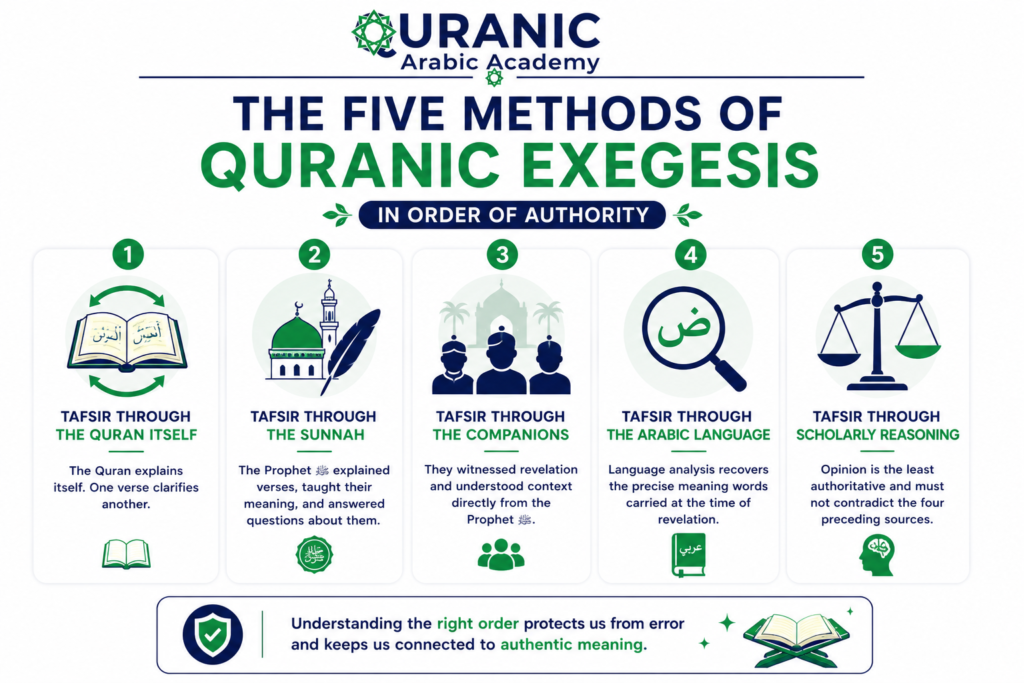
Quranic interpretation does not follow personal opinion or random selection of sources. Scholars established a ranked methodology that every exegete must follow, beginning with the most authoritative source and moving to the next only when the previous source does not provide a sufficient explanation.
The five methods of quranic exegesis in order of authority are:
Tafsir through the Quran itself
The most authoritative and revered method, known as Tafsir bil-Mathur, involves explaining one verse by referencing other verses. Many meanings that appear unclear in one place are clarified in another, making the Quran its own primary interpreter.
Tafsir through the Sunnah
The Prophet explained verses directly to his Companions, demonstrated their meanings through his actions, and answered questions about unclear passages. His explanations form the foundation of all authentic quranic interpretation after the Quran itself.
Tafsir through the sayings of the Companions
The Companions lived with the Prophet, witnessed the circumstances of revelation, and received direct instruction from him. Their interpretations carry authority because they drew on firsthand knowledge of the context in which verses were revealed.
Tafsir through the Arabic language
After the death of the Prophet, the Arabic language began incorporating foreign terms and losing some original meanings. Linguistic analysis became essential to recover the precise meanings that words carried at the time of revelation.
Tafsir through scholarly reasoning
Opinion-based interpretation is the least authoritative method and must not contradict the four preceding sources. The Prophet warned that anyone who interprets the Quran by opinion alone has erred, even if the conclusion happens to be correct.
Read also: Quranic Education: How to Get the Best Quranic Education
3- Thirteen Disciplines Qualify a Scholar to Interpret the Quran
Quranic exegesis is not a discipline that any person can practice without preparation. Scholars established that a qualified exegete must master thirteen sciences before interpreting the Quran with independent judgment.
These disciplines protect the Quran from distortion and prevent scholars from making claims about Allah without knowledge. The thirteen sciences required for quranic exegesis are:
- Lexicology: Explains the established meanings of words, since a single word may carry multiple meanings and only one may be intended by the text.
- Grammar: Meanings in Arabic change according to grammatical structure, making grammatical mastery essential for accurate interpretation.
- Morphology: Provides knowledge of the structure and forms of words, since the form of a word directly affects its meaning.
- Etymology: A word may derive from two different roots with different meanings, and identifying the correct root determines the correct interpretation.
- The rhetorical sciences: Three sub-disciplines covering the order and structure of speech, the factors that affect clarity and obscurity, and the techniques of eloquence.
- The science of recitation: Knowledge of how to pronounce and recite the Quranic text, including the ability to compare various readings and distinguish between widely transmitted and rejected readings.
- Principles of theology: Knowledge of what is necessary, possible, and impossible with regard to Allah, protecting the exegete from error when interpreting verses related to divine attributes.
- Legal interpretation: Knowledge of how rulings are derived and proven from the Quranic text.
- Reasons of revelation: Understanding the historical circumstances and specific events that prompted the revelation of particular verses.
- Knowledge of abrogation: Identifying which verses establish currently binding rulings and which were superseded, preventing the application of abrogated legal judgments.
- Knowledge of hadiths that elucidate unclear verses: Ability to distinguish between strong and weak or fabricated hadiths when using prophetic narrations to clarify Quranic passages.
- History: Detailed knowledge of historical narrations that clarify what the Quran mentions in general terms, and the ability to distinguish valid historical information from interpolations.
- Insight: The God-given understanding that comes to those who act on what they know, described in the Quran as the knowledge that Allah grants to those who are mindful of Him.
Accessing classical tafsir works that demonstrate these disciplines in practice requires reading Arabic at a level beyond basic recognition. The Online Quranic Arabic Classes for Adults develop the reading comprehension and grammatical understanding that serious students of quranic exegesis need.
Begin Learning with Qualified Instructors.
4- Quranic Exegesis Began with the Prophet and Developed Across Generations
Quranic exegesis began in the era of the Prophet ﷺ, who clarified unclear verses directly—such as explaining that “error” meant polytheism, demonstrating how the Quran explains itself.
Early tafsir was not documented independently; prophetic explanations and the Companions’ understandings were transmitted orally through generations. Regional centers preserved specific traditions, such as Makkah preserving Ibn Abbas’s tafsir and Kufa preserving Ibn Masud’s narrations.
Systematic written documentation began during the late Umayyad and early Abbasid periods with scholars like al-Tabari compiling verse-by-verse explanations, establishing a foundation that subsequent generations built upon.
See It in Action:
Wondering what our interactive sessions look like? Click below to peek inside a live session and watch how our expert instructors make learning Quranic Arabic accessible and engaging.
Ready to Begin Your Quranic Journey?
Start learning with professional instructors through our structured curriculum.
Book Your Free Trial5- The Companions Drew on Five Sources in Their Independent Interpretation
When the Companions interpreted the Quran independently, without direct recourse to a prophetic narration, they drew on five specific sources that qualified them to do so. Understanding these sources explains why their interpretations carry authority that later generations cannot replicate.
The five sources the Companions used in quranic interpretation are:
- Knowledge of the Arabic language: Their native mastery of Arabic allowed them to understand verses expressed in classical Arabic without needing external linguistic analysis.
- Knowledge of the circumstances of revelation: The Companions witnessed the events that prompted specific verses, giving them direct contextual knowledge that later generations can only access through transmitted reports.
- Knowledge of the conditions of the Jews and Christians in Arabia: Many Quranic verses address the People of the Book, and the Companions had direct knowledge of their beliefs and practices at the time of revelation.
- Knowledge of Arab customs: The Quran references Arab customs and social practices that the Companions understood from lived experience rather than historical study.
- Capacity for understanding and insight: This is a God-given quality that the Prophet specifically invoked for figures like Ibn Abbas, praying that Allah would grant him deep understanding of the religion and teach him interpretation.
Read also : A Beginner’s Guide to Quranic Tafsir and Exegesis
6- Six Classical Works Define the Canon of Quranic Exegesis
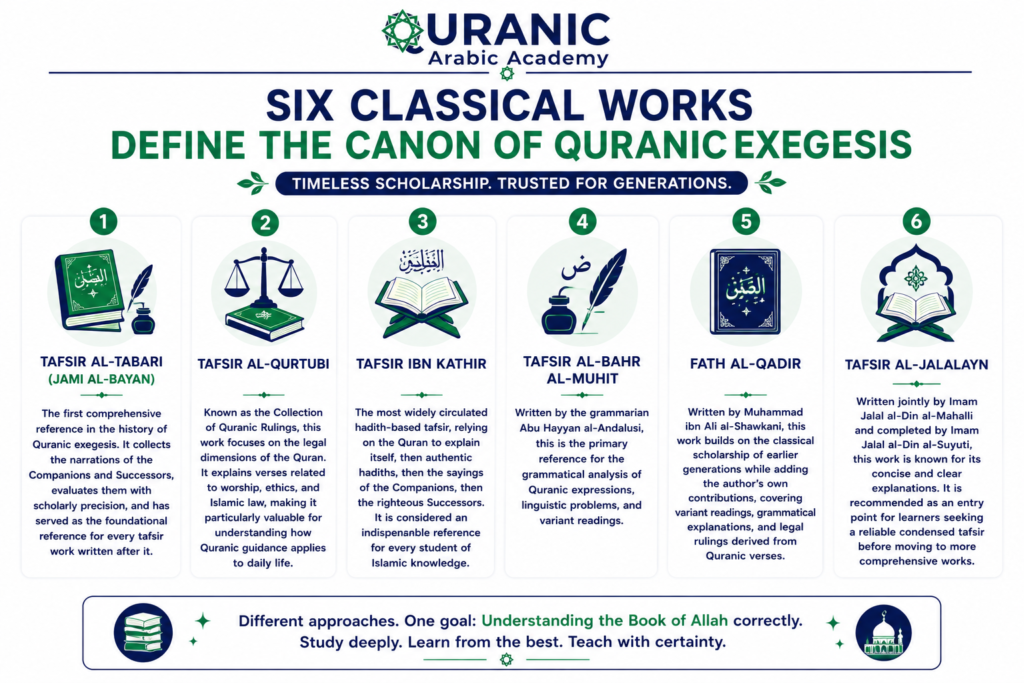
Every serious student of quranic interpretation must know the foundational classical works that scholars have relied upon for centuries. These six works represent different methodological approaches and collectively cover the full range of quranic exegesis:
Tafsir al-Tabari (Jami al-Bayan)
Written by Muhammad ibn Jarir al-Tabari, this is the first comprehensive reference in the history of quranic exegesis. It collects the narrations of the Companions and Successors, evaluates them with scholarly precision, and has served as the foundational reference for every tafsir work written after it.
Tafsir al-Qurtubi
Known as the Collection of Quranic Rulings, this work focuses on the legal dimensions of the Quran. It explains verses related to worship, ethics, and Islamic law, making it particularly valuable for understanding how Quranic guidance applies to daily life.
Tafsir Ibn Kathir
The most widely circulated hadith-based tafsir, relying on the Quran to explain itself, then authentic hadiths, then the sayings of the Companions, then the righteous Successors. It is considered an indispensable reference for every student of Islamic knowledge.
Tafsir al-Bahr al-Muhit
Written by the grammarian Abu Hayyan al-Andalusi, this is the primary reference for the grammatical analysis of Quranic expressions, linguistic problems, and variant readings.
Fath al-Qadir
Written by Muhammad ibn Ali al-Shawkani, this work builds on the classical scholarship of earlier generations while adding the author’s own contributions, covering variant readings, grammatical explanations, and legal rulings derived from Quranic verses.
Tafsir al-Jalalayn
Written jointly by Imam Jalal al-Din al-Mahalli and completed by Imam Jalal al-Din al-Suyuti, this work is known for its concise and clear explanations. It is recommended as an entry point for learners seeking a reliable condensed tafsir before moving to more comprehensive works.
Understanding these works directly in Arabic gives students access to the full depth of quranic exegesis that no translation can replicate. The Arabic Courses for Understanding the Quran develop the comprehension skills needed to engage with classical scholarship in its original language.
Try a Free Class with Certified Arab Tutors.
Read Also: Quranic Epistemology – Islam’s Complete Theory of Knowledge
7- Tafsir Ibn Kathir Is the Most Widely Recognized Sunni Exegesis
Imam Ismail ibn Umar ibn Kathir was born in Damascus in 1301 CE and dedicated his scholarly career to the preservation of authentic knowledge of the Quran and Sunnah. He specialized in tafsir, hadith, history, and Islamic jurisprudence, and his tafsir remains the most widely circulated hadith-based exegesis in the world today.
Ibn Kathir followed the creed of Ahl al-Sunnah wal-Jamaah and applied a rigorous methodology that prioritized hadith-based explanations over personal reasoning. His tafsir relies on four sources in order:
- The Quran explaining itself through cross-referencing related verses.
- Authentic hadiths that directly address the meaning of specific verses.
- The opinions of the Companions, who received their understanding directly from the Prophet.
- The narrations of the righteous Successors, who learned from the Companions.
This methodology ensures that interpretations in Tafsir Ibn Kathir remain aligned with Sunni principles of aqeedah and jurisprudence. While respected across the Muslim world for its accuracy and accessibility, it is firmly grounded in the Sunni scholarly tradition and reflects the understanding of the early generations of Islam.
Many learners who want to study Tafsir Ibn Kathir seriously find that reading it in Arabic is significantly richer than any translated version. The Online Quranic Arabic Courses for Advanced Learners are designed for students who want to move from basic comprehension to reading classical scholarship directly.
Start Learning and Access Classical Tafsir Directly.
Read Also: Which Dialect Is Closest to Quranic Arabic?
8- Thematic Tafsir Applies Timeless Quranic Principles to Modern Questions
Classical quranic exegesis follows the order of the Mushaf, explaining verses sequentially from the opening of the Quran to its close. Thematic tafsir takes a different approach, organizing verses around specific topics such as morality, social justice, family life, or legal rulings, and bringing together all related verses regardless of where they appear in the Quran.
This method has particular value for modern learners because it allows the Quran’s guidance on a specific question to be studied comprehensively rather than in isolated pieces.
A student studying Quranic ethics, for example, can gather every verse related to honesty, justice, or treatment of parents into a single thematic study rather than encountering them scattered across different chapters.
Modern scholars have used thematic tafsir to address contemporary challenges including ethical dilemmas, questions of social justice, and issues related to family and community life.
One of the most significant modern works using a reflective approach is Fi Zilal al-Quran, In the Shade of the Quran, which combines spiritual reflection, linguistic insight, and contextual commentary while remaining faithful to classical methodology.
Read Also: Quranic Arabic Prepositions
9- Online Tafsir Learning Requires Authentic Scholar-Led Platforms
The growth of digital access has made quranic exegesis more accessible than at any point in Islamic history. Students in North America, Europe, Asia, and the Middle East can now access classical tafsir explanations in multiple languages, study at their own pace, and revisit lessons as many times as needed. This flexibility makes it possible to integrate tafsir study into daily life in a way that was not feasible for previous generations of non-Arab learners.
The primary risk of online tafsir learning is the abundance of unverified content. Social media posts, unknown websites, and self-taught interpretations present serious dangers because a single misunderstood verse can lead to confusion or misapplication in worship and daily conduct. The discipline of quranic interpretation was developed precisely to protect believers from this kind of error.
Effective online tafsir study requires three non-negotiable conditions: a qualified scholar or teacher who corrects misunderstandings in real time, authentic sources grounded in classical scholarship and the Sunnah of the Prophet, and a structured curriculum that builds knowledge gradually rather than presenting isolated interpretations without context.
Read Also: Quranic Education
10- Learning Quranic Exegesis the Right Way Requires Structure and Guidance
Studying quranic exegesis is not a process that can be rushed or self-directed without risk. The discipline was built over fourteen centuries precisely because interpreting the Quran without proper tools leads to error. The Prophet explicitly warned that interpreting the Quran through personal opinion alone is a mistake even when the conclusion reached happens to be correct.
The right approach to learning quranic interpretation follows a clear progression:
- Begin with a concise tafsir such as Tafsir al-Jalalayn to build familiarity with the structure and language of classical exegesis.
- Study the reasons of revelation alongside the tafsir text to understand the historical context of each passage.
- Build Arabic language and grammar skills progressively, since the depth of quranic exegesis accessible to a student is directly proportional to their Arabic comprehension.
- Move to comprehensive classical works such as Tafsir Ibn Kathir and Tafsir al-Tabari only after the foundational disciplines are in place.
- Always study under qualified scholars who can correct misunderstandings before they become embedded assumptions.
The most important single factor in successful tafsir study is humility. Recognizing the limits of personal understanding and remaining anchored to qualified scholarship and authentic sources is what separates genuine engagement with quranic exegesis from mere personal opinion dressed in religious language.
Read Also: Quranic Ethics – What the Quran Teaches About Akhlaq and Behaviour?
Experience Our Teaching Style:
We believe in clarity and engagement. Watch these short highlights from our actual classes to see our teachers’ methodology and student interactions in real-time.
Ready to Begin Your Quranic Journey?
Start learning with professional instructors through our structured curriculum.
Book Your Free TrialStart Your Journey into Quranic Exegesis with Qualified Arab Tutors
Most non-Arab Muslims who want to study quranic exegesis seriously find that their Arabic comprehension is the primary limitation. Classical tafsir works contain grammatical analysis, rhetorical explanation, and linguistic argument that only become accessible with a real foundation in Quranic Arabic.
The Best Quranic Arabic Classes at The Quranic Arabic Academy are taught one-on-one by certified Arab tutors holding Ijazah credentials, with structured progression from foundational Arabic through to the level required for reading classical scholarship directly.
Sessions are scheduled flexibly across all global time zones, with real-time Makharij correction, monthly progress reports, and family enrollment discounts.
Our Arabic Courses
- Quranic Arabic Classes
- Quranic Arabic Course for Beginners
- Online Quranic Arabic Courses for Advanced Learners
- Quranic Arabic Grammar Course
- Arabic Courses for Understanding the Quran
- Quranic Arabic Course for Sisters (Female)
- Quranic Arabic Course for Kids
- Online Quranic Arabic Classes for Adults
- Quranic Arabic Course UK
- Quranic Arabic Course London
- Quranic Arabic Course USA
- Quranic Arabic Course Canada
- Quranic Arabic Course Australia
- Quranic Arabic Course UAE
- Quranic Arabic Course Germany
Conclusion
Quranic exegesis is the science that connects every believer to the intended meaning of Allah’s words across fourteen centuries of scholarship. Understanding quranic exegesis meaning goes beyond knowing that tafsir means explanation.
It means recognizing that the Quran was revealed with a methodology for its own interpretation, transmitted first through the Prophet, then through his Companions, then through generations of qualified scholars who preserved its meaning with precision and care.
A brief introduction to quranic exegesis reveals five ranked methods, thirteen required disciplines, and six canonical classical works that together form the foundation of authentic quranic interpretation. Engaging with this tradition correctly requires structure, qualified guidance, and a commitment to building the Arabic language skills that make direct access to classical scholarship possible.
Frequently Asked Questions
What is quranic exegesis and why is it necessary?
Quranic exegesis, known as tafsir, is the scientific discipline that explains the intended meaning of Quranic verses through language, authenticated transmission, and scholarly methodology. It is necessary because translation alone cannot preserve the linguistic precision and historical context of the original Arabic text.
What is the difference between quranic exegesis and quranic interpretation?
Quranic exegesis refers to the full scientific discipline of tafsir, grounded in authenticated sources and established methodology. Quranic interpretation is a broader term that can include both systematic tafsir and the deeper exploration known as tawil, which must remain within scholarly boundaries.
What does a brief introduction to quranic exegesis cover?
A brief introduction to quranic exegesis covers the meaning of tafsir, its five ranked methods, the disciplines required to practice it correctly, its historical development from the era of the Prophet, and the classical works that preserve authentic interpretation.
Is it permissible to study quranic exegesis without a teacher?
Scholars strongly advise against self-directed tafsir study without qualified guidance. The Prophet warned that interpreting the Quran through personal opinion is an error even when the conclusion is correct. A qualified teacher prevents misunderstanding from becoming embedded through repeated incorrect interpretation.
Which classical work of quranic exegesis is best for beginners?
Tafsir al-Jalalayn is most commonly recommended for beginners because of its concise and clear explanations. Students can then progress to Tafsir Ibn Kathir for comprehensive hadith-based interpretation, and eventually to Tafsir al-Tabari for the deepest engagement with the transmitted narrations of early Islamic scholarship.
Related Articles
Learn Quranic Arabic





Leave a Reply