 Learn Quranic Arabic

Thousands of Muslims begin their quranic education every year with strong intention but no clear plan. They open the Mushaf, struggle with unfamiliar letters, and within weeks the sessions stop. The problem is almost never motivation. It is the absence of a structured system, a qualified teacher, and a realistic path that fits real life. This guide fixes that. Every step below is a concrete action you can take immediately. Follow the sequence and your quranic education will build on a foundation that holds.
1- Defining Your Goal Is the Foundation of Quranic Education
Before enrolling in any course or searching for a quranic education center, you must know exactly what you are trying to achieve. A Hifz teacher and a Tajweed teacher serve completely different needs. Choosing the wrong one wastes months of effort and progress.
The Four Core Areas of Quranic Education
| Goal | What It Covers | Who It Is For |
| Recitation (Tilawah) | Reading the Quran fluently from the Mushaf | Complete beginners |
| Tajweed | Rules of correct pronunciation and articulation | Anyone who reads but makes errors |
| Memorization (Hifz) | Committing portions or the full Quran to memory | Consistent daily learners |
| Tafsir and Comprehension | Understanding meaning and context of verses | Intermediate and advanced students |
Questions to Identify Your Starting Point
Ask yourself the following before contacting any quranic education center:
- Can you read Arabic letters without hesitation?
- Do you make consistent pronunciation mistakes in Salah?
- Is your goal to memorize specific surahs or the full Quran?
- Do you want to understand what you are reciting, or focus on accuracy first?
Why Skipping This Step Causes Failure
A student who cannot read Arabic fluently must begin with Noorani Qaida before anything else. A student who reads but mispronounces letters needs Tajweed correction before advancing to Hifz. Jumping directly to memorization without this clarity produces work that must be corrected and re-learned entirely from scratch.
Students who are unsure of their level need a structured assessment before committing to a program. The Quranic Arabic for Beginners course at The Quranic Arabic Academy opens with an evaluation session that identifies exactly where each student stands and places them on the correct learning path from day one, whether that is foundational Arabic reading, Tajweed correction, or structured Hifz.
Enroll in Quranic Arabic for Beginners at The Quranic Arabic Academy
2- Building Arabic Reading Fluency Unlocks Every Next Step
No form of quranic education produces results without Arabic reading fluency. Students who struggle to decode letters during memorization sessions spend the majority of their time on letter recognition rather than retention. The most productive study window of the day gets consumed by a problem that should already be solved.
What Noorani Qaida Covers in Sequence
- Arabic letter recognition in isolated form.
- Letter joining across all vowel patterns: Fatha, Kasra, Damma.
- Sukoon and Tanween application at natural reading speed.
- Compound letter combinations.
- Basic Tajweed rules applied directly to short Quranic phrases.
The Milestone That Confirms Readiness to Advance
A student is ready to move beyond Noorani Qaida when they can open any page of the Mushaf and read continuously without stopping to decode individual letters. Until that milestone is reached, advancing to Tajweed or Hifz produces embedded errors that require full correction and re-learning later.
How Long This Stage Takes for American Learners
Most American Muslim adults and children with no prior Arabic background reach reading fluency within 8 to 16 weeks with daily practice. The timeline depends entirely on session consistency, not natural ability. A student who practices 20 minutes daily will progress faster than one who attempts two-hour sessions twice a week.
3- Mastering Tajweed Rules Protects Every Verse You Memorize
Tajweed is not an optional refinement added after basic reading. It is the system that determines whether your recitation is accurate or whether mispronounced words are stored permanently in memory. Every repetition reinforces whatever the brain hears, correct or incorrect, and the brain cannot distinguish between an accurate letter and an approximated one during encoding.
Read also: Quranic Ethics – What the Quran Teaches About Akhlaq and Behaviour?
The Tajweed Rules Every Learner Must Master First
| Rule | What It Governs | Common American Learner Error |
| Makharij | Articulation point of each Arabic letter | Letters like ع and خ approximated or replaced |
| Ghunnah | Nasal resonance on Noon and Meem | Duration too short or completely absent |
| Madd | Vowel elongation lengths | Inconsistent length, especially in Madd Lazim |
| Qalqalah | Echo sound on five specific letters | Applied to wrong letters or missing entirely |
| Idgham | Merging of letters at word boundaries | Boundary ignored, letters pronounced separately |
Why Self-Study Tajweed Fails Consistently
The core problem with learning Tajweed without a teacher is that students cannot hear their own errors. A Makhraj mistake sounds correct to the person making it because they have no reference point for the accurate sound. Only a qualified teacher correcting in real time can catch what the student cannot detect alone.
The Cost of Ignoring Tajweed Early
A student who memorizes 20 pages with a consistent Ghunnah error has trained that error into long-term memory. Correcting it then requires unlearning before relearning, a process far more difficult than building accuracy from the start.
English-speaking American learners face a specific set of Tajweed challenges that Arabic native speakers never encounter: sounds like ع, خ, ص, and ض have no equivalent in English, so they get approximated without the student realizing it. The Arabic Courses for Understanding the Quran at The Quranic Arabic Academy address these specific articulation challenges through dedicated Makharij training, correcting each letter at the articulation point before it becomes a permanent habit.
Enroll in Arabic Courses for Understanding the Quran at The Quranic Arabic Academy
4- Finding a Certified Quranic Education Center Determines Your Outcome
Not every platform offering Quran courses delivers authentic quranic education. The difference between a qualified quranic education center and an unqualified one determines whether your recitation is valid or filled with errors you cannot hear yourself.
Mandatory Credentials to Verify Before Enrolling
- Ijazah in recitation or Tajweed: The teacher holds a certified chain of transmission linked to the Prophet, peace be upon him.
- Degree from a recognized Islamic institution: Al-Azhar University is the internationally recognized standard.
- Experience teaching non-Arab learners: Understanding the specific pronunciation errors English speakers make is a distinct skill.
- Separate male and female instruction options: A requirement for many Muslim families.
Red Flags That Indicate an Unqualified Center
- No verifiable teacher credentials listed on the platform.
- No free trial session before payment commitment.
- No structured curriculum with clear progression levels.
- Promises of fluency in unrealistically short timeframes.
How to Evaluate a Quranic Education Center Before Committing
| Evaluation Criterion | What to Look For | What to Avoid |
| Teacher credentials | Ijazah or Al-Azhar degree listed and verifiable | Vague claims with no documentation |
| Trial session | Free trial available before enrollment | Payment required before any session |
| Curriculum structure | Clear levels with defined outcomes | Generic “learn at your own pace” only |
| Correction method | Real-time audio correction in every session | Pre-recorded lessons with no live teacher |
| Student reviews | Verified reviews from learners in your region | Only testimonials on the academy’s own site |
See It in Action:
Wondering what our interactive sessions look like? Click below to peek inside a live session and watch how our expert instructors make learning Quranic Arabic accessible and engaging.
Ready to Begin Your Quranic Journey?
Start learning with professional instructors through our structured curriculum.
Book Your Free Trial5- Establishing a Fixed Daily Schedule Determines Your Long-Term Progress
Consistency in timing matters more than total weekly hours. The brain forms stronger memory traces when Quranic material is encountered at predictable intervals. A daily 30-minute session at the same time every day produces stronger retention than a two-hour session three times a week.
The Optimal Daily Schedule for Quranic Education
| Time of Day | Best Use | Notes |
| After Fajr | New memorization or new lesson content | Brain is rested, distractions absent |
| After Asr | Review of morning material | Strong secondary window for revision |
| Before Sleep | Light listening only | Passive reinforcement, not new learning |
| Midday | Not recommended for new content | Mental fatigue reduces encoding quality |
The Two-Session Model That Produces Steady Progress
Structure your day around two distinct sessions with completely different functions:
- Morning session (20 to 45 minutes): New material only. Read new verses aloud three to five times before attempting memorization. Memorize line by line, then recite the full portion from memory at least three times continuously.
- Evening session (15 to 20 minutes): Revision only. Never introduce new material in the evening. Review the current week’s content and rotate one section from older memorized material.
The Weekly Structure That Protects Everything You Have Learned
- Saturday through Thursday: new memorization in the morning, current week revision in the evening
- Friday: no new memorization, full revision from the beginning of the week only
Friday as a dedicated revision day protects the entire week’s work before new material begins on Saturday. Students who skip this weekly consolidation session consistently find that their total memorized content does not grow because gains at the front equal losses at the back.
Adults in the United States juggling careers, families, and community commitments struggle most with protecting this daily window consistently. The Online Quranic Arabic Classes for Adults at The Quranic Arabic Academy are scheduled around EST, PST, and CST time zones with flexible morning, afternoon, and evening slots that fit real American working life, not an idealized version of it.
Enroll in Online Quranic Arabic Classes for Adults at The Quranic Arabic Academy
6- Choosing the Right Program for Your Age Maximizes Learning Speed
Children and adults do not learn in the same way. Applying adult learning assumptions to young learners produces consistent underperformance. Every effective quranic education program is designed around the cognitive reality of its specific learner, not a generic curriculum applied to all ages.
Quranic Education for Children
- Peak focus window falls between 9 AM and 11 AM after a full night’s sleep and breakfast.
- Sessions must be 15 to 20 minutes maximum before attention naturally breaks down.
- Evening sessions must stay limited to familiar, previously memorized material only.
- New memorization attempted after a full school day embeds errors quickly due to cognitive fatigue.
Quranic Education for Adults
- After Fajr remains the strongest window for new content for most adult learners.
- Adults can sustain 30 to 45 minute sessions with proper preparation and environment.
- Shift workers and parents with newborns should identify the time they can genuinely protect daily.
- Evening revision sessions for adults can carry more structured load than children’s sessions.
Comparison of Learning Needs by Age Group
| Factor | Children (5 to 15) | Adults (16 and above) |
| Optimal session length | 15 to 20 minutes | 30 to 45 minutes |
| Peak focus window | 9 AM to 11 AM | After Fajr |
| Evening session use | Light familiar review only | Structured revision |
| Teacher communication style | Encouragement-focused, patient | Correction-focused, direct |
| Retention method | Repetition and audio reinforcement | Repetition plus meaning comprehension |
Read Also: Which Dialect Is Closest to Quranic Arabic?
7- Integrating Tafsir with Recitation Deepens Retention and Understanding
Understanding the meaning of what you are reciting creates multiple memory pathways for each verse. When a student understands that an ayah describes a specific event, a divine command, or a description of Jannah, the brain stores that verse through both semantic memory and acoustic memory. This makes the verse far more resistant to forgetting.
What Tafsir-Integrated Learning Delivers
- Stronger retention because meaning creates a second memory anchor alongside sound.
- Greater motivation because the learner understands what they are committing to memory.
- More accurate recitation because the student recognizes verse boundaries from their meaning.
- Deeper connection to Salah because every recited verse carries understood weight.
The Quranic Command That Makes This Step Mandatory
“أَفَلَا يَتَدَبَّرُونَ الْقُرْآنَ أَمْ عَلَىٰ قُلُوبٍ أَقْفَالُهَا ﴿٢٤﴾ ”
Afalā yatadabbarūna l-Qur’āna am ʿalā qulūbin aqfāluhā
“Then do they not reflect upon the Qur’an, or are there locks upon [their] hearts? (24)”
How to Integrate Tafsir into Your Existing Schedule
- After memorizing a new passage, spend 5 minutes reading its Sahih International translation.
- Once a week, review the classical Tafsir context for what you memorized that week.
- Connect each passage to a practical application in your daily life or worship.
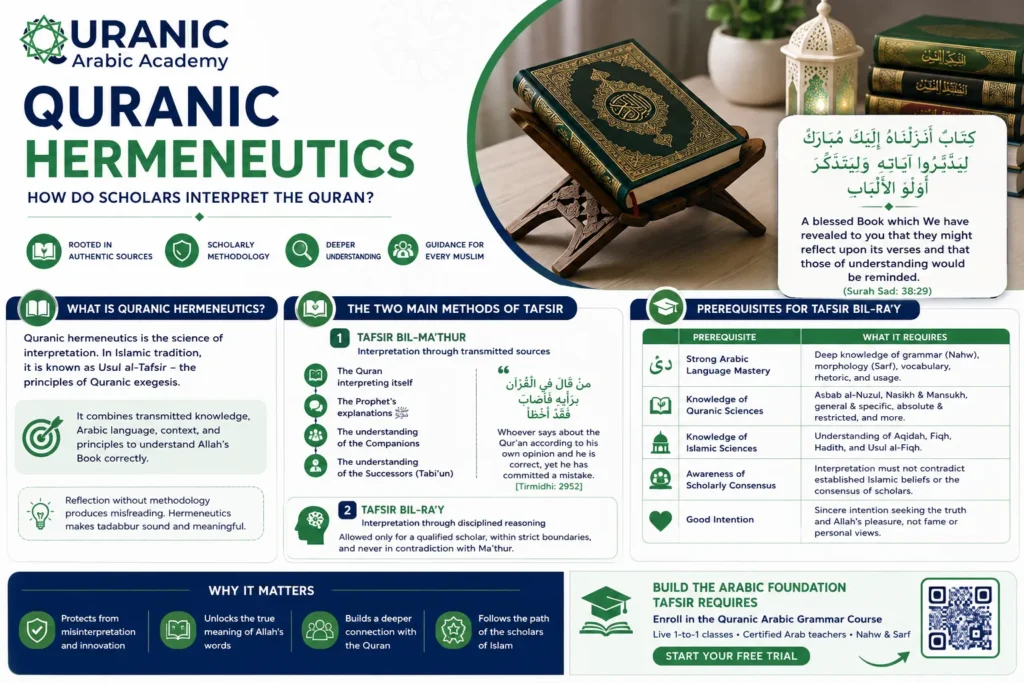
Many American Muslim learners who want to combine Quranic comprehension with structured Arabic grammar find that Nahw and Sarf taught through actual ayat analysis produces faster results than studying grammar rules in isolation. The Quranic Arabic Grammar Course at The Quranic Arabic Academy teaches Nahw and Sarf directly through Quranic verses, so every grammar lesson simultaneously deepens your understanding of what you are memorizing.
Read Also: Quranic Epistemology – Islam’s Complete Theory of Knowledge
Enroll in the Quranic Arabic Grammar Course at The Quranic Arabic Academy
Read Also: Quranic Arabic Prepositions
8- Building a Three-Tier Revision System Prevents Losing What You Learn
The most common reason students abandon quranic education is not slow progress. It is losing previously memorized material faster than they gain new material. Without a structured revision system, new verses overwrite old ones because nothing holds everything together.
The Three-Tier Revision Cycle
| Tier | Coverage | Frequency |
| Near-past review | Last 5 pages memorized | Daily, non-negotiable |
| Mid-past review | Pages 6 to 20 behind current position | Every 2 to 3 days |
| Far-past review | All previously memorized material | Weekly rotation |
Read Also: Essentials of Quranic Arabic Every Muslim Learner Must Know
The Hadith That Confirms Why Revision Cannot Be Optional
” تَعَاهَدُوا الْقُرْآنَ فَوَالَّذِي نَفْسِي بِيَدِهِ لَهُوَ أَشَدُّ تَفَصِّيًا مِنَ الإِبِلِ فِي عُقُلِهَا ”.
“Commit yourself to the Qur’an, for by Him in whose Hand is my soul, it is surely more prone to break away than a camel in its bind”.
What Happens When Revision Is Skipped
Recall strength decays rapidly in the first 24 to 48 hours after initial memorization. Skipping revision for two or three consecutive days can undo an entire week of memorization work. Students who focus entirely on new material and treat revision as optional consistently find that their total memorized amount does not grow because what is gained at the front is lost at the back at the same rate.
Read Also: Quranic Exegesis (Tafsir)
Experience Our Teaching Style:
We believe in clarity and engagement. Watch these short highlights from our actual classes to see our teachers’ methodology and student interactions in real-time.
Ready to Begin Your Quranic Journey?
Start learning with professional instructors through our structured curriculum.
Book Your Free TrialRead Also: Quranic Ethics – What the Quran Teaches About Akhlaq and Behaviour?
Start Your Quranic Education with The Quranic Arabic Academy
Most Muslims who struggle with quranic education are not failing because of weak memory or insufficient motivation. They are failing because they are learning alone, at inconsistent times, without Tajweed correction, and without a structured revision plan built into the commitment from day one.
The Quranic Arabic Academy provides the complete framework that turns intention into lasting results:
- Certified Arab tutors holding Ijazah in recitation or degrees in Islamic studies from recognized institutions.
- One-on-one live sessions tailored specifically to each student’s individual mistakes and learning pace.
- Real-time Makharij correction using audio-visual feedback during every single session.
- Structured progression from Noorani Qaida through to Ijazah certification.
- Flexible scheduling covering EST, PST, CST, and GMT time zones.
- Monthly progress reports and written feedback provided after every session.
- Affordable pricing with transparent packages and family enrollment discounts.
- Programs serving students across North America, Europe, Asia, and the Middle East.
Whether you are beginning for the first time, restarting after a break, or advancing toward Ijazah certification, there is a program at The Quranic Arabic Academy designed for your exact stage.
Our Arabic Courses
- Quranic Arabic Classes
- Quranic Arabic Course for Beginners
- Online Quranic Arabic Courses for Advanced Learners
- Quranic Arabic Grammar Course
- Arabic Courses for Understanding the Quran
- Quranic Arabic Course for Sisters (Female)
- Quranic Arabic Course for Kids
- Online Quranic Arabic Classes for Adults
- Quranic Arabic Course UK
- Quranic Arabic Course London
- Quranic Arabic Course USA
- Quranic Arabic Course Canada
- Quranic Arabic Course Australia
- Quranic Arabic Course UAE
- Quranic Arabic Course Germany
Book Your Free Trial at The Quranic Arabic Academy
FAQ
What is quranic education and what does it include?
Quranic education includes Noorani Qaida, Tajweed, Hifz, and Tafsir, helping learners read, recite, memorize, and understand the Quran step by step.
How do I find a reliable quranic education center in the USA?
Choose a center with qualified teachers, a structured curriculum, live one-on-one classes, and a free trial lesson before enrollment.
How long does it take to complete a full quranic education program?
Reading basics take 2–4 months, Tajweed 6–12 months, and full Quran memorization usually requires 2–5 years.
Can adults start quranic education without any prior Arabic knowledge?
Yes. Adults begin with Noorani Qaida, which teaches Arabic letters and Quran reading without requiring previous knowledge.
What is the difference between a quranic education center and a regular Quran app?
A Quranic education center provides live teacher feedback and error correction, while Quran apps mainly offer reading and listening support.
Related Articles
Learn Quranic Arabic






Leave a Reply