 Learn Quranic Arabic
Many people assume the Quran is primarily a book of rituals and legal rulings. This assumption misses the heart of what the Quran actually contains. The Prophet himself stated that he was sent to perfect good character, and scholars across centuries have identified quranic ethics as the central mission of his message.
Quran verses about behaviour cover nearly every aspect of life, from how a person walks to how they treat an orphan’s property. Quran verses about akhlaq are addressed to all of humanity, not Muslims alone, which is why scholars describe them as universal values that transcend religion, race, and region.
1- Kindness to Parents Is the First Duty After Worshipping Allah
The Quran places the command to honour parents immediately after the command to worship Allah alone. This positioning is deliberate. It signals that parental rights occupy the highest rank among all human obligations in quranic ethics. The command covers every detail of interaction, including speech, tone, and physical attitude:
“وَقَضَىٰ رَبُّكَ أَلَّا تَعْبُدُوا إِلَّا إِيَّاهُ وَبِالْوَالِدَيْنِ إِحْسَانًا ۚ إِمَّا يَبْلُغَنَّ عِندَكَ الْكِبَرَ أَحَدُهُمَا أَوْ كِلَاهُمَا فَلَا تَقُل لَّهُمَا أُفٍّ وَلَا تَنْهَرْهُمَا وَقُل لَّهُمَا قَوْلًا كَرِيمًا ﴿٢٣﴾”
Wa qaḍā rabbuka allā taʿbudū illā iyyāhu wa bil-wālidayni iḥsānā, immā yablughanna ʿindaka l-kibara aḥaduhumā aw kilāhumā falā taqul lahumā uffin wa lā tanharhumā wa qul lahumā qawlan karīmā.
“And your Lord has decreed that you not worship except Him, and to parents, good treatment. Whether one or both of them reach old age [while] with you, say not to them [so much as], “uff,” and do not repel them but speak to them a noble word. (23) .”
This obligation toward parents has four distinct levels that the Quran establishes in order of increasing depth:
- Never say a word of disrespect, even a single syllable of impatience.
- Never raise your voice or repel them with harsh tone or gesture.
- Address them always with noble and honourable speech.
- Lower the wing of humility toward them out of mercy, and pray for them.
This command extends even when parents hold different beliefs. The Quran instructs believers to treat non-Muslim parents with kindness and companionship in this world, separating belief from the obligation of good character entirely.
Non-Arab learners who engage with quran verses about akhlaq often miss the full weight of these commands without grounding in the original Arabic. The Quranic Arabic for Beginners course builds that connection directly from the Quran itself.
2- Justice Toward All People Is a Core Quranic Obligation
Justice in quranic ethics is not selective or conditional. The Quran commands believers to maintain absolute fairness even when it goes against their own interests or those of their closest relatives. The Quran uses the word qist, meaning absolute balanced fairness, and connects it directly to taqwa:
“يَا أَيُّهَا الَّذِينَ آمَنُوا كُونُوا قَوَّامِينَ لِلَّهِ شُهَدَاءَ بِالْقِسْطِ ۖ وَلَا يَجْرِمَنَّكُمْ شَنَآنُ قَوْمٍ عَلَىٰ أَلَّا تَعْدِلُوا ۚ اعْدِلُوا هُوَ أَقْرَبُ لِلتَّقْوَىٰ”
Yā ayyuhā lladhīna āmanū kūnū qawwāmīna lillāhi shuhadāʾa bil-qisṭi wa lā yajrimannakum shanaʾānu qawmin ʿalā allā taʿdilū, iʿdilū huwa aqrabu lil-taqwā.
” O you who have believed, be persistently standing firm for Allah, witnesses in justice, and do not let the hatred of a people prevent you from being just. Be just; that is nearer to righteousness.”
The Quran makes justice obligatory in three areas simultaneously:
| Area | Quranic Requirement |
| Personal dealings | Justice even against yourself and your own kin |
| Public testimony | Full honest witness regardless of who benefits |
| Relations with enemies | Fairness upheld even toward those you hate |
Allah Himself is identified in the Quran with the quality of justice, making it among the most central of all quranic ethics. No stable society can exist without it, and oppression is framed as the direct cause of conflict and collapse across history.
Read also: Quranic Epistemology – Islam’s Complete Theory of Knowledge
3- Honesty in Speech and Trade Defines the True Believer
Truthfulness in quranic ethics is demanded in every circumstance, including when honesty is personally costly. The Quran praises truthfulness as a defining prophetic virtue, describing Prophet Ibrahim as siddiq, meaning one who is deeply and consistently truthful. It commands believers to give full measure and full weight in all transactions:
“وَأَوْفُوا الْكَيْلَ إِذَا كِلْتُمْ وَزِنُوا بِالْقِسْطَاسِ الْمُسْتَقِيمِ ۚ ذَٰلِكَ خَيْرٌ وَأَحْسَنُ تَأْوِيلًا ﴿٣٥﴾”
Wa awfū l-kayla idhā kiltum wa zinū bil-qisṭāsi l-mustaqīm, dhālika khayrun wa aḥsanu taʾwīlā.
“And give full measure when you measure, and weigh with an even balance. That is the best [way] and best in result. (35).”
Honesty in quranic ethics operates on three connected levels:
- Truthfulness in speech, including testimony even against yourself or your own kin.
- Truthfulness in trade, giving full measure and full weight without deception.
- Truthfulness in character, embodying sincerity as a permanent personal trait.
The Quran ties honesty directly to accountability on the Day of Judgment, giving it a weight that goes far beyond social virtue into the realm of salvation itself.
Understanding why each Arabic word in quran verses about behaviour carries such moral force requires more than translation. The Quranic Arabic Grammar Course teaches students to engage with these commands in their original language.
Enroll Now and Start Learning.
Read also: Essentials of Quranic Arabic Every Muslim Learner Must Know
4- Balanced Spending Protects the Individual and Society
The Quran identifies two opposite financial failures and condemns both equally. Extravagance is condemned with the Quran describing those who waste their wealth as brothers of Shaytan. Miserliness is equally rejected, with the image of a person whose hand is chained to their neck serving as a warning against withholding what should be given:
“وَلَا تَجْعَلْ يَدَكَ مَغْلُولَةً إِلَىٰ عُنُقِكَ وَلَا تَبْسُطْهَا كُلَّ الْبَسْطِ فَتَقْعُدَ مَلُومًا مَّحْسُورًا ﴿٢٩﴾ “
Wa lā tajʿal yadaka maghlūlatan ilā ʿunuqika wa lā tabsuṭhā kulla l-basṭi fataqʿuda malūman maḥsūrā.
“And do not make your hand [as] chained to your neck or extend it completely and [thereby] become blamed and insolvent. (29).”
The table below shows how the Quran positions balanced spending between two condemned extremes:
| Extreme | Quranic Description | Consequence |
| Extravagance | Brothers of Shaytan | Blame and moral corruption |
| Miserliness | Hand chained to the neck | Blame and exhaustion |
| Balance | Servants of the Most Merciful | Stability and righteousness |
The Quran connects extravagant consumption directly to social injustice. When wealth accumulates without care for the poor and the needy, the moral collapse that follows affects the entire community. The Quran also condemns usury as one of the most destructive forms of financial exploitation, framing it as a force that breeds greed, anger, and violence among the oppressed.
See It in Action:
Wondering what our interactive sessions look like? Click below to peek inside a live session and watch how our expert instructors make learning Quranic Arabic accessible and engaging.
Ready to Begin Your Quranic Journey?
Start learning with professional instructors through our structured curriculum.
Book Your Free Trial5- Modest Walking and Lowering the Voice Are Quranic Manners
Quran verses about behaviour reach into the most physical aspects of daily life. The Quran forbids walking with arrogance and pride, stating that no person can tear the earth with their feet or reach the height of mountains, making arrogance in movement both sinful and absurd:
“وَاقْصِدْ فِي مَشْيِكَ وَاغْضُضْ مِن صَوْتِكَ ۚ إِنَّ أَنكَرَ الْأَصْوَاتِ لَصَوْتُ الْحَمِيرِ ﴿١٩﴾”
Waqṣid fī mashyika waghdud min ṣawtika, inna ankara l-aṣwāti laṣawtu l-ḥamīr.
“And be moderate in your pace and lower your voice; indeed, the most disagreeable of sounds is the voice of donkeys.” (19).”
The Quran extends this instruction to cover multiple dimensions of daily conduct:
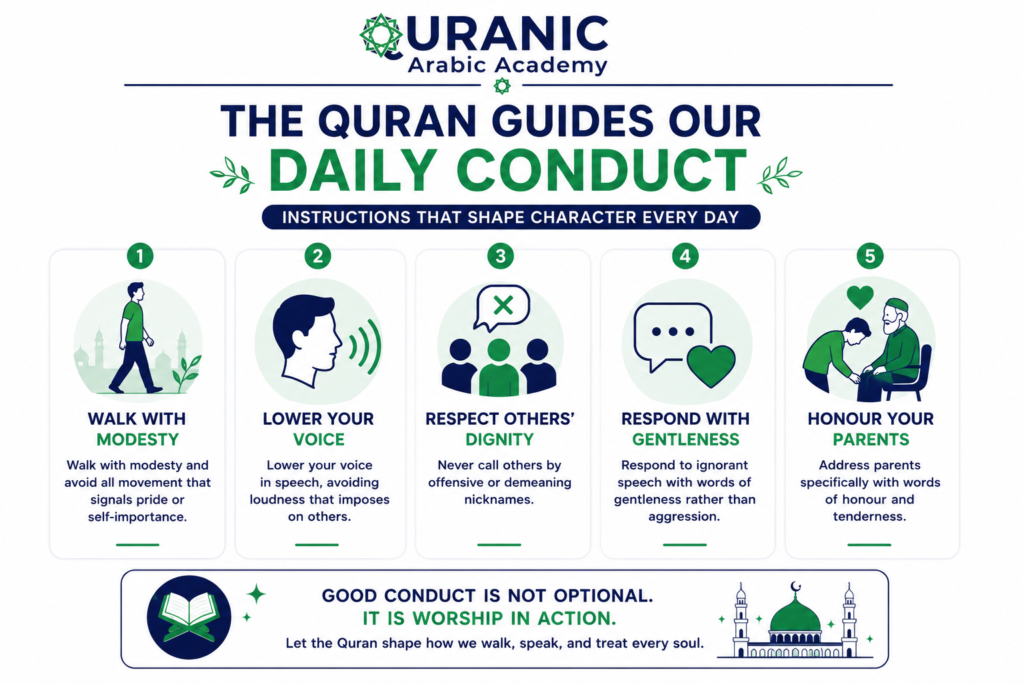
- Walk with modesty and avoid all movement that signals pride or self-importance.
- Lower your voice in speech, avoiding loudness that imposes on others.
- Never call others by offensive or demeaning nicknames.
- Respond to ignorant speech with words of gentleness rather than aggression.
- Address parents specifically with words of honour and tenderness.
These quran verses about akhlaq show that Islamic morality covers the full texture of everyday conduct, not only major moral decisions.
6- Guarding the Eyes and Senses Protects the Heart
The Quran does not only forbid immoral acts but closes every avenue that leads to them. The Arabic word furuj in these verses covers all the openings through which sin enters a person: the eyes, the ears, the tongue, the hands, and the feet. The command to lower the gaze is addressed to both men and women directly:
“قُل لِّلْمُؤْمِنِينَ يَغُضُّوا مِنْ أَبْصَارِهِمْ وَيَحْفَظُوا فُرُوجَهُمْ ۚ ذَٰلِكَ أَزْكَىٰ لَهُمْ ۗ إِنَّ اللَّهَ خَبِيرٌ بِمَا يَصْنَعُونَ ﴿٣٠﴾”
Qul lil-muʾminīna yaghuddū min abṣārihim wa yaḥfaẓū furūjahum, dhālika azkā lahum.
“Tell the believing men to reduce [some] of their vision and guard their private parts. That is purer for them. Indeed, Allah is Acquainted with what they do. (30).”
The Quran also states that the ear, the eye, and the heart will each be questioned separately on the Day of Judgment. This means that passively hearing false information or looking at what is forbidden carries its own accountability. Sight is identified as the primary gateway through which the heart is corrupted, which is why the Quran addresses it before all other senses.
Reading quran verses about behaviour in Arabic reveals the precise moral logic behind every command. The Arabic Courses for Understanding the Quran help students engage with this moral framework in its original language.
7- Keeping Promises Is a Mark of the True Believer
The Quran treats promise-keeping as a matter of divine accountability. Breaking a commitment is not treated as a personal failing but as something that will be questioned directly on the Day of Judgment. The Quran praises faithfulness to promises as one of the defining qualities of the prophets, specifically describing Prophet Ismail as one who was true to his promise:
“وَأَوْفُوا بِالْعَهْدِ ۖ إِنَّ الْعَهْدَ كَانَ مَسْئُولًا”
Wa awfū bil-ʿahd, inna l-ʿahda kāna masʾūlā.
“And fulfill [every] commitment. Indeed, the commitment is ever [that about which one will be] questioned. .”
Trust between people is the foundation of any functioning society, and this trust collapses the moment promises become negotiable. The Quran connects faithfulness to promises with honesty in speech and fairness in trade as three inseparable pillars of quranic ethics. The believers described as truly righteous in the Quran are those who keep their word whenever they promise, and remain patient in hardship and times of conflict.
8- Verifying News Before Sharing It Is a Quranic Duty
The Quran addresses the spread of unverified information directly, treating it as a moral failure with real consequences. Sharing news without confirming its source can cause harm to innocent people and generate conflict where none existed:
“يَا أَيُّهَا الَّذِينَ آمَنُوا إِن جَاءَكُمْ فَاسِقٌ بِنَبَإٍ فَتَبَيَّنُوا أَن تُصِيبُوا قَوْمًا بِجَهَالَةٍ فَتُصْبِحُوا عَلَىٰ مَا فَعَلْتُمْ نَادِمِينَ ﴿٦﴾”
Yā ayyuhā lladhīna āmanū in jāʾakum fāsiqun bi-nabaʾin fatabayyanū an tuṣībū qawman bi-jahālatin fatuṣbiḥū ʿalā mā faʿaltum nādimīn.
“O you who have believed, if there comes to you a disobedient one with information, investigate, lest you harm a people out of ignorance and become, over what you have done, regretful. (6).”
The Quran identifies three sequential sources of suspicion that a believer must guard against:
- What the ear hears, which is the first and most common entry point for false information.
- What the eye sees, which can be misinterpreted and used to judge others unfairly.
- What the mind fabricates, which is the most dangerous source because it has no external basis at all.
Mere evidence from any one of these three is not sufficient to judge another person or form an unfavourable opinion about them.
Read Also: Essentials of Quranic Arabic Every Muslim Learner Must Know
9- Protecting Privacy and Avoiding Suspicion Is a Quranic Command
The Quran instructs believers not to spy on one another, not to backbite, and not to harbour suspicion without cause. These quran verses about behaviour treat privacy as a right that every person holds, and violation of it as a sin the believer must actively avoid:
“يَا أَيُّهَا الَّذِينَ آمَنُوا اجْتَنِبُوا كَثِيرًا مِّنَ الظَّنِّ إِنَّ بَعْضَ الظَّنِّ إِثْمٌ ۖ وَلَا تَجَسَّسُوا وَلَا يَغْتَب بَّعْضُكُم بَعْضًا”
Yā ayyuhā lladhīna āmanū jtanibū kathīran mina l-ẓanni inna baʿḍa l-ẓanni ithm, wa lā tajassasū wa lā yaghtab baʿḍukum baʿḍā.
“O you who have believed, avoid much [negative] assumption. Indeed, some assumption is sin. And do not spy or backbite each other..”
The Quran also instructs believers not to enter the homes of others without seeking permission first, protecting people from being seen in conditions that could give rise to false suspicion. This instruction serves both to prevent scandal and to establish a culture of mutual respect in daily social life.
Students who want to read and understand these commands directly benefit most from structured Arabic instruction. The Online Quranic Arabic Classes for Adults are designed for exactly this purpose.
Read Also: Which Dialect Is Closest to Quranic Arabic?
Begin Learning with Qualified Instructors.
Read Also: Quranic Epistemology – Islam’s Complete Theory of Knowledge
10- Rejecting Arrogance Toward Others Is an Islamic Duty
The Quran identifies arrogance as one of the most destructive forces in human society. It places two categories in direct opposition in quranic ethics:
| Category | Quranic Position |
| Istikbar (arrogance of power) | Condemned repeatedly as a great evil |
| Istidaf (being among the weak) | Honoured as a virtue in quranic ethics |
Historical figures like Pharaoh and Nimrod are cited in the Quran as examples of what istikbar produces: oppression, injustice, and the destruction of societies. Power in quranic ethics is never given to dominate others but to fight evil and establish justice:
“وَلَا تُصَعِّرْ خَدَّكَ لِلنَّاسِ وَلَا تَمْشِ فِي الْأَرْضِ مَرَحًا ۖ إِنَّ اللَّهَ لَا يُحِبُّ كُلَّ مُخْتَالٍ فَخُورٍ ﴿١٨﴾”
Wa lā tuṣaʿʿir khaddaka lil-nāsi wa lā tamshi fī l-arḍi maraḥā, inna llāha lā yuḥibbu kulla mukhtālin fakhūr.
“And do not turn your cheek [in contempt] toward people and do not walk through the earth exultantly. Indeed, Allah does not like everyone self-deluded and boastful. (18).”
Read Also: Quranic Arabic Prepositions
11- Patience and Steadfastness on Truth Define Real Faith
The Quran frames patience not as passive acceptance but as active moral courage. Surah Al-Asr presents the complete formula for human success in just three verses, identifying four qualities that together define the person who avoids loss:
“وَالْعَصْرِ ﴿١﴾ إِنَّ الْإِنسَانَ لَفِي خُسْرٍ ﴿٢﴾ إِلَّا الَّذِينَ آمَنُوا وَعَمِلُوا الصَّالِحَاتِ وَتَوَاصَوْا بِالْحَقِّ وَتَوَاصَوْا بِالصَّبْرِ ﴿٣﴾”
Wal-ʿaṣr, inna l-insāna lafī khusr, illā lladhīna āmanū wa ʿamilū l-ṣāliḥāti wa tawāṣaw bil-ḥaqqi wa tawāṣaw bil-ṣabr.
“By time, (1) Indeed, mankind is in loss, (2) Except for those who have believed and done righteous deeds and advised each other to truth and advised each other to patience. (3).”
The four qualities Surah Al-Asr identifies as the conditions for escaping loss are:
- Faith, as the foundation without which no action carries its full weight.
- Righteous deeds, because faith without action produces no change in the world.
- Advising one another to truth, because truth requires courage to uphold publicly.
- Advising one another to patience, because those who stand for truth will face opposition and must endure.
Read Also: Quranic Exegesis (Tafsir)
12- Cleanliness Is an Act of Faith in the Quran
The Quran connects cleanliness directly to faith, making physical purity an expression of spiritual commitment rather than a separate concern. The Prophet stated that cleanliness is half of faith, and the Quran confirms that Allah loves those who purify themselves:
“إِنَّ اللَّهَ يُحِبُّ التَّوَّابِينَ وَيُحِبُّ الْمُتَطَهِّرِينَ “
Inna llāha yuḥibbu l-tawwābīna wa yuḥibbu l-mutaṭahhirīn.
“Indeed, Allah loves those who are constantly repentant and loves those who purify themselves.”
Cleanliness in quranic ethics extends beyond the body to cover the environment and the community. A dirty or disordered environment reflects a breakdown in the moral standards the Quran calls believers to uphold. The connection between physical purity and spiritual readiness runs throughout the Quran, making cleanliness one of the most practical and immediate expressions of quranic ethics in daily life.
Read Also: Quranic Education
Experience Our Teaching Style:
We believe in clarity and engagement. Watch these short highlights from our actual classes to see our teachers’ methodology and student interactions in real-time.
Ready to Begin Your Quranic Journey?
Start learning with professional instructors through our structured curriculum.
Book Your Free TrialStart Learning Quranic Arabic with Qualified Instructors
Most people who read quran verses about akhlaq in translation never experience the full moral depth these commands carry in their original Arabic form. Every word in these verses was chosen with precision, and understanding that precision requires direct engagement with the Quranic text itself.
The Best Quranic Arabic Classes at The Quranic Arabic Academy are taught one-on-one by certified Arab tutors holding Ijazah credentials, with real-time Makharij correction and structured progression from beginner level through to advanced comprehension. Sessions are scheduled flexibly across all global time zones, with monthly progress reports after every session.
The academy serves students across North America, Europe, Asia, and the Middle East, with dedicated courses for adults, beginners, sisters, and advanced learners. Affordable pricing, family enrollment discounts, and a free trial make starting accessible for every learner regardless of level or location.
Our Arabic Courses
- Quranic Arabic Classes
- Quranic Arabic Course for Beginners
- Online Quranic Arabic Courses for Advanced Learners
- Quranic Arabic Grammar Course
- Arabic Courses for Understanding the Quran
- Quranic Arabic Course for Sisters (Female)
- Quranic Arabic Course for Kids
- Online Quranic Arabic Classes for Adults
- Quranic Arabic Course UK
- Quranic Arabic Course London
- Quranic Arabic Course USA
- Quranic Arabic Course Canada
- Quranic Arabic Course Australia
- Quranic Arabic Course UAE
- Quranic Arabic Course Germany
Conclusion
Quranic ethics form a complete and universal moral system that covers every dimension of human life. From the obligation to honour parents and uphold justice, to the commands governing how a person walks, spends money, and speaks to others, quran verses about behaviour leave no area of daily life unaddressed.
Quran verses about akhlaq are not historically limited. Scholars across centuries confirm that these values apply to every time and place, making the Quran a living moral guide for all of humanity. Engaging with these commands in their original Arabic form deepens their impact and transforms the way a believer understands and applies them in daily life.
Frequently Asked Questions
What are quranic ethics and why do they matter for all people?
Quranic ethics are the moral values and behavioural principles that the Quran establishes for all of humanity. They matter because they address every aspect of human life, from personal conduct to social justice, and scholars confirm they apply universally regardless of religion or background.
What do quran verses about behaviour cover in daily life?
Quran verses about behaviour cover how a person walks, speaks, spends money, treats parents, conducts trade, keeps promises, and interacts with neighbours. The Quran addresses both major moral decisions and the smallest details of everyday conduct.
What do quran verses about akhlaq say about dealing with non-Muslims?
Quran verses about akhlaq instruct believers to maintain justice, kindness, and honesty in all dealings regardless of the other person’s religion. The Quran explicitly commands believers to treat even non-Muslim parents with kindness and companionship in this world.
How does the Quran define righteousness beyond prayer and fasting?
The Quran defines righteousness as a combination of belief, spending wealth for those in need, keeping promises, and remaining patient in hardship. Prayer alone is described as insufficient if a person mistreats orphans and ignores the needy.
Why is learning Quranic Arabic important for understanding Islamic ethics?
Quranic Arabic contains precise moral logic in every word choice and grammatical structure that translations cannot fully replicate. Learning the original language allows a person to engage directly with quran verses about akhlaq and understand the full weight of each command.
Related Articles
Learn Quranic Arabic





Leave a Reply