 Learn Quranic Arabic
Many students of Islam study the Quran as a book of worship and law, without realizing it also contains a fully developed theory of knowledge. Quranic epistemology answers the most fundamental questions a thinking person can ask: What is knowledge? How is it acquired? How do we distinguish truth from falsehood? Understanding this framework changes how a Muslim engages with the Quran entirely.
Quranic Epistemology Defines What Knowledge Actually Means
In Islamic scholarship, knowledge means awareness and perception in their broadest sense. It covers every form of consciousness — whether gained through a medium or not, whether conceptual or propositional. Quranic epistemology does not restrict knowledge to religious texts alone but treats it as a universal category covering all human experience.
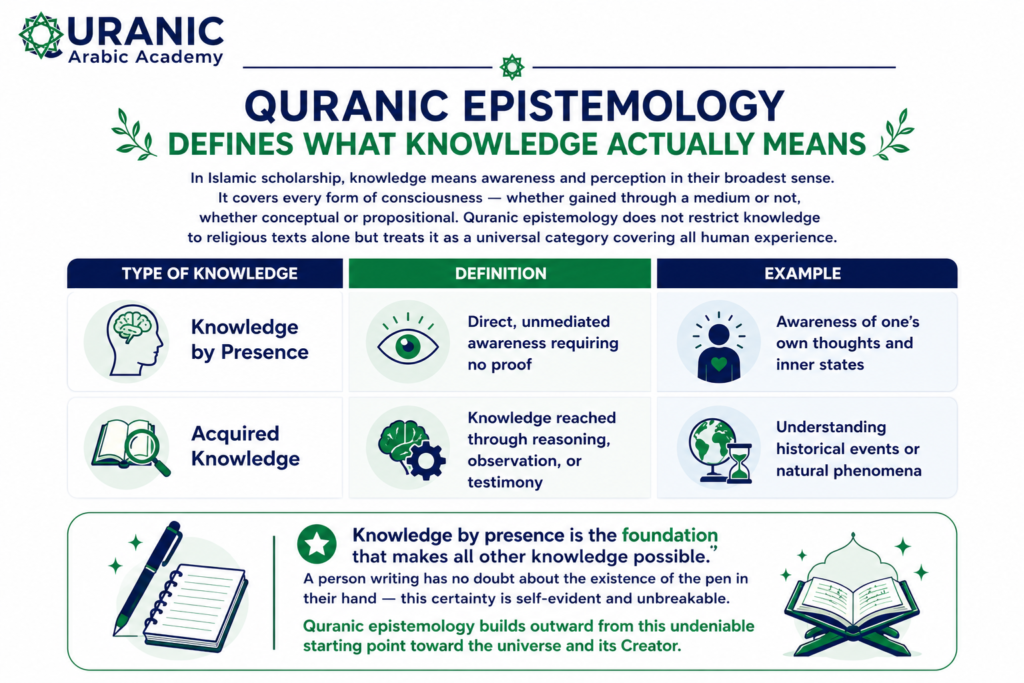
| Type of Knowledge | Definition | Example |
| Knowledge by Presence | Direct, unmediated awareness requiring no proof | Awareness of one’s own thoughts and inner states |
| Acquired Knowledge | Knowledge reached through reasoning, observation, or testimony | Understanding historical events or natural phenomena |
Knowledge by presence is the foundation that makes all other knowledge possible. A person writing has no doubt about the existence of the pen in their hand — this certainty is self-evident and unbreakable. Quranic epistemology builds outward from this undeniable starting point toward the universe and its Creator.
Many learners approach Quranic Arabic without the conceptual tools to engage with what they are reading. The Quranic Arabic for Beginners course at The Quranic Arabic Academy builds that foundation from the ground up, so students engage with the Quran’s meaning, not just its words.
Enroll in Quranic Arabic for Beginners at The Quranic Arabic Academy
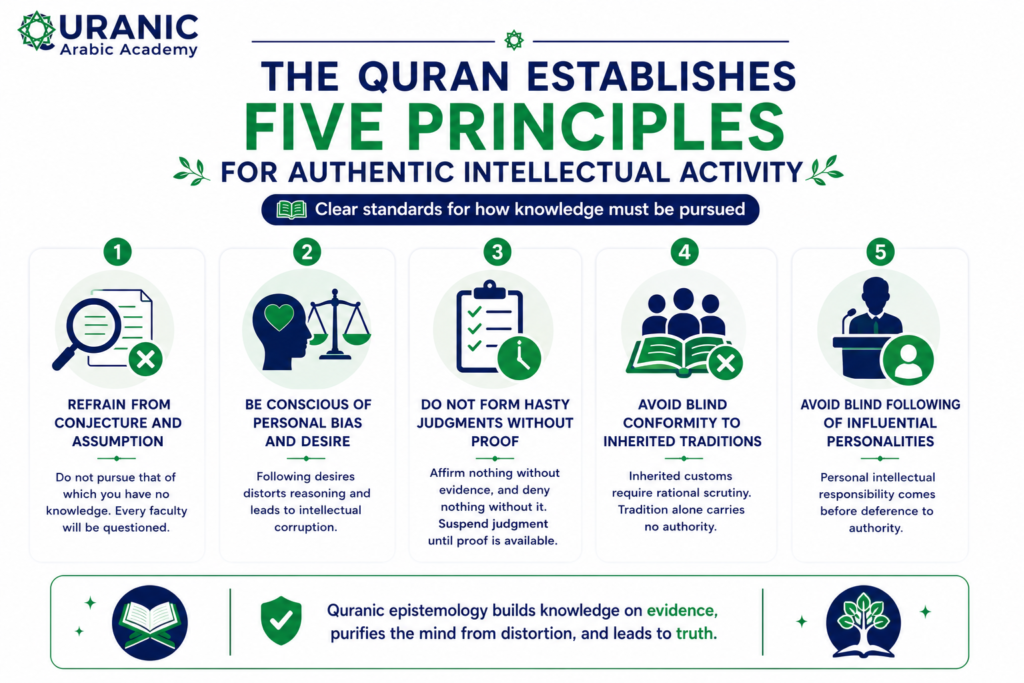
The Quran Establishes Five Principles for Authentic Intellectual Activity
Quranic epistemology does not only define what knowledge is — it establishes clear standards for how knowledge must be pursued:
Refraining from Conjecture and Assumption
The Quran warns directly against following anything without sound evidence:
“وَلَا تَقْفُ مَا لَيْسَ لَكَ بِهِ عِلْمٌ ۚ إِنَّ السَّمْعَ وَالْبَصَرَ وَالْفُؤَادَ كُلُّ أُولَٰئِكَ كَانَ عَنْهُ مَسْئُولًا ﴿٣٦﴾”
Wa lā taqfu mā laysa laka bihī ʿilm, inna s-samʿa wa-l-baṣara wa-l-fuʾāda kulla ulāʾika kāna ʿanhu masʾūlā.
“And do not pursue that of which you have no knowledge. Indeed, the hearing, the sight and the heart – about all those [one] will be questioned. (36).”
Every faculty of perception carries moral responsibility in Quranic epistemology. Conjecture is not a neutral error — it is a direct accountability issue before Allah.
Being Conscious of Personal Bias and Desire
The Quran links intellectual corruption directly to following personal desires. When beliefs are shaped by what a person wants to be true rather than what evidence supports, their reasoning becomes distorted. Quranic epistemology treats this as a fundamental epistemic failure, not merely a moral lapse.
Not Forming Hasty Judgments without Proof
Nothing should be affirmed without evidence supporting it, and nothing should be denied without evidence against it. Quranic epistemology demands that the epistemic agent suspend judgment until proof is available, regardless of how convenient a quick conclusion may be.
Avoiding Blind Conformity to Inherited Traditions
The Quran explicitly rejects following ancestral customs without rational scrutiny. Inherited tradition carries no automatic authority in Quranic epistemology — it must be evaluated against sound evidence like any other claim.
Avoiding Blind Following of Influential Personalities
Quranic epistemology places personal intellectual responsibility above deference to authority figures. The Quran warns that following powerful personalities without developing one’s own understanding is a path to misguidance, not knowledge.
Quranic Epistemology Identifies Three Primary Sources of Knowledge
The Quran did not leave the sources of human knowledge undefined. It specified them directly across multiple verses:
Nature and the Physical World
The Quran calls repeatedly on believers to observe, reflect, and draw conclusions from the natural world:
“ إِنَّ فِي خَلْقِ السَّمَاوَاتِ وَالْأَرْضِ وَاخْتِلَافِ اللَّيْلِ وَالنَّهَارِ لَآيَاتٍ لِّأُولِي الْأَلْبَابِ ﴿١٩٠﴾”
Inna fī khalqi s-samāwāti wa-l-arḍi wa-khitilāfi l-layli wa-n-nahāri la-āyātin li-ulī l-albāb.
“Indeed, in the creation of the heavens and the earth and the alternation of the night and the day are signs for those of understanding. (190).”
The natural world is not background scenery in Quranic epistemology — it is an active source of knowledge about the Creator and His design.
History and Human Society
The Quran directs believers to study the patterns of civilizations, their rise, their collapse, and the causes behind both. Social and historical inquiry is not peripheral to Islamic thought — it is a Quranic command for those who seek genuine understanding.
Self-Awareness and Inner Consciousness
The Quran identifies the human self as a primary site of knowledge:
“سَنُرِيهِمْ آيَاتِنَا فِي الْآفَاقِ وَفِي أَنفُسِهِمْ حَتَّىٰ يَتَبَيَّنَ لَهُمْ أَنَّهُ الْحَقُّ ۗ”
Sanurīhim āyātinā fī l-āfāqi wa-fī anfusihim ḥattā yatabayyana lahum annahu l-ḥaqq.
“We will show them Our signs in the horizons and within themselves until it becomes clear to them that it is the truth.”
Together, these three sources — nature, history, and self — form an integrated epistemological system in which the physical, social, and inner worlds all point toward the same ultimate truth.
Students who want to read the Quran’s epistemological arguments directly in Arabic need more than vocabulary — they need grammatical fluency. The Quranic Arabic Grammar Course at The Quranic Arabic Academy builds the structural understanding that makes Quranic reasoning accessible in its original language.
[Enroll in the Quranic Arabic Grammar Course at The Quranic Arabic Academy]
The Quran and Sunnah Together Form the Epistemological Foundation
The Quran provides overarching principles and the Sunnah provides their practical application. Neither source is complete without the other in Quranic epistemology. The Quran commands prayer — the Sunnah specifies its timings, postures, and recitations. The Quran establishes the obligation of fasting — the Sunnah details its rules and etiquettes. This division of function is not a gap in the system; it is the system.
The Sunnah also plays a critical role in preserving the correct understanding of Quranic text. During the lifetime of the Prophet, the Quran was transmitted orally, and the Sunnah ensured its pronunciation, application, and interpretation remained accurate. Together they provide:
- Doctrinal principles through the Quran.
- Practical implementation through the Sunnah.
- Interpretation of ambiguous Quranic passages through Prophetic explanation.
- Ethical application of Quranic commands through lived example.
See It in Action:
Wondering what our interactive sessions look like? Click below to peek inside a live session and watch how our expert instructors make learning Quranic Arabic accessible and engaging.
Ready to Begin Your Quranic Journey?
Start learning with professional instructors through our structured curriculum.
Book Your Free TrialQuranic Epistemology Links the Intellect Directly to Guidance and Misguidance
The Quran does not treat the intellect as a neutral tool. In Quranic epistemology, using the intellect is directly connected to being rightly guided, and abandoning it is connected to misguidance:
“وَيَجْعَلُ الرِّجْسَ عَلَى الَّذِينَ لَا يَعْقِلُونَ ”
Wa jaʿala r-rijsa ʿalā lladhīna lā yaʿqilūn.
“and He will place defilement upon those who will not use reason. (100).”
The Arabic verb used throughout the Quran for intellectual activity — ya’qilūn — appears only in verb form, never as a noun. This grammatical choice is deliberate: the intellect in Quranic epistemology is only relevant in its activity. A dormant intellect carries no epistemic or spiritual value.
The Quran goes further, linking the failure to use reason directly to the punishment of the Fire:
“وَقَالُوا لَوْ كُنَّا نَسْمَعُ أَوْ نَعْقِلُ مَا كُنَّا فِي أَصْحَابِ السَّعِيرِ ﴿١٠﴾”
Wa qālū law kunnā nasmaʿu aw naʿqilu mā kunnā fī aṣḥābi s-saʿīr.
“And they will say, “If only we had been listening or reasoning, we would not be among the companions of the Blaze.” (10)”
Quranic epistemology therefore makes intellectual engagement an act of worship and its abandonment a form of spiritual failure.
The Arabic Courses for Understanding the Quran at The Quranic Arabic Academy are designed specifically for students who want to engage with the Quran’s arguments and proofs directly — reading the text the way its original audience heard it.
Enroll in Arabic Courses for Understanding the Quran at The Quranic Arabic Academy]
Said Nursi Expands Quranic Epistemology for the Modern Age
Said Nursi, in his Risale-i Nur collection, developed the most comprehensive modern application of Quranic epistemology. His framework serves as a bridge between classical Islamic scholarship and the intellectual challenges of the contemporary world.
The core elements of Nursi’s epistemological framework include:
- Upholding the Quran as the ultimate and comprehensive source of knowledge, covering all aspects of life.
- Integrating faith and reason as complementary rather than competing — true knowledge does not contradict religious belief but deepens it.
- Emphasizing tadabbur — deep reflection on Quranic verses and the signs present in the natural world — as a primary method of acquiring knowledge.
- Recognizing that all knowledge carries moral and ethical implications, and that genuine understanding leads to virtuous conduct.
- Treating the universe itself as filled with signs of Allah’s existence and attributes, making natural inquiry an act of epistemological and spiritual significance.
Nursi’s contribution to Quranic epistemology matters for contemporary learners because it demonstrates that the framework is not historically confined. It addresses the questions that secular modernity raises about faith and knowledge directly, on epistemological grounds, using the Quran as its foundation.
Experience Our Teaching Style:
We believe in clarity and engagement. Watch these short highlights from our actual classes to see our teachers’ methodology and student interactions in real-time.
Ready to Begin Your Quranic Journey?
Start learning with professional instructors through our structured curriculum.
Book Your Free TrialQuranic Epistemology Assigns Knowledge a Moral Responsibility
The very first verses revealed to the Prophet were not about prayer or fasting — they were about reading, writing, and the acquisition of knowledge:
اقْرَأْ بِاسْمِ رَبِّكَ الَّذِي خَلَقَ ﴿١﴾ خَلَقَ الْإِنسَانَ مِنْ عَلَقٍ ﴿٢﴾ اقْرَأْ وَرَبُّكَ الْأَكْرَمُ ﴿٣﴾ الَّذِي عَلَّمَ بِالْقَلَمِ ﴿٤﴾ عَلَّمَ الْإِنسَانَ مَا لَمْ يَعْلَمْ ﴿٥﴾
” Iqraʾ bi-smi rabbika lladhī khalaq. Khalaqa l-insāna min ʿalaq. Iqraʾ wa-rabbuka l-akram. Alladhī ʿallama bi-l-qalam. ʿAllama l-insāna mā lam yaʿlam.
“Recite in the name of your Lord who created – (1) Created man from a clinging substance. (2) Recite, and your Lord is the most Generous – (3) Who taught by the pen – (4) Taught man that which he knew not. (5) .”
This was not coincidental. Quranic epistemology places the pursuit of knowledge at the center of what it means to be human. Knowledge in Islam is not morally neutral — every act of learning carries ethical weight, and every type of knowledge generates responsibilities.
| Type of Knowledge | Moral Responsibility Generated |
| Knowledge of Allah and His attributes | Worship, gratitude, and submission |
| Knowledge of the natural world | Stewardship and reflection on divine signs |
| Knowledge of human history | Learning from the rise and fall of nations |
| Knowledge of the self | Accountability for one’s inner states and intentions |
Quranic epistemology does not separate the intellectual from the ethical. Knowing more means being responsible for more — a principle woven into the Quran from its very first revelation.
Sisters who want to engage with Quranic knowledge in a structured and comfortable learning environment will find dedicated support through the Quranic Arabic Course for Sisters at The Quranic Arabic Academy — taught by qualified instructors with flexible scheduling.
Enroll in the Quranic Arabic Course for Sisters at The Quranic Arabic Academy]
Start Building Your Foundation in Quranic Arabic Today
Most students who want to understand Quranic epistemology directly from the text face one obstacle: they cannot yet read the Quran in Arabic with enough fluency to access its arguments firsthand. The Quranic Arabic Academy removes that obstacle through one-on-one live instruction built around each student’s individual level and goals.
Every course at The Quranic Arabic Academy includes:
- Certified Arab tutors holding Ijazah in recitation or degrees in Islamic studies from recognized institutions.
- One-on-one live sessions tailored specifically to each student’s individual mistakes and pace.
- Real-time Makharij correction using audio-visual feedback during every session.
- Structured progression from foundational Arabic through to advanced Quranic comprehension.
- Flexible scheduling covering all global time zones — EST, PST, GMT, CET, IST, and beyond.
- Monthly progress reports and written feedback provided after every session.
Our Arabic Courses
- Quranic Arabic Classes
- Quranic Arabic Course for Beginners
- Online Quranic Arabic Courses for Advanced Learners
- Quranic Arabic Grammar Course
- Arabic Courses for Understanding the Quran
- Quranic Arabic Course for Sisters (Female)
- Quranic Arabic Course for Kids
- Online Quranic Arabic Classes for Adults
- Quranic Arabic Course UK
- Quranic Arabic Course London
- Quranic Arabic Course USA
- Quranic Arabic Course Canada
- Quranic Arabic Course Australia
- Quranic Arabic Course UAE
- Quranic Arabic Course Germany
Book Your Free Trial at The Quranic Arabic Academy]
Ready to Begin Your Quranic Journey?
Start learning with professional instructors through our structured curriculum.
Book Your Free TrialConclusion
Quranic epistemology is not a peripheral academic subject — it is the intellectual backbone of how the Quran expects its readers to think, reason, and know.
From its definition of knowledge to its five principles of authentic inquiry, its three sources of knowing, and its insistence on the moral weight of every act of learning, Quranic epistemology provides a complete and coherent framework that has guided Muslim scholars for fourteen centuries and remains directly relevant today.
Said Nursi demonstrated that this framework speaks to modern questions as powerfully as it spoke to classical ones.
Frequently Asked Questions
What is Quranic epistemology in simple terms?
Quranic epistemology is the theory of knowledge found in the Quran — it defines what knowledge is, how it should be acquired, what sources are valid, and what intellectual responsibilities a Muslim carries. It treats the pursuit of knowledge as both a rational and a moral act.
Does Quranic epistemology reject reason in favor of blind faith?
No. Quranic epistemology explicitly condemns blind faith and blind following of traditions or authority figures. The Quran repeatedly commands the use of the intellect and warns that abandoning reason leads to misguidance. Faith in Quranic epistemology is not opposed to reason — it is built on it.
How do the Quran and Sunnah work together in Quranic epistemology?
The Quran provides overarching principles and the Sunnah provides their practical application. The Quran commands prayer, fasting, and ethical conduct — the Sunnah specifies how those commands are fulfilled. Together they form a complete epistemological and practical system that neither source provides alone.
Related Articles
Learn Quranic Arabic





Leave a Reply