 Learn Quranic Arabic
Most non-Arab Muslims recite the Quran every day without understanding what they are saying. They recognize the sounds, feel the rhythm, and sense the reverence, but the actual meaning of Allah’s words sits on the other side of a language barrier they do not know how to cross.
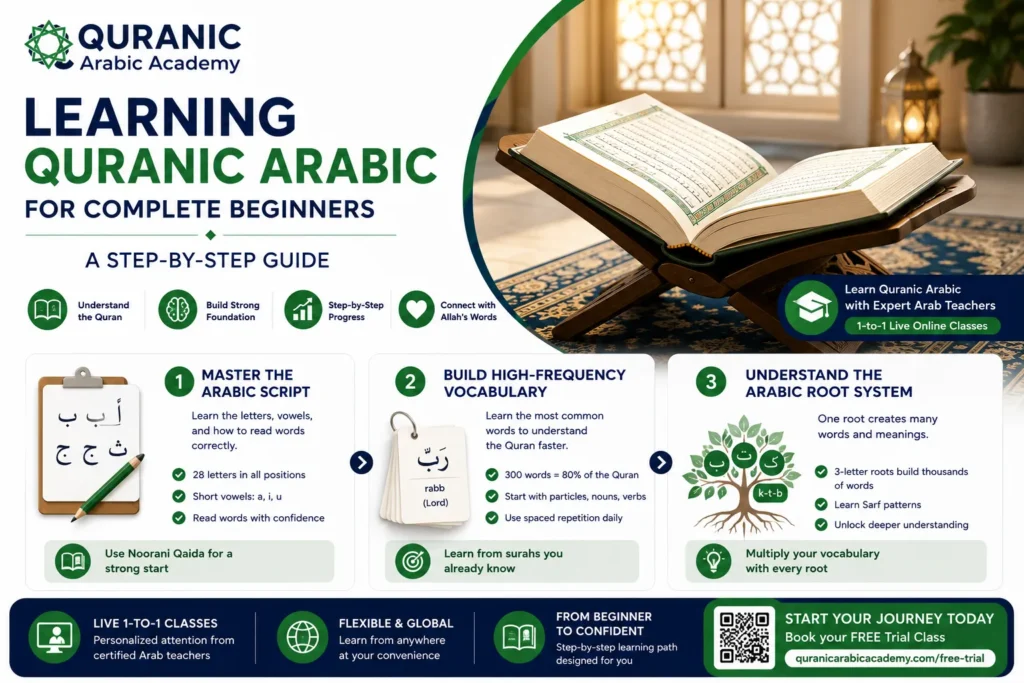
That barrier is not as wide as most beginners believe. The Quran’s vocabulary is built on a small number of repeated root words, its sentences follow recurring patterns, and its script is completely phonetic once learned. What closes the gap is not talent or years of free time. It is a correct sequence of steps followed consistently every day. This guide provides that sequence for anyone starting learning Quranic Arabic for complete beginners from zero.
1- Mastering the Arabic Script Is the Starting Point for Every Beginner
The Arabic script has 28 letters. It is written from right to left, and each letter takes a different shape depending on whether it appears at the beginning, middle, or end of a word. Short vowel markings called Harakat are written above and below the letters and determine pronunciation and grammatical function.
A complete beginner must reach three specific milestones at this stage:
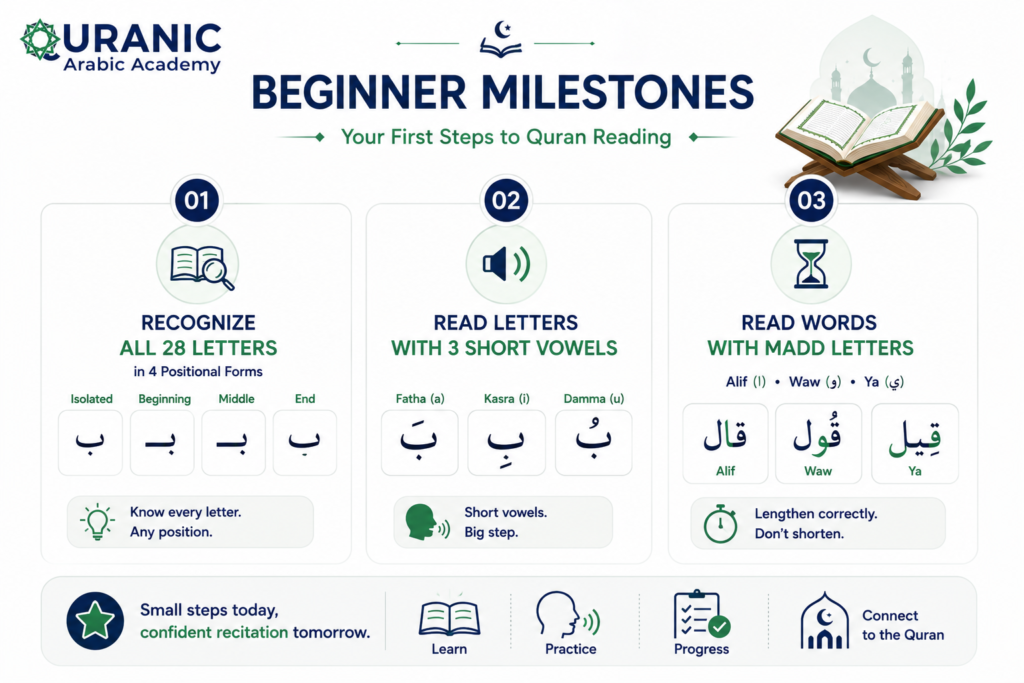
- Recognizing all 28 letters in their four positional forms: isolated, beginning, middle, and end.
- Reading letters combined with the three short vowels: Fatha (a), Kasra (i), and Damma (u).
- Reading words that include Madd letters, which are the long vowels Alif, Waw, and Ya, without shortening their required length.
The standard tool for this stage is the Noorani Qaida, a 17-lesson phonics-based primer that takes a beginner from individual letter recognition to full word reading using exactly the sounds found in the Quran. It is structured specifically for non-Arab learners and has been used for generations across South Asia, Southeast Asia, Africa, Europe, and the Americas.
Most adults who practice 20 minutes daily complete solid Arabic script recognition within four to eight weeks. The key rule at this stage is simple: do not begin vocabulary or grammar study before reading Arabic words fluently.
A beginner who tries to memorize Quranic words before they can read the script will collapse under the combined cognitive load of two tasks that each require full attention on their own.
Non-Arab learners who want live correction from the very first letter benefit most from structured teacher-led sessions. The Quranic Arabic for Beginners course at The Quranic Arabic Academy begins exactly here, with real-time Makharij correction from certified Arab instructors in one-on-one sessions.
Read also: Juz Amma Quranic Studies: The Complete Guide
[Start Learning the Arabic Script with a Qualified Teacher Today]
2- Building a High-Frequency Vocabulary Is the Fastest Route to Comprehension
Once a beginner reads Arabic script fluently, the next step is vocabulary. Most beginners assume they need to memorize thousands of words before the Quran starts making sense. The actual number is far smaller.
The Quran contains approximately 77,430 total words, but only around 14,870 unique word forms. When those word forms are grouped by their three-letter roots, the number reduces further to approximately 1,700 distinct roots across the entire text.
Most critically, just 300 high-frequency root words account for roughly 80% of the Quran by occurrence. This means a beginner who learns 300 carefully chosen words will recognize the majority of what they encounter in almost every verse they read.
The order in which to learn these words matters:
- Particles and connectives first: words like wa (and), fi (in), min (from), inna (indeed), and la (no/not) appear on almost every page and unlock sentence-level parsing immediately.
- High-frequency nouns next: words like rabb (Lord), yawm (day), nas (people), and ard (earth) appear hundreds of times across the Quran.
- Core verbs third: words like qala (he said), amana (he believed), and kana (was/were) form the backbone of Quranic narrative.
The most effective practice method is spaced repetition: reviewing new words at increasing intervals so they move from short-term into permanent memory. Twenty new words per week, reviewed daily, gets a dedicated beginner through the core 300-word list in approximately four months. That milestone represents a genuine turning point, because verses that once sounded entirely foreign begin to yield partial meaning on first hearing.
The critical rule at this stage is to learn words from surahs already recited in Salah. Connecting new vocabulary to familiar sounds dramatically improves retention and gives every prayer an immediate layer of new meaning.
Read also: Quranic Injunction Meaning: What Every Muslim Needs to Know
3- Understanding the Arabic Root System Multiplies Every Word Learned
Arabic is not built like English. Most Arabic words derive from three-letter roots that carry a core meaning, with prefixes, suffixes, and vowel patterns layered on top to create verbs, nouns, adjectives, and verbal nouns from a single starting point.
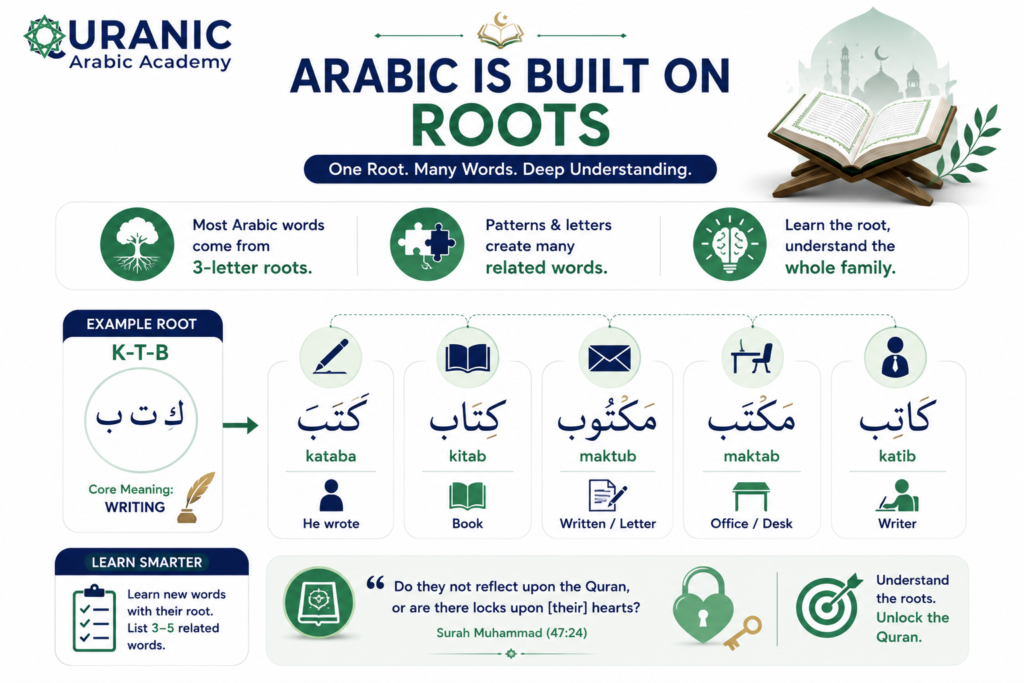
Understanding this system, called Sarf in classical Arabic grammar, means that every root a beginner learns generates a whole family of related words simultaneously. Consider the root k-t-b, which carries the core concept of writing:
- Kataba means he wrote.
- Kitab means book.
- Maktub means written or letter.
- Maktab means office or desk.
- Katib means writer.
A beginner who memorizes “kitab” as an isolated vocabulary item learns one word. A beginner who learns the root k-t-b and its pattern system immediately recognizes all five forms the moment they encounter them in the Quran, even without having studied them individually.
The practical instruction for this stage is to study every new vocabulary word alongside its three-letter root and list three to five related words from the same root. This approach doubles retention speed and builds pattern recognition that accelerates comprehension across the entire Quran.
The Quran commands Muslims to reflect upon its verses with understanding:
“أَفَلَا يَتَدَبَّرُونَ الْقُرْآنَ أَمْ عَلَىٰ قُلُوبٍ أَقْفَالُهَا ﴿٢٤﴾ ”
Afalā yatadabbarūna al-Qur’āna am ‘alā qulūbin aqfāluhā.
“Then do they not reflect upon the Qur’an, or are there locks upon [their] hearts? (24)”
Tadabbur, genuine Quranic reflection, requires understanding the words being reflected upon. The root system is what makes that understanding scalable.
Learners who want structured guidance through the root system alongside their vocabulary study benefit from the Arabic Courses for Understanding the Quran at The Quranic Arabic Academy, which teaches roots and patterns directly through Quranic verses rather than through abstract grammar exercises.
[Build Quranic Vocabulary the Right Way with a Certified Instructor]
Read Also: Quranic Information
4- Learning Basic Quranic Grammar Converts Word Recognition into Real Understanding
Vocabulary recognition tells a beginner what individual words mean. Grammar tells them how those words relate to each other to produce a complete meaning. Both are necessary, and neither alone is sufficient.
Quranic grammar has two components that every beginner must learn:
Nahw covers how words function within sentences. It governs the relationship between subjects, verbs, and objects, and it determines how word endings change depending on each word’s grammatical role. In Arabic, a single vowel on the final letter of a word signals whether that word is the subject, the object, or governed by a preposition. Missing that ending means missing the meaning.
Sarf covers how individual words are formed from their three-letter roots. It explains verb conjugation patterns, derived noun forms, and the system by which one root generates a predictable family of related words across different grammatical categories.
The sequence matters: beginners study basic Nahw first to understand sentence structure, then introduce Sarf at the intermediate stage to understand how words are built. Trying to study both simultaneously before having either foundation is a common mistake that stalls learners for months.
A focused beginner grammar course covers what is needed in a few months. The goal at this stage is not to recite rules from memory but to look at a Quranic verse and see its structure clearly: who is doing what, to whom, and under what conditions.
The Prophet ﷺ confirmed that the Quran was sent down specifically to be understood:
” إِنَّا أَنزَلْنَاهُ قُرْآنًا عَرَبِيًّا لَّعَلَّكُمْ تَعْقِلُونَ ﴿٢﴾”
Innā anzalnāhu Qur’ānan ‘arabiyyan la’allakum ta’qilūn.
“Indeed, We have sent it down as an Arabic Qur’an that you might understand. (2).”
Understanding, ta’qilun, is the stated purpose. Grammar is the tool that makes it achievable.
Read also: How to Dispose of Quranic Verses the Right Way
See It in Action:
Wondering what our interactive sessions look like? Click below to peek inside a live session and watch how our expert instructors make learning Quranic Arabic accessible and engaging.
Ready to Begin Your Quranic Journey?
Start learning with professional instructors through our structured curriculum.
Book Your Free Trial5- Applying What You Learn Directly to the Surahs of Daily Salah Locks In Progress
Grammar and vocabulary studied in isolation fade quickly. The step that converts knowledge into lasting competence is applying it immediately to the verses already recited five times a day.
The surahs of Juz Amma are the ideal application point. Every Muslim who prays already recites these surahs repeatedly. That built-in repetition becomes a revision session the moment a beginner starts attaching meaning to the sounds they already know.
The practical method for this step is as follows:
- Take Surah Al-Fatiha first, because it contains the structural patterns that appear throughout the entire Quran: nominal sentences, prepositional phrases, verb-object relationships, and divine attribute nouns.
- Read the surah in Arabic, then check a word-by-word interlinear translation that shows the meaning of each Arabic word directly beneath it.
- Read the surah again in Arabic without looking at the translation.
- Identify every word whose root has been studied, and confirm that the meaning recognized matches the word-by-word translation.
- Move to the next short surah from Juz Amma and repeat the process.
A standard prayer contains between 50 and 100 unique Arabic words depending on the surahs recited. Most adults who study consistently reach meaningful comprehension of their five daily prayers within three to six months of this applied practice. That milestone transforms Salah from a beautiful but opaque recitation into a direct conversation with Allah.
The Online Quranic Arabic Classes for Adults at The Quranic Arabic Academy are built specifically for adult learners who want to reach exactly this milestone, with one-on-one sessions that apply grammar and vocabulary directly to the surahs recited in daily prayer from the very first lesson.
[Transform Your Salah with Real Quranic Arabic Comprehension].
6- Reading Quranic Verses with a Word-by-Word Mushaf Builds Independent Comprehension
Once a beginner has applied their learning to the surahs of Salah, the next step is expanding that comprehension systematically through the rest of the Quran using a word-by-word Mushaf.
A word-by-word Mushaf is a Quran that displays the Arabic text with the meaning of each individual word written directly beneath it. When a beginner reads this format, they see the Arabic word first, then its meaning immediately below. The mind connects the two rapidly, and common words stop feeling new within weeks.
The instruction at this stage is precise: read the Arabic word aloud before reading its meaning. This trains the tongue and the mind together. When a beginner reads the Arabic first and then confirms the meaning, they are building direct recognition of the Arabic itself, not dependence on the translation sitting below it. Over time, this repetition creates the internal recognition that fires automatically during recitation in prayer.
Working through one short surah at a time in this format, reading the Arabic, checking the word-by-word meaning, and then reading the Arabic again without looking, builds a progression that compounds steadily. Learners who have memorized the surahs of Juz Amma find this step particularly effective because they already know the sound. Adding the word-by-word meaning layer activates an entirely new dimension of connection to verses they have carried in their memory for years.
Read also: Mastering the Vocabulary of the Quran: A Guide to Quranic Dictionaries
7- Studying Tafsir Alongside Arabic Turns Recognition into Genuine Understanding
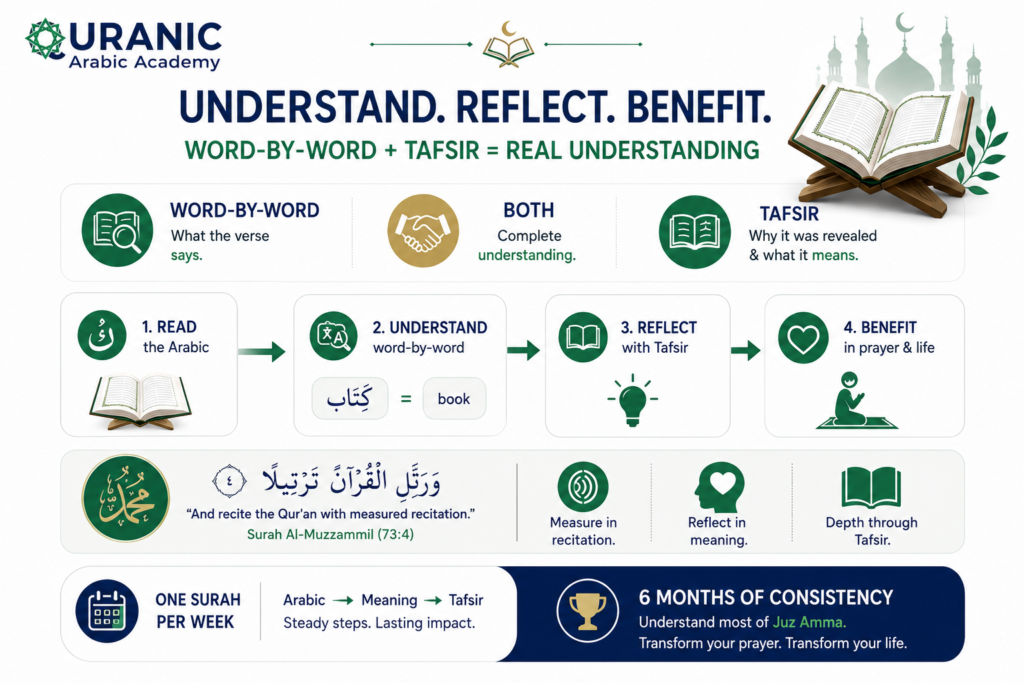
Word-by-word comprehension tells a beginner what a verse says. Tafsir tells them why it was revealed, what it refers to, and how the scholars of Islam understood it across fourteen centuries. Both are necessary for genuine Quranic understanding, and the two disciplines complement each other directly.
Once a beginner can follow the Arabic of a surah word by word, reading a simplified Tafsir of that same surah alongside converts mechanical recognition into real engagement with the meaning. The historical context of a verse, its occasion of revelation, and the scholarly consensus around its interpretation give the Arabic words their full weight in ways that word-by-word study alone cannot provide.
The Prophet ﷺ commanded measured, attentive recitation of the Quran specifically because this is how its meaning penetrates:
“وَرَتِّلِ الْقُرْآنَ تَرْتِيلًا ﴿٤﴾”
Wa rattili al-Qur’āna tartīlā.
“and recite the Qur’an with measured recitation. (4).”
Tarteel, measured recitation, is not only about pronunciation. Classical scholars explained that reciting with Tarteel means giving each word its full due in both sound and reflection. That reflection requires understanding the Arabic, and Tafsir is what gives that understanding its full depth.
Working through one surah per week at this stage, reading the Arabic, then the word-by-word meaning, then the Tafsir commentary, compounds into serious comprehension over months. Six months of this practice covers the majority of Juz Amma at a level of understanding that transforms both prayer and personal Quran study permanently.
Experience Our Teaching Style:
We believe in clarity and engagement. Watch these short highlights from our actual classes to see our teachers’ methodology and student interactions in real-time.
Ready to Begin Your Quranic Journey?
Start learning with professional instructors through our structured curriculum.
Book Your Free TrialBuild Your Foundation with The Quranic Arabic Academy
Most beginners who want to learn Quranic Arabic are not lacking motivation. They are lacking a structured programme that takes them from the Arabic script to genuine verse comprehension step by step, with a qualified teacher correcting what they cannot catch themselves.
The Quranic Arabic Academy provides that structure for non-Arab learners across North America, Europe, Asia, and the Middle East:
- Certified Arab tutors holding Ijazah or recognized degrees in Islamic studies.
- One-on-one live sessions tailored to each student’s individual pace and gaps.
- Real-time Makharij correction using audio-visual feedback in every session.
- Structured progression from Noorani Qaida through Quranic Arabic Grammar to Tafsir-integrated study.
- Flexible scheduling across all global time zones including EST, PST, GMT, CET, IST, GST, and MYT.
- Affordable pricing with transparent packages and family enrollment discounts.
- Monthly progress reports and written feedback after every session.
The Best Quranic Arabic Classes at The Quranic Arabic Academy are designed specifically for learners who want a complete, reliable path from zero Arabic to real Quranic understanding, taught live by instructors who have guided thousands of non-Arab students through every stage of this exact journey.
Our Arabic Courses
- Quranic Arabic Classes
- Quranic Arabic Course for Beginners
- Online Quranic Arabic Courses for Advanced Learners
- Quranic Arabic Grammar Course
- Arabic Courses for Understanding the Quran
- Quranic Arabic Course for Sisters (Female)
- Quranic Arabic Course for Kids
- Online Quranic Arabic Classes for Adults
- Quranic Arabic Course UK
- Quranic Arabic Course London
- Quranic Arabic Course USA
- Quranic Arabic Course Canada
- Quranic Arabic Course Australia
- Quranic Arabic Course UAE
- Quranic Arabic Course Germany
[Book Your Free Trial at The Quranic Arabic Academy]
Ready to Begin Your Quranic Journey?
Start learning with professional instructors through our structured curriculum.
Book Your Free TrialConclusion
Learning Quranic Arabic for complete beginners follows a clear sequence: master the Arabic script, build high-frequency vocabulary through roots, learn basic Nahw and Sarf, apply everything directly to the surahs of Salah, read with a word-by-word Mushaf, and study Tafsir alongside. Each step builds directly on the one before it, and none can be skipped without weakening everything that follows.
The journey is achievable for any committed adult, and the reward at every stage is immediate: more of Allah’s words understood, more of every prayer experienced as genuine meaning rather than familiar sound.
Frequently Asked Questions
How long does learning Quranic Arabic for complete beginners take?
Most adults reach meaningful comprehension of their five daily prayers within three to six months of structured daily study. Full comprehension of the Quran without translation typically takes twelve to eighteen months at five hours of study per week.
Can adults really learn Quranic Arabic starting from zero?
Yes. Adults learn Quranic Arabic just as effectively as children with consistent effort. Children may have more available time, but adults have stronger motivation and context. The key is structured, daily practice rather than occasional long sessions.
Do I need to learn Modern Standard Arabic before Quranic Arabic?
No. Quranic Arabic is Classical Arabic, which is different from Modern Standard Arabic in vocabulary, rhetorical structures, and grammar. Learning Modern Standard Arabic first adds material a Quranic learner does not need. Start directly with Quranic Arabic from step one.
What is the Noorani Qaida and why is it the starting point?
The Noorani Qaida is a 17-lesson phonics-based primer designed specifically for non-Arab learners who want to read the Arabic script accurately. It teaches letter recognition, vowel markings, and basic pronunciation rules in a structured sequence that directly prepares a beginner for Quranic recitation.
How many words do I need to understand most of the Quran?
Approximately 300 high-frequency root words account for roughly 80% of the Quran by occurrence. Learning these words in order of frequency, starting with particles and connectives, gives a beginner recognition of the vast majority of what they encounter in almost every verse.
Why is a qualified teacher necessary for learning Quranic Arabic?
A qualified teacher catches pronunciation errors, grammar misunderstandings, and vocabulary gaps that a learner cannot detect in their own study. Without correction, mistakes become permanent habits that are significantly harder to fix later than they would have been to prevent at the start.
Related Articles
Learn Quranic Arabic





Leave a Reply