 Learn Quranic Arabic
Most non-Arab Muslims recite the Quran daily without understanding a single word of it. This is not a minor gap — it means repeating the words of Allah for years without grasping their meaning, missing the intent behind every command, every promise, and every warning. The essentials of Quranic Arabic are the direct answer to this problem: the foundational grammar and vocabulary skills that transform recitation into comprehension.
Allah SWT describes the Quran’s accessibility directly:
“وَلَقَدْ يَسَّرْنَا الْقُرْآنَ لِلذِّكْرِ فَهَلْ مِن مُّدَّكِرٍ ”
Wa laqad yassarnal-Qur’āna lidhdhikri fahal min muddakir.
“And We have certainly made the Qur’an easy for remembrance, so is there any who will remember? (40)”
This guide covers the core grammar skills, vocabulary approach, and learning methodology that every non-Arab Muslim needs to begin building genuine Quranic comprehension.
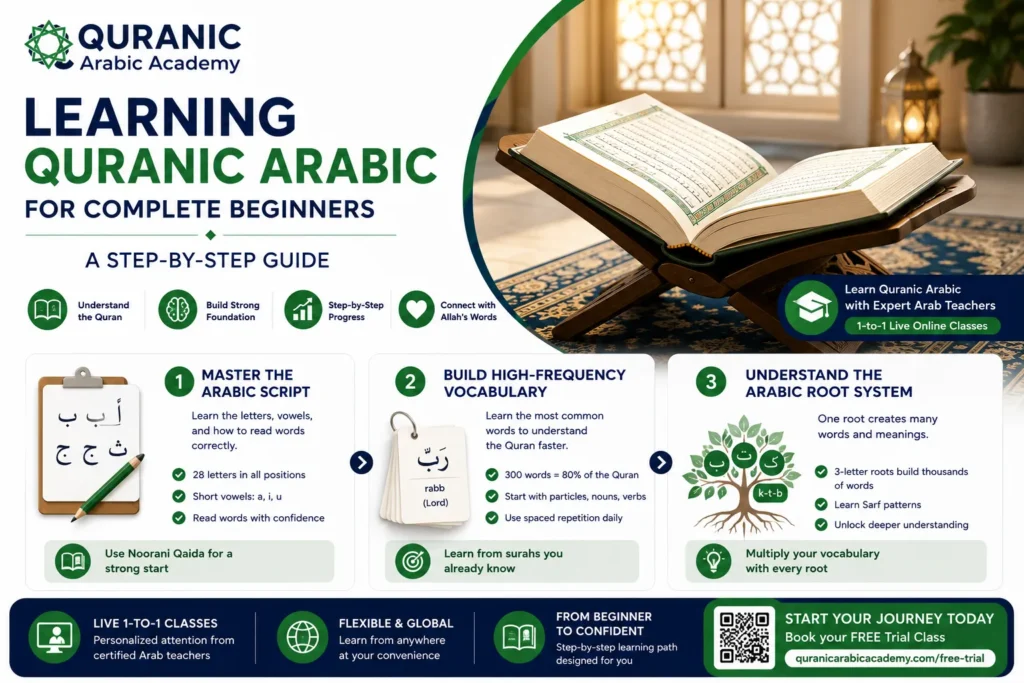
1. The Three Word Types Form the Entire Foundation of Quranic Arabic
Every single word in the Quran belongs to one of three categories: a noun (Ism), a verb (Fi’l), or a particle (Harf). This classification determines how a word behaves, how its ending changes, and what role it plays within a sentence. No learner can progress in the essentials of Quranic Arabic without internalizing this distinction before anything else.
The three categories are:
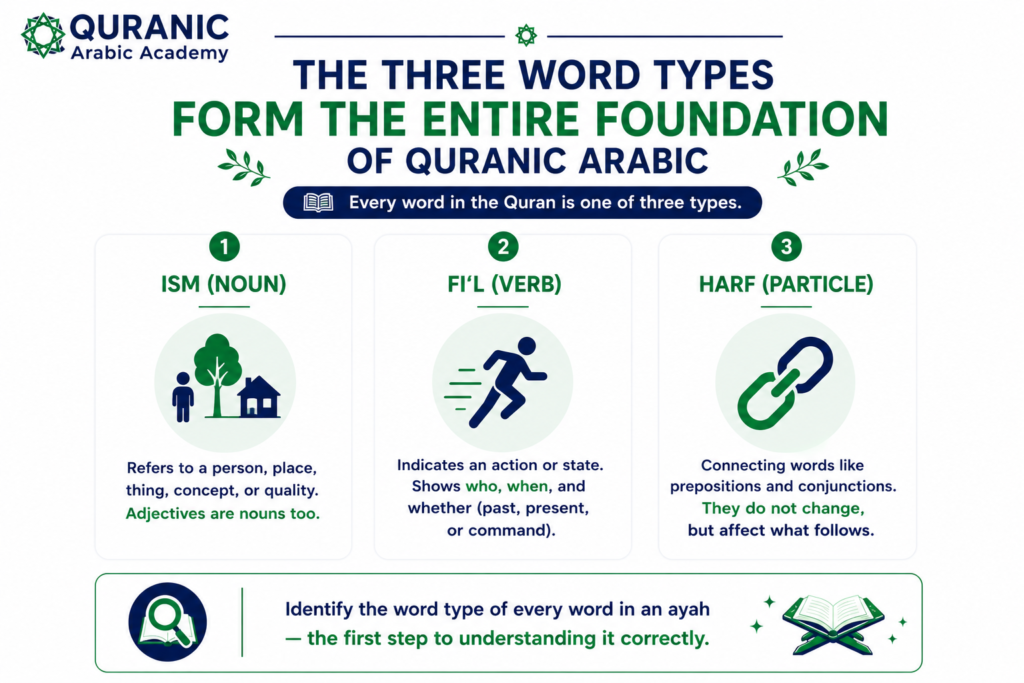
- Ism (Noun): Any word referring to a person, place, thing, concept, or quality. Adjectives in Arabic are also classified as nouns, which surprises most beginners but makes Quranic sentence parsing far more predictable once understood.
- Fi’l (Verb): Any word indicating an action or state. Arabic verbs encode who performed the action and when — past, present, or command — all within the word’s own form.
- Harf (Particle): Connecting or relational words such as prepositions and conjunctions. Particles do not change their own form, but they directly govern the case endings of the words that follow them.
Identifying the word type of every word in an ayah is the first step in any correct grammatical analysis. A learner who skips this step and relies on recognizing familiar roots guesses at meaning rather than extracting it accurately.
The Best Quranic Arabic Classes at The Quranic Arabic Academy teach these foundational concepts through direct ayah analysis from the very first session, with certified Arab tutors correcting grammatical misidentification in real time.
Start Your Quranic Arabic Journey Today
2. The Arabic Case System Determines the Role of Every Noun in the Quran
Quranic Arabic uses a case system called I’rab, which marks the grammatical role of every noun through a specific vowel sound at the end of the word. There are three cases, and every noun in the Quran carries one of them:
| Case | Arabic Term | Vowel Marker | Grammatical Role |
| Nominative | Raf’ | Damma (ـُ) | Subject of a sentence |
| Accusative | Nasb | Fatha (ـَ) | Object of a verb or certain particles |
| Genitive | Jarr | Kasra (ـِ) | After prepositions or in possessive constructions |
Non-Arab learners consistently underestimate I’rab because they focus on recognizing root words and inferring meaning from context. This approach fails at the intermediate level, where case endings are the only signal distinguishing who performed an action from who received it. Two sentences using identical root words can carry opposite meanings based on their I’rab alone.
Idafa — the possessive construction — is the most frequent application of the Jarr case in the Quran. In an Idafa, the first noun is the item being described and the second noun takes Kasra.
This structure appears in the Quran’s most central expressions: رَبِّ الْعَالَمِينَ (Lord of the Worlds), يَوْمِ الدِّينِ (Day of Judgment), كِتَابُ اللَّهِ (Book of Allah). Recognizing Idafa allows a learner to extract accurate meaning from unfamiliar Quranic phrases from the earliest stages of study.
See It in Action:
Wondering what our interactive sessions look like? Click below to peek inside a live session and watch how our expert instructors make learning Quranic Arabic accessible and engaging.
Ready to Begin Your Quranic Journey?
Start learning with professional instructors through our structured curriculum.
Book Your Free Trial3. The Nominal and Verbal Sentence Structures Cover Most Quranic Ayat
Arabic sentences divide into two types: the nominal sentence (Jumlah Ismiyyah), which begins with a noun, and the verbal sentence (Jumlah Fi’liyyah), which begins with a verb. Identifying which type an ayah uses is one of the most immediately practical essentials of Quranic Arabic, because each type conveys a fundamentally different kind of meaning.
A nominal sentence consists of a subject (Mubtada) and a predicate (Khabar), both in Raf’ case. The Mubtada is almost always definite. Nominal sentences in Arabic carry a sense of permanence and established fact — which is precisely why the Quran uses them for its most foundational declarations about Allah’s nature, His attributes, and His absolute sovereignty.
A learner who cannot identify the Mubtada and Khabar in a nominal sentence cannot correctly parse these declarations.
A verbal sentence begins with a verb, followed by its subject and then its object (for transitive verbs). The most common word order in the Quran is Verb — Subject — Object, which differs from English and requires deliberate adjustment.
Every Quranic narrative — the stories of the prophets, the events of the Day of Judgment — and every divine command directed at believers uses this structure. Knowing how to locate the verb, identify its subject, and find its object allows a learner to reconstruct the full meaning of any narrative ayah correctly.
The Arabic Courses for Understanding the Quran at The Quranic Arabic Academy train learners to identify both sentence types across actual Quranic text, building comprehension that transfers directly to independent Quran reading.
Enroll in Arabic Courses for Understanding the Quran
4. Nahw and Sarf Together Build Complete Quranic Grammar Competence
The study of Quranic Arabic grammar divides into two disciplines. Nahw governs syntax — how words relate to each other within a sentence, what case endings they carry, and how word order and grammatical position shape meaning.
Sarf governs morphology — how words are formed from roots, how verbs are conjugated across tenses and persons, and how a single three-letter root generates dozens of related words with distinct meanings.
These two disciplines cannot be separated in practice. A learner who studies Nahw without Sarf can identify sentence structures but cannot recognize verb forms or explain why a word takes the shape it does. A learner who studies Sarf without Nahw can identify word patterns but cannot determine how each word functions within the sentence.
The goal of combining both is specific: to reach the point where a learner can open the Quran at any page and construct the meaning of an unfamiliar ayah accurately, without relying on a pre-existing translation.
The ten verb form patterns (Awzan) are the most important Sarf content any beginner must master. Each pattern modifies a root’s meaning in a systematic and predictable way. Understanding why نَزَّلَ (sent down repeatedly) differs from نَزَلَ (descended once) is a Sarf distinction with direct consequences for understanding Tafsir.
These differences are invisible to a learner who has not studied verb patterns and are the source of many translation errors among self-taught students.
Read also: How to Make Your Quran Recitation More Beautiful and Accurate
5. Essentials of Quranic Arabic Volume 1 Teaches Grammar Through the Quran Itself
Essentials of Quranic Arabic Volume 1 by Masood Ranginwala is a textbook built specifically for non-Arab learners who want Quran comprehension rather than conversational fluency.
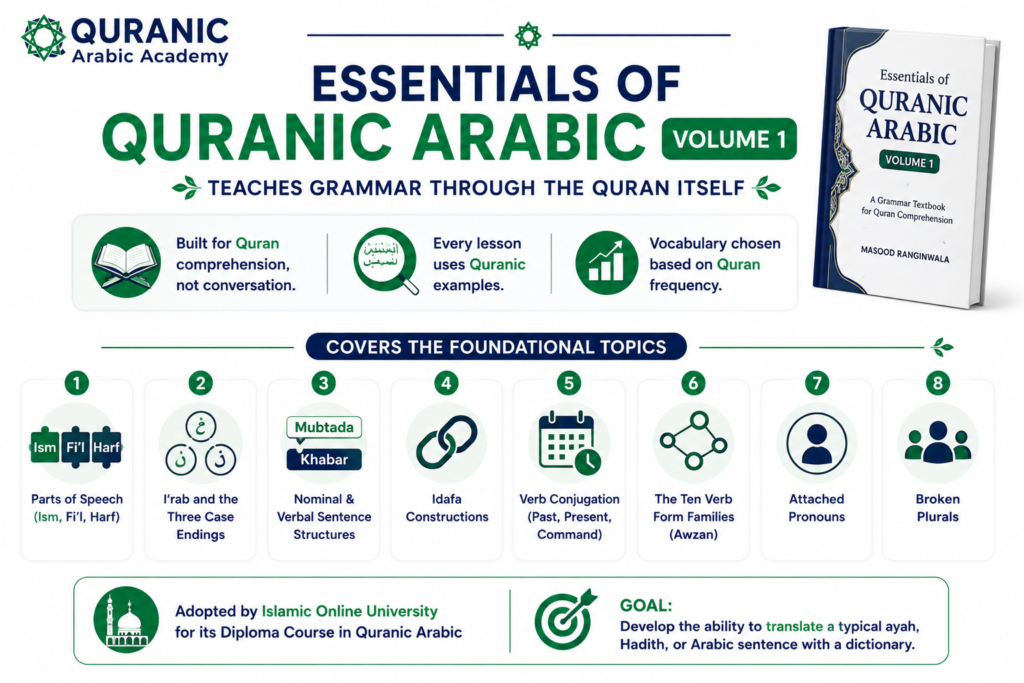
Its methodology differs from other Arabic grammar books in one key respect: conversational Arabic and vocabulary unrelated to the Quran are not emphasized. Every grammar principle is taught through Quranic examples, and vocabulary is selected based on how frequently each word appears in the Quran.
The book covers the foundational topics every beginner needs, progressing in a step-by-step sequence:
- Parts of speech (Ism, Fi’l, Harf) and how to identify them in Quranic text.
- I’rab and the three case endings, with examples drawn from actual ayat.
- Nominal sentence structure (Mubtada and Khabar) and verbal sentence structure.
- Idafa constructions and how possessive relationships are expressed throughout the Quran.
- Verb conjugation across past, present, and command tenses for all persons and genders.
- The ten verb form families (Awzan) and the systematic meaning changes each pattern produces.
- Attached pronouns and how they function on nouns, verbs, and prepositions.
- Broken plurals — the irregular plural forms that appear throughout Quranic vocabulary.
This textbook was adopted by Islamic Online University for its Diploma Course Series in Quranic Arabic, which reflects the rigor of its approach. The stated goal of Volume 1 is to develop the ability to translate a typical ayah from the Quran, a Hadith, or an Arabic sentence with the aid of a dictionary — not to produce conversational speakers.
The Online Quranic Arabic Classes for Adults at The Quranic Arabic Academy provide exactly the structured, teacher-led environment that makes working through this level of grammar content productive rather than overwhelming, with one-on-one sessions tailored to each learner’s pace and mistakes.
Enroll in Online Quranic Arabic Classes for Adults
6. High-Yield Quranic Vocabulary Accelerates Comprehension Faster Than Any Other Method
Grammar alone does not produce Quranic comprehension. A learner who has mastered every Nahw rule but knows no vocabulary cannot translate a single ayah. The essentials of Quranic Arabic therefore require a deliberate approach to vocabulary acquisition — one focused on words that appear most frequently in the Quran rather than words drawn from conversational or modern Arabic.
The principle behind high-yield Quranic vocabulary is straightforward: a small number of words accounts for a large proportion of the Quran’s total text. The 200 most frequent words in the Quran account for approximately 80% of its content by occurrence.
A learner who prioritizes these words gains the ability to recognize the majority of what they encounter in any ayah, long before they have memorized thousands of words.
Essentials of Quranic Arabic Volume 1 builds vocabulary lists directly from Quranic occurrence frequency, meaning every word a learner memorizes from the textbook is immediately applicable to actual Quran reading.
This is the clearest structural difference between a Quran-focused grammar resource and a general Arabic language textbook — and it is the difference that determines whether a learner sees progress within months or spends years acquiring vocabulary that does not appear in the Quran at all.
7. Quranic Arabic Is a Classical Language Distinct from Modern Arabic
A common misconception among non-Arab learners is that studying spoken or modern standard Arabic will lead to Quran comprehension. Quranic Arabic is a preserved classical form of the language — referred to as Al-Fusha, meaning the most eloquent — that shares grammatical structures with modern standard Arabic but differs in vocabulary, style, and the precision of its grammatical application.
The differences matter practically:
| Feature | Quranic Arabic | Modern Standard Arabic |
| Primary goal | Understand the Quran and classical Islamic texts | Modern media, press, and formal communication |
| Vocabulary focus | Quranic and classical terms | Contemporary terms and expressions |
| Grammar precision | Full I’rab application throughout | I’rab often dropped in practice |
| Verb forms studied | All ten Awzan with classical usage | Simplified forms emphasizing common usage |
| Learning outcome | Quran comprehension and Tafsir access | Reading newspapers and formal correspondence |
A learner who invests time in conversational Arabic study and expects this to transfer to Quran understanding will consistently find the transfer incomplete. Quranic Arabic requires its own dedicated study path, using resources and teachers who specialize in the classical form rather than its modern variant.
Read also: The Ultimate Guide to Quranic Arabic Dictionaries and Vocabulary
8. A Qualified Teacher Prevents Grammar Errors from Becoming Permanent
Many learners of Quranic Arabic attempt self-study using textbooks, apps, or recorded lectures. The fundamental problem with self-study is not pace — it is error detection.
A learner who misidentifies a word type, misapplies a case ending, or incorrectly parses a sentence structure will repeat that error in every subsequent exercise. Without a teacher present to correct it immediately, the error becomes part of how the learner understands the language.
By the time a self-taught student has completed twenty lessons with a consistent grammatical misunderstanding embedded in their approach, correcting it requires unlearning before relearning — a process far more difficult than building accuracy from the start. A qualified teacher catches these errors when they first appear, before repetition converts a misunderstanding into a habit.
The Prophet ﷺ emphasized the connection between intention and outcome in every act of learning:
“إِنَّمَا الأَعْمَالُ بِالنِّيَّاتِ، وَإِنَّمَا لِكُلِّ امْرِئٍ مَا نَوَى”
“The reward of deeds depends upon the intentions and every person will get the reward according to what he has intended.”
Approaching Quranic Arabic study with sincere intention and a structured method — including a qualified teacher — is the combination that produces lasting comprehension rather than surface-level familiarity.
The Quranic Arabic for Beginners course at The Quranic Arabic Academy is designed for learners who are starting from zero, with certified Arab tutors providing real-time correction of grammatical errors, Makharij, and sentence parsing from the very first lesson.
Experience Our Teaching Style:
We believe in clarity and engagement. Watch these short highlights from our actual classes to see our teachers’ methodology and student interactions in real-time.
Ready to Begin Your Quranic Journey?
Start learning with professional instructors through our structured curriculum.
Book Your Free Trial
Enroll in Quranic Arabic for Beginners
Start Building Quranic Comprehension with The Quranic Arabic Academy
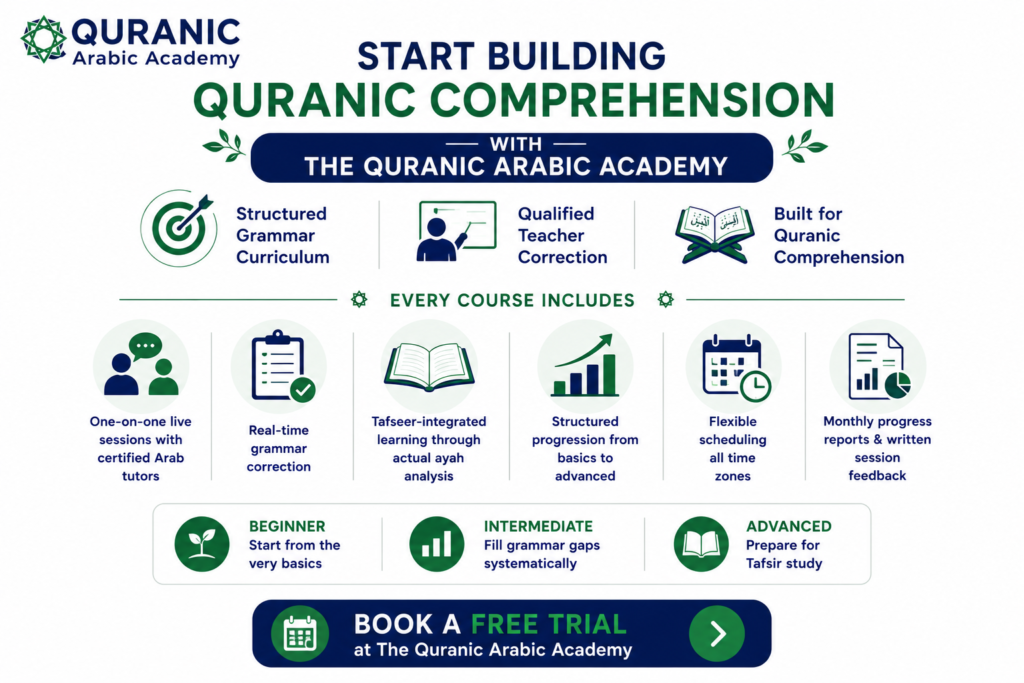
Most non-Arab Muslims who struggle to understand the Quran are not lacking motivation — they are lacking a structured grammar curriculum, qualified teacher correction, and a learning system built specifically for Quranic comprehension rather than general Arabic.
The Quranic Arabic Academy provides all three through its complete range of courses, delivered one-on-one with certified Arab instructors holding recognized qualifications in Islamic studies.
Every course at The Quranic Arabic Academy includes:
- One-on-one live sessions with certified Arab tutors holding Ijazah or recognized degrees in Islamic studies.
- Real-time grammar correction so every I’rab, Idafa, and sentence parsing error is caught before it becomes embedded.
- Tafseer-integrated learning — Nahw and Sarf taught through actual ayah analysis rather than abstract grammar drills.
- Structured progression from foundational word types through to advanced sentence structures and verb patterns.
- Flexible scheduling covering all global time zones, with sessions designed to fit around work, family, and daily commitments.
- Monthly progress reports and written session feedback so learners track exactly where they stand.
Whether you are a complete beginner approaching Arabic letters for the first time, an intermediate learner who wants to systematically fill grammar gaps, or an advanced student preparing for Tafsir study, there is a course built for your exact level and goal.
Our Arabic Courses
- Quranic Arabic Classes
- Quranic Arabic Course for Beginners
- Online Quranic Arabic Courses for Advanced Learners
- Quranic Arabic Grammar Course
- Arabic Courses for Understanding the Quran
- Quranic Arabic Course for Sisters (Female)
- Quranic Arabic Course for Kids
- Online Quranic Arabic Classes for Adults
- Quranic Arabic Course UK
- Quranic Arabic Course London
- Quranic Arabic Course USA
- Quranic Arabic Course Canada
- Quranic Arabic Course Australia
- Quranic Arabic Course UAE
- Quranic Arabic Course Germany
Book a Free Trial at The Quranic Arabic Academy
Conclusion
The essentials of Quranic Arabic provide the foundation for understanding rather than simply reciting the Quran. Mastering the three word types, I’rab, Idafa, sentence structures, Nahw, and Sarf builds genuine Quranic comprehension. Structured resources such as Essentials of Quranic Arabic Volume 1, combined with guidance from a qualified teacher, help learners progress accurately from recitation toward understanding.
Frequently Asked Questions
What is the first thing a non-Arab learner should study in Quranic Arabic?
Begin with the three Arabic word types — Ism, Fi’l, and Harf — and the I’rab case system. These two foundations determine how every word in the Quran functions and cannot be skipped.
Is Essentials of Quranic Arabic Volume 1 suitable for complete beginners?
Yes.The book progresses from foundational concepts step by step, with grammar explained through Quranic examples. It is used by Islamic Online University for its introductory Quranic Arabic diploma series.
How is Quranic Arabic different from modern Arabic?
Quranic Arabic is a preserved classical form that applies full I’rab, uses classical vocabulary specific to the Quran, and requires dedicated study separate from conversational or modern standard Arabic.
How long does it take to understand the Quran through Quranic Arabic study?
With consistent study of around five hours per week, basic Nahw and I’rab takes four to eight months. Meaningful Quranic comprehension typically develops within twelve to eighteen months of focused grammar and vocabulary study.
Why is a qualified teacher necessary for learning Quranic Arabic?
A teacher catches grammatical misidentifications and parsing errors the moment they occur, preventing them from becoming permanent habits that require unlearning later.




Leave a Reply