 Learn Quranic Arabic
Many Muslims recite the Quran daily yet remain unable to answer a basic question: how do scholars know what a verse actually means? A verse is heard in the Friday khutbah, encountered in a study circle, or recited in Salah — but the methodology behind its interpretation remains invisible. This is not a minor gap. It is the difference between receiving the Quran as a set of sounds and receiving it as guidance.
Quranic hermeneutics is the science that makes interpretation principled rather than arbitrary. It is what separates qualified Quranic scholarship from personal opinion dressed in religious language — and every Muslim who wants to understand Allah’s Book deserves to know how it works.
Quranic Hermeneutics Defines the Science of Tafsir
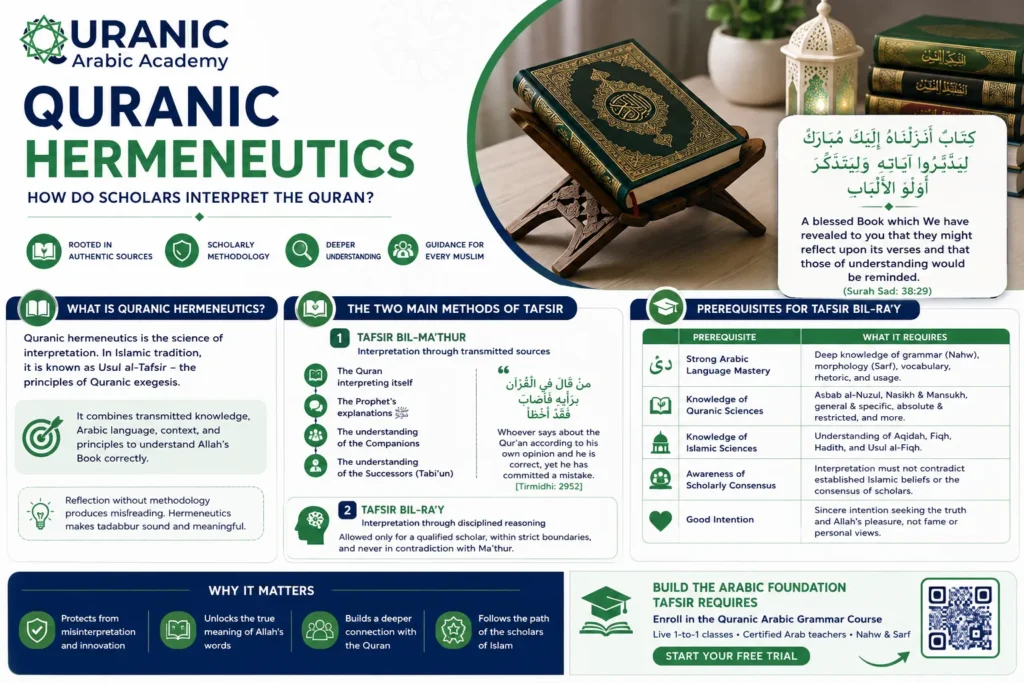
Quranic hermeneutics is the systematic study of the theories, methods, and principles that govern how the Quran is interpreted. The word hermeneutics itself refers to the theory of interpretation — when applied to the Quran, it encompasses every scholarly discipline that determines how a verse is understood correctly.
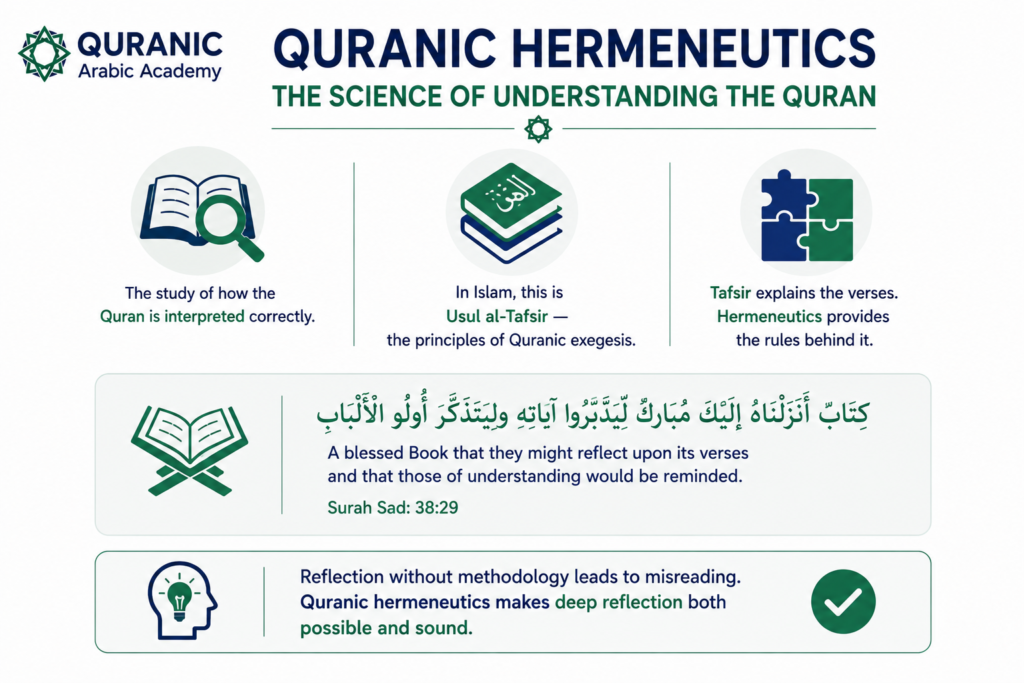
In the Islamic tradition, this science is known as Usul al-Tafsir — the principles of Quranic exegesis. It is not a single method but a complete framework that includes transmitted narrations, Arabic linguistic analysis, historical context, and principles for handling ambiguous verses.
The two terms — hermeneutics and tafsir — overlap significantly. Tafsir refers to the practical verse-by-verse explanation of the Quran. Hermeneutics refers to the governing theory behind that explanation. Together they form the complete science of Quranic interpretation.
The Quran itself calls Muslims toward principled reflection on its verses:
“كِتَابٌ أَنزَلْنَاهُ إِلَيْكَ مُبَارَكٌ لِّيَدَّبَّرُوا آيَاتِهِ وَلِيَتَذَكَّرَ أُولُو الْأَلْبَابِ”
Kitābun anzalnāhu ilayka mubārakun liyaddabbarū āyātihi wa-liyatadhakkara ulū al-albāb.
“[This is] a blessed Book which We have revealed to you, [O Muhammad], that they might reflect upon its verses and that those of understanding would be reminded.”
Reflection without methodology produces misreading. Quranic hermeneutics is the discipline that makes tadabbur — deep Quranic reflection — both possible and sound.
Non-Arab learners who want to move beyond translation and engage with tafsir directly need a real Arabic foundation. The Quranic Arabic Grammar Course at The Quranic Arabic Academy teaches the grammatical sciences — Nahw and Sarf — that classical tafsir scholarship is built upon, through live one-on-one sessions with certified Arab instructors.
Read also: Quranic Reflections – The Complete Guide to Tadabbur and Its Daily Practice
[Build the Arabic Foundation Tafsir Requires]
Tafsir Bil-Ma’thur Grounds Interpretation in Transmitted Sources
The first and most authoritative method in Quranic hermeneutics is Tafsir Bil-Ma’thur — interpretation through transmitted knowledge. It relies exclusively on sources that carry chain-verified authority, arranged in a strict hierarchy that scholars have followed since the first century of Islam.
The sources of Tafsir Bil-Ma’thur are ordered as follows:
- The Quran interpreting itself: One verse clarifies another. A general command in one surah is specified by a verse elsewhere. This is considered the most authoritative level because the meaning comes directly from divine speech.
- The Prophet’s explanations: The Prophet ﷺ was the first interpreter of the Quran, and his clarifications are preserved in authenticated hadith. His explanations carry a weight no later scholar can match.
- The understanding of the Companions: The Companions witnessed the revelation, lived alongside the Prophet ﷺ, and learned from him directly. Their interpretations are authoritative because their context is unmatched.
- The understanding of the Successors (Tabi’un): Those who learned from the Companions form the final tier of transmitted authority in this method.
The Prophet ﷺ warned against interpreting the Quran from personal opinion alone:
“مَنْ قَالَ فِي الْقُرْآنِ بِرَأْيِهِ فَأَصَابَ فَقَدْ أَخْطَأَ”
“Whoever says (something) about the Qur’an according to his own opinion and he is correct, yet he has committed a mistake.”
This narration explains why Tafsir Bil-Ma’thur became the dominant method across fourteen centuries of Islamic scholarship. Being accidentally correct is not the same as being methodologically sound.
Read also: Quranic Principles – The 8 Foundational Values
See It in Action:
Wondering what our interactive sessions look like? Click below to peek inside a live session and watch how our expert instructors make learning Quranic Arabic accessible and engaging.
Ready to Begin Your Quranic Journey?
Start learning with professional instructors through our structured curriculum.
Book Your Free TrialTafsir Bil-Ra’y Applies Disciplined Reasoning Under Strict Conditions
The second major method is Tafsir Bil-Ra’y — interpretation through scholarly reasoning. This method is not personal opinion. It is structured, disciplined reasoning applied within boundaries that classical scholars defined carefully over generations.
Tafsir Bil-Ra’y is only considered valid when the scholar applying it satisfies a set of prerequisites:
| Prerequisite | What It Requires |
| Mastery of Classical Arabic | Full command of grammar, morphology, and Arabic rhetoric |
| Knowledge of Asbab al-Nuzul | Understanding the historical occasion behind each relevant verse |
| Knowledge of Naskh | Knowing which rulings were abrogated and what replaced them |
| Familiarity with Muhkam and Mutashabih | Ability to distinguish clear verses from ambiguous ones |
| Consistency with transmitted sources | No contradiction with authentic hadith or Companion understanding |
Where these conditions are met, Tafsir Bil-Ra’y has produced some of the most important works in the Islamic scholarly tradition — covering legal derivation, theological analysis, and linguistic depth. Where they are not met, the result is forbidden personal opinion that the Prophet ﷺ explicitly warned against.
The distinction between valid scholarly reasoning and forbidden personal opinion is not always visible from the outside. This is precisely why Quranic hermeneutics requires formal study under qualified scholars — not self-guided reading of translated summaries.
Read also: Qur’anic Punctuation: The Complete Guide to Waqf Signs and Recitation Rules
Asbab al-Nuzul Connects Each Verse to Its Moment of Revelation
Asbab al-Nuzul — literally “the occasions of revelation” — refers to the specific historical events, questions, or circumstances that caused particular Quranic verses to be revealed during the Prophet’s ﷺ lifetime. It is a non-negotiable tool in Quranic hermeneutics.
Understanding why a verse was revealed determines how it is applied. A verse revealed in response to a specific question from the Companions may carry a universal ruling, or it may be limited to its specific context. Without knowing the occasion, a reader cannot make that determination.
There are two specific errors that Asbab al-Nuzul prevents:
- Over-application: Treating a verse that addressed a specific historical event as a universal, unlimited ruling for all times.
- Under-application: Treating a universal divine command as though it only applied to the people of that moment.
Classical scholars collected and verified narrations about occasions of revelation with the same rigor they applied to hadith — evaluating chains of transmission, identifying weak reports, and preserving only what could be reliably established. This discipline became a specialized branch of Quranic sciences in its own right.
The Quran commands Muslims not to follow what they do not have knowledge of:
“وَلَا تَقْفُ مَا لَيْسَ لَكَ بِهِ عِلْمٌ ۚ إِنَّ السَّمْعَ وَالْبَصَرَ وَالْفُؤَادَ كُلُّ أُولَٰئِكَ كَانَ عَنْهُ مَسْئُولًا”
Wa-lā taqfu mā laysa laka bihi ‘ilmun inna al-sam’a wa-al-baṣara wa-al-fu’āda kullu ulā’ika kāna ‘anhu mas’ūlā. “And do not pursue that of which you have no knowledge.
And do not pursue that of which you have no knowledge. Indeed, the hearing, the sight and the heart – about all those [one] will be questioned.”
Engaging with Quranic meaning without knowledge of its context is precisely what this verse guards against. Asbab al-Nuzul is a foundational part of that contextual knowledge.
Accessing Asbab al-Nuzul material in its original Arabic sources requires genuine Quranic vocabulary and reading ability. The Arabic Courses for Understanding the Quran at The Quranic Arabic Academy are built specifically to develop the comprehension skills that allow non-Arab Muslims to engage with primary Quranic scholarship rather than relying solely on secondary translations.
[Start Reading the Quran With Real Comprehension]
Muhkam and Mutashabih Determine How Every Verse Is Approached
One of the most essential classification tools in Quranic hermeneutics is the division of all Quranic verses into two categories: Muhkam and Mutashabih. The Quran itself establishes this classification.
“هُوَ الَّذِي أَنزَلَ عَلَيْكَ الْكِتَابَ مِنْهُ آيَاتٌ مُّحْكَمَاتٌ هُنَّ أُمُّ الْكِتَابِ وَأُخَرُ مُتَشَابِهَاتٌ ۖ”
Huwa alladhī anzala ‘alayka al-Kitāba minhu āyātun muḥkamātun hunna ummu al-Kitābi wa-ukharu mutashābihāt.
“It is He who has sent down to you, [O Muhammad], the Book; in it are verses [that are] precise – they are the foundation of the Book – and others unspecific.”
This verse is itself a hermeneutical instruction embedded in the Quran. It establishes that not all verses carry the same interpretive status, and that the Muhkam verses must serve as the anchor for understanding the Mutashabih ones.
The two categories function as follows:
| Category | Meaning | Role in Hermeneutics |
| Muhkam | Clear verses with established, unambiguous meaning | Serve as the interpretive anchor for the entire Quran |
| Mutashabih | Verses with multiple possible meanings or requiring further interpretation | Must be interpreted in light of the Muhkam verses |
A common example is the category of verses that describe Allah’s attributes — His hand, His face, His settling over the Throne. These are Mutashabih verses. Scholars apply strict hermeneutical rules when approaching them, grounding interpretation in the Muhkam principle that nothing resembles Allah, rather than imposing literal human meanings onto divine speech.
Ignoring this classification — treating Mutashabih verses as though they carry the same directness as Muhkam verses — is one of the most common sources of deviant interpretation across Islamic history.
Read also: Quranic Epistemology – Islam’s Complete Theory of Knowledge
Classical Tafsir Works Applied These Principles Across the Quran
Quranic hermeneutics did not remain theoretical. Scholars across generations produced comprehensive tafsir works that applied these methods systematically to every verse of the Quran. Three works established the standards that all subsequent scholarship has engaged with.
Tafsir al-Tabari, compiled in the third century of Islam, set the methodological foundation for the entire tradition. It compiled transmitted narrations with complete chains of authority, evaluated conflicting reports, applied Arabic linguistic analysis, and reached reasoned conclusions about the strongest interpretation of each verse. It remains the most comprehensive reference in transmission-based tafsir.
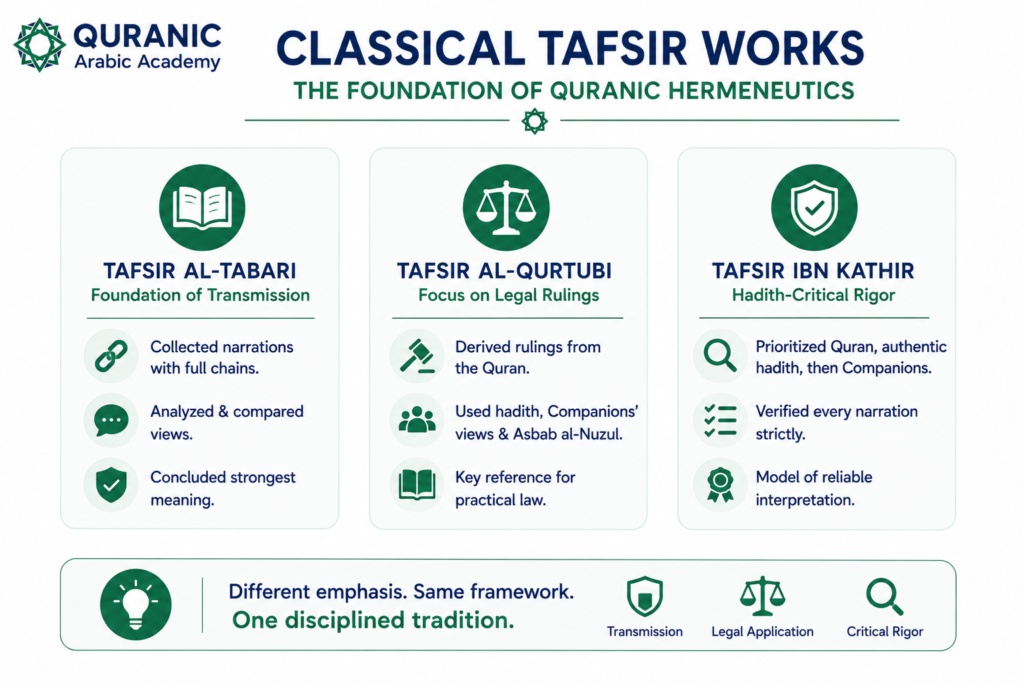
Tafsir al-Qurtubi focused on extracting legal rulings from the Quran. It drew on the Quran, authenticated hadith, the views of the Companions and Successors, Asbab al-Nuzul narrations, Arabic linguistic analysis, and the positions of the major legal schools. For legal and practical application of Quranic guidance, it remains a primary reference.
Tafsir Ibn Kathir applied the strictest standards of hadith authentication to Quranic interpretation. It prioritized the Quran explaining itself, then authenticated prophetic narrations, then Companion understanding — and critically evaluated every narration it included. Its rejection of unverified secondary narratives made it a defining model for transmission-based hermeneutics.
Each of these works represents a different emphasis within the same hermeneutical framework — transmitted authority, legal application, and hadith-critical rigor. Together they show that Quranic hermeneutics is not a single rigid method but a disciplined tradition with internal breadth.
Arabic Is Not a Supplement to Quranic Hermeneutics — It Is Its Entry Point
Every method in Quranic hermeneutics depends on Arabic. Tafsir Bil-Ma’thur requires reading transmitted narrations in their original Arabic form. Tafsir Bil-Ra’y requires mastery of Arabic grammar, morphology, and rhetoric as a prerequisite for validity. Asbab al-Nuzul literature is preserved in Arabic. The distinction between Muhkam and Mutashabih often turns on a single Arabic word and its range of meanings.
A non-Arab learner who reads only English translations of tafsir is not engaging with Quranic hermeneutics. They are reading one scholar’s interpretation of another scholar’s interpretation of the Quran — with every layer of Arabic nuance filtered out before it reaches them.
The Prophet ﷺ specifically connected the Arabic language of the Quran to the obligation of understanding it:
“إِنَّا أَنزَلْنَاهُ قُرْآنًا عَرَبِيًّا لَّعَلَّكُمْ تَعْقِلُونَ ”
Innā anzalnāhu Qur’ānan ‘arabiyyan la’allakum ta’qilūn.
“Indeed, We have sent it down as an Arabic Qur’an that you might understand.”
The Arabic is not incidental to the meaning — the Arabic is the meaning. Every serious engagement with Quranic hermeneutics begins with the language.
Experience Our Teaching Style:
We believe in clarity and engagement. Watch these short highlights from our actual classes to see our teachers’ methodology and student interactions in real-time.
Ready to Begin Your Quranic Journey?
Start learning with professional instructors through our structured curriculum.
Book Your Free TrialBegin Your Quranic Arabic Journey with The Quranic Arabic Academy
Most non-Arab Muslims who want to understand the Quran are not lacking motivation. They are lacking a structured Arabic programme that connects directly to tafsir and Quranic comprehension — taught by qualified scholars who understand both the language and the science of interpretation.
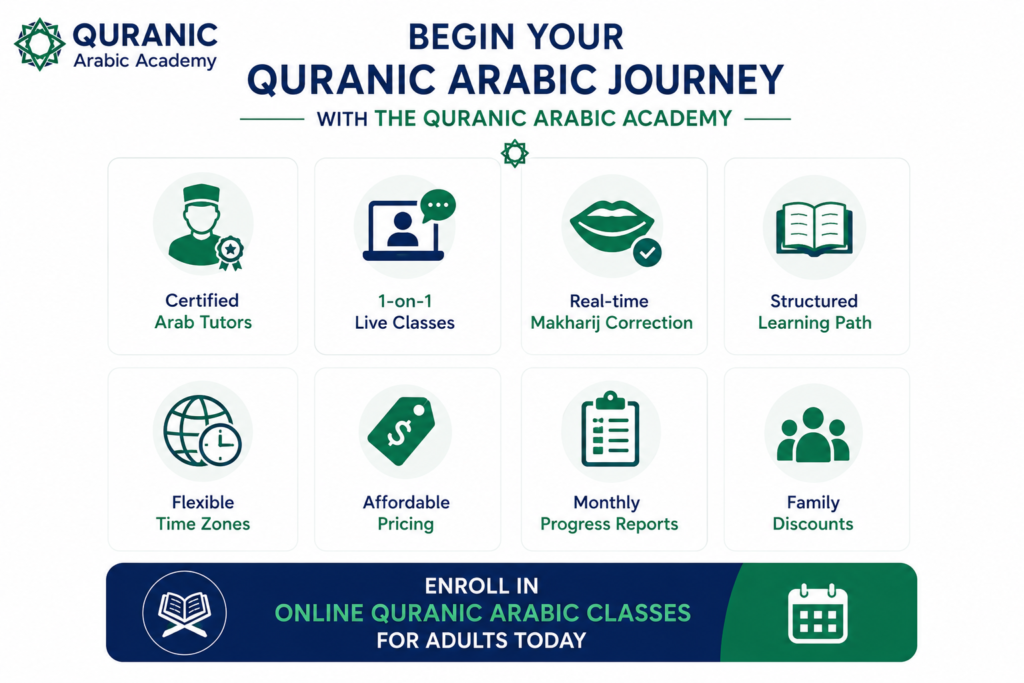
The Quranic Arabic Academy provides the complete framework for non-Arab learners globally:
- Certified Arab tutors holding Ijazah in recitation or degrees in Islamic studies from recognized institutions.
- One-on-one live sessions tailored specifically to each student’s individual progress and gaps.
- Real-time Makharij correction and grammatical feedback during every session.
- Structured progression from Noorani Qaida through Quranic Arabic Grammar to Tafsir-integrated study.
- Flexible scheduling across all global time zones — EST, PST, GMT, CET, IST, GST, and MYT.
- Affordable pricing with transparent packages and family enrollment discounts.
- Monthly progress reports and written feedback provided after every session.
Our Arabic Courses
- Quranic Arabic Classes
- Quranic Arabic Course for Beginners
- Online Quranic Arabic Courses for Advanced Learners
- Quranic Arabic Grammar Course
- Arabic Courses for Understanding the Quran
- Quranic Arabic Course for Sisters (Female)
- Quranic Arabic Course for Kids
- Online Quranic Arabic Classes for Adults
- Quranic Arabic Course UK
- Quranic Arabic Course London
- Quranic Arabic Course USA
- Quranic Arabic Course Canada
- Quranic Arabic Course Australia
- Quranic Arabic Course UAE
- Quranic Arabic Course Germany
Enroll in Online Quranic Arabic Classes for Adults Today
Ready to Begin Your Quranic Journey?
Start learning with professional instructors through our structured curriculum.
Book Your Free TrialConclusion
Quranic hermeneutics is the science that separates principled Islamic scholarship from personal opinion. It governs how the Quran is interpreted through transmitted authority, disciplined reasoning, contextual knowledge, and Arabic linguistic mastery — and it has done so for over fourteen centuries of unbroken scholarly tradition.
For non-Arab Muslims seeking to understand Allah’s Book beyond the surface level of recitation, engaging with this science is the essential next step — and that engagement begins with the Arabic language that makes the Quran what it is.
Frequently Asked Questions
What is Quranic hermeneutics in simple terms?
Quranic hermeneutics is the science of how scholars interpret the Quran. It covers the methods, principles, and tools used to determine what Quranic verses mean correctly and avoid misinterpretation.
How is Quranic hermeneutics different from tafsir?
Tafsir is the practical verse-by-verse explanation of the Quran. Quranic hermeneutics is the governing theory and methodology behind that explanation. Tafsir is what scholars produce; hermeneutics is the science that governs how they produce it.
What are the two main methods in Quranic hermeneutics?
The two main methods are Tafsir Bil-Ma’thur, which interprets the Quran through transmitted sources such as hadith and Companion understanding, and Tafsir Bil-Ra’y, which applies structured scholarly reasoning within established Islamic principles.
Why is Arabic necessary for Quranic hermeneutics?
Every method in Quranic hermeneutics depends on Arabic. Transmitted narrations, grammatical analysis, and the distinction between clear and ambiguous verses all require direct engagement with Arabic. Without Arabic, a learner can only access filtered translations, not the science itself.
What is the role of Asbab al-Nuzul in Quranic hermeneutics?
Asbab al-Nuzul refers to the historical occasions that caused specific verses to be revealed. It is a foundational tool that prevents over-application or under-application of Quranic verses by anchoring their meaning in the context in which Allah revealed them.
What is the difference between Muhkam and Mutashabih verses?
Muhkam verses are clear and unambiguous — they form the interpretive foundation of the Quran. Mutashabih verses contain multiple possible meanings and must be interpreted in light of the Muhkam verses. This distinction governs how scholars approach every verse they interpret.
Related Articles
Learn Quranic Arabic





Leave a Reply