 Quranic Grammar
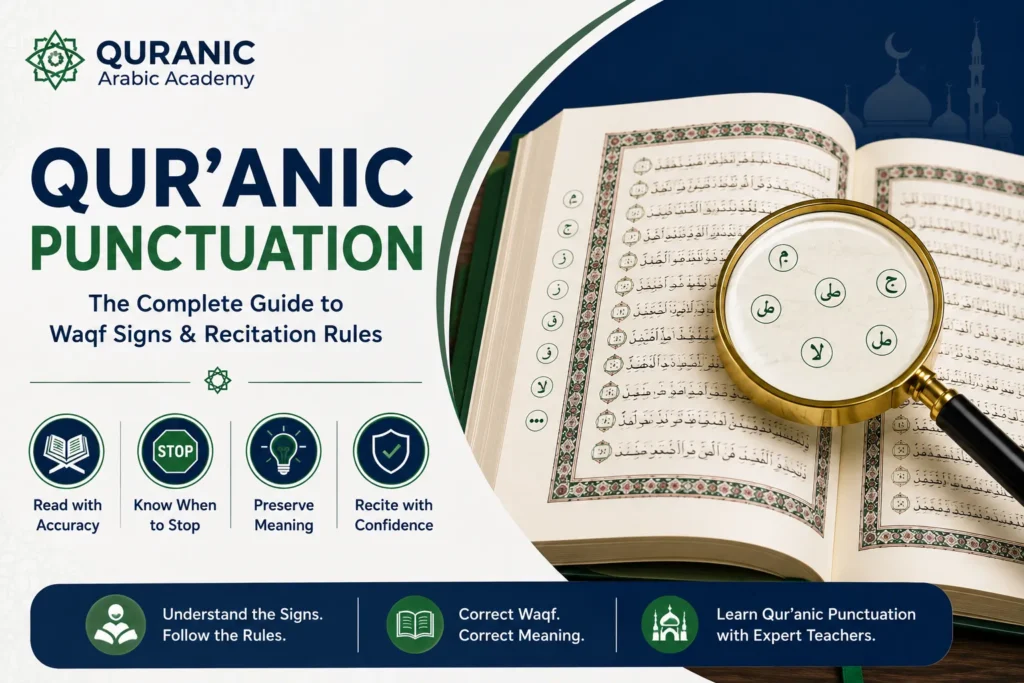
The small symbols in the Mushaf, such as م, ج, and لا, are Qur’anic punctuation marks that guide the reciter on where to stop or continue. They are essential for preserving meaning during recitation. Waqf knowledge is therefore a fundamental part of correct Quran reading, alongside accurate letter pronunciation. This guide explains the primary punctuation signs, what each requires from the reciter, and how to apply Arabic punctuation Quran with Tajweed correctly.
Qur’anic Punctuation Has a Scholarly Origin and a Divine Purpose
The original Mushaf written during the time of the companions contained no Waqf signs. The Quran was transmitted orally, from teacher to student, in an unbroken chain stretching back to the Prophet (PBUH) himself. As Islam expanded beyond the Arab world and non-Arab Muslims began reciting the Quran, scholars recognized an urgent need to formalize the rules of stopping.
Allah commands this precision directly:
“وَرَتِّلِ الْقُرْآنَ تَرْتِيلًا ”
Wa rattili al-qur’ana tartila.
“and recite the Qur’an with measured recitation.”
When Ali ibn Abi Talib (may Allah be pleased with him) was asked to explain Tarteel in this verse, he answered with a definition that became the foundation of the entire science of Qur’anic punctuation: “It is the Tajweed of letters and the knowledge of Waqf.” This statement is recorded in Al-Nashr of Ibn al-Jazari and is cited by every major scholar of Tajweed.
The Waqf signs in standard Mushafs today trace primarily to Imam al-Sajawandi (d. 560 AH), whose system became the most widely adopted framework across printed editions worldwide. Before him, Imam Abu Ja’far al-Nahhas (d. 338 AH) had written the first dedicated scholarly work on stopping and starting in the Quran.
The 1924 Cairo edition, published under the supervision of King Fuad I, standardized these signs across printed Mushafs globally, making Arabic punctuation Quran in English and non-Arabic contexts accessible for the first time at scale.
One classical scholar summarized the weight of this science with a statement preserved in the books of Tajweed: “Waqf is an issue of great significance and terrific danger.” The danger he referred to was not grammatical. It was theological: a misplaced stop can introduce incorrect attributes of Allah into recitation.
Many students who recite daily have never been formally taught the Qur’anic punctuation system. The Quranic Arabic for Beginners course at The Quranic Arabic Academy covers Waqf rules systematically through live, one-on-one sessions with certified Arab instructors who correct every error in real time.
Read also: Quranic Arabic Diacritics: The Complete Guide to Harakat, Tashkeel, and Tajweed
Learn to read every sign correctly today.
Arabic Punctuation Quran Words Fall Into Four Scholarly Categories
Before examining individual symbols, every student of Qur’anic punctuation must understand that the classical scholars classified all possible stopping points into four meaning-based categories. These categories are not printed in the Mushaf as symbols. They are the scholarly framework that produced the symbols.
| Category | Arabic Name | Definition | Ruling |
| Complete Stop | Waqf Taam | Meaning is fully independent with no grammatical or semantic link to what follows | Stopping is fully correct |
| Sufficient Stop | Waqf Kafi | Meaning is complete but a thematic connection to the next phrase remains | Stopping is permitted |
| Good Stop | Waqf Hasan | The word carries local meaning but is grammatically dependent on what follows | Stopping is permissible but resuming should ideally return to an earlier point |
| Defective Stop | Waqf Qabih | Stopping here distorts meaning or misrepresents what Allah said | Stopping is forbidden |
These four categories produced the printed symbols that appear in the Mushaf as Arabic punctuation Quran with Tajweed markers. Understanding them transforms the symbols from mysterious letters into logical instructions.
Read also: Quranic Fruits: Every Fruit Allah Mentions in the Quran
3. The Complete Arabic Punctuation Quran Sign Reference
The ten primary Waqf symbols in the standard Mushaf each carry a precise ruling. The following is the complete reference guide for Arabic punctuation Quran in English.
| Symbol | Name | Ruling | What the Reciter Must Do |
| مـ | Waqf Lazim (Mandatory Stop) | Compulsory stop | Stop completely. Continuing without stopping can change the meaning entirely. |
| لا | Laa (Prohibited Stop) | Stopping is forbidden | Continue without pausing. If breath is urgently needed, return and re-read the word before the لا. |
| ج | Waqf Ja’iz (Permissible Stop) | Either stopping or continuing is acceptable | Choose based on breath and reading pace. Neither option affects the meaning. |
| ط | Waqf Mutlaq (Absolute Stop) | A complete pause is indicated | Stop fully. This marks a significant shift in subject or a rhetorical transition. |
| ص | Waqf Murakhkhas (Permitted for Necessity) | Stopping is permitted only if breath is needed | Stop only when necessary. Continuing is preferred. |
| صلى | Al-Wasl Awla (Continuation Preferred) | Continuing is stronger but stopping is not forbidden | Continue where possible. Treat this as a strong recommendation, not a command. |
| قف | Qif (Pause Here) | Pausing is recommended | Stop to allow the meaning to settle before continuing. |
| س or ص | Saktah (Brief Silent Pause) | A momentary silence without disconnecting the breath | Pause briefly, do not take a breath, then continue immediately. |
| ∴ | Mu’anaqah (Embrace Stop) | Two possible stopping points appear together | Stop at one of the two marked points, never at both. |
| | End of Ayah (Verse Marker) | The Ayah is complete | Stop, take a breath, and reflect before continuing to the next verse. |
The Mandatory Stop Protects Meaning From Distortion
The most critical symbol in Qur’anic punctuation is Waqf Lazim, marked by مـ. This is the Mandatory Stop, and its purpose is entirely protective. Wherever it appears, continuing without stopping would change the meaning of the verse in a way that could misrepresent Allah’s words.
The example most commonly cited by Tajweed scholars appears in Surah Al-An’am:
“إِنَّمَا يَسْتَجِيبُ الَّذِينَ يَسْمَعُونَ ۘ وَالْمَوْتَىٰ يَبْعَثُهُمُ اللَّهُ”
The مـ sign appears after “يَسْمَعُونَ.” The verse is distinguishing between those who hear and respond, and the dead whom only Allah can resurrect. If a reciter continues without stopping, the sentence structure collapses this distinction entirely, implying that the dead also respond. This is not a grammatical issue. It is a theological one.
A second commonly taught example comes from Surah Al-Baqarah (2:2):
“ذَٰلِكَ الْكِتَابُ لَا رَيْبَ ۛ فِيهِ”
The sign here instructs the reciter not to pause after “الْكِتَابُ,” because pausing would make the statement read as “This is the Book. No doubt in it,” losing the intended assertion that the Book is beyond doubt. Arabic punctuation Quran in English must explain this distinction clearly because non-Arab learners often pause instinctively at what feels like a natural breath point.
Correct Qur’anic punctuation requires a qualified teacher who can demonstrate these distinctions live. The Quranic Arabic Grammar Course at The Quranic Arabic Academy combines structured Arabic punctuation instruction with real-time Makharij correction in every session.
Protect the meaning of every verse you recite.
The Prohibited Stop Sign Prevents Grammatical and Meaning Errors
The لا sign is the direct opposite of مـ. Where the Mandatory Stop requires the reciter to pause, لا requires the reciter to continue. Stopping at a لا marker breaks a grammatical unit, severs a conditional from its answer, or separates a verb from its object in a way that leaves the meaning hanging or produces an incorrect reading.
The classical scholars taught a specific remedy for situations where a reciter reaches a لا sign but has genuinely run out of breath. The ruling is precise: stop, then return and re-read the word immediately before the لا sign, then continue. This preserves the grammatical flow rather than beginning from a point that distorts the sentence.
The لا sign appears with particular frequency in verses where Allah negates something, because interrupting a negation at the wrong point can reverse its meaning entirely..
See It in Action:
Wondering what our interactive sessions look like? Click below to peek inside a live session and watch how our expert instructors make learning Quranic Arabic accessible and engaging.
Ready to Begin Your Quranic Journey?
Start learning with professional instructors through our structured curriculum.
Book Your Free TrialThe Saktah Is a Unique Feature of Arabic Punctuation Quran With Tajweed
The Saktah (س or ص) is one of the most distinctive elements of Qur’anic punctuation. It is not a regular Waqf sign. The Saktah requires a very brief silence, a momentary pause of approximately one breath count, without actually disconnecting the breath. The reciter holds silent for an instant, then continues without inhaling.
This is distinct from every other stopping sign in Arabic punctuation Quran with Tajweed, because all other stops involve either a full breath or a choice about breathing. The Saktah is specifically transmitted in certain positions within the Hafs ‘an Asim recitation, and its locations are limited to four well-known positions in the Quran:
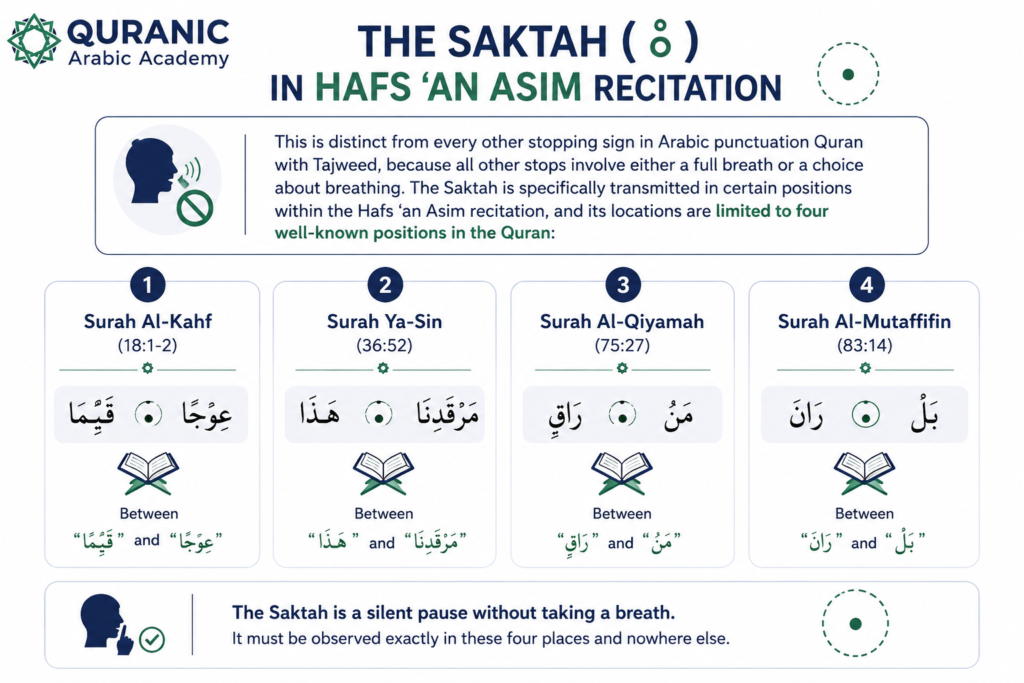
- Surah Al-Kahf (18:1-2): between “عِوَجًا” and “قَيِّمًا.”
- Surah Ya-Sin (36:52): between “مَرْقَدِنَا” and “هَٰذَا.”
- Surah Al-Qiyamah (75:27): between “مَنْ” and “رَاقٍ.”
- Surah Al-Mutaffifin (83:14): between “بَلْ” and “رَانَ.”
These four positions are not marked by scholars’ analysis of grammar. They are transmitted positions from the Prophet (PBUH) himself through the chain of Hafs ‘an Asim, making them part of the oral tradition of Qur’anic recitation that no printed Mushaf can fully replace.
Read also: Early Quranic Manuscripts: History, Scripts, and Oldest Surviving Copies
The Mu’anaqah Sign Requires a Choice Between Two Valid Stopping Points
The Mu’anaqah sign (∴) appears in pairs. When a reciter sees two sets of three dots within a short stretch of text, the ruling is that they must stop at one of the two marked positions and must not stop at both. The name Mu’anaqah means “embrace” in Arabic, describing the relationship between the two points.
The choice between the two stopping positions is not arbitrary. Each option produces a different but equally valid reading of the verse. Stopping at the first point produces one complete meaning. Stopping at the second produces another. Stopping at both breaks the verse into three fragments, none of which carries the intended weight of the complete statement.
This sign is relatively rare in the Mushaf but appears in some of the most discussed verses in Arabic punctuation Quran in English explanations, particularly in Surah Al-Baqarah. Understanding the Mu’anaqah requires both grammatical knowledge and Tafsir awareness, because the choice of stopping point reflects a scholarly interpretation of the verse’s structure.
The Arabic Courses for Understanding the Quran at The Quranic Arabic Academy builds the Arabic grammar foundation that makes understanding complex Qur’anic punctuation decisions intuitive rather than confusing.
Build the foundation that makes recitation meaningful.
Ibtida: Where You Resume After Every Waqf Matters as Much as Where You Stop
Qur’anic punctuation is not only about where to stop. It is equally about where to resume. The science of Ibtida (resuming recitation after a stop) is the second half of the same discipline that governs Waqf. Ali ibn Abi Talib (may Allah be pleased with him) linked them together in his definition of Tarteel, and the classical scholars treated them as inseparable.
The general principles of correct Ibtida are:
- After a Waqf Taam (complete stop), resume from the next word. No repetition is needed.
- After a Waqf Kafi (sufficient stop), resume from the next word. The meaning connects thematically but not grammatically.
- After a Waqf Hasan (good stop), resume by returning one or two words earlier to restore the grammatical link before continuing forward.
- After an emergency stop on a لا sign, return and re-read the word before the sign, then continue.
The classical scholars stated that incorrect Ibtida can distort meaning just as severely as incorrect Waqf. A reciter who stops correctly but resumes from the wrong word has still broken the intended message of the verse.
Experience Our Teaching Style:
We believe in clarity and engagement. Watch these short highlights from our actual classes to see our teachers’ methodology and student interactions in real-time.
Ready to Begin Your Quranic Journey?
Start learning with professional instructors through our structured curriculum.
Book Your Free TrialMaster Arabic Punctuation Quran With Tajweed Through Certified Instruction
Reading Qur’anic punctuation correctly requires more than memorizing a table of symbols. It requires a qualified teacher who demonstrates each sign in live recitation, corrects errors in real time, and builds the grammatical awareness to make independent decisions at signs like ج and ∴.
The Quran Reading Academy provides certified Arab tutors holding Ijazah in recitation, one-on-one live sessions tailored to each student’s exact mistakes, real-time Makharij correction, and flexible scheduling across all global time zones.
Every student progresses from their current level through a structured curriculum built around authentic transmission of the recitation tradition.
Our Arabic Courses
- Quranic Arabic Classes
- Quranic Arabic Course for Beginners
- Online Quranic Arabic Courses for Advanced Learners
- Quranic Arabic Grammar Course
- Arabic Courses for Understanding the Quran
- Quranic Arabic Course for Sisters (Female)
- Quranic Arabic Course for Kids
- Online Quranic Arabic Classes for Adults
- Quranic Arabic Course UK
- Quranic Arabic Course London
- Quranic Arabic Course USA
- Quranic Arabic Course Canada
- Quranic Arabic Course Australia
- Quranic Arabic Course UAE
- Quranic Arabic Course Germany

Start your journey with a free trial today.
Ready to Begin Your Quranic Journey?
Start learning with professional instructors through our structured curriculum.
Book Your Free TrialConclusion
Qur’anic punctuation is an essential part of Tajweed, with each Mushaf symbol guiding where to pause or continue based on Arabic grammar, Quranic meaning, and the transmitted recitation tradition. Signs such as مـ, لا, ∴, and Saktah help preserve meaning and proper recitation. Mastering Arabic punctuation Quran with Tajweed means understanding these signs in context and applying each pause and continuation correctly.
Frequently Asked Questions
What is Qur’anic punctuation?
Qur’anic punctuation refers to the Waqf signs placed in the Mushaf by classical scholars to guide reciters on where to stop, pause, or continue in order to protect the meaning of each verse.
What does Arabic punctuation Quran in English mean for non-Arab learners?
For non-Arab learners, Arabic punctuation Quran in English means understanding each Waqf symbol’s ruling in their own language so they can apply the correct stopping or continuation instruction during recitation.
What is the most important Waqf sign in Qur’anic punctuation?
The مـ sign, Waqf Lazim, is the most critical. Ignoring it can alter the theological meaning of a verse, which is why scholars classified stopping here as compulsory without exception.
Who developed the Qur’anic punctuation system?
The standard Waqf sign system used today was developed primarily by Imam al-Sajawandi (d. 560 AH). His framework was later standardized in the 1924 Cairo Mushaf and adopted in printed Mushafs worldwide.
What is the Saktah in Arabic punctuation Quran with Tajweed?
The Saktah is a brief silent pause without disconnecting the breath. It appears in exactly four positions in the Hafs ‘an Asim recitation and is a transmitted Sunnah position, not a scholarly addition.
What is Ibtida and why does it matter?
Ibtida is the science of where to resume recitation after a stop. Ali ibn Abi Talib linked it directly to Waqf as the two halves of Tarteel. Incorrect Ibtida can distort meaning just as severely as an incorrect stop.






Leave a Reply