History of the Quranic Text: From the First Revelation to the Standard Mushaf
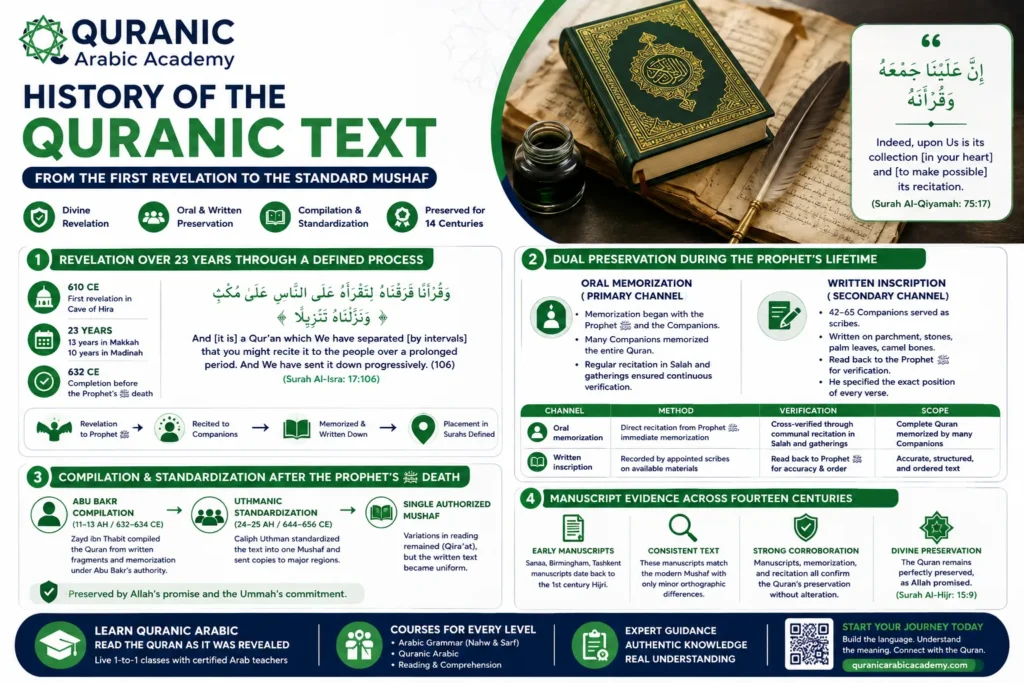
The history of the Quranic text reflects a unique preservation tradition combining oral and written transmission from the earliest revelation. The Quran was preserved through recitation alongside written records, followed by the Abu Bakr compilation and Uthmanic standardization.
This article traces the development of the Quranic text from the first revelation through oral transmission, early compilations, standardization, and manuscript evidence documenting its preservation across fourteen centuries.
The Quran Was Revealed Gradually Over 23 Years Through a Defined Process
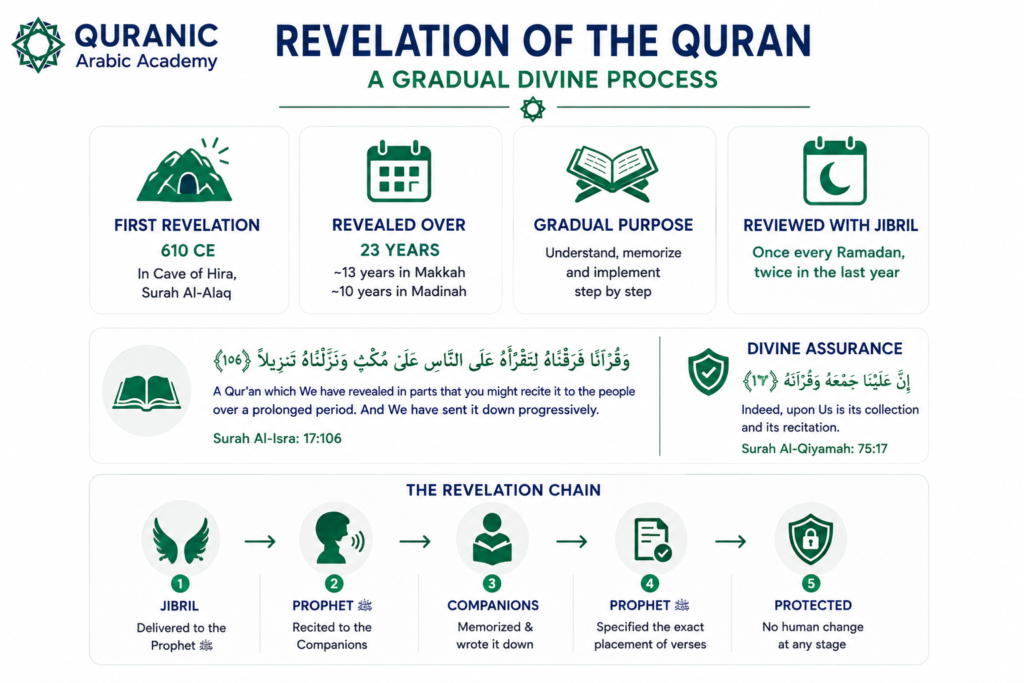
The Quran was not revealed all at once. The first revelation descended in 610 CE in the Cave of Hira near Mecca, when the Angel Jibril (Gabriel) delivered the opening verses of Surah Al-Alaq to the Prophet Muhammad ﷺ.
The revelation continued over the following 23 years — first in Mecca for approximately 13 years, then in Medina for approximately 10 years — concluding with the final verses shortly before the Prophet’s death in 632 CE.
Wa Qur’ānan faraqnāhu li-taqra’ahu ‘alā n-nāsi ‘alā mukthin wa nazzalnāhu tanzīlā
“And [it is] a Qur’an which We have separated [by intervals] that you might recite it to the people over a prolonged period. And We have sent it down progressively. (106) .”
The gradual nature of revelation served a precise purpose: it allowed the Muslim community to absorb, memorize, and implement each portion before the next arrived. The Prophet ﷺ reviewed the entire Quran with the Angel Jibril once every Ramadan, and in the final year of his life reviewed it twice — a practice that confirmed the sequence and content of the complete text before his death.
The revelation process operated through a defined chain that excluded human modification at every stage:
Jibril delivered the revelation to the Prophet ﷺ with exact wording and instruction.
The Prophet ﷺ recited the revelation aloud to the Companions immediately upon receipt.
The Companions memorized the verses and designated scribes wrote them down simultaneously.
The Prophet ﷺ specified the precise placement of each verse within its Surah.
Allah gave a direct assurance regarding the Prophet’s preservation of the text:
” إِنَّ عَلَيْنَا جَمْعَهُ وَقُرْآنَهُ ﴿١٧﴾”
Inna ‘alaynā jam’ahu wa qur’ānah
“Indeed, upon Us is its collection [in your heart] and [to make possible] its recitation. (17) .”
The Best Quranic Arabic Classes at The Quranic Arabic Academy teach non-Arab learners to read the Quran in the same Arabic that was revealed — building direct reading competency through one-on-one instruction with certified Arab tutors.
The Quran Was Preserved Through Two Independent Channels During the Prophet’s Lifetime
During the 23 years of revelation, the Quran was preserved simultaneously through oral memorization and written inscription — two independent channels that operated in parallel and cross-verified each other. This dual-channel preservation system is the foundation of the Quran’s textual integrity.
Oral Memorization — The Primary Preservation Channel
Memorization of the Quran began with the Prophet ﷺ and the Companions. Each revealed verse was recited by the Prophet ﷺ, memorized by the Companions, and taught to others. Many Companions memorized the entire Quran and became known as Hafiz.
This created a broad, multi-witness chain of oral preservation. Regular Quran recitation in Salah and gatherings also provided continuous communal verification, ensuring the Quran was preserved through shared and cross-checked memorization.
Written Inscription — The Secondary Preservation Channel
Alongside oral transmission, the Prophet ﷺ appointed scribes to record each revelation in writing. Historical sources mention 42–65 Companions who served as Quran scribes, using available materials such as parchment, stones, palm leaves, and camel shoulder blades.
The written text was read back to the Prophet ﷺ for verification, and he specified each verse’s position within its Surah. This ensured the Quran was preserved as an accurate, structured, and ordered text. The following table summarizes the two preservation channels:
Channel
Method
Verification
Scope
Oral memorization
Direct recitation from Prophet ﷺ, immediate memorization
Cross-verified through communal recitation in Salah and gatherings
Complete Quran memorized by many Companions
Written inscription
Dictation to appointed scribes on available materials
Written text read back to Prophet ﷺ for correction
All verses written during the Prophet’s lifetime
Although all verses of the Quran were written down during the Prophet’s lifetime, the written fragments were not compiled into a single unified physical book during this period — because the revelation was still ongoing, and direct access to the Prophet ﷺ himself made a unified written codex unnecessary.
The Abu Bakr Compilation Produced the First Official Written Quran
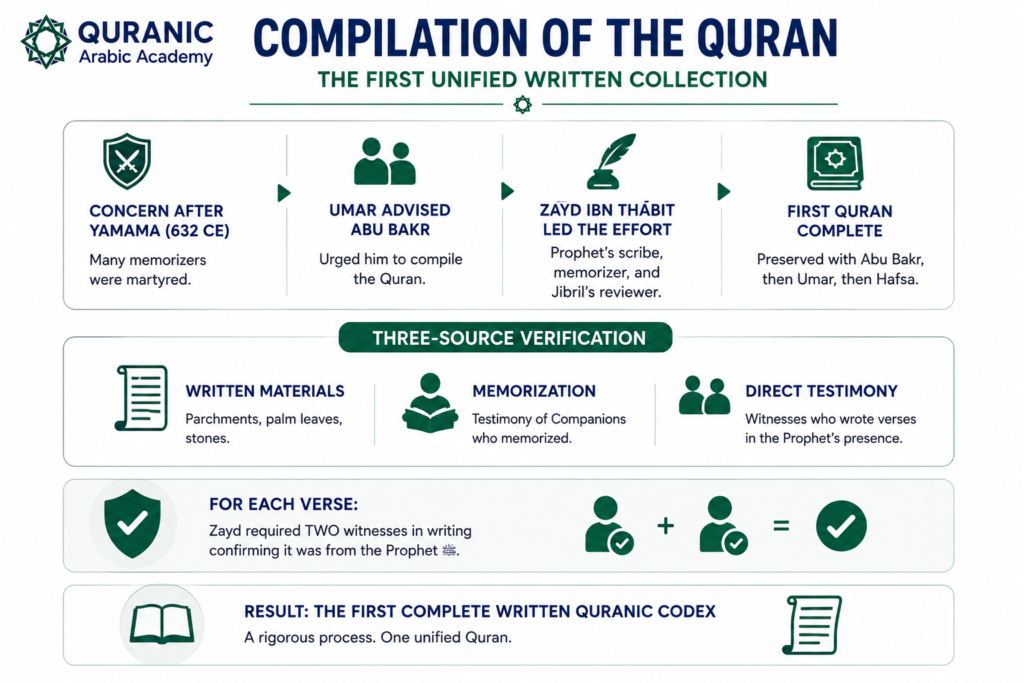
After the Prophet ﷺ died in 632 CE, the Battle of Yamama raised new concerns about Quran preservation as many Quran memorizers were martyred. Umar ibn al-Khattab urged Abu Bakr to compile the Quran into a unified written collection.
Abu Bakr agreed and appointed Zayd ibn Thabit, the Prophet’s principal scribe, to lead the effort. Zayd had memorized the Quran, recorded revelation, and participated in the Prophet’s final annual review with Angel Jibril, making him highly qualified for the task.
The compilation process employed by Zayd ibn Thabit was methodologically rigorous. He did not rely on his own memorization alone, nor did he simply transcribe from existing written fragments. Instead, he applied a three-source verification system:
Written materials — parchments, palm leaves, and stones on which verses had been inscribed during the Prophet’s lifetime.
Memorization — the testimony of Companions who had memorized specific verses directly from the Prophet ﷺ.
Direct testimony — witnesses who had personally written verses in the Prophet’s presence and could testify under oath to that fact.
For each verse, Zayd ibn Thabit required two witnesses who had the verse in writing and could confirm that it was recorded directly from the Prophet ﷺ. No verse was accepted based on a single person’s recollection alone.
This rigorous process produced the first complete, unified written Quranic codex, preserved on parchment. It was kept by Abu Bakr, then Umar, and after Umar’s death by his daughter Hafsa, the widow of the Prophet ﷺ.
The Arabic Courses for Understanding the Quran at The Quranic Arabic Academy connect non-Arab learners to the Quranic Arabic vocabulary that makes every verse meaningful beyond its transliteration, taught through live one-on-one sessions with certified Arab tutors.
See It in Action:
Wondering what our interactive sessions look like? Click below to peek inside a live session and watch how our expert instructors make learning Quranic Arabic accessible and engaging.
Ready to Begin Your Quranic Journey?
Start learning with professional instructors through our structured curriculum.
The Uthmanic Standardization Established the Definitive Written Text of the Quran
During the reign of Caliph Uthman ibn Affan, the expansion of the Islamic empire created new challenges for Quranic preservation. Companions such as Abdullah ibn Masud, Abu Musa al-Ashari, Muadh ibn Jabal, and Abu al-Darda taught Quranic recitation in different regions according to the seven ahruf permitted by the Prophet ﷺ.
As Muslims from different regions met and heard unfamiliar recitations, disagreements arose over which readings were valid. What had originally facilitated Quran learning across Arab dialects now required careful standardization to prevent conflict.
The Motivation for Uthmanic Standardization
The Companion Hudhayfah ibn al-Yaman (may Allah be pleased with him) witnessed these disputes firsthand while on campaign in Armenia and Azerbaijan. He returned to Medina and addressed Uthman directly: “Save this nation before they differ about the Book as Jews and Christians did before.
” Uthman recognized the threat to the community’s unity and convened a committee to produce an authoritative standard text.
The Uthmanic Committee and Its Process
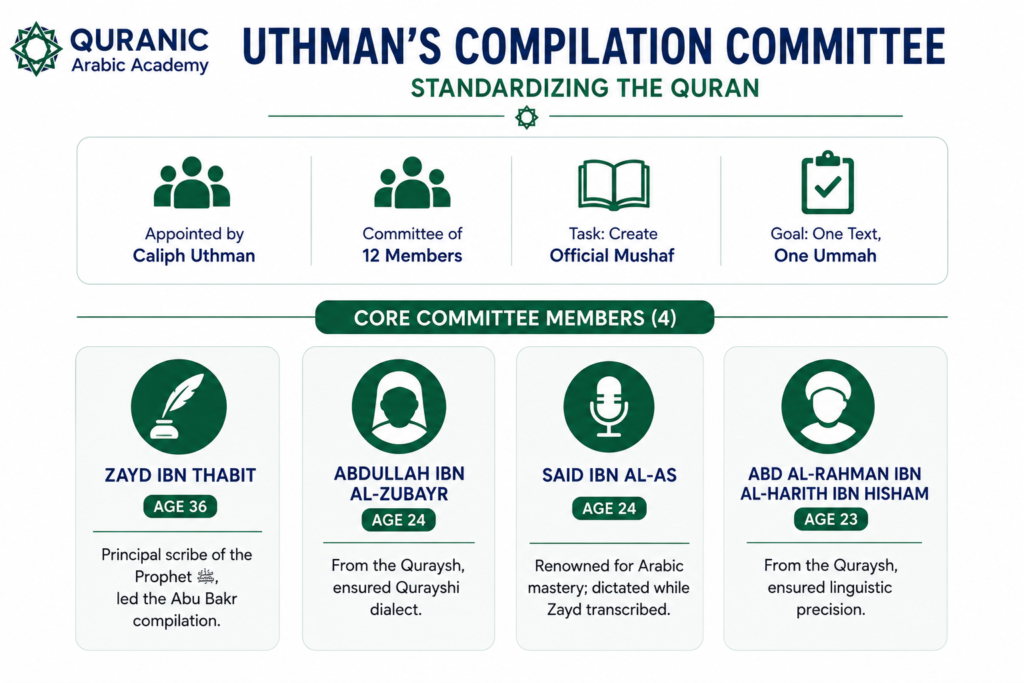
Uthman appointed a four-member core committee, again led by Zayd ibn Thabit, alongside three Qurayshi Companions: Abdullah ibn al-Zubayr, Said ibn al-As, and Abd al-Rahman ibn al-Harith ibn Hisham. Historical sources mention that the committee ultimately comprised twelve members in total. The core committee members at the time of compilation were:
Zayd ibn Thabit (age 36) — principal scribe of the Prophet ﷺ, leader of the Abu Bakr compilation.
Abdullah ibn al-Zubayr (age 24) — from the Quraysh, ensuring Qurayshi dialect.
Said ibn al-As (age 24) — renowned for linguistic mastery of Arabic; responsible for dictating while Zayd transcribed.
Abd al-Rahman ibn al-Harith ibn Hisham (age 23) — from the Quraysh, ensuring linguistic precision.
The Uthmanic standardization was conducted as an independent verification process rather than simply copying the Abu Bakr compilation. Written verses were presented by witnesses who confirmed their direct recording from the Prophet ﷺ, while memory and written evidence were cross-checked before inscription.
The Abu Bakr compilation held by Hafsa was then used for additional verification, and both records were found to agree. When dialect differences arose, Uthman instructed the committee to use the Quraysh dialect, the linguistic standard of the Prophet ﷺ.
The Distribution and Burning of Non-Standard Copies
After completing the Uthmanic standardization, official copies of the standardized Mushaf were sent to major Islamic cities, with historical sources reporting between four and nine copies. At least four were sent to Medina, Basra, Kufa, and Damascus, where recitation disputes had emerged.
Uthman ordered non-standard written copies to be removed or corrected to prevent further confusion. This was understood as part of the standardization process, and Ali ibn Abi Talib explicitly supported Uthman’s decision.
The Uthmanic Text Was Written Without Diacritical Marks to Accommodate Multiple Valid Readings
The Uthmanic codex used a consonantal skeleton known as the rasm, without vowel signs or dots distinguishing similar letters. This deliberate structure allowed multiple authenticated qira’at to be represented within the same written text. Where readings required different spellings, regional copies preserved the variations.
These variants were understood by scholars as authenticated Prophetic readings rather than errors. Modern research also supports the consistency of early Quranic manuscripts. Marijn van Putten’s study of the spelling of ni’mat across 14 early manuscripts found identical orthographic patterns, supporting the conclusion that these manuscripts derive from a single written archetype.
The Qiraat Are Authenticated Oral Transmissions Rooted in the Uthmanic Text
The qira’at are not evidence of textual variation but a continuation of the Quran’s authenticated oral transmission from the Prophet ﷺ through the Companions. The Quran was revealed according to the seven ahruf, and the Uthmanic standardization preserved readings that fit the consonantal text.
The ten widely transmitted qira’at today remain traceable through authenticated chains to the Companions. Regional Uthmanic codices also correspond to established regional reading traditions, showing that these variations reflect transmitted recitations rather than scribal choices.
The Quranic Arabic Grammar Course at The Quranic Arabic Academy gives non-Arab learners a structured understanding of the Arabic consonantal system — the same rasm that forms the textual foundation of the Uthmanic Mushaf — taught through actual Quranic verse analysis in live one-on-one sessions.
Physical Manuscript Evidence Confirms the Quran’s Textual Integrity
The history of the Quranic text does not rest on Islamic tradition alone. Physical manuscript evidence, dated and analyzed through modern scientific methods, confirms what Muslims have always known: the Quranic text has remained consistent across fourteen centuries.
The following are the most significant pieces of physical evidence:
Manuscript
Date Range
Script
Textual Conformity
Birmingham Quran
568–645 CE (radiocarbon)
Hijazi
Confirmed Uthmanic text type
Sanaa Manuscript (upper text)
After 671 CE
Hijazi
Conforms to Uthmanic standard
Tübingen Fragment
649–675 CE (radiocarbon)
Hijazi
Conforms to Uthmanic standard
Codex Parisino-Petropolitanus
Late 7th century CE
Hijazi
Conforms to Uthmanic standard
Topkapi Manuscript
Early 8th century CE
Kufic
Contains 99%+ of Quranic text
According to Corpus Coranicum, more than 60 manuscript fragments comprising over 2,000 folios — approximately 4,000 pages — survive as textual witnesses of the Quran produced before 800 CE. Every major manuscript aligns with the Uthmanic textual standard. Western revisionist theories suggesting a later date for the Quran’s canonization have been described by scholars as “untenable” in light of the manuscript evidence.
Allah’s promise of preservation, stated at the beginning of this history, has been confirmed through both the unbroken chains of human transmission and the physical artifacts of early Islamic civilization:
We believe in clarity and engagement. Watch these short highlights from our actual classes to see our teachers’ methodology and student interactions in real-time.
Ready to Begin Your Quranic Journey?
Start learning with professional instructors through our structured curriculum.
Begin Your Journey with The Quranic Arabic Academy
The history of the Quranic text is the history of a text that has been transmitted with greater precision, across more parallel channels, with more physical evidence, than any other religious scripture in human history. Reading that text directly in Arabic — with accuracy, fluency, and comprehension — is the deepest form of connection to this history that any Muslim learner can build.
The Quranic Arabic Academy provides non-Arab Muslim learners worldwide with the structured Arabic instruction needed to engage with the Quran in its original language, through one-on-one live sessions with certified Arab tutors.
Every program at The Quranic Arabic Academy includes:
Certified Arab tutors holding Ijazah in recitation or degrees in Islamic studies from recognized institutions.
One-on-one live sessions tailored to each student’s individual level and goals.
Real-time Makharij correction using audio-visual feedback during every session.
Tafseer-integrated learning — Nahw and Sarf taught through actual Quranic verse analysis.
Flexible scheduling covering all global time zones: EST, PST, GMT, CET, IST, GST, and MYT.
Affordable pricing with transparent packages and family enrollment discounts.
Monthly progress reports and written feedback after every session.
Serves students across North America, Europe, Asia, and the Middle East.
The history of the Quranic text reflects deliberate, multi-layered preservation from the first revelation. The Quran was memorized and written during the Prophet’s lifetime, compiled under Abu Bakr through verification, standardized under Uthman, and supported by early manuscript evidence and continuous oral transmission.
Together, these layers of preservation and cross-verification demonstrate the continuity of the Quranic text from the Prophet Muhammad ﷺ to Muslims today.
FAQ
When did the history of the Quranic text begin?
The history of the Quranic text began in 610 CE with the first revelation in the Cave of Hira, continuing with progressive revelation over 23 years until the Prophet’s death in 632 CE.
How many scribes recorded the Quran during the Prophet’s lifetime?
Between 42 and 65 Companions served as scribes of the Quran during the Prophet’s lifetime, recording each revelation on available materials including parchment, palm leaves, and flat stones.
What was the difference between the Abu Bakr and Uthmanic compilations?
The Abu Bakr compilation gathered all written Quranic material into a single physical codex to prevent loss after the martyrdom of Huffaz at Yamama. The Uthmanic standardization produced authorized copies distributed to major cities and required abandonment of non-standard texts, in order to resolve recitation disputes across the expanding Islamic empire.
Why did Uthman burn other Quranic manuscripts?
Uthman ordered non-standard copies burned because leaving them in circulation would have undermined the standardization project entirely. The goal was to unify the Muslim community on one authoritative text, and that goal required eliminating competing copies. In Islamic tradition, burning is a recognized respectful method of disposing of texts containing Quranic verses.
Does physical manuscript evidence support the Quran’s preservation?
Yes. More than 60 manuscript fragments comprising over 2,000 folios survive from before 800 CE. Every major manuscript, including the Birmingham Quran dated to 568–645 CE, aligns with the Uthmanic textual standard, confirming the Quran’s preservation through physical evidence.
 Quran
Quran









Leave a Reply