 Quran
Quran
Millions of Muslims in the USA, UK, Canada, Australia, France, Germany, South Asia, Southeast Asia, and the Gulf search for guidance on how to read the Quran without knowing where to begin.
The problem is rarely motivation. It is a method. Most learners begin at the wrong stage, skip foundational steps, and end up reading slowly, inaccurately, or not at all after months of effort.
Nine graded steps, taken in order, solve this problem. Each step builds on the last, and skipping none of them is what separates confident readers from permanent beginners.
This article discusses nine steps following the sequence used in traditional Quran education across centuries and cultures. They are designed so that completing one step makes the next one noticeably easier. Begin at Step 1, regardless of how much you feel you already know.
1. Master The Arabic Alphabet In All Three Written Positions
Arabic letters change shape depending on whether they appear at the start, middle, or end of a word. Learning all three positional forms is not optional; it determines whether you can identify letters inside connected words at all.
Most beginners recognize isolated letters but freeze when they appear joined. Practice initial, medial, and final forms for each of the 28 letters before advancing; visual recognition of all positions is what makes word-level reading possible.
Studying the Quranic Arabic alphabet in all three positions builds the visual foundation every later skill depends on. A reader who skips this stage misidentifies letters under real text pressure and does not understand why.
Spend at least one to two focused weeks here. Recognition drills, not repetitive writing, accelerate this stage; the goal is instant visual identification at reading speed, not slow recall from memory or finger-tracing.
Start Your Quranic Arabic Foundation Today
2. Learn Each Letter Sound From Its Physical Articulation Point
Arabic has 28 distinct phonemes, and many have no equivalent in English, French, Urdu, or other major world languages. Knowing a letter’s written shape is insufficient; each sound must be produced from its correct physical point in the throat or mouth.
Every Arabic letter originates from a specific articulation point, called a makhraj in classical Tajweed terminology. Learning the makhraj for each letter gives you a physical reference to return to whenever a sound becomes inconsistent or unclear during reading practice.
Letters like ض, ظ, ع, and غ are particularly difficult for non-native speakers because they involve throat movements unused in most other languages. These require isolated, deliberate practice before you encounter them inside connected words at reading pace.
Work through makhaarij in the classical sequence: throat letters first, then tongue positions from back to front, then lip sounds. This order reflects how Arabic phonology was systematically organized and makes the contrast between similar-sounding letters physically clear.
See It in Action:
Wondering what our interactive sessions look like? Click below to peek inside a live session and watch how our expert instructors make learning Quranic Arabic accessible and engaging.
Ready to Begin Your Quranic Journey?
Start learning with professional instructors through our structured curriculum.
Book Your Free Trial3. Apply Short Vowel Marks Until Reading Them Requires No Thought
Quranic Arabic diacritics are the small marks above and below letters that carry vowel sounds. Without them, Arabic letters carry no inherent vowel; the marks transform a consonant cluster into a pronounceable, readable word.
The three primary short vowels are fatha (a), kasra (i), and damma (u). Each has a doubled form called tanween, and sukoon signals the absence of a vowel. These six marks govern the vast majority of pronunciation decisions in Quranic text.
At the early stage, beginners read each mark consciously and slowly. The goal is automaticity; a reader who still thinks about each fatha or kasra cannot read at any functional pace. Reaching automaticity takes deliberate daily drilling on the same short passages.
Read the same short text multiple times until your eye picks up diacritics without conscious effort.
Beginners who advance before reaching this automaticity spend months struggling at word level, not because the text is hard, but because the foundation was never made automatic.
Discover Why The Quranic Arabic Academy Leads in Quranic Arabic Grammar Education?

4. Practice On Short Surahs Before Advancing To Longer Passages
The Quran’s own structure provides a ready-made graded reader. The shorter surahs at the end of the Quran are one to six verses long and contain the most frequently practiced vocabulary and phonemes in the entire text.
Starting with Al-Ikhlas, Al-Falaq, and An-Nas gives dense phonetic practice in minimal time. These surahs also pack multiple Tajweed rules into compact form, making them excellent diagnostic tools for any teacher checking a student’s accuracy and consistency.
Juz Amma Quranic studies progress systematically through the 30th part of the Quran, which contains 37 surahs. Working through them in reverse order, from An-Nas back toward An-Naba, provides continuous, natural graded progression from shorter to longer text.
Resist the pull to move to longer chapters before Juz Amma is stable. Longer surahs expose weaknesses that short ones do not reveal, and premature advancement creates reading habits that take far longer to correct under the pressure of extended text.
Join our online Quranic Arabic course for adults

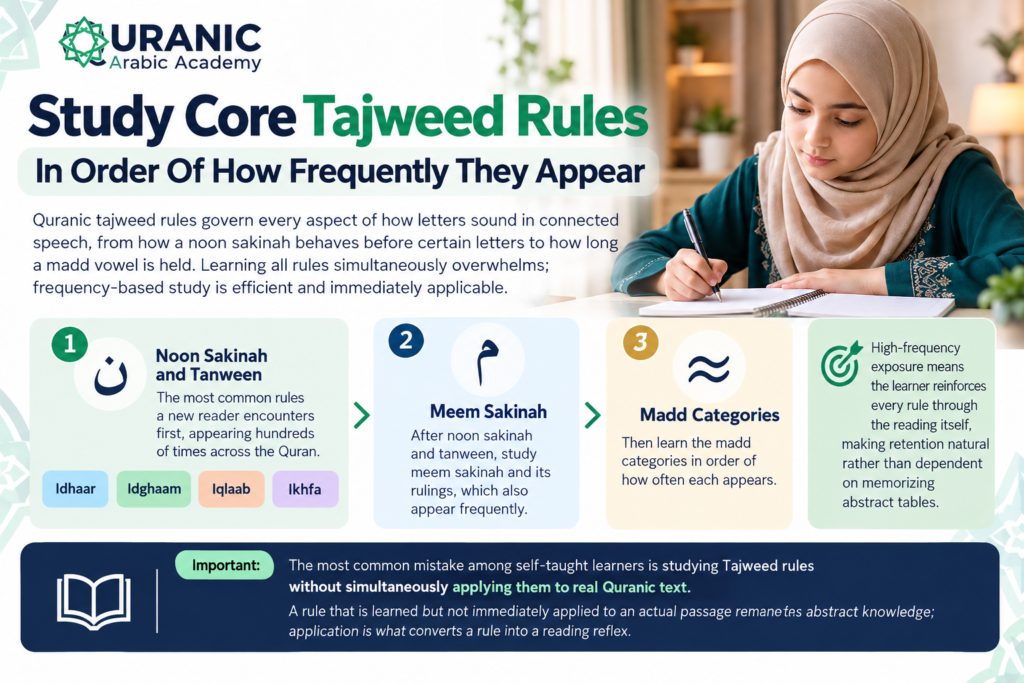
5. Study Core Tajweed Rules In Order Of How Frequently They Appear
Quranic tajweed rules govern every aspect of how letters sound in connected speech, from how a noon sakinah behaves before certain letters to how long a madd vowel is held. Learning all rules simultaneously overwhelms; frequency-based study is efficient and immediately applicable.
The most common rules a new reader encounters first are noon sakinah and tanween, which appear hundreds of times across the Quran. The four rules governing these, idhaar, idghaam, iqlaab, and ikhfa, determine how the noon sound transforms based on the letter immediately following it.
After noon sakinah and tanween, study meem sakinah and then the madd categories in order of how often each appears. High-frequency exposure means the learner reinforces every rule through the reading itself, making retention natural rather than dependent on memorizing abstract tables.
The most common mistake among self-taught learners is studying Tajweed rules without simultaneously applying them to real Quranic text.
A rule that is learned but not immediately applied to an actual passage remains abstract knowledge; application is what converts a rule into a reading reflex.
6. Listen Actively To A Skilled Reciter For Daily Sound Modeling
Accurate pronunciation requires an accurate internal model of what correct sound is. A beginner who has only ever heard their own recitation cannot identify errors because they have no external reference point to measure their sound against.
Daily listening to a skilled reciter builds that internal sound library over time. Sheikh Mahmoud Khalil Al-Hussary is widely recommended for learners because his recitation is slow, technically precise, and pedagogically designed for pronunciation study, not performance.
Active listening means following along in the Mushaf while the audio plays, not using recitation as background sound. The eye tracks each word as the ear processes its sound; this synchronized input significantly accelerates the connection between written and spoken form.
Twenty minutes of active daily listening produces measurable improvement within three to four weeks of consistent practice.
Passive background listening has almost no measurable effect on pronunciation acquisition; the level of attention brought to each session determines its value entirely.
Transform Your Relationship with the Quran with Quranic Arabic Academy
7. Read Aloud With A Qualified Teacher For Live Pronunciation Correction
Reading silently does not catch pronunciation errors; it reinforces them. A qualified teacher who listens as you read aloud identifies the exact letter or rule causing difficulty and corrects it before that mistake becomes a deeply ingrained reading habit.
Self-correction is unreliable at the beginner and intermediate stages because mispronunciation feels correct to the learner producing it. The feedback loop that fixes errors requires an external listener who knows the correct sound and can model it clearly for you.
Online Quranic studies make qualified teacher access possible from any country, eliminating the geographic barrier that historically limited Quran learning to those near traditional Islamic centers.
Learners in the USA, UK, Canada, Germany, France, Australia, South Asia, and Southeast Asia now have full access to certified instruction.
Quranic Arabic Academy connects learners worldwide with experienced, certified instructors who specialize in Quran recitation for non-native speakers. Live one-to-one sessions deliver real-time correction, structured weekly progression, and the accountability that self-study cannot replicate.
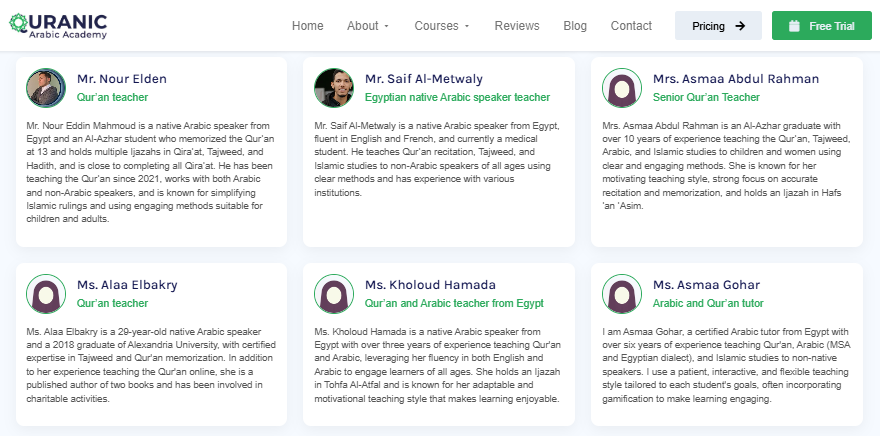
Meet our Dedicated & Experienced Arabic and Quran Teachers.
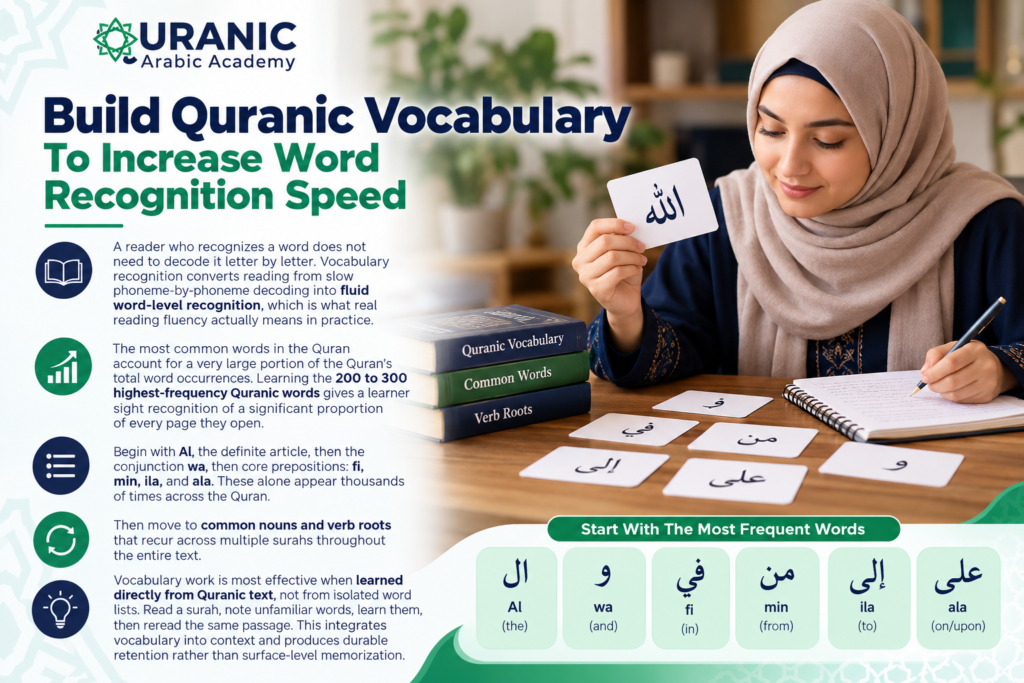
8. Build Quranic Vocabulary To Increase Word Recognition Speed
A reader who recognizes a word does not need to decode it letter by letter. Vocabulary recognition converts reading from slow phoneme-by-phoneme decoding into fluid word-level recognition, which is what real reading fluency actually means in practice.
The most common words in the Quran account for a very large portion of the Quran’s total word occurrences. Learning the 200 to 300 highest-frequency Quranic words gives a learner sight recognition of a significant proportion of every page they open.
Begin with Al, the definite article, then the conjunction wa, then core prepositions: fi, min, ila, and ala. These alone appear thousands of times across the Quran.
Then move to common nouns and verb roots that recur across multiple surahs throughout the entire text.
Vocabulary work is most effective when learned directly from Quranic text, not from isolated word lists. Read a surah, note unfamiliar words, learn them, then reread the same passage. This integrates vocabulary into context and produces durable retention rather than surface-level memorization.
9. Establish A Fixed Daily Reading Block To Build Lasting Fluency
Fluency is built through accumulated, consistent reading time, not through the intensity of occasional long sessions.
A learner who reads fifteen focused minutes every day improves faster than one who reads two hours once a week, because regularity builds the neural pathways reading requires.
Knowing how to build a daily Quran routine is a practical skill that determines whether learning continues or gradually stalls. The most effective reading block is scheduled at the same time each day and linked to an existing anchor habit, such as immediately after Fajr prayer.
Set a minimum you will always meet on difficult days, not a maximum reserved for your best days. Ten minutes of focused, deliberate reading every day without exception builds more fluency over six months than intermittent sixty-minute sessions driven by inconsistent motivation.
Track your progress visibly: record the surah and verse number reached at the end of each session. Seeing continuous forward movement provides intrinsic motivation to continue, and the written record creates personal accountability to the standard you set at the beginning.
Start Your Quranic Arabic Course UK Journey Today

Three Mistakes That Block Real Progress Of Reading The Quran
Understanding how to read the Quran properly requires identifying what prevents progress, not only what enables it. These three mistakes appear consistently across beginner and intermediate learners in every country and learning context.
Each mistake looks different on the surface. They share a common cause: advancing past a stage before it is consolidated enough to support the next one.
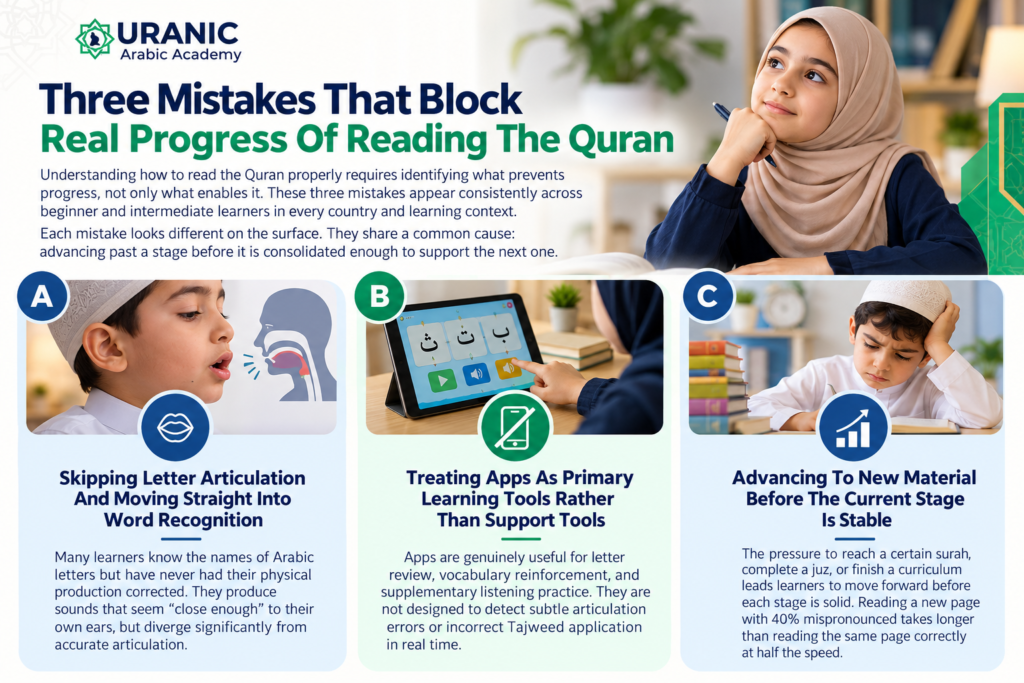
A. Skipping Letter Articulation And Moving Straight Into Word Recognition
Many learners know the names of Arabic letters but have never had their physical production corrected. They produce sounds that seem “close enough” to their own ears, but diverge significantly from accurate articulation.
Essentials of Quranic Arabic every Muslim learner must know addresses exactly this issue. It is the most consistent reason that self-taught learners who read daily for years still mispronounce the same letters they struggled with in week one.
What Are the Outcomes of Our Quranic Arabic Courses for Advanced Learners?
B. Treating Apps As Primary Learning Tools Rather Than Support Tools
Apps are genuinely useful for letter review, vocabulary reinforcement, and supplementary listening practice. They are not designed to detect subtle articulation errors or incorrect Tajweed application in real time.
Best apps to learn Quranic Arabic identifies which app features genuinely support reading development and which remain firmly in the teacher’s domain. Use digital tools for what they do well; reserve real-time correction for a qualified instructor.
C. Advancing To New Material Before The Current Stage Is Stable
The pressure to reach a certain surah, complete a juz, or finish a curriculum leads learners to move forward before each stage is solid. Reading a new page with 40% mispronounced takes longer than reading the same page correctly at half the speed.
How to get better at reading the Quran includes a practical self-assessment method for determining when a stage is genuinely consolidated enough to advance. The answer is almost always: one more week of consolidation than you currently think you need.
Experience Our Teaching Style:
We believe in clarity and engagement. Watch these short highlights from our actual classes to see our teachers’ methodology and student interactions in real-time.
Ready to Begin Your Quranic Journey?
Start learning with professional instructors through our structured curriculum.
Book Your Free TrialLearn To Read The Quran Correctly With An Expert Teacher Today
If you have been searching for how to read the Quran properly and progress has been slower than expected, the issue is almost always method, not effort or natural ability.
Quranic Arabic Academy offers structured, one-on-one online Quran reading courses with certified native Arabic-speaking instructors, each trained in Tajweed correction.
Every session is built around your specific level, whether you are starting from the first letter or correcting years of informal reading habits.
Students from the USA, UK, Canada, Germany, France, Australia, South Asia, Southeast Asia, and the Gulf join live sessions daily, at times designed to fit their time zones and schedules.
Check out our top courses to start learning Quranic Arabic today:
- Quranic Arabic Classes
- Arabic Courses for Understanding the Quran
- Quranic Arabic Course for Sisters (Female)
- Quranic Arabic Course for Kids
- Quranic Arabic Course Canada
Enroll In The Quranic Arabic Academy Today With a Free Trial And Begin Understanding The Quran

Conclusion
Reading the Quran fluently is not about how many hours you spend; it is about spending those hours in the correct order.
The nine steps in this guide reflect the same sequence used in traditional Quran education across centuries, and the reason that sequence has not changed is that it consistently produces results no shortcut can replicate.
Master the alphabet. Build the sounds. Apply the marks. Read short surahs. Layer in Tajweed. Listen actively. Read with a teacher. Build vocabulary. Anchor a daily habit.
The benefits of reading the Quran daily grow in proportion to the quality of your recitation, not just the quantity. How to read Quran fluently is a sequence, not a secret. Follow it, complete each step before advancing, and the fluency you are working toward will arrive.
Frequently Asked Questions
How Long Does It Take To Learn To Read The Quran From Scratch?
Most adults with no prior Arabic reading experience begin reading simple, fully voweled Quranic text within 3 to 6 months of daily structured practice. Fluent Tajweed-compliant reading of unfamiliar passages typically develops over 1 to 2 years with consistent teacher feedback.
Do I Have To Know Arabic To Learn How To Read The Quran?
You need to learn Quranic Arabic script and its specific phonetics. Full Arabic language fluency is a separate goal. Many Muslims in South Asia, Southeast Asia, and Gulf countries read the Quran correctly without any conversational Arabic ability.
Can Adults Actually Learn To Read The Quran Fluently?
Yes. Adults often progress faster than children in foundational stages because they grasp the logic of rules quickly and apply teacher feedback efficiently. Age is not the limiting factor; correct method and consistent daily practice are.
How Important Is Tajweed For Someone Who Is Just Starting Out?
Scholars agree that avoiding mispronunciations that change a word’s meaning is obligatory for every reader. Full mastery of all Tajweed rules is a collective obligation. The core rules introduced in Step 5 of this guide satisfy the standard required of individual daily reading.
What Is The Most Effective Way To Read The Quran Fluently?
Follow a graded sequence, complete each stage before advancing, read aloud daily, and receive weekly correction from a qualified teacher. Skipping stages in the name of speed consistently produces slower total results over time, not faster ones.






Leave a Reply