 Quranic Verses
Non-Arab Muslims who encounter the phrase “Quranic injunction” in Islamic literature, khutbahs, or scholarly discussions often lack a clear understanding of what it actually means. The term is used frequently but rarely explained in a way that a Muslim learning about their religion from English-language sources can fully grasp.
This article explains the Quranic injunction meaning from its Arabic root, identifies its main categories, and shows how injunctions govern every dimension of a Muslim’s life. Understanding this concept is foundational to understanding how the Quran functions as a complete code of conduct for humanity.
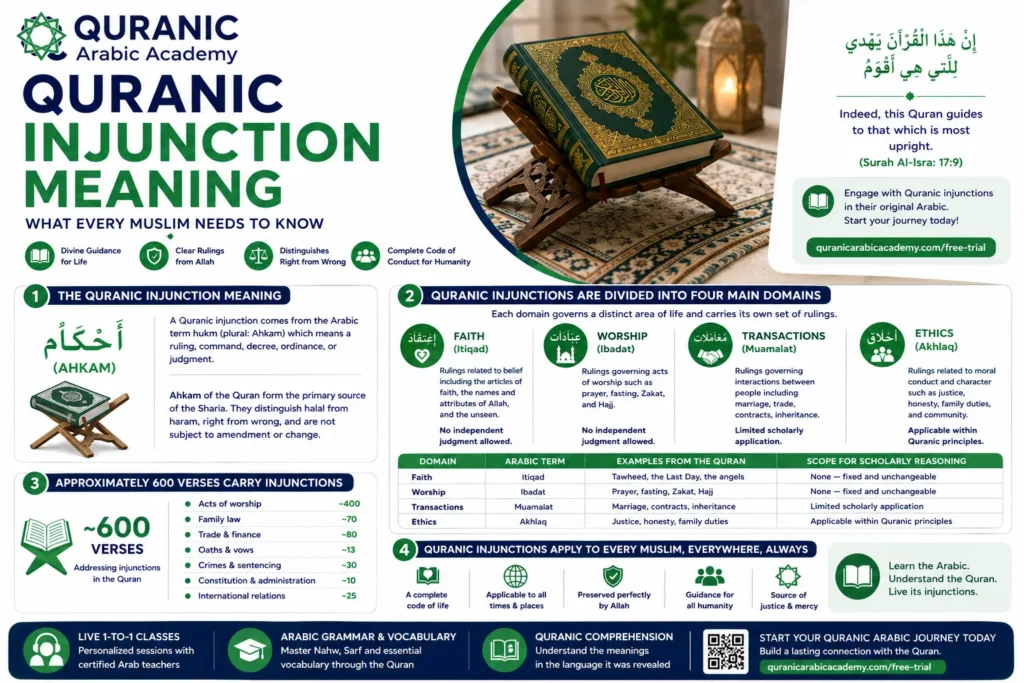
The Quranic Injunction Meaning Comes from the Arabic Term Ahkam
A Quranic injunction is the English rendering of the Arabic term hukm, plural Ahkam. The word hukm carries several overlapping meanings in classical Arabic: a ruling, a command, a decree, an ordinance, or a judgment.
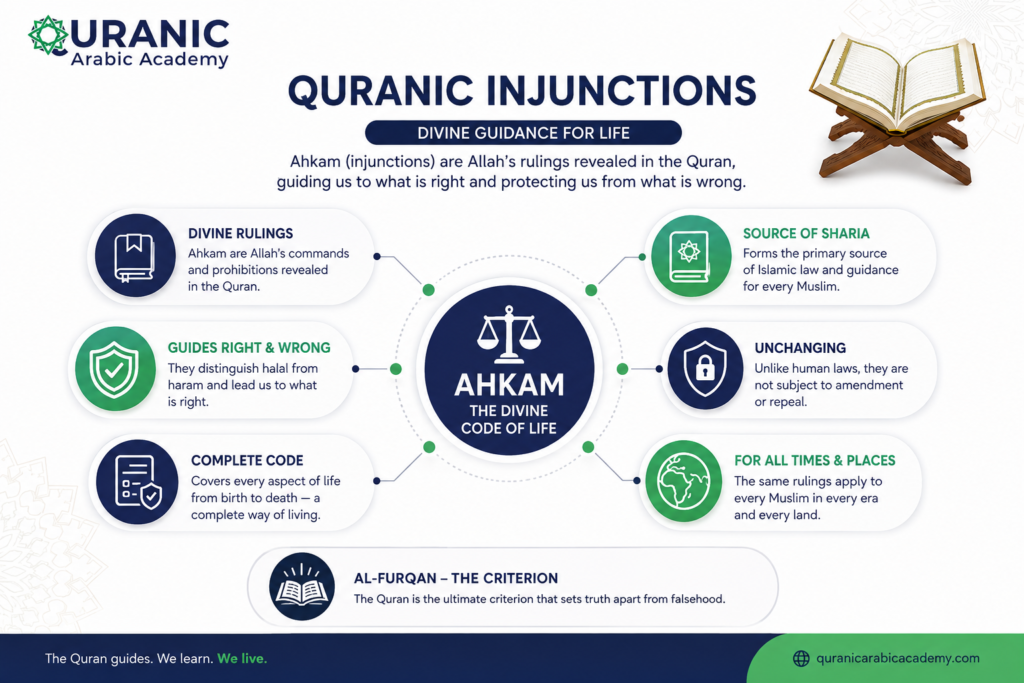
In the context of the Quran, Ahkam refers specifically to the divine rulings that establish what is lawful and what is unlawful, what is obligatory and what is forbidden, in every sphere of human life.
Scholars describe the Ahkam of the Quran as forming the primary source of the Sharia. The verses of the Quran that carry legal connotations provide the complete code of conduct for every Muslim from birth to death.
They supply the criterion to distinguish the lawful, known as halal, from the unlawful, known as haram, and the right from the wrong. This is why the Quran is also referred to as al-Furqan, meaning the criterion or the distinguisher.
The commands of the Quran are unlike any human-made laws. They are not subject to amendment, repeal, or revision. They have remained the same across the fourteen centuries since revelation, applying equally to every Muslim in every era and every land.
Engaging with Quranic injunctions in their original Arabic is the most direct way to access their full meaning. The Best Quranic Arabic Classes at The Quranic Arabic Academy teach non-Arab Muslim learners to read and comprehend Quranic Arabic directly, with certified Arab instructors delivering one-on-one live sessions across all global time zones.
Read also: How to Dispose of Quranic Verses the Right Way
[Start Your Quranic Arabic Journey Today]
Quranic Injunctions Are Divided into Four Main Domains
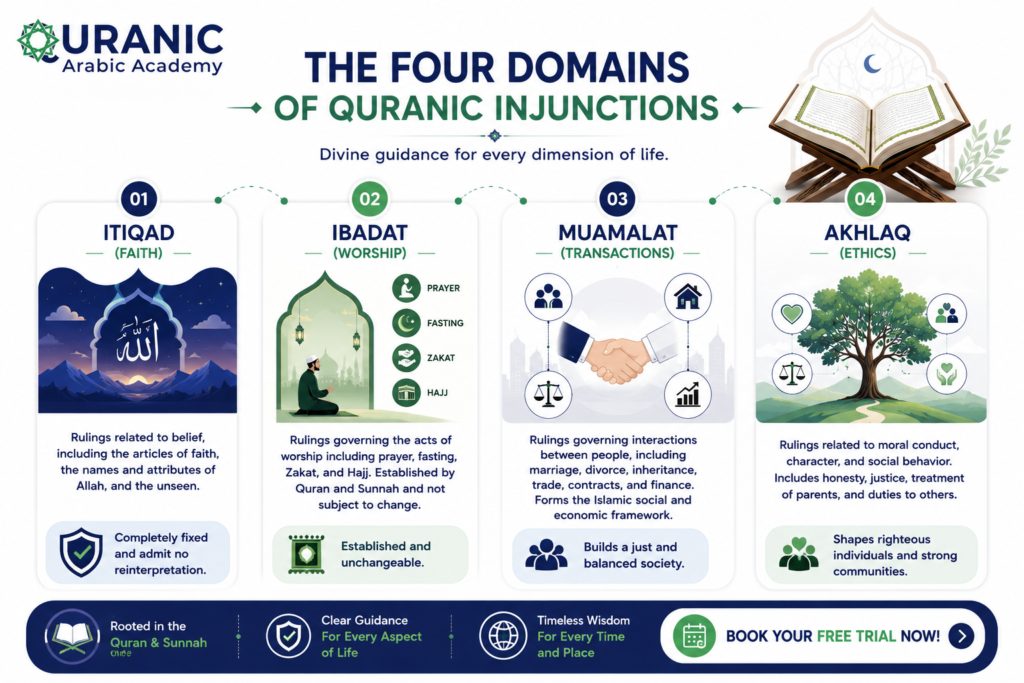
Scholars of Islamic jurisprudence have organized the Ahkam of the Quran into four foundational domains. Each domain governs a distinct area of Muslim life and carries its own set of rulings derived from the Quranic text and the Sunnah of the Prophet ﷺ.
The four domains are:
- Itiqad (Faith): Rulings related to belief, including the articles of faith, the names and attributes of Allah, and the unseen. These injunctions are completely fixed and admit no independent judgment or reinterpretation.
- Ibadat (Worship): Rulings governing the acts of worship including prayer, fasting, Zakat, and Hajj. These have been established by definitive Quranic text and Sunnah and are also not subject to change.
- Muamalat (Transactions): Rulings governing interactions between people, including marriage, divorce, inheritance, trade, contracts, and finance. These form the Islamic social and economic framework.
- Akhlaq (Ethics): Rulings related to moral conduct, character, and social behavior, including honesty, justice, treatment of parents, and obligations to neighbors and the community.
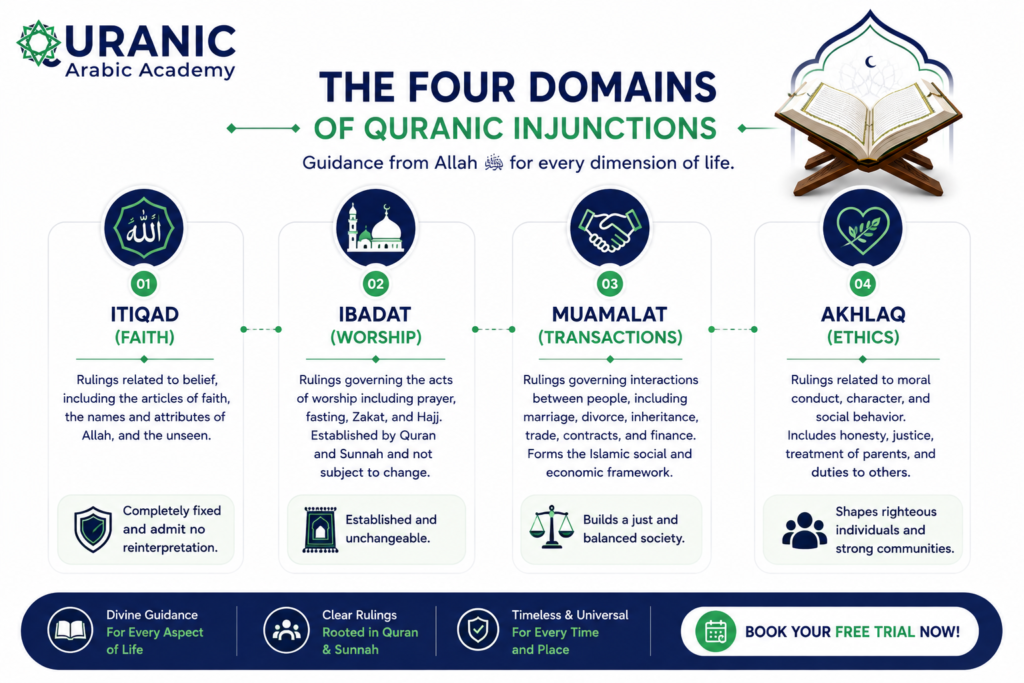
The following table summarizes how each domain operates within the broader framework of Quranic injunctions:
| Domain | Arabic Term | Examples from the Quran | Scope for Scholarly Reasoning |
| Faith | Itiqad | Tawheed, the Last Day, the angels | None — fixed and unchangeable |
| Worship | Ibadat | Prayer, fasting, Zakat, Hajj | None — fixed and unchangeable |
| Transactions | Muamalat | Marriage, contracts, inheritance | Limited scholarly application |
| Ethics | Akhlaq | Justice, honesty, family duties | Applicable within Quranic principles |
Approximately 600 Verses of the Quran Carry Injunctions
The Quran contains approximately 600 verses that directly address Quranic injunctions. Understanding their distribution across different areas of life reveals the comprehensive scope of what the Quran governs. Scholars have counted these verses as follows:
- About 400 pertain to acts of worship, covering purification, prayer, fasting, Zakat, Hajj, oaths, remembrance of Allah, and supplication.
- About 70 pertain to family law, covering marriage, divorce, child-rearing, and inheritance.
- About 80 pertain to trade and finance, covering contracts, loans, documentation, and guarantees.
- About 13 pertain to oaths and vows.
- About 30 pertain to crimes and sentencing.
- About 10 pertain to constitutional and administrative matters.
- About 25 pertain to international relations and law.
These numbers reflect only the verses that deal directly with injunctions. Many additional verses address the same areas indirectly, through prophetic narratives and historical accounts from which scholars have derived further rulings.
The Arabic Courses for Understanding the Quran at The Quranic Arabic Academy give non-Arab Muslims the vocabulary and grammatical tools to engage directly with Quranic verses across all these areas, removing the barrier of translation and bringing the learner into direct contact with the divine rulings as they were revealed.
Read also: History of the Quranic Text: From the First Revelation to the Standard Mushaf
[Explore the Arabic Comprehension Course]
See It in Action:
Wondering what our interactive sessions look like? Click below to peek inside a live session and watch how our expert instructors make learning Quranic Arabic accessible and engaging.
Ready to Begin Your Quranic Journey?
Start learning with professional instructors through our structured curriculum.
Book Your Free TrialFive Categories Define Every Quranic Injunction
Every Quranic injunction falls into one of five categories established by the scholars of Islamic jurisprudence. These categories define the legal weight of each ruling and determine what action a Muslim is required to take. Non-Arab Muslims encountering these terms in Islamic study will recognize them as the fundamental vocabulary of Fiqh:
| Category | Arabic Term | Meaning | Example |
| Obligatory | Wajib | Must be performed; omission is sinful | The five daily prayers |
| Forbidden | Haram | Must be avoided; commission is sinful | Consuming intoxicants |
| Recommended | Mustahab | Encouraged but not compulsory | Voluntary night prayers |
| Disliked | Makruh | Discouraged but not forbidden | Certain unnecessary acts |
| Permissible | Mubah | Neutral — neither rewarded nor punished | Most everyday activities |
An important point for learners to understand is that the grammatical form of a Quranic command does not always indicate obligation. Some verses use the command form but carry only permissive meaning. Recognizing this distinction requires knowledge of both Arabic grammar and the science of Fiqh, because the linguistic form alone is insufficient to determine the legal weight of an injunction.
Read also: Quranic Hermeneutics – How Do Scholars Interpret the Quran?
The Sunnah Is Inseparable from Understanding Quranic Injunctions
The Sunnah of the Prophet ﷺ serves as the second primary source of Islamic law and the authoritative explanation of the Quran. For every Quranic injunction, the Sunnah provides the details, applications, and practical implementation that the Quran itself often states only in general terms. The relationship between the two sources operates in the following ways:
- The Sunnah specifies what the Quran states generally. For example, the Quran commands prayer but the Prophet ﷺ demonstrated through practice exactly how each prayer is performed.
- The Sunnah restricts what the Quran states broadly. A Quranic injunction that applies to all believers may be clarified by the Sunnah as exempting specific groups such as travelers, the sick, or children.
- The Sunnah extends what the Quran establishes as a principle. New situations not explicitly addressed in the Quran are resolved by scholars through analogy with established Quranic and Sunnah rulings.
Allah ﷻ says about this relationship:
“بِالْبَيِّنَاتِ وَالزُّبُرِ ۗ وَأَنزَلْنَا إِلَيْكَ الذِّكْرَ لِتُبَيِّنَ لِلنَّاسِ مَا نُزِّلَ إِلَيْهِمْ وَلَعَلَّهُمْ يَتَفَكَّرُونَ ﴿٤٤﴾”
Bil-bayyināti waz-zubur, wa-anzalnā ilayka adh-dhikra litubayyina lin-nāsi mā nuzzila ilayhim wa-la’allahum yatafakkarūn.
“[We sent them] with clear proofs and written ordinances. And We revealed to you the message that you may make clear to the people what was sent down to them and that they might give thought. (44).”
The Quranic Arabic Grammar Course at The Quranic Arabic Academy teaches Nahw and Sarf directly through Quranic ayat, equipping non-Arab learners to understand the grammatical structures that determine the meaning and legal weight of each injunction as it appears in the original Arabic text.
[Begin the Quranic Grammar Course]
The Language of Quranic Injunctions Has a Distinctive Style
The verses of Quranic injunction carry a unique linguistic style that sets them apart from the narrative, theological, and eschatological passages of the Quran. Scholars who study the Ahkam have identified several consistent features of how Allah ﷻ addresses the believers in these verses:
- Many injunctions open with a direct address: “O you who believe.” This phrasing signals that what follows is a command directed specifically at those who have submitted to Allah and accepted the Quran as their guide.
- The command form in Arabic, known as the imperative, is used throughout verses of injunction, but its legal weight must always be determined by consulting Fiqh and the Sunnah rather than the grammatical form alone.
- Some verses follow a command with a permission. For example, after commanding Muslims to stop business dealings for the Friday prayer, the Quran immediately permits them to disperse and resume their activities after the prayer ends. The command and the permission together form the complete injunction.
- Verses of injunction frequently conclude with one of the names or attributes of Allah, reminding the believer of the divine authority behind the ruling and the mercy available to those who strive to comply.
Allah ﷻ describes the attitude expected of believers when they receive an injunction:
إِنَّمَا كَانَ قَوْلَ الْمُؤْمِنِينَ إِذَا دُعُوا إِلَى اللَّهِ وَرَسُولِهِ لِيَحْكُمَ بَيْنَهُمْ أَن يَقُولُوا سَمِعْنَا وَأَطَعْنَا ۚ وَأُولَٰئِكَ هُمُ الْمُفْلِحُونَ
Innamā kāna qawla al-mu’minīna idhā du’ū ilā-llāhi wa-rasūlihi li-yahkuma baynahum an yaqūlū sami’nā wa-ata’nā, wa-ulā’ika humu al-muflihūn.
“The only statement of the [true] believers when they are called to Allah and His Messenger to judge between them is that they say, “We hear and we obey.” And those are the successful. (51).”
Quranic Injunctions Are Permanent and Not Subject to Human Revision
One of the defining characteristics of Quranic injunctions that distinguishes them from all man-made legal systems is their permanence. The decisive injunctions of the Quran cannot be altered, reinterpreted out of existence, or overridden by cultural convention, changing social norms, or individual preference.
Scholars specify two categories in this regard:
Decisive injunctions
Decisive injunctions are those established by definitive Quranic text and confirmed by the Sunnah and scholarly consensus. They include the obligation of the five prayers, fasting in Ramadan, the prohibition of polytheism, the prohibition of murder, and the prohibition of adultery. No scholar in any era has the authority to apply independent judgment to these rulings or declare them no longer applicable.
Applied injunctions
Applied injunctions are those where the general Quranic principle is established but scholars exercise reasoned judgment in applying it to new circumstances. These are the areas where the four schools of Fiqh may differ in their detailed rulings while agreeing on the foundational principle.
Understanding this distinction helps non-Arab Muslims navigate confidently between what is settled and what is subject to scholarly discussion in Islamic law.
The Quranic Arabic Course for Sisters at The Quranic Arabic Academy provides female learners worldwide with a dedicated environment to study Quranic Arabic with certified Arab female instructors, covering grammar, vocabulary, and Quranic comprehension through structured one-on-one sessions.
[Join the Sisters’ Quranic Arabic Course]
Understanding Quranic Injunctions Requires Learning Quranic Arabic
The Quran was revealed in Arabic, and the legal rulings it contains cannot be fully accessed through translation alone. A translation renders the approximate meaning of a verse but cannot preserve the precise linguistic signals that scholars use to determine whether a command is obligatory or merely permissive, specific or general, restricted or universal. These distinctions reside in the Arabic text itself.
Scholars studying the Ahkam must consider the following dimensions that only the Arabic original carries:
- Whether the command form in a verse carries the weight of obligation or permission.
- Whether a particle of restriction or generality limits or extends the scope of the ruling.
- Whether a verse abrogates or is abrogated by another verse, a determination that depends entirely on the Arabic text and its context within the full Quran.
- How the verse connects grammatically to the verses before and after it, which affects interpretation of its scope and application.
This is why Islamic scholars across fourteen centuries have insisted that the Quran can only be properly studied in its original Arabic language. For non-Arab Muslims worldwide, learning Quranic Arabic is the gateway to engaging with these rulings as they were revealed.
Read Also: Quranic Information
Experience Our Teaching Style:
We believe in clarity and engagement. Watch these short highlights from our actual classes to see our teachers’ methodology and student interactions in real-time.
Ready to Begin Your Quranic Journey?
Start learning with professional instructors through our structured curriculum.
Book Your Free TrialThe Quranic Arabic Academy Connects You Directly to the Quran
The Quranic injunction meaning is not merely an academic concept. It is the practical framework through which a Muslim navigates every area of life in obedience to Allah ﷻ. Accessing that framework fully requires reading the Quran in the Arabic it was revealed in.
The Quranic Arabic Academy serves non-Arab Muslim learners across North America, Europe, Asia, and the Middle East through one-on-one live sessions with certified Arab instructors holding Ijazah in recitation or recognized degrees in Islamic studies. Every program includes:
- Real-time Makharij correction using audio-visual feedback during every session.
- Nahw and Sarf taught directly through the analysis of actual Quranic ayat.
- Structured progression from foundational Arabic reading through to advanced Quranic grammar.
- Tafseer-integrated learning connecting grammatical understanding to meaning and application.
- Flexible scheduling covering EST, PST, GMT, CET, IST, GST, and MYT time zones.
- Monthly progress reports and written feedback provided after every session.
- Affordable packages with family enrollment discounts available globally.
Our Arabic Courses
- Quranic Arabic Classes
- Quranic Arabic Course for Beginners
- Online Quranic Arabic Courses for Advanced Learners
- Quranic Arabic Grammar Course
- Arabic Courses for Understanding the Quran
- Quranic Arabic Course for Sisters (Female)
- Quranic Arabic Course for Kids
- Online Quranic Arabic Classes for Adults
- Quranic Arabic Course UK
- Quranic Arabic Course London
- Quranic Arabic Course USA
- Quranic Arabic Course Canada
- Quranic Arabic Course Australia
- Quranic Arabic Course UAE
- Quranic Arabic Course Germany

Ready to Begin Your Quranic Journey?
Start learning with professional instructors through our structured curriculum.
Book Your Free TrialConclusion
The Quranic injunction meaning centers on the Arabic concept of Ahkam: the divine rulings that govern a Muslim’s faith, worship, transactions, and ethics from birth to death. Approximately 600 verses carry these rulings directly, organized into five legal categories and drawn from the Quran as the primary source of Islamic law.
These injunctions are permanent, comprehensive, and accessible in their fullest form only through the original Arabic of the Quran.
Frequently Asked Questions
What does Quranic injunction mean in simple terms?
A Quranic injunction is a divine ruling or command from the Quran that tells Muslims what they must do, must avoid, or are permitted to do in any area of life.
What is the Arabic word for Quranic injunction?
The Arabic term is hukm, plural Ahkam. It means a ruling, decree, or judgment issued by divine authority through the Quran.
How many Quranic injunctions are there in the Quran?
Approximately 600 verses carry direct injunctions, covering worship, family law, finance, criminal law, ethics, and international relations.
What are the five categories of Quranic injunctions?
The five categories are Wajib (obligatory), Haram (forbidden), Mustahab (recommended), Makruh (disliked), and Mubah (permissible).
Can Quranic injunctions be changed over time?
No. Decisive Quranic injunctions established by definitive text and scholarly consensus cannot be changed, amended, or overridden by human authority or cultural change.
Why is learning Arabic necessary to understand Quranic injunctions?
The precise legal weight and scope of each injunction depends on Arabic grammar and vocabulary that translations cannot fully preserve. The original Arabic is required for accurate understanding.
Related Articles
Quranic Verses





Leave a Reply