 Quranic Arabic
Many Muslims and new Muslims search for reliable quranic information to understand the Book of Allah more deeply. The Qur’an is not simply a religious text it is a linguistically and legislatively unmatched revelation, preserved without alteration for over 1,400 years.
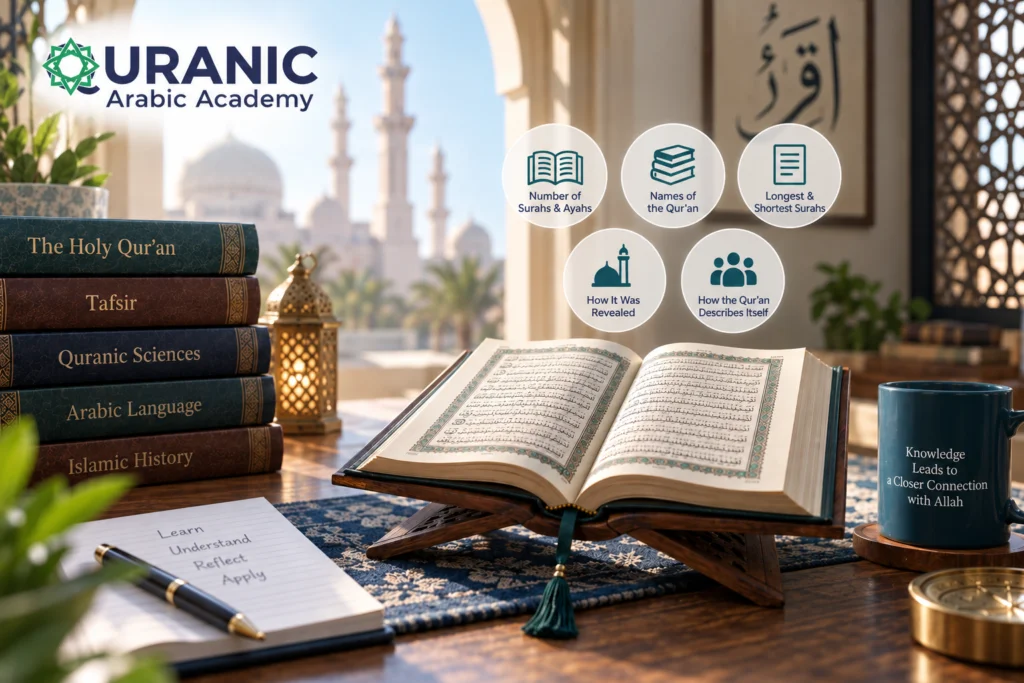
This article brings together well-established quranic information: the number of surahs and ayahs, the names of the Qur’an, its longest and shortest chapters, how it was revealed, and how the Qur’an describes itself. Consider this a starting point for anyone who wants to learn and understand the Qur’an correctly.
What You Will Learn
- The exact number of surahs, ayahs, and juz’ in the Qur’an.
- The difference between Makkan and Madinan surahs.
- The most well-known names and descriptions of the Qur’an.
- The longest and shortest surah and ayah in the Qur’an.
- How the Qur’an describes itself, with a verified verse and source.
- A brief, practical overview of the etiquette of reciting the Qur’an.
What Is the Quran and How Was It Revealed?
The Qur’an is the literal speech of Allah, revealed to Prophet Muhammad ﷺ through the angel Jibreel (Gabriel), recited as an act of worship, and transmitted to us through unbroken, mass transmission (tawatur).
It begins with Surah Al-Fatihah and ends with Surah An-Nas. It was revealed gradually over approximately 23 years, about 13 years in Makkah and 10 years in Madinah.
Key Quran Facts and Numbers at a Glance
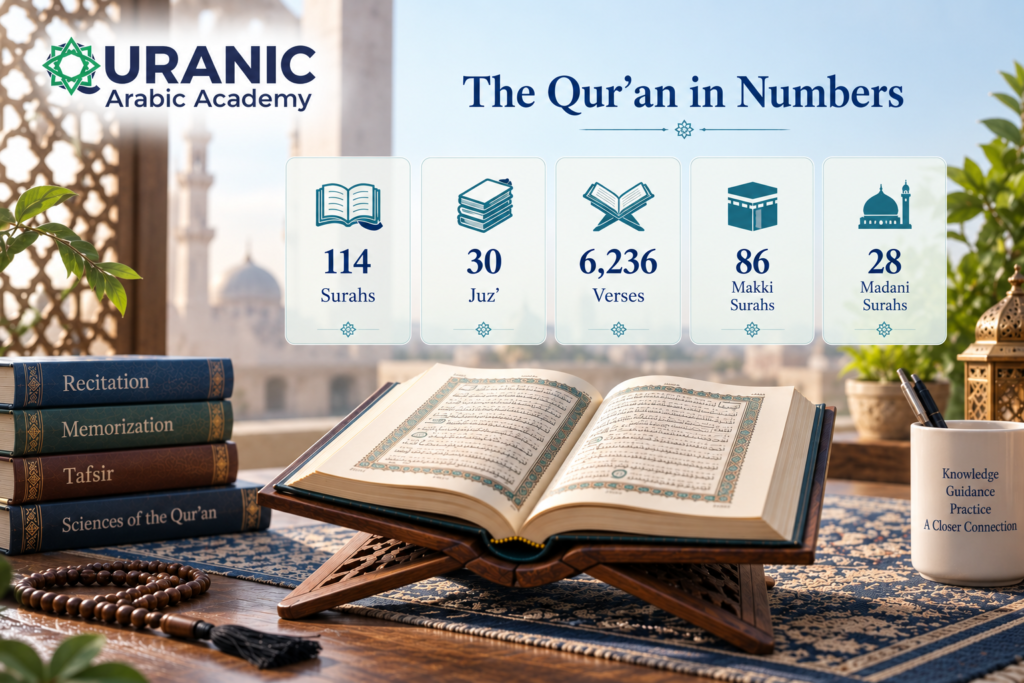
Understanding the Qur’an through its basic numerical and structural information can give students a clearer picture of how the Book of Allah is organized. Details such as the number of surahs, juz’, verses, Makki and Madani chapters, and other structural divisions provide useful reference points for anyone studying recitation, memorization, tafsir, or the sciences of the Qur’an.
These facts can also help learners navigate the Mushaf more confidently and understand how scholars have traditionally divided and classified its content.
For beginners in particular, learning these figures offers a simple introduction to the broader field of Quranic studies before moving into more detailed subjects such as revelation, compilation, interpretation, and linguistic analysis.
They also provide helpful context for students planning a memorization or study schedule. The following figures are therefore among the most frequently searched pieces of Quranic information among students of Islamic knowledge:
| Statistic | Value |
| Number of Surahs | 114 Surahs |
| Number of Juz’ (Parts) | 30 Juz’ |
| Number of Hizbs | 60 Hizbs |
| Number of Ayahs (Verses) | 6,236 Ayahs |
| Makkan Surahs | 87 Surahs |
| Madinan Surahs | 27 Surahs |
| Period of Revelation | About 23 years |
Each of the 30 juz’ is divided into two hizbs, which is why the Qur’an contains 60 hizbs in total. This division did not exist during the Prophet’s ﷺ lifetime; it was introduced later to make memorization, recitation, and completing the Qur’an (khatmah) easier for Muslims.
The Main Names and Descriptions of the Quran
The Qur’an refers to itself through several significant names and descriptions found throughout its verses. Each of these terms highlights a particular aspect of its nature, purpose, or relationship with those who receive its guidance.
Rather than functioning merely as different titles, these names help readers understand the Qur’an as revelation from Allah, a source of guidance and remembrance, and a criterion through which truth can be distinguished from falsehood.
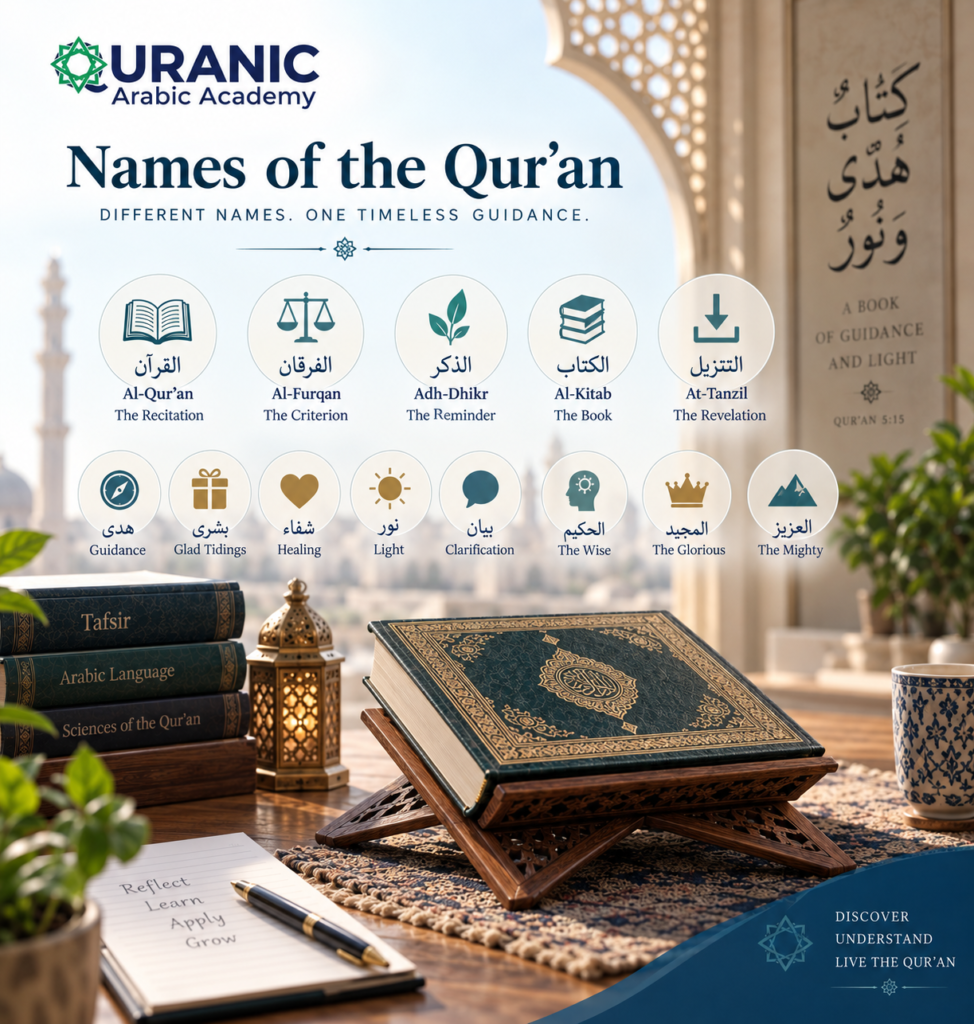
Among its most well-known names and descriptions are:
- Al-Qur’an — from the root meaning “recitation.”
- Al-Furqan — “the Criterion,” because it distinguishes truth from falsehood.
- Adh-Dhikr — “the Reminder,” as a means of admonition.
- Al-Kitab — “the Book,” as it is written and preserved.
- At-Tanzil — “the Revelation,” sent down from Allah.
Other descriptions used for the Qur’an include: guidance (huda), glad tidings (bushra), healing (shifa’), light (nur), clarification (bayan), the Wise (Al-Hakim), the Glorious (Al-Majid), and the Mighty (Al-‘Aziz).
Join our comprehensive online courses and learn from qualified scholars today.
Lessons are led by qualified, experienced teachers who ensure correct pronunciation and accurate understanding of the text.
Surahs Named After Prophets in the Quran
An interesting aspect of Quranic structure is that several surahs bear the names of prophets. These names draw attention to the important place that the prophets and their missions occupy within the Qur’an.
Their stories are not presented merely as historical accounts; they communicate lessons about faith, patience, reliance upon Allah, perseverance in calling people to the truth, and remaining steadfast when facing rejection or hardship.
There are six surahs directly named after prophets: Yunus, Hud, Yusuf, Ibrahim, Muhammad, and Nuh. Although a surah may carry the name of a particular prophet, this does not necessarily mean that the entire chapter is devoted exclusively to that prophet’s story.
Rather, the name may highlight an important theme, event, or message associated with that prophet while the surah addresses a wider range of subjects.
Lessons are led by qualified, experienced teachers who ensure correct pronunciation and accurate understanding of the text.
Makkan vs. Madinan Surahs: What Is the Difference?
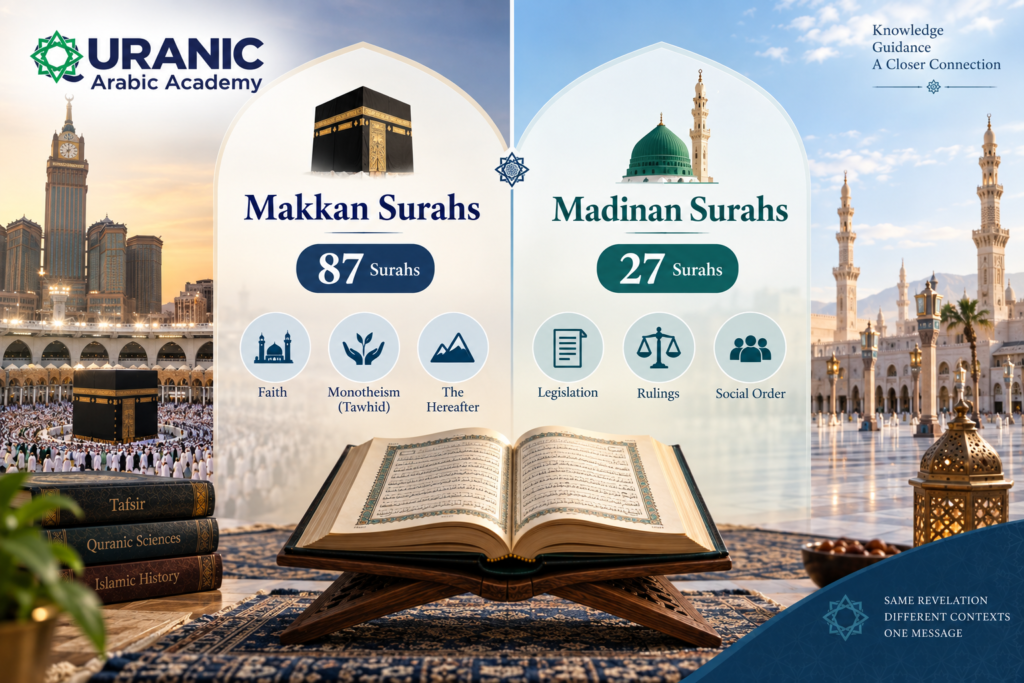
Makkan surahs are those revealed before the Prophet’s ﷺ migration (Hijrah) to Madinah, numbering 87 surahs, and they largely focus on faith, monotheism (tawhid), and the Hereafter.
Madinan surahs, numbering 27, were revealed after the Hijrah and largely address legislation, rulings, and the social order of the Muslim community.
Some scholars hold that a surah’s classification as Makkan or Madinan depends on the place of revelation rather than the timing of the Hijrah itself. This is a legitimate scholarly difference among commentators and does not change the overall meaning of the classification.
You may also enjoy this article on Qur’anic ethics and how the Qur’an shapes the character, which expands on how recitation connects to daily conduct.
The Longest and Shortest Surahs and Ayahs in the Quran
The Qur’an contains surahs and ayahs of remarkably different lengths, and learning about these variations is a useful part of understanding its structure. Some chapters extend across many pages and address a wide range of subjects, while others consist of only a few short verses that communicate profound meanings in a highly concise form.
These differences also demonstrate the diversity of Quranic expression, where guidance may be delivered through detailed passages, extended narratives, legal instructions, or brief and powerful statements.
Among the most frequently mentioned facts are:
- Longest surah: Surah Al-Baqarah, with 286 ayahs.
- Shortest surah: Surah Al-Kawthar, with only 3 ayahs.
- Longest ayah: the verse on debt (ayat al-dayn) in Surah Al-Baqarah, ayah 282.
- Among the shortest ayahs: the word “mudhammatan” in Surah Ar-Rahman, and the letters “Ya-Sin” at the opening of the surah of the same name.
For readers who want a structured starting point, this complete guide to learning Qur’anic Arabic for beginners explains how to approach the language step by step.
Surahs That Begin with the Disjointed Letters
Twenty-nine surahs in the Qur’an begin with disjointed letters (al-huruf al-muqatta’ah), such as Alif-Lam-Meem, Ta-Ha, Ya-Sin, Saad, and Qaf. Commentators have differed on their meaning, and the view held by many scholars is that their precise meaning is known only to Allah, and that they are part of the Qur’an’s linguistic inimitability (i’jaz).
See It in Action:
Wondering what our interactive sessions look like? Click below to peek inside a live session and watch how our expert instructors make learning Quranic Arabic accessible and engaging.
Ready to Begin Your Quranic Journey?
Start learning with professional instructors through our structured curriculum.
Book Your Free TrialHow Does the Quran Describe Its Purpose and Guidance?
The Qur’an describes its own purpose and qualities in many of its verses, giving readers a clear understanding of the role revelation is intended to play in human life. It is presented not simply as a text to be recited, but as a source of guidance that directs people toward truth, strengthens faith, provides moral instruction, and encourages reflection.
These self-descriptions help students understand that Quranic knowledge is closely connected to both learning and personal transformation.
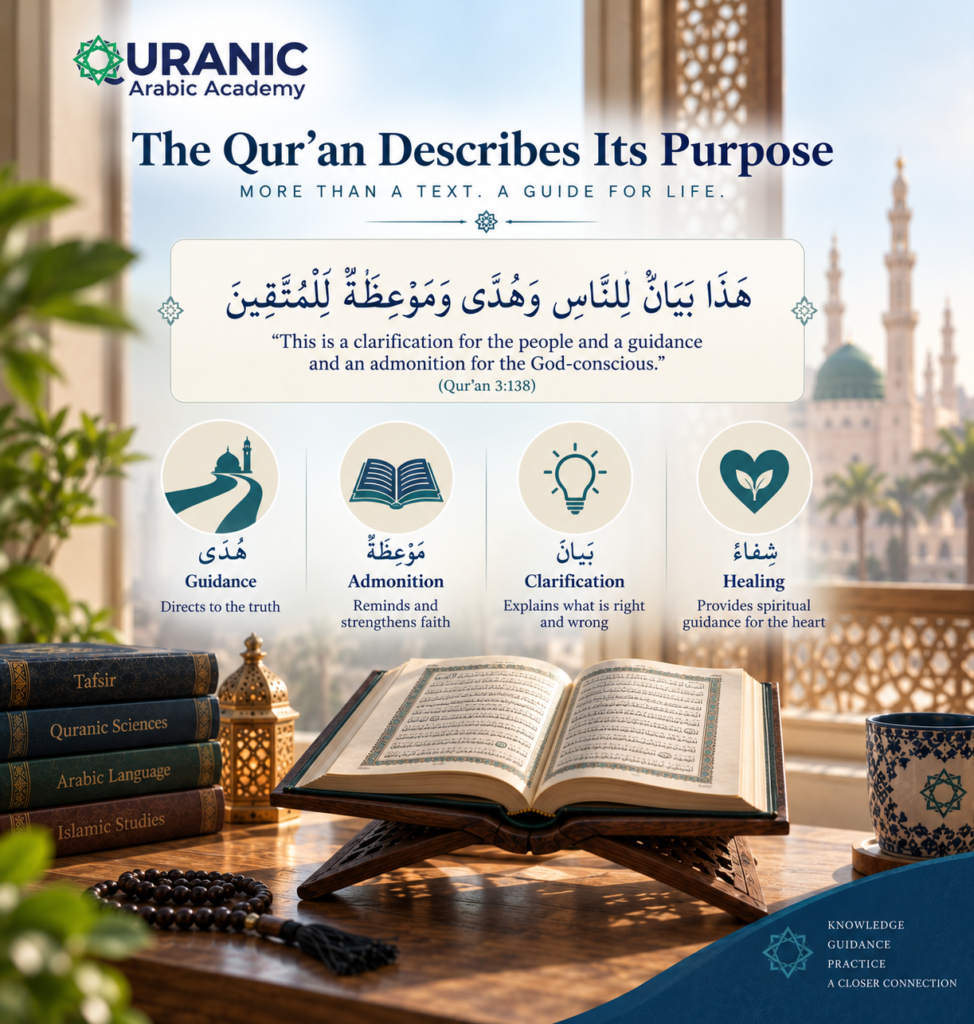
Among the recurring descriptions associated with Quranic revelation are guidance (huda), admonition (maw’izah), clarification (bayan), and healing (shifa’). Each term emphasizes a different dimension of divine guidance.
The Qur’an clarifies fundamental truths, teaches people how to distinguish right from wrong, reminds them of their responsibilities before Allah, and provides spiritual guidance for the heart. Studying these descriptions therefore offers a deeper understanding of how the Qur’an presents its own function and significance.
هَذَا بَيَانٌ لِلنَّاسِ وَهُدًى وَمَوْعِظَةٌ لِلْمُتَّقِينَ
“This [Qur’an] is a clear statement to [all] the people, and it is guidance and instruction for those conscious of Allah.”
What the Stories of the Prophets Teach Us in the Quran
The Qur’an narrates the stories of the prophets, peace be upon them, for reflection and lesson-taking. Among the prophets whose stories are mentioned: Adam, Nuh (Noah), Ibrahim (Abraham), Isma’il (Ishmael), Musa (Moses), ‘Isa (Jesus), Yusuf (Joseph), Dawud (David), Sulayman (Solomon), and Yunus (Jonah), peace be upon them all.
These accounts were not narrated for entertainment, but to draw out lessons in patience, monotheism, and steadfastness upon truth.
For those who wish to study these stories more deeply and connect them to their correct Qur’anic context, learning Qur’anic Arabic is the most important gateway; many precise meanings are lost to a reader relying on translation alone.
This is where the Quranic Arabic Academy comes in, helping students understand the Qur’an from its original source by learning Qur’anic Arabic in a structured, gradual way.
Read also: Stories of the Prophets in the Quran: A Complete Overview
Essential Etiquette for Reading and Reciting the Quran
Reciting the Qur’an is an act of worship that involves more than correctly pronouncing its words. Islamic teachings encourage the reader to approach the Book of Allah with respect, attentiveness, sincerity, and an awareness of the importance of what is being recited.
The etiquette of Quranic recitation therefore includes both outward practices connected to preparation and proper recitation, and inward qualities related to the heart, intention, humility, and reflection.
Reciting the Qur’an carries both outward and inward etiquette, including:
- Being in a state of ritual purity before beginning recitation.
- Seeking refuge in Allah (isti’adhah) and beginning with the basmalah.
- Observing the rules of tajweed and correct pronunciation of letters.
- Being present of heart and reflecting on the meanings of the verses.
- Reciting with humility (khushu’) and being moved by its meanings.
Read also: The Essentials of Quranic Recitation: Tilawah, Tajweed, and Tarteel Explained
For those who want to master this practically, learning with a qualified teacher remains the soundest path. A teacher corrects pronunciation and explains meaning, rather than relying on self-study alone.
Experience Our Teaching Style:
We believe in clarity and engagement. Watch these short highlights from our actual classes to see our teachers’ methodology and student interactions in real-time.
Ready to Begin Your Quranic Journey?
Start learning with professional instructors through our structured curriculum.
Book Your Free TrialStart Your Journey to Learn the Qur’an and Qur’anic Arabic
If you want to move beyond quranic information and start understanding the Qur’an directly from its Arabic text, Quranic Arabic Academy offers specialized programs in Qur’anic Arabic for non-native speakers and new Muslims, taught gradually and simply for both beginners and advanced learners.
You can book a free trial class to experience the teaching style before committing to a full course.
Our Arabic Courses
- Quranic Arabic Classes
- Quranic Arabic Course for Beginners
- Online Quranic Arabic Courses for Advanced Learners
- Quranic Arabic Grammar Course
- Arabic Courses for Understanding the Quran
- Quranic Arabic Course for Sisters (Female)
- Quranic Arabic Course for Kids
- Online Quranic Arabic Classes for Adults
- Quranic Arabic Course UK
- Quranic Arabic Course London
- Quranic Arabic Course USA
- Quranic Arabic Course Canada
- Quranic Arabic Course Australia
- Quranic Arabic Course UAE
- Quranic Arabic Course Germany
Conclusion
The Qur’an is a miraculous book in its wording, meaning, and structure, containing 114 surahs and 6,236 ayahs distributed across 30 juz’ and 60 hizbs.
In this article, we covered essential quranic information: its names, its longest and shortest surahs and ayahs, the difference between Makkan and Madinan surahs, and how the Qur’an describes itself as guidance, healing, and admonition.
This information is only a starting point. True depth in understanding the Qur’an requires learning Arabic and reflecting on its verses with a qualified teacher something you can begin today.
Frequently Asked Questions
How many surahs does the Qur’an have?
The Qur’an has 114 surahs, of which 87 are Makkan and 27 are Madinan, arranged in the mushaf according to a fixed order that does not correspond to the order of revelation.
What is the longest and shortest surah in the Qur’an?
The longest surah in the Qur’an is Surah Al-Baqarah, with 286 ayahs, while the shortest is Surah Al-Kawthar, with only three ayahs.
How many ayahs does the Qur’an contain?
The Qur’an contains 6,236 ayahs, distributed across 114 surahs and 30 juz’, with minor differences between counting traditions in how certain verses are divided this does not affect the Qur’anic text itself.
What is the difference between Makkan and Madinan surahs?
Makkan surahs were revealed before the Prophet’s ﷺ migration and focus on faith and monotheism, while Madinan surahs were revealed after the migration and focus on legislation, rulings, and the social order of the Muslim community.
How long did the revelation of the Qur’an take?
The revelation of the Qur’an took approximately 23 years, revealed gradually in response to events and needs about 13 years in Makkah and 10 years in Madinah.
Related Articles
Quranic Arabic




Leave a Reply