 Quran
Quran

Many people who search for quranic quizzes want to test how well they understand Quranic teachings and one of the most searched Quranic themes is the idea of life as a test. The Quran does not describe this world as a place of guaranteed comfort. Instead, it describes life itself as an examination.
Whether you are new to Islam, preparing for quranic quizzes on faith topics, or simply want a deeper understanding of the Quran, this guide connects the idea of “being tested” to authentic Quranic evidence.

What You Will Learn
- What “ibtila” (trial) means in the Quran, and how it relates to common quranic quizzes on faith.
- The difference between trials through hardship and trials through blessing.
- Why Allah tests His servants, according to the Quran.
- Lessons from the trials of Prophets Ayyub, Ibrahim, and Yusuf.
- Practical steps a Muslim can take when facing a difficult trial.
What Do Trials and Tests Mean in the Quran?
A trial, known in Arabic as ibtila or fitnah, is any situation difficult or pleasant that Allah places before a person to reveal what is genuinely in their heart: their faith, patience, gratitude, and obedience.
This is the starting point for most quranic quizzes that ask about the purpose of hardship in a believer’s life.
الَّذِي خَلَقَ الْمَوْتَ وَالْحَيَاةَ لِيَبْلُوَكُمْ أَيُّكُمْ أَحْسَنُ عَمَلًا ۚ وَهُوَ الْعَزِيزُ الْغَفُورُ
“[He] who created death and life to test you [as to] which of you is best in deed — and He is the Exalted in Might, the Forgiving.”
This verse shows that life and death themselves are structured as a test. The goal is not simply for people to pass through events, but for their actions during those events to reveal who behaves best.
Why the Quran Describes Life as a Test
The Quran teaches that trials are an unavoidable part of human life and that even sincere believers will face periods of hardship, uncertainty, and difficulty. These tests can reveal the strength of faith, develop patience, and encourage believers to turn to Allah with greater trust and reliance.
Rather than viewing every hardship as a sign of divine displeasure, Islam teaches that trials can carry wisdom and become opportunities for spiritual growth.
أَحَسِبَ النَّاسُ أَن يُتْرَكُوا أَن يَقُولُوا آمَنَّا وَهُمْ لَا يُفْتَنُونَ
“Do the people think that they will be left to say, “We believe” and they will not be tried?”
Faith, according to this verse, is not only a statement a person makes with their tongue. Its true weight becomes visible only when a person is tested through fear, loss, or hardship and still holds on to trust in Allah.

See It in Action:
Wondering what our interactive sessions look like? Click below to peek inside a live session and watch how our expert instructors make learning Quranic Arabic accessible and engaging.
Ready to Begin Your Quranic Journey?
Start learning with professional instructors through our structured curriculum.
Book Your Free TrialHow Allah Tests People Through Hardship and Loss
The Quran explains that trials can take many forms, including fear, hunger, financial loss, the loss of loved ones, and reduced provisions. These experiences can test a believer’s patience, trust in Allah, and ability to remain steadfast during difficult circumstances.
Surah Al-Baqarah reminds believers that hardship is part of the test of life while giving glad tidings to those who respond with patience.
وَلَنَبْلُوَنَّكُم بِشَيْءٍ مِّنَ الْخَوْفِ وَالْجُوعِ وَنَقْصٍ مِّنَ الْأَمْوَالِ وَالْأَنفُسِ وَالثَّمَرَاتِ ۗ وَبَشِّرِ الصَّابِرِينَ
“And We will surely test you with something of fear and hunger and a loss of wealth and lives and fruits, but give good tidings to the patient.”
This verse names fear, hunger, financial loss, loss of life, and loss of produce as real forms of trial a person may face. Immediately after naming these hardships, Allah links them to good news for those who remain patient.
Patience here does not mean a person feels no sadness or pain. It means holding on to faith, avoiding objection to Allah’s decree, and continuing to obey Him despite difficulty.
Readers who want to explore the deeper linguistic roots of words like sabr (patience) and bala (trial) often study the Closest Dialect to Quranic Arabic, since the original Arabic carries shades of meaning that translation alone cannot fully capture.

How Blessings, Wealth, and Success Can Also Be Tests
The Quran teaches that a test does not always come through pain or loss. Blessings such as wealth, health, success, family, and ease can also test how a person responds to what Allah has given them.
Such blessings may reveal whether a believer remains grateful, humble, generous, and obedient rather than becoming careless or overly attached to worldly life. Both difficulty and prosperity, therefore, can become opportunities to demonstrate faith and responsibility.
كُلُّ نَفْسٍ ذَائِقَةُ الْمَوْتِ ۗ وَنَبْلُوكُم بِالشَّرِّ وَالْخَيْرِ فِتْنَةً ۖ وَإِلَيْنَا تُرْجَعُونَ
“Every soul will taste death. And We test you with evil and with good as trial; and to Us you will be returned.”
This verse shows that a person may be tested by what they love just as much as by what they dislike. When someone receives a blessing, the real question becomes whether they will thank Allah for it, or become distracted by it and forget Him.

Why Does Allah Test His Servants?
The Quran presents trials as part of the wisdom and purpose of human life. Through different forms of testing, a believer’s faith, patience, gratitude, and reliance upon Allah are brought into practice.
Trials can also encourage self-reflection, strengthen spiritual character, and remind people of their dependence upon Allah. Whether a test comes through hardship or blessing, it can become an opportunity to grow closer to Allah and respond in a way that reflects sincere faith.
1. To Distinguish Sincere Faith
Trials reveal what is truly inside a person’s heart. It is easy to speak about patience and trust in Allah when life is stable, but the strength of a person’s faith becomes visible under real difficulty.
2. To Raise a Believer’s Rank
A believer may face a trial that is not a punishment at all, but a means of raising their status with Allah. A person does not always know the full wisdom behind what happens to them, but trusts that Allah’s decree is wise.
3. To Remind People of Their Need for Allah
When life goes smoothly, a person can feel self-sufficient and forget their dependence on Allah. Hardship often brings a person back to supplication, humility, and reliance on their Creator.
4. To Develop Patience Through Difficulties
Patience is one of the greatest character traits a person can develop, but it cannot be learned without facing situations that require it. Trials function as a training ground where patience, calmness, and trust are built over time.
The Quranic Arabic Academy offers structured courses that help students connect Quranic vocabulary, grammar, and meaning in a guided, step-by-step way.
If you would like to explore this style of learning, you can book a free trial and experience a live class before making any commitment.

What the Prophets’ Trials Teach Us About Faith
The Quran presents the prophets as powerful examples of how believers should respond to trials. Despite their strong faith and closeness to Allah, they experienced loss, rejection, illness, persecution, and other serious hardships.
Their stories demonstrate that experiencing difficulty does not by itself indicate weak faith or Allah’s displeasure. Instead, the prophets teach believers to face trials with patience, trust in Allah, sincere supplication, and steadfastness upon the truth.
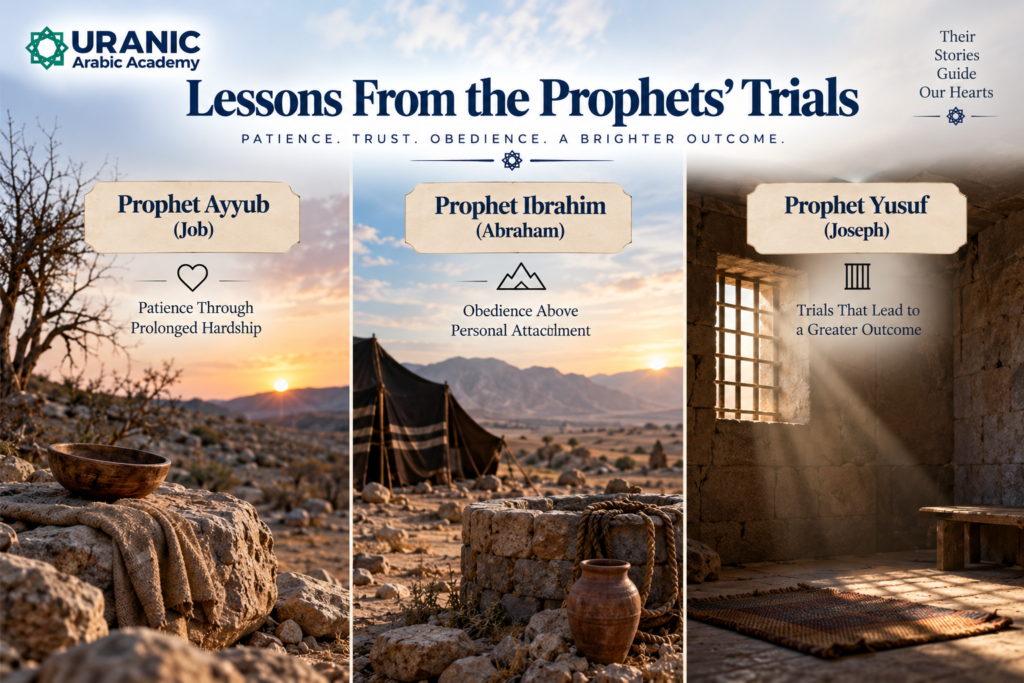
What Prophet Ayyub’s Trial Teaches About Patience
Prophet Ayyub faced a prolonged and severe trial, yet he remained turned toward Allah and never lost trust in His mercy. His story teaches that a long trial does not mean relief will never come, and that a believer can feel pain while still holding on to patience and trust.
Read also:The Messengers of Allah in the Quran: A Comprehensive Guide
What Prophet Ibrahim’s Trials Teach About Obedience
Prophet Ibrahim faced major trials throughout his life, and in each one he placed obedience to Allah above what he personally loved. His story shows that a trial can involve the things closest to a person’s heart, and that true faith reveals itself when a person chooses Allah’s pleasure over personal attachment.
What Prophet Yusuf’s Trials Teach About Trusting Allah
Prophet Yusuf experienced repeated trials being thrown into a well, separated from his family, and imprisoned despite his innocence. His story teaches that painful events can be part of a path leading toward a good outcome that a person cannot see at the time.
Studying these stories directly in Quranic Arabic often reveals nuances of meaning that a single English translation cannot fully deliver. This is one reason many students choose to study with the Quranic Arabic Academy, where structured courses connect language learning directly to understanding the Quran’s message.
How Should Muslims Respond to Trials and Hardships?
Islam teaches that a believer’s response to a trial is as important as the trial itself. The Quran and the examples of the prophets encourage Muslims to meet hardship with sabr (patience), tawakkul (reliance upon Allah), dua, and continued obedience.
Rather than allowing difficulties to lead to despair, believers are encouraged to seek Allah’s help, reflect on the lessons within their circumstances, take appropriate action, and remain hopeful of His mercy and wisdom.

1. Remain Patient During the Trial
Patience is the foundation of how a believer deals with trials. It does not mean giving up or refusing to seek a solution; it means facing difficulty while holding on to faith and obedience.
2. Turn to Allah Through Dua
Turning to Allah in supplication during hard times brings strength and reassurance to the heart. Dua reminds a person that Allah is able to change their circumstances, no matter how difficult they appear.
3. Take Practical Steps While Trusting Allah
Relying on Allah does not mean abandoning practical effort. A sick person seeks treatment, and a person facing financial hardship seeks work and improvement, while still placing their trust in Allah’s decree.
4. Maintain a Good Opinion of Allah
A person may not understand the wisdom behind certain events at the time they occur. Faith encourages trusting that Allah’s knowledge and wisdom are greater than human understanding.
Many of the supplications recited during hardship come directly from the Quran and Sunnah, and reciting them accurately paying attention to Quranic Arabic Diacritics helps preserve both their pronunciation and their intended meaning.
Does Every Hardship Mean Allah Is Punishing You?
A common misunderstanding is assuming that every hardship a person faces is a punishment from Allah. The Quran and the stories of the Prophets show that a trial may instead be a test, a means of raising rank, a reminder, or an expiation of sins.
For this reason, a person should not make a definite judgment about why another individual is being tested. What appears to be a hardship may, in Allah’s knowledge, be leading toward a much greater good.
Likewise, an abundance of blessings does not automatically mean a person is free from being tested, since blessings themselves require gratitude and proper use.

Why Your Response to a Trial Matters Most
What matters most is not only what happens to a person, but how they respond to it. When a blessing arrives, the test is gratitude. When hardship arrives, the test is patience. When a person is given power or ability, the test is how they use it.
These forms of quranic quizzes about life continue in different shapes throughout a person’s life, and at every stage a person is called to return to Allah and reflect on their own actions.
The wording and history of these teachings have been preserved with remarkable consistency, a continuity documented in studies of Early Quranic Manuscripts, which confirm that the Quran’s message on trials has remained unchanged since it was first revealed.
Experience Our Teaching Style:
We believe in clarity and engagement. Watch these short highlights from our actual classes to see our teachers’ methodology and student interactions in real-time.
Deepen Your Understanding of the Quran With the Quranic Arabic Academy
Understanding trials in the Quran becomes clearer once a person can read and understand the original Arabic text directly, rather than relying only on translation. The Quranic Arabic Academy offers structured courses that help students connect Quranic vocabulary, grammar, and meaning in a guided, step-by-step way.
Ready to Begin Your Quranic Journey?
Start learning with professional instructors through our structured curriculum.
Our Arabic Courses
- Quranic Arabic Classes
- Quranic Arabic Course for Beginners
- Online Quranic Arabic Courses for Advanced Learners
- Quranic Arabic Grammar Course
- Arabic Courses for Understanding the Quran
- Quranic Arabic Course for Sisters (Female)
- Quranic Arabic Course for Kids
- Online Quranic Arabic Classes for Adults
- Quranic Arabic Course UK
- Quranic Arabic Course London
- Quranic Arabic Course USA
- Quranic Arabic Course Canada
- Quranic Arabic Course Australia
- Quranic Arabic Course UAE
- Quranic Arabic Course Germany
Conclusion
The Quran teaches that trials are not exceptions in life but a fundamental part of it. A trial may appear as pain, loss, or hardship, and it may also appear as ease, blessing, and success.
The more important question is not “why is this happening to me,” but “how will I respond to it in a way that pleases Allah.”
A believer understands that this world is temporary, and that everything a person experiences is part of a larger journey that ends in returning to Allah. Patience during hardship, gratitude during blessing, and reliance on Allah while still taking practical means are among the most important ways a Muslim navigates the trials of life.
Frequently Asked Questions
What does the word “ibtila” mean in the Quran?
Ibtila refers to a trial or test that Allah places before a person, whether through hardship or through blessing, in order to reveal what is truly in their heart.
Are all trials in life a form of punishment?
No. The Quran and the stories of the Prophets show that a trial can be a test of faith, a means of raising a believer’s rank, a reminder to return to Allah, or an expiation of sins not only a punishment.
Why were the Prophets tested if they were sinless?
The Prophets were tested to demonstrate the highest level of patience, trust, and obedience to Allah, serving as an example for the believers who came after them.
How can quranic quizzes help me understand trials in Islam?
Quranic quizzes can help reinforce key verses and concepts about trials, though they should always be paired with accurate explanations and reliable sources rather than used alone.
What should a Muslim do when facing a difficult trial?
A Muslim is encouraged to remain patient, turn to Allah in supplication, take practical steps to address the situation, and maintain a good opinion of Allah’s wisdom.







Leave a Reply