 Quranic Resources & Apps
Non-Arab Muslim learners encounter the Quran daily in recitation but rarely engage with its physical history — the manuscripts that connect the text they recite today to the first generation of Islam. Early Quranic manuscripts are not artifacts of historical curiosity.
They are physical evidence of the Quran’s preservation, each one confirming that the text has remained unchanged from its original revelation.This guide covers what early Quranic manuscripts are, the scripts they were written in, the historical process that produced them, and the most significant surviving copies known to scholarship today.
Early Quranic Manuscripts Are the Oldest Physical Evidence of the Quran’s Preservation
Early Quranic manuscripts are handwritten copies of the Quran produced during the first two centuries of Islam, written on parchment — animal skin prepared for writing — using the Arabic scripts of the early Islamic period.
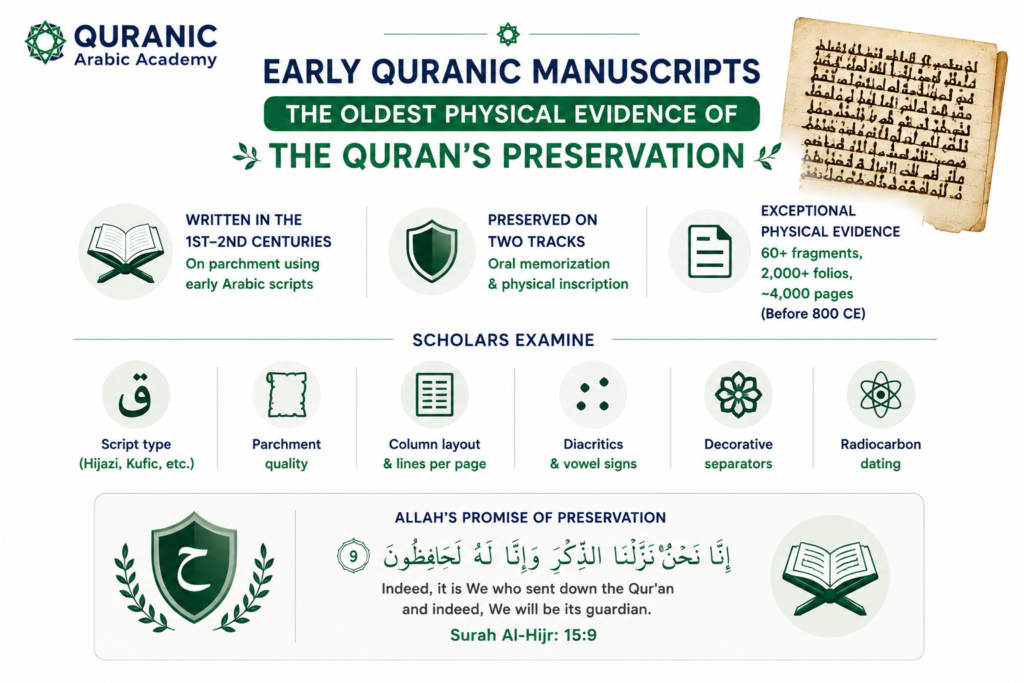
They represent the written dimension of a preservation system that always operated on two parallel tracks: oral memorization by the Huffaz, and physical inscription by trained scribes.
According to Corpus Coranicum — the most comprehensive scholarly database of early Quranic manuscripts — more than 60 fragments comprising over 2,000 folios, amounting to approximately 4,000 pages, are currently known as textual witnesses of the Quran produced before 800 CE.
This body of physical evidence is exceptional by the standards of ancient religious texts, and it places the Quran among the most thoroughly documented scriptures in human history.
The physical features scholars examine when studying early Quranic manuscripts include:
- Script type — whether Hijazi, Kufic, or a transitional variant.
- Parchment quality and preparation method.
- Column layout and line count per page.
- Presence or absence of diacritical marks and vowel signs.
- Decorative verse separators and Surah dividers.
- Radiocarbon dating of the organic parchment material.
Allah’s promise of preservation is the theological foundation behind what these manuscripts confirm physically:
“إِنَّا نَحْنُ نَزَّلْنَا الذِّكْرَ وَإِنَّا لَهُ لَحَافِظُونَ ﴿٩﴾ “
Innā naḥnu nazzalnā adh-dhikra wa innā lahu laḥāfiẓūn
“Indeed, it is We who sent down the Qur’an and indeed, We will be its guardian. (9).”
The Best Quranic Arabic Classes at The Quranic Arabic Academy teach non-Arab learners to read the same Arabic script tradition that connects these manuscripts to the text recited in every Salah today, building direct reading competency through one-on-one instruction with certified Arab tutors.
Read also: Quranic Tarbiyah: The Complete Practical Guide for Parents and Learners

Start Your Quranic Arabic Journey Today
The Quran Was Compiled in Writing Through Two Distinct Historical Stages
The written Quran that exists today is the product of a deliberate, two-stage compilation process that occurred within the first two decades after the Prophet’s death in 632 CE. Understanding these two stages is essential for understanding what early Quranic manuscripts represent.
The First Stage — Abu Bakr’s Compilation (632–634 CE)
After the Prophet Muhammad ﷺ passed away, his Companion and successor Abu Bakr (may Allah be pleased with him) ordered the collection of all written Quranic material into a single physical codex.
The impetus was the Battle of Yamama in 632 CE, in which a significant number of Companions who had memorized the Quran were martyred, raising concern about the long-term preservation of the text if the memorizers were lost.
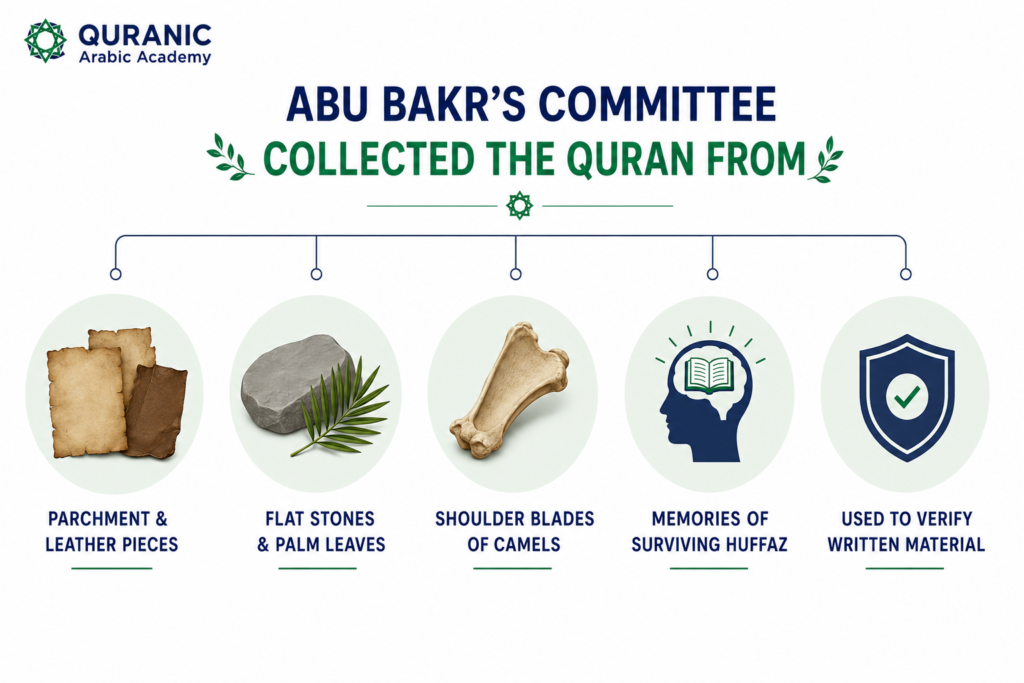
The written material collected by Abu Bakr’s committee — led by Zayd ibn Thabit (may Allah be pleased with him) — came from a range of physical surfaces:
- Parchment and leather pieces.
- Flat stones and palm leaves.
- The shoulder blades of camels.
- The memories of surviving Huffaz, used to verify written material.
This first codex was kept with Abu Bakr, then passed to Caliph Umar, then to Umar’s daughter Hafsa (may Allah be pleased with her) after Umar’s death.
The Second Stage — Uthman’s Standardization (644–656 CE)
The third Caliph Uthman ibn Affan (may Allah be pleased with him) commissioned a committee — again led by Zayd ibn Thabit — to produce a standardized authoritative codex from the Hafsa codex. The reason was the emergence of recitation differences among Muslims in different regions as Islam expanded rapidly beyond Arabia.
Uthman distributed copies of the standardized text to the major Islamic cities — Mecca, Medina, Kufa, Basra, Damascus, and possibly others — and ordered all divergent private manuscripts to be burned to prevent future disagreement.
The following table compares the two stages:
| Stage | Caliph | Year | Purpose | Outcome |
| First compilation | Abu Bakr | 632–634 CE | Preserve written material after Yamama | Single physical codex kept with Hafsa |
| Standardization | Uthman | 644–656 CE | Resolve regional recitation differences | Authoritative copies distributed to major cities |
Every surviving early manuscript is understood by scholars to be a descendant of this Uthmanic textual standard. The spelling patterns, orthographic conventions, and consonantal skeleton found across all major early manuscripts are consistent with Uthmanic codification..
Read also: Quranic Revelation: The Complete 3 Stages and 23-Year Timeline
Experience Our Teaching Style:
We believe in clarity and engagement. Watch these short highlights from our actual classes to see our teachers’ methodology and student interactions in real-time.
Ready to Begin Your Quranic Journey?
Start learning with professional instructors through our structured curriculum.
Book Your Free TrialHijazi and Kufic Are the Two Scripts of Early Quranic Manuscripts
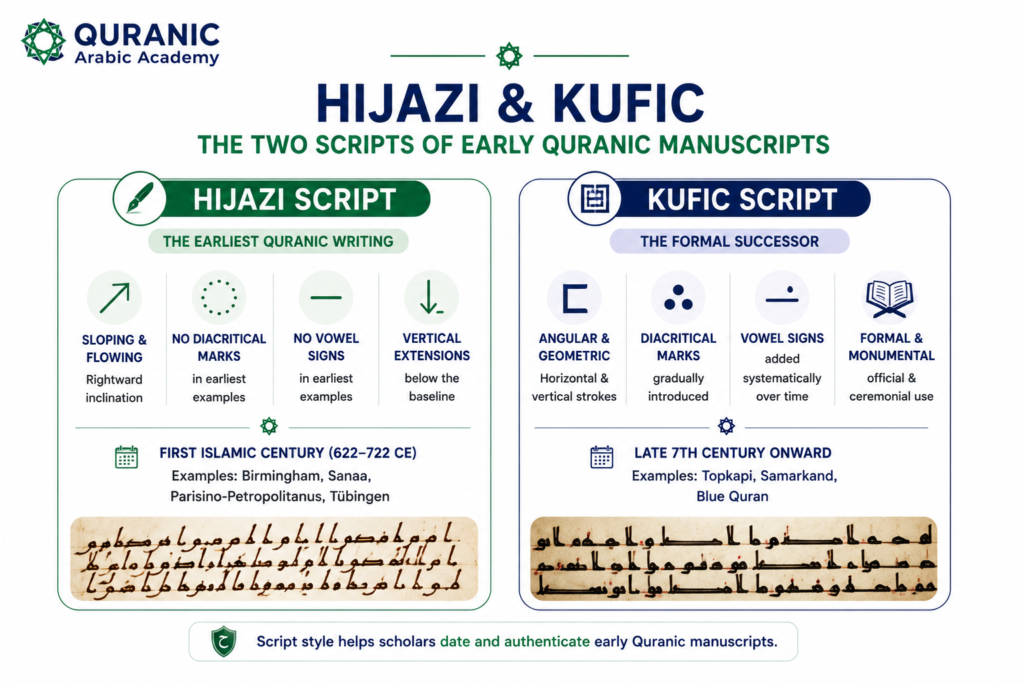
The script in which a manuscript is written is one of the primary tools scholars use to date and authenticate early Quranic manuscripts. Two distinct script families dominate the early manuscript tradition, each associated with a specific period and context of production.
Hijazi Script — The Earliest Quranic Writing
Hijazi script is the oldest Arabic script found in Quranic manuscripts. It is characterized by its informal, sloping ductus — the tall shafts of letters incline rightward and the script has a flowing, non-angular quality.
Hijazi was the native writing tradition of the Hejaz region — the area of Mecca and Medina — and it was the script in which the earliest recorded Quranic material was written.
Key features of Hijazi script in early manuscripts:
- Rightward inclination of tall letter shafts.
- Absence of diacritical marks (dots distinguishing similar letters) in the earliest examples.
- Absence of vowel signs in early examples.
- Vertical extension of certain letters below the baseline.
Scholars associate Hijazi manuscripts with the first Islamic century (622–722 CE). The Birmingham Quran, Codex Parisino-Petropolitanus, Sanaa manuscript, and Tübingen fragment are all written in Hijazi script.
Read also: Quranic Exegesis (Tafsir) – A Full Guide to Quranic Interpretation
Kufic Script — The Formal Successor
Kufic script emerged as the preferred formal style for Quranic manuscripts from the late 7th century onward, coinciding with the institutional reforms of Umayyad Caliph Abd al-Malik (reigned 685–705 CE).
Kufic is distinguished by its angular, geometric character — sharp horizontal and vertical strokes with minimal curves. It became the dominant script for monumental, ceremonial, and officially produced Quranic manuscripts through the Umayyad and Abbasid periods.
The following table compares the two scripts:
| Feature | Hijazi Script | Kufic Script |
| Character | Informal, sloping, flowing | Angular, geometric, formal |
| Period of dominance | First Islamic century (7th CE) | Late 7th century onward |
| Diacritical marks | Absent in earliest examples | Gradually introduced |
| Vowel signs | Absent in earliest examples | Added systematically over time |
| Associated manuscripts | Birmingham, Sanaa, Parisino-Petropolitanus | Topkapi, Samarkand, Blue Quran |
The Quranic Arabic Grammar Course at The Quranic Arabic Academy gives non-Arab learners a structured understanding of the Arabic consonantal system — the same rasm (consonantal skeleton) that forms the textual foundation of every early Quranic manuscript — taught through actual Quranic verse analysis in live one-on-one sessions.

The Most Significant Early Quranic Manuscripts Confirmed by Modern Scholarship
The following are the most important surviving early Quranic manuscripts, arranged chronologically by their established or estimated dates:
The Birmingham Quran (568–645 CE)
Held at the University of Birmingham’s Cadbury Research Library as part of the Mingana Collection, the Birmingham Quran is the most significant early Quranic manuscript discovered in the modern era.
Radiocarbon dated in 2015 to between 568 and 645 CE with 95.4% accuracy, it is the only known manuscript that may have physically existed during the lifetime of the Prophet Muhammad ﷺ (approximately 570–632 CE).
It comprises two parchment leaves written in Hijazi script, preserving portions of Surahs 19 (Maryam) and 20 (Ta-Ha). Scholars have confirmed it is a descendant of the Uthmanic text type, with spelling patterns fully consistent with Uthmanic orthographic conventions.
The Sanaa Manuscript (Before 671 CE)
Discovered in 1972 during restoration of the Great Mosque of Sanaa, Yemen, the Sanaa manuscript is a palimpsest — a parchment that was washed and reused, leaving two layers of text. Its two layers are:
- Upper layer: Conforms to the standard Uthmanic Quran.
- Lower layer: Contains textual variants; radiocarbon dated to before 671 CE with 99% accuracy.
An edition of the lower text was published by Sadeghi and Goudarzi in 2012. The manuscript provides the oldest known example of a pre-standardization Quranic text, written in Hijazi script.
The Codex Parisino-Petropolitanus (Late 7th–Early 8th Century CE)
One of the most extensively studied early Quranic manuscripts, the Codex Parisino-Petropolitanus contains approximately 45% of the total Quranic text across 118 surviving folios, written in Hijazi script by five different scribes working concurrently. Its folios are currently distributed across four institutions:
- 70 folios at the Bibliothèque Nationale de France, Paris.
- 46 folios at the National Library of Russia, Saint Petersburg.
- 1 folio at the Vatican Library, Rome.
- 1 folio at the Khalili Collection, London.
Read also: Quranic Education: How to Get the Best Quranic Education
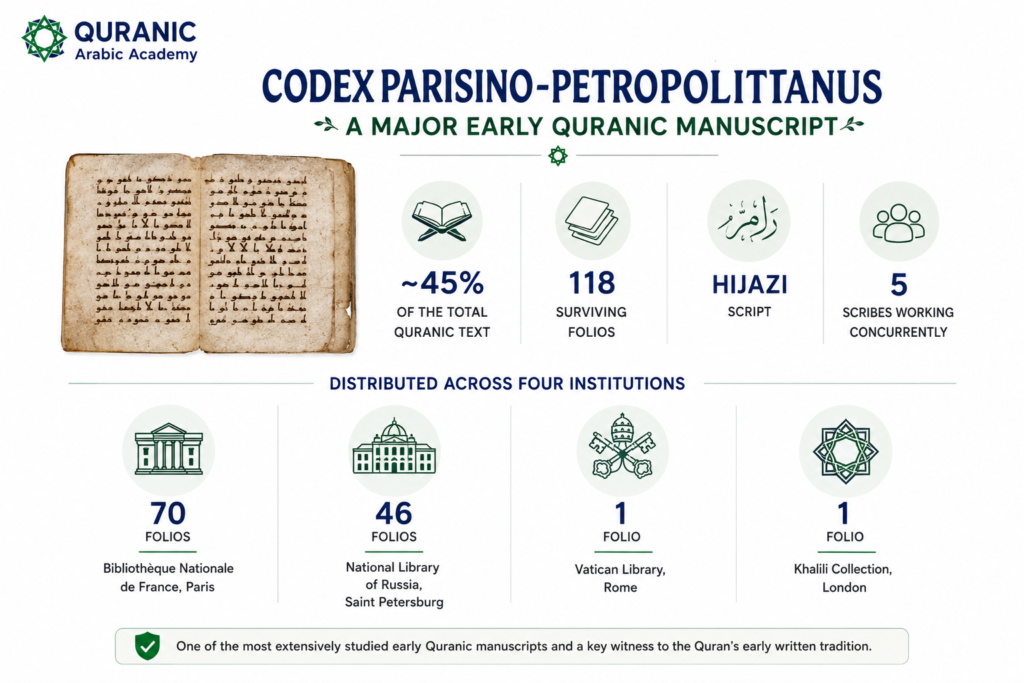
Paleographer François Déroche dates the manuscript to the mid-7th century — the early Umayyad period — placing it among the earliest organized large-scale Quran production efforts after Uthmanic standardization.
The Tübingen Fragment (649–675 CE)
Housed at the University of Tübingen, Germany, the Tübingen fragment was radiocarbon dated in 2014 to between 649 and 675 CE with 94.8% confidence.
Written in Hijazi script, it contains Quranic text from Surah Al-Isra (17:35) through Surah Ya-Sin (36:57), placing it firmly within the first Islamic century and within the lifetime of the Companions of the Prophet ﷺ.
The Codex Mashhad (680–720 CE)
Housed in the Astan-i Quds Library in Mashhad, Iran, the Codex Mashhad comprises two manuscripts (MSS 18 and 4116) that together contain over 90% of the Quranic text across more than 252 discovered folios.
Written in Hijazi or mail script, it is the only Hijazi manuscript in vertical format in Iran, and is believed to have been copied within the first Islamic century based on textual, orthographic, and variant analyses.
The Topkapi Manuscript (Early 8th Century CE)
Held at the Topkapi Palace Museum in Istanbul, Turkey, the Topkapi manuscript is written in Kufic script and contains more than 99% of the Quranic text — making it the most complete early Quran in existence.
With only two pages and 23 verses missing, it is the closest to a full Quranic text among manuscripts of its era. Although Islamic tradition attributes it to Caliph Uthman, paleographic assessment places its production in the early to mid-8th century CE.
The Samarkand (Tashkent) Quran (795–855 CE)
Preserved at the Hast Imam Library in Tashkent, Uzbekistan, the Samarkand Quran is a Kufic manuscript traditionally attributed to Caliph Uthman.
Radiocarbon dating has shown a 95.4% probability of a date between 795 and 855 CE. The manuscript begins in the middle of Surah Al-Baqarah (2:7) and ends at Surah Az-Zukhruf (43:10), constituting approximately 81% of the Quran. It is treated as a national treasure by the government of Uzbekistan.
Read also: Learning Quranic Arabic for Complete Beginners: A Step-by-Step Guide
See It in Action:
Wondering what our interactive sessions look like? Click below to peek inside a live session and watch how our expert instructors make learning Quranic Arabic accessible and engaging.
Ready to Begin Your Quranic Journey?
Start learning with professional instructors through our structured curriculum.
Book Your Free TrialBegin Your Journey with The Quranic Arabic Academy
Every early Quranic manuscript was written in an Arabic script tradition that connects directly to the Quran non-Arab Muslims recite today. Reading that text with accuracy, fluency, and comprehension — rather than approximation — is what The Quranic Arabic Academy equips every learner to do through one-on-one live sessions with certified Arab tutors worldwide.
Every program at The Quranic Arabic Academy includes:
- Certified Arab tutors holding Ijazah in recitation or degrees in Islamic studies from recognized institutions.
- One-on-one live sessions tailored to each student’s individual level and goals.
- Real-time Makharij correction using audio-visual feedback during every session.
- Tafseer-integrated learning — Nahw and Sarf taught through actual Quranic verse analysis.
- Flexible scheduling covering all global time zones: EST, PST, GMT, CET, IST, GST, and MYT.
- Affordable pricing with transparent packages and family enrollment discounts.
- Monthly progress reports and written feedback provided after every session.
- Serves students across North America, Europe, Asia, and the Middle East.
Our Arabic Courses
- Quranic Arabic Classes
- Quranic Arabic Course for Beginners
- Online Quranic Arabic Courses for Advanced Learners
- Quranic Arabic Grammar Course
- Arabic Courses for Understanding the Quran
- Quranic Arabic Course for Sisters (Female)
- Quranic Arabic Course for Kids
- Online Quranic Arabic Classes for Adults
- Quranic Arabic Course UK
- Quranic Arabic Course London
- Quranic Arabic Course USA
- Quranic Arabic Course Canada
- Quranic Arabic Course Australia
- Quranic Arabic Course UAE
- Quranic Arabic Course Germany

Book Your Free Trial and Start Today
Ready to Begin Your Quranic Journey?
Start learning with professional instructors through our structured curriculum.
Book Your Free TrialConclusion
Early Quranic manuscripts provide physical evidence of the Quran’s early written preservation. The Birmingham Quran, Sanaa manuscript, Codex Parisino-Petropolitanus, Tübingen fragment, Codex Mashhad, Topkapi manuscript, and Samarkand Quran represent important surviving manuscripts from the early Islamic period.
For non-Arab Muslim learners, this history is more than academic. These manuscripts preserve the Arabic text connected to the Quran recited by Muslims today, linking modern readers to the scribes, Hafiz, and generations of believers who preserved the Quran.
FAQs
What are early Quranic manuscripts and why do they matter?
Early Quranic manuscripts are handwritten parchment copies of the Quran produced during the first two Islamic centuries. They matter because they provide physical, dateable evidence that the Quranic text has remained consistent with the Uthmanic standard across fourteen centuries of transmission.
Which is the oldest surviving Quranic manuscript?
The Birmingham Quran, radiocarbon dated to 568–645 CE, is currently the oldest known Quranic manuscript. Its parchment may have been produced during the lifetime of the Prophet Muhammad ﷺ himself.
What is the difference between Hijazi and Kufic scripts in early manuscripts?
Hijazi script is the informal, sloping Arabic script used in the earliest Quranic manuscripts of the 7th century. Kufic is the angular, geometric formal script that replaced it from the late 7th century onward. All manuscripts written before approximately 700 CE use Hijazi script; later formal manuscripts use Kufic.
How many early Quranic manuscripts survive today?
According to Corpus Coranicum, more than 60 fragments comprising over 2,000 folios — approximately 4,000 pages — survive as textual witnesses of the Quran produced before 800 CE.
Do early Quranic manuscripts confirm the text used today?
Yes. Every major surviving early manuscript aligns with the Uthmanic textual standard in its consonantal skeleton. Scholars including François Déroche and Marijn van Putten have confirmed that manuscripts such as the Birmingham Quran and the Codex Parisino-Petropolitanus are clearly descendants of the Uthmanic text type.
Related Articles
Quranic Resources & Apps







Leave a Reply