 Quran
Quran

The Quranic concept of war is built on a simple foundation: war is a last resort, permitted only to repel aggression, end persecution, and protect the freedom to worship, never a tool for domination or forced conversion.
This article explains what the Quran actually says about fighting, why it was permitted, and the ethical limits placed on Muslim armies.
Many people encounter isolated verses about fighting without the surrounding context of when, why, and under what conditions they apply.
Understanding the Quranic concept of war requires looking at the full picture: the verses that permit fighting, the verses that command peace, and the Prophetic teachings that define how war must be conducted.
What You Will Learn
- What the Quranic concept of war actually permits and prohibits.
- The theological, social, political, and security purposes behind Quranic legislation on fighting.
- The exact verses that command restraint, mercy, and peace whenever the enemy ceases hostility.
- The ethical rules the Quran and Sunnah place on Muslim fighters, including protection of civilians.
- Where to study these verses in their original Arabic for a deeper and more accurate understanding.
The Quranic Concept of War: A Direct Definition
The Quranic concept of war (qital) is the idea that armed conflict in Islam is a regulated, defensive response to aggression, persecution, or injustice not an unrestricted or offensive doctrine.
The Quran repeatedly ties permission to fight to a specific cause, such as being attacked first, being expelled from one’s home, or being prevented from practicing one’s faith.
This is different from the idea of war as conquest for its own sake. The Quran frames qital as a legal and moral response to a wrong that has already occurred, with clear conditions for when it must stop.
Why Does the Quran Permit Fighting?
The Quran permits fighting within specific circumstances rather than presenting violence as an unrestricted religious objective. Quranic passages discuss armed conflict in contexts such as aggression, persecution, and the defense of communities, while also placing moral limits on conduct and prohibiting transgression.
Understanding these verses therefore requires attention to their historical and textual context, the conditions surrounding them, and the broader Quranic principles of justice, restraint, and peace.
1. Defense Against Aggression
One of the clearest contexts in which the Quran permits fighting is self-defense against active aggression. The command is directed toward fighting those who are engaged in fighting while immediately warning believers not to transgress beyond permitted limits.
This establishes an important distinction between legitimate defense and unrestricted violence, showing that armed conflict in the Quran is subject to moral boundaries rather than being a general command to fight people simply because they follow a different religion.
وَقَاتِلُوا فِي سَبِيلِ اللَّهِ الَّذِينَ يُقَاتِلُونَكُمْ وَلَا تَعْتَدُوا إِنَّ اللَّهَ لَا يُحِبُّ الْمُعْتَدِينَ
“Fight in the way of Allah those who fight you but do not transgress. Indeed, Allah does not like transgressors.”
2. Ending Persecution (Fitna)
Another context in which the Quran discusses fighting is fitna, a term that in these passages has been understood in relation to persecution and pressure against believers because of their faith.
The verses address circumstances in which Muslims faced hostility and were prevented from practicing their religion securely. Fighting is therefore presented within a context of resisting such persecution, while the surrounding verses also establish limits and indicate that hostility should cease when the aggression ends.
وَقَاتِلُوهُمْ حَتَّىٰ لَا تَكُونَ فِتْنَةٌ وَيَكُونَ الدِّينُ لِلَّهِ ۖ فَإِنِ انتَهَوْا فَلَا عُدْوَانَ إِلَّا عَلَى الظَّالِمِينَ
“And fight them until there is no [more] fitnah and worship is [acknowledged to be] for Allah. But if they cease, then there is to be no aggression except against the oppressors.”
3. Protecting Freedom of Belief
The Quran establishes the principle that faith cannot be imposed through coercion. Belief is a matter of sincere conviction, and forcing someone to accept Islam would contradict this principle.
In this broader framework, resisting religious persecution should not be understood as compelling others to believe, but as protecting people from coercion and allowing faith to be practiced without oppression.
لَا إِكْرَاهَ فِي الدِّينِ ۖ قَد تَّبَيَّنَ الرُّشْدُ مِنَ الْغَيِّ
“There shall be no compulsion in [acceptance of] the religion. The right course has become clear from the wrong.”

| Read These Verses in Their Original ArabicUnderstanding the precise wording of verses like these is easier when you can read Quranic Arabic directly. Explore structured courses built for Quran study.Explore Quranic Arabic Classes for Quran |
See It in Action:
Wondering what our interactive sessions look like? Click below to peek inside a live session and watch how our expert instructors make learning Quranic Arabic accessible and engaging.
Ready to Begin Your Quranic Journey?
Start learning with professional instructors through our structured curriculum.
Book Your Free TrialThe Purposes (Maqasid) of War in the Quran
Quranic discussions of warfare are connected to specific purposes and circumstances rather than treating war as an end in itself.
Scholars examining these verses have identified objectives such as responding to aggression, resisting persecution and oppression, protecting communities, and restoring security and justice.
Understanding these purposes (maqasid) helps place verses about fighting within their broader Quranic and historical context and clarifies the principles and limits governing armed conflict.
Read Also: Quranic Arabic Prepositions
Theological Purpose: Protecting the Freedom to Worship God Alone
One theological purpose associated with Quranic discussions of fighting is resisting persecution that prevents believers from worshipping Allah freely.
In this context, fighting is connected to ending fitna and removing coercive conditions that interfere with religious practice, as reflected in Surah Al-Baqarah (2:193).
Legislative Purpose: Responding to Broken Commitments
The Quran places great importance on fulfilling treaties and agreements. When groups maintained their commitments, those agreements were to be respected; when particular parties violated treaties and engaged in hostility, the Quran permitted an appropriate response to that breach.
The issue is therefore connected to specific acts of betrayal and aggression rather than religious identity alone.
Social Purpose: Defending the Oppressed
The Quran also presents the defense of oppressed people as a legitimate context for fighting. Surah An-Nisa refers specifically to vulnerable men, women, and children suffering oppression, framing their protection as a matter of justice and responsibility toward those unable to defend themselves.
وَمَا لَكُمْ لَا تُقَاتِلُونَ فِي سَبِيلِ اللَّهِ وَالْمُسْتَضْعَفِينَ مِنَ الرِّجَالِ وَالنِّسَاءِ وَالْوِلْدَانِ
“And what is [the matter] with you that you fight not in the cause of Allah, and [for] the weak among men, women, and children…”
Political Purpose: Protection from Unjust Expulsion
The Quran also connects permission to fight with the experience of people who had been wronged and unjustly expelled from their homes.
This establishes protection against persecution and displacement as another important context for understanding Quranic permission for armed defense.
أُذِنَ لِلَّذِينَ يُقَاتَلُونَ بِأَنَّهُمْ ظُلِمُوا ۚ وَإِنَّ اللَّهَ عَلَىٰ نَصْرِهِمْ لَقَدِيرٌ
“Permission [to fight] has been given to those who are being fought, because they were wronged. And indeed, Allah is competent to support them.”
Security Purpose: Deterrence, Not Aggression
The Quran also frames military readiness as a deterrent meant to discourage attack, not as preparation for unprovoked conquest; the goal is safety for the community, not expansion for its own sake.
Read Also: Quranic Exegesis (Tafsir)
When Does the Quran Command Peace Instead of War?
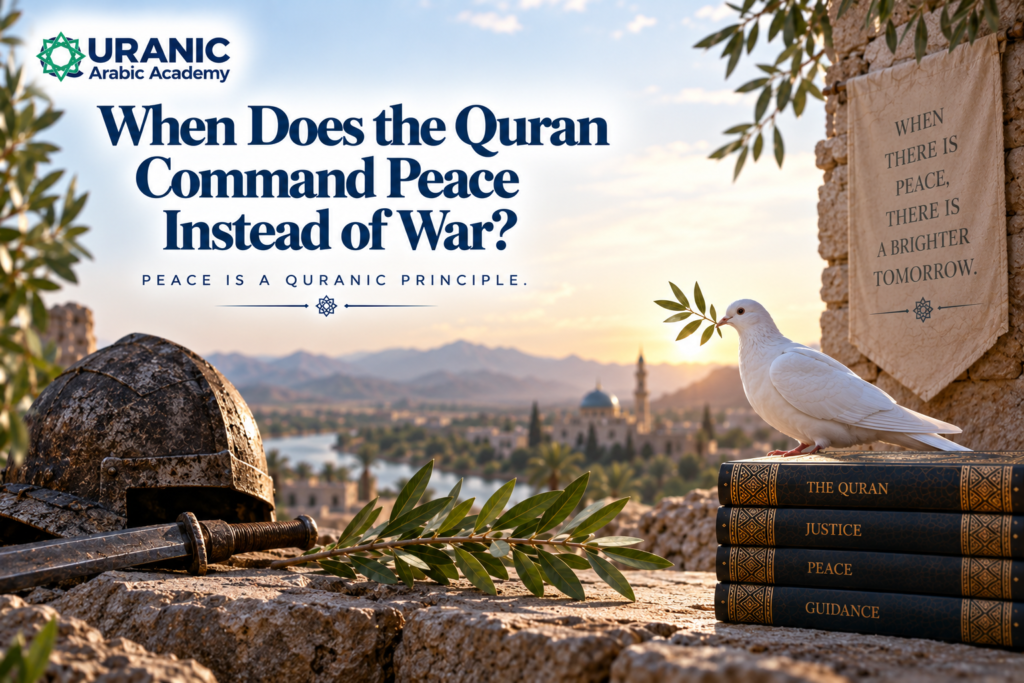
The Quran does not present fighting as a permanent condition. It repeatedly connects armed conflict to particular circumstances and instructs Muslims to cease hostilities when aggression ends or when the opposing side genuinely seeks peace.
This principle places clear limits on warfare and shows that continuing aggression without justification is not permitted. Peace, therefore, should be accepted when the conditions that justified fighting no longer exist.
وَإِن جَنَحُوا لِلسَّلْمِ فَاجْنَحْ لَهَا وَتَوَكَّلْ عَلَى اللَّهِ
“And if they incline to peace, then incline to it [also] and rely upon Allah.”
The Quran also protects peaceful non-Muslims who neither fight Muslims nor expel them from their homes, commanding kindness and justice toward them rather than hostility.
لَّا يَنْهَاكُمُ اللَّهُ عَنِ الَّذِينَ لَمْ يُقَاتِلُوكُمْ فِي الدِّينِ وَلَمْ يُخْرِجُوكُم مِّن دِيَارِكُمْ أَن تَبَرُّوهُمْ وَتُقْسِطُوا إِلَيْهِمْ ۚ إِنَّ اللَّهَ يُحِبُّ الْمُقْسِطِينَ
“Allah does not forbid you from those who do not fight you because of religion and do not expel you from your homes – from being righteous toward them and acting justly toward them. Indeed, Allah loves those who act justly.”

| New to Quranic Arabic?If you are just starting to explore the language of the Quran, a beginner-friendly path makes verses like these much easier to follow in the original text.Start with Classes for Beginners |
Ethical Rules of War in the Quran and Sunnah
Islamic teachings place ethical limits on the conduct of warfare, even when fighting is considered permissible.
The Quran prohibits transgression, while the Sunnah provides further guidance concerning conduct during conflict, including protections for those not participating in hostilities and restrictions on unnecessary destruction.
These principles emphasize that warfare is not without moral boundaries and that justice, restraint, and accountability remain essential even during armed conflict.
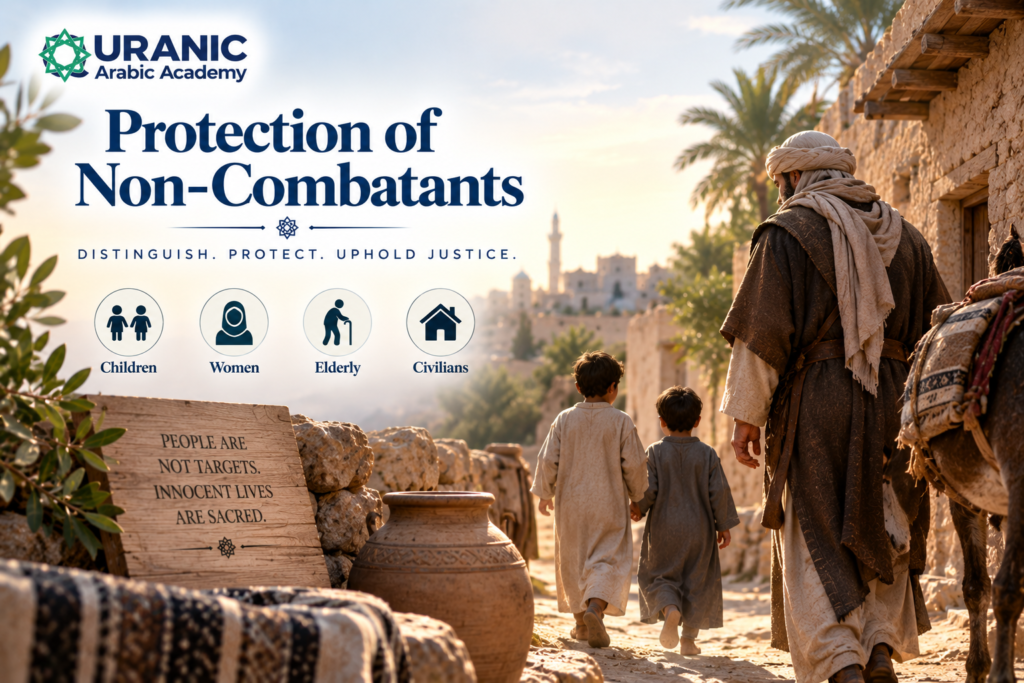
1. Protection of Non-Combatants
The Quran commands fighters to distinguish carefully between combatants and non-combatants before taking any action, warning against harming those who are not actually fighting.
يَا أَيُّهَا الَّذِينَ آمَنُوا إِذَا ضَرَبْتُمْ فِي سَبِيلِ اللَّهِ فَتَبَيَّنُوا
“O you who have believed, when you go forth [to fight] in the cause of Allah, investigate [thoroughly]…”
This principle is reinforced in the Sunnah, which explicitly prohibits killing children and non-combatants during military campaigns.
اغزوا باسم الله في سبيل الله، قاتلوا من كفر بالله، اغزوا ولا تغلوا، ولا تغدروا، ولا تمثلوا، ولا تقتلوا وليدًا
“Fight in the name of Allah and in the cause of Allah. Fight those who disbelieve in Allah. Make war, but do not embezzle the spoils; do not break your pledge; do not mutilate the dead; and do not kill children.”
2. Prohibition of Treachery and Mutilation
The Sunnah places clear restrictions on conduct during warfare. Treachery, breaking agreements, mutilating the dead, and unlawfully taking from war spoils are prohibited, emphasizing that even during conflict Muslims remain bound by moral and legal responsibilities.
Warfare does not remove the obligation to act with justice and restraint.
3. Restraint and Proportional Response
The Quran also establishes limits on retaliation. Where a response to wrongdoing is permitted, it must not exceed the harm suffered, while patience and restraint are presented as better when appropriate.
This principle prevents retaliation from becoming an excuse for excessive or uncontrolled violence.
وَإِنْ عَاقَبْتُمْ فَعَاقِبُوا بِمِثْلِ مَا عُوقِبْتُم بِهِ ۖ وَلَئِن صَبَرْتُمْ لَهُوَ خَيْرٌ لِّلصَّابِرِينَ
“And if you punish [an enemy], punish with an equivalent of that with which you were harmed. But if you are patient, it is better for those who are patient.”
4. Mercy Toward a Surrendering or Repentant Enemy
The Prophet ﷺ taught that any sign of surrender or declaration of faith, even from someone previously hostile, must stop the fighting immediately.
This is illustrated in the well-known account of Usama ibn Zayd, who was questioned by the Prophet ﷺ after killing a man who had declared his faith in the middle of battle.
يا أسامة، أقتلته بعدما قال لا إله إلا الله؟
“O Usama, did you kill him after he said, ‘There is no god but Allah’?”
Enroll in The Quranic Arabic Academy And Get A Free Trial
Summary of Wartime Ethical Principles
| Principle | Practical Meaning |
| Distinction (tabayyun) | Verify who is actually fighting before taking action. |
| No mutilation or treachery | The dead and agreements must be respected. |
| Proportionality | Response may not exceed the harm received. |
| Mercy on surrender | Fighting stops the moment an enemy submits or declares faith. |
| Protection of the vulnerable | Women, children, and non-combatants are not targeted. |
Experience Our Teaching Style:
We believe in clarity and engagement. Watch these short highlights from our actual classes to see our teachers’ methodology and student interactions in real-time.
Ready to Begin Your Quranic Journey?
Start learning with professional instructors through our structured curriculum.
Book Your Free TrialStudy the Quran in Its Original Language With the Quranic Arabic Academy
Reading these verses in Arabic, alongside a reliable translation, gives a far more precise understanding of the Quranic concept of war than translation alone can offer. The Quranic Arabic Academy offers guided, one-on-one courses for learners at every level, including classes designed for sisters and classes for absolute beginners.

| Deepen Your Understanding of the QuranJoin a free trial class and start reading Quranic verses in their original Arabic with qualified teachers.Book Your Free Trial |
Our Arabic Courses
- Quranic Arabic Classes
- Quranic Arabic Course for Beginners
- Online Quranic Arabic Courses for Advanced Learners
- Quranic Arabic Grammar Course
- Arabic Courses for Understanding the Quran
- Quranic Arabic Course for Sisters (Female)
- Quranic Arabic Course for Kids
- Online Quranic Arabic Classes for Adults
- Quranic Arabic Course UK
- Quranic Arabic Course London
- Quranic Arabic Course USA
- Quranic Arabic Course Canada
- Quranic Arabic Course Australia
- Quranic Arabic Course UAE
- Quranic Arabic Course Germany
Conclusion
The Quranic concept of war is defensive, conditional, and tightly regulated. Fighting is permitted only in response to aggression, persecution, or injustice, and it must stop the instant the other side seeks peace or surrenders.
Alongside this permission, the Quran and Sunnah set firm ethical boundaries: no harming non-combatants, no mutilation, no betrayal of agreements, and no forced conversion.
Understanding these verses accurately — in their original context and language protects against both misreading isolated verses out of context and dismissing the real historical circumstances they address.
Studying Quranic Arabic directly is one of the most effective ways to reach that accurate understanding.
Frequently Asked Questions
Does the Quran command Muslims to fight all non-Muslims?
No. The Quran ties permission to fight to specific causes such as being attacked first, persecuted, or expelled from one’s home, not to a general command against all non-Muslims .
Does the Quran allow forced conversion to Islam?
No. The Quran explicitly states there is no compulsion in religion, and the goal of ending persecution is to restore freedom of belief, not to force acceptance of Islam.
What happens if the enemy stops fighting?
Fighting must stop immediately. The Quran states that once hostility ceases, aggression is only permitted against those who continue to act unjustly.
Are civilians protected under the Quranic concept of war?
Yes. The Quran commands fighters to verify who is actually engaged in combat, and authentic hadith explicitly prohibit killing children and non-combatants during military campaigns.
Is mutilation or breaking agreements permitted in Islamic warfare?
No. Authentic hadith explicitly prohibit mutilating the dead, breaking pledges, and misappropriating war spoils, regardless of how the conflict began.







Leave a Reply