 Learn Quranic Arabic
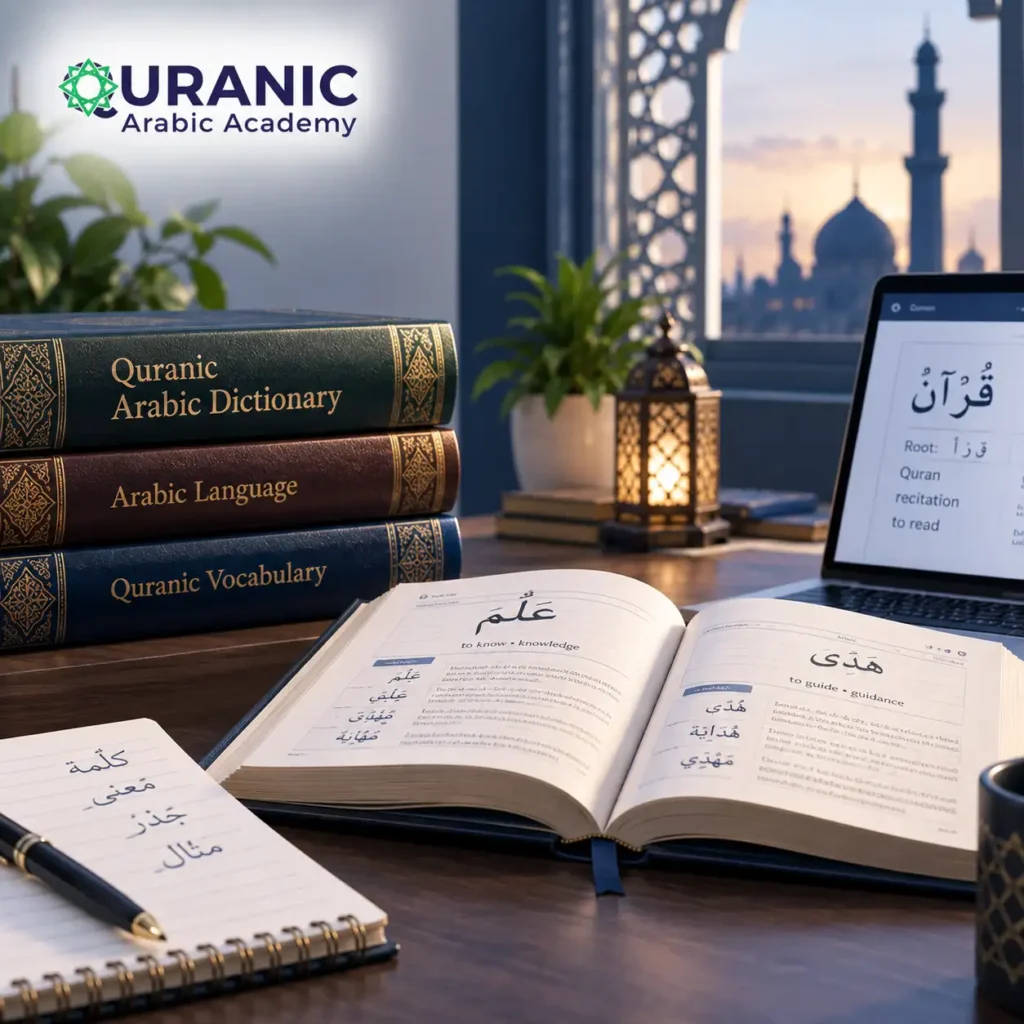
A quranic Arabic dictionary is one of the most valuable tools for anyone who wants to move beyond translation and understand the Quran through its own language.
Many readers can recite the Quran fluently yet still feel disconnected from the meaning of individual words, especially when a word’s Quranic sense differs from how it is used in everyday modern Arabic.
Whether you are a beginner learning your first Quranic words or a student who already reads Arabic, this article gives you a practical starting point for building real, lasting vocabulary knowledge.
What You Will Learn
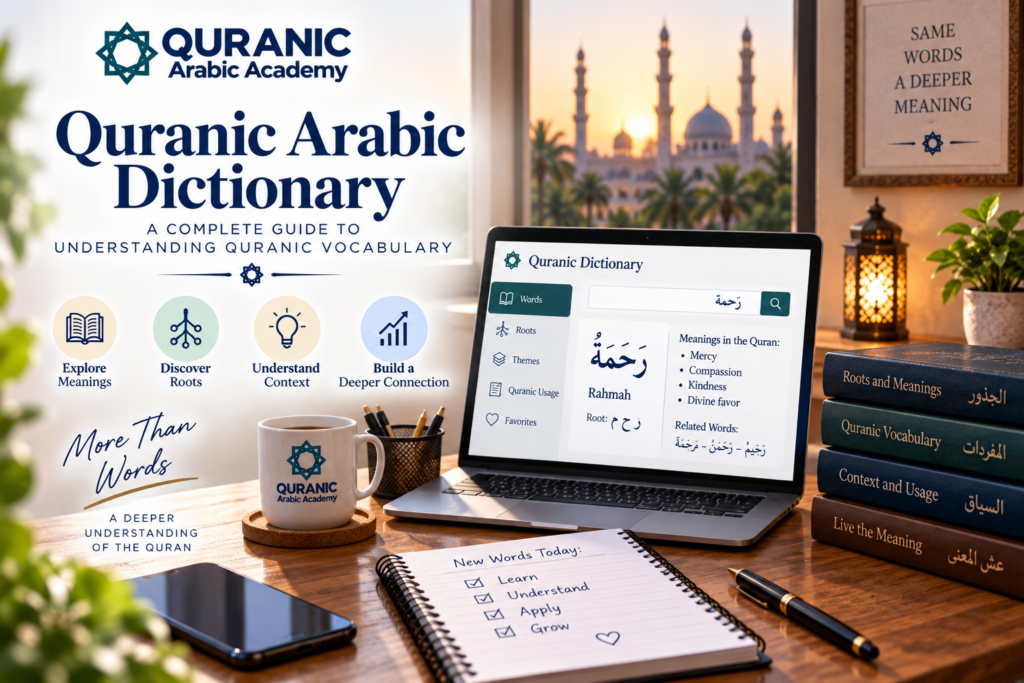
- What a Quranic Arabic dictionary is and how it differs from a general Arabic dictionary.
- Why root letters are central to understanding Quranic vocabulary.
- A practical, step-by-step method for using a dictionary while reading the Quran.
- Which classical and modern dictionaries are considered reliable references.
- How to build a personal Quranic vocabulary list that grows with your study.
Quranic Arabic Dictionary: What It Is and How It Works
A Quranic Arabic dictionary is a specialized language reference that explains the words used in the Quran by tracing each word back to its root letters and clarifying how that root is used across different verses. Unlike a simple word list, it shows the relationship between a word and its family of related terms.
Rather than giving only a one-word translation, a good Quranic Arabic dictionary shows the core meaning of the root, the specific form a word takes in a given verse, and, in many cases, other places in the Quran where the same root appears. This is what allows a reader to move from surface translation to genuine understanding.
اقْرَأْ بِاسْمِ رَبِّكَ الَّذِي خَلَقَ
“Read in the name of your Lord who created.”
Why a Quranic Arabic Dictionary Matters
Translation alone cannot always carry the full weight of a Quranic word. Many Arabic words used in the Quran hold a range of meanings, nuances, and linguistic associations that a single English word cannot fully express.
A translated word may communicate the general idea, but it can sometimes leave out subtle aspects of meaning that become clearer when the original Arabic is examined.
This is why a Quranic Arabic dictionary can be a valuable tool for anyone who wants to develop a deeper understanding of the Quran. It can help learners explore the roots of words, their different meanings, and how they are used within the Quranic context.
Rather than relying entirely on a single translation, readers can use a dictionary alongside a trusted translation and explanation to gain a more complete picture of the words they encounter.
Learning the meanings of Quranic Arabic words can also make recitation more meaningful. As you become familiar with the vocabulary and linguistic richness of the Quran, you may begin to recognize connections between different verses and understand the message with greater depth.
This makes a Quranic Arabic dictionary useful not only for studying individual words but also for gradually building a stronger relationship with the language of the Quran.
Read also: Juz Amma Quranic Studies: The Complete Guide
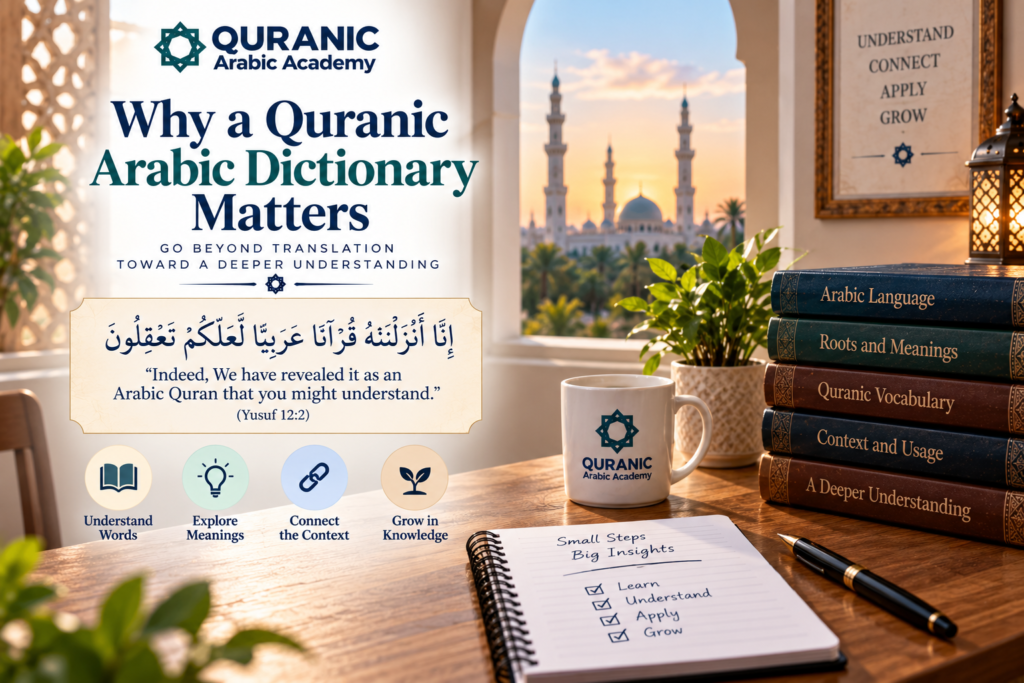
إِنَّا أَنزَلْنَاهُ قُرْآنًا عَرَبِيًّا لَّعَلَّكُمْ تَعْقِلُونَ
“Indeed, We have sent it down as an Arabic Qur’an that you might understand.”
This is exactly the gap a Quranic Arabic dictionary is designed to close. By working with the original Arabic wording rather than translation alone, a reader gains direct access to the layers of meaning the verse was revealed with.
| Learn Quranic Arabic With Guided InstructionA dictionary is a powerful tool, but structured teaching helps you use it correctly. The Quranic Arabic Academy offers guided courses for students who want to read the Quran with real understanding.Learn More |
See It in Action:
Wondering what our interactive sessions look like? Click below to peek inside a live session and watch how our expert instructors make learning Quranic Arabic accessible and engaging.
Ready to Begin Your Quranic Journey?
Start learning with professional instructors through our structured curriculum.
Book Your Free TrialHow a Quranic Arabic Dictionary Differs From a General Arabic Dictionary
A general Arabic dictionary explains words across a wide range of classical and modern contexts, while a Quranic Arabic dictionary focuses specifically on vocabulary found in the Quran.
It helps learners explore a word’s root, Quranic meanings, grammatical forms, and how its meaning may change according to the verse in which it appears.
This makes it particularly useful for students who want to move beyond translation and develop a more precise understanding of Quranic vocabulary.
| General Arabic Dictionary | Quranic Arabic Dictionary |
|---|---|
| Covers modern and classical vocabulary broadly | Covers only the words used in the Quran |
| Gives the common, general meaning | Gives the specific Quranic usage and meaning |
| Roots are listed but not always emphasized | Root letters are central to how entries are organized |
| Rarely references specific verses | Often shows every verse where a word appears |
| Used by general Arabic learners | Used by students of the Quran and Quranic Arabic |
How to Use a Quranic Arabic Dictionary Effectively
Using a Quranic Arabic dictionary effectively involves more than simply looking up the translation of an unfamiliar word. Learners should pay attention to the word’s root, different forms, meanings in context, and other places where it appears in the Quran.
Following a consistent method helps connect individual vocabulary with broader Quranic usage, making new words easier to understand, remember, and recognize during future reading.
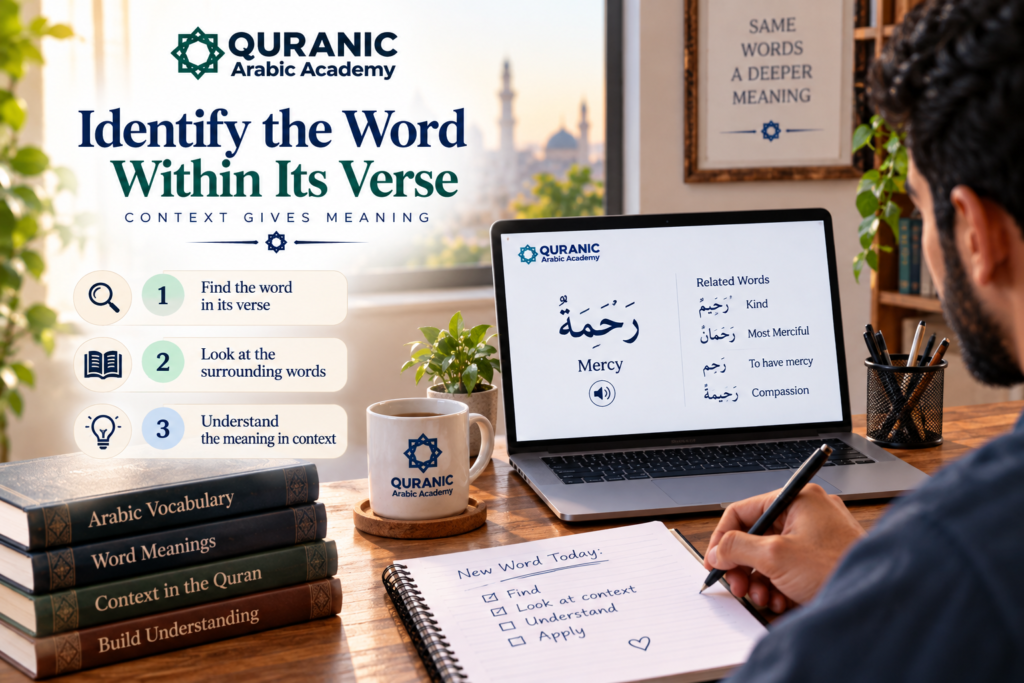
1. Identify the Word Within Its Verse
Begin by identifying the unfamiliar word within the Quranic verse where it appears rather than studying it in isolation. The surrounding words and overall meaning of the verse provide essential context that can clarify which meaning is intended.
This approach also helps learners connect vocabulary with real Quranic usage, making the word easier to understand and remember.
2. Find the Root Letters
After identifying the word in its verse, look for its root letters, which are often three consonants in Arabic. Recognizing the root helps you connect the word with other related Quranic vocabulary and understand the central meaning shared across different forms.
Over time, this skill makes unfamiliar words easier to recognize and expands your Quranic Arabic vocabulary more efficiently.
Read also: Quranic Injunction Meaning: What Every Muslim Needs to Know
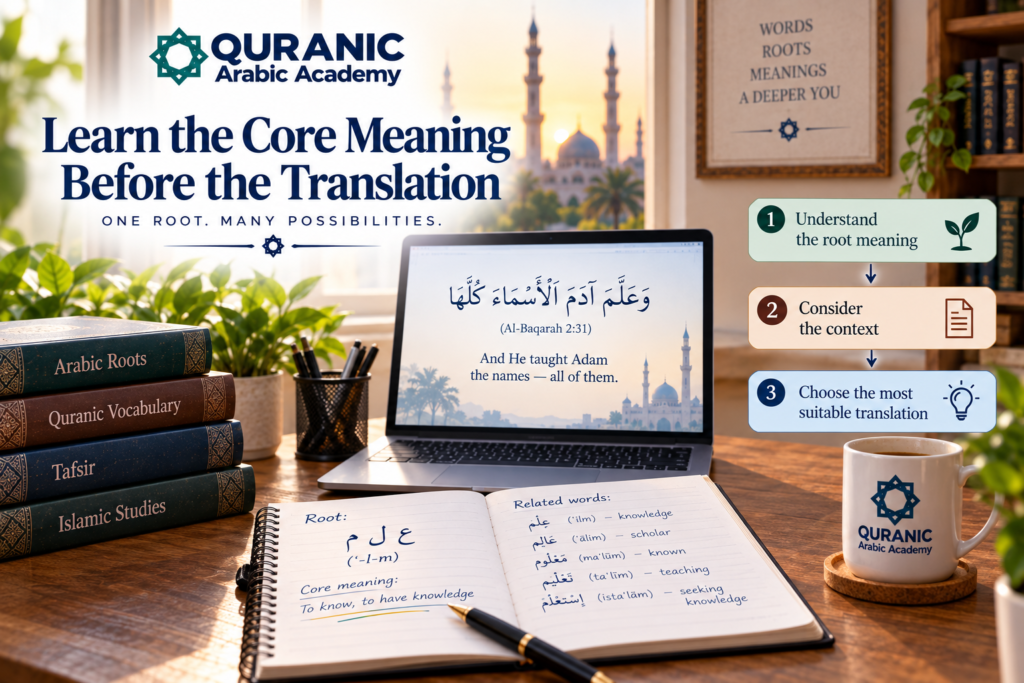
3. Learn the Core Meaning Before the Translation
Before choosing a single English translation, take time to understand the core meaning of the Arabic root.
Many Quranic words have a broader range of meanings than one translated equivalent can express, and their precise meaning may depend on the sentence and surrounding verses.
Learning the root meaning first helps you understand why translators may choose different words for the same Arabic term in different contexts.
4. Review Other Verses Where the Word Appears
When your Quranic Arabic dictionary provides other verses containing the same word or root, review several of these examples. Comparing different occurrences helps you see how a shared core meaning can take on different shades or implications depending on the context.
It also strengthens vocabulary retention because you begin recognizing the word as part of a wider family of related Quranic expressions rather than as an isolated term.
5. Return to Tafsir When Needed
A dictionary is useful for understanding vocabulary, roots, and possible meanings, but it does not always provide everything needed to interpret an entire verse. Some expressions become clearer only when their grammatical structure, surrounding passage, circumstances of revelation, or broader Quranic context is considered.
In these cases, consult a reliable tafsir alongside the dictionary to understand how qualified scholars have explained the verse and how the individual word contributes to its overall meaning.
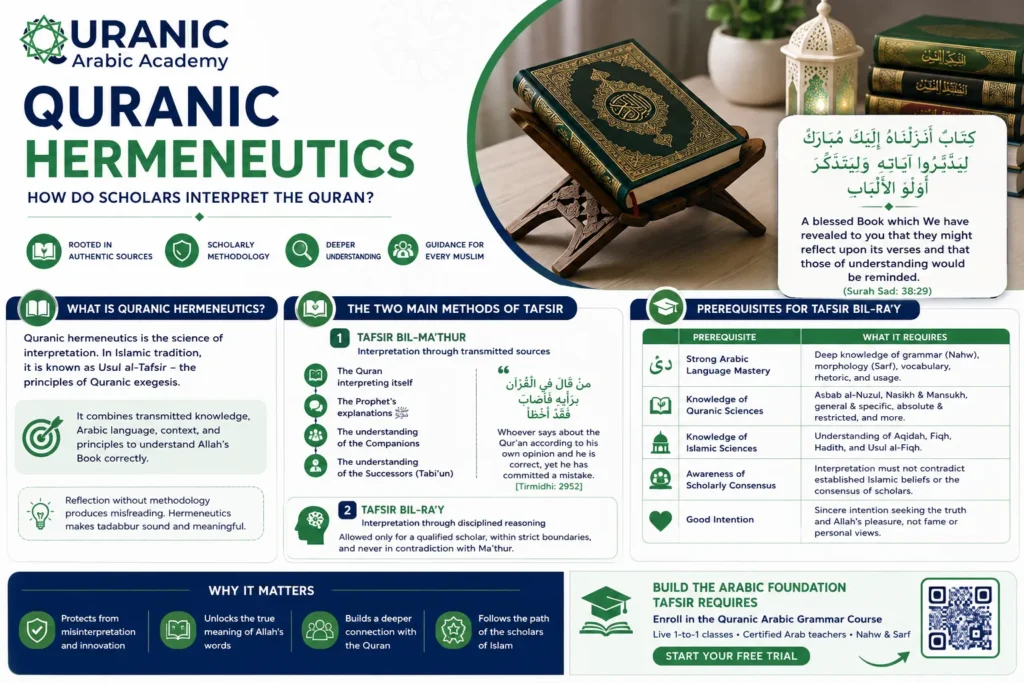
Read also: Exploring Tafsir Al-Quran: Methods and Principles of Interpretation
Why Root Letters Matter in a Quranic Arabic Dictionary
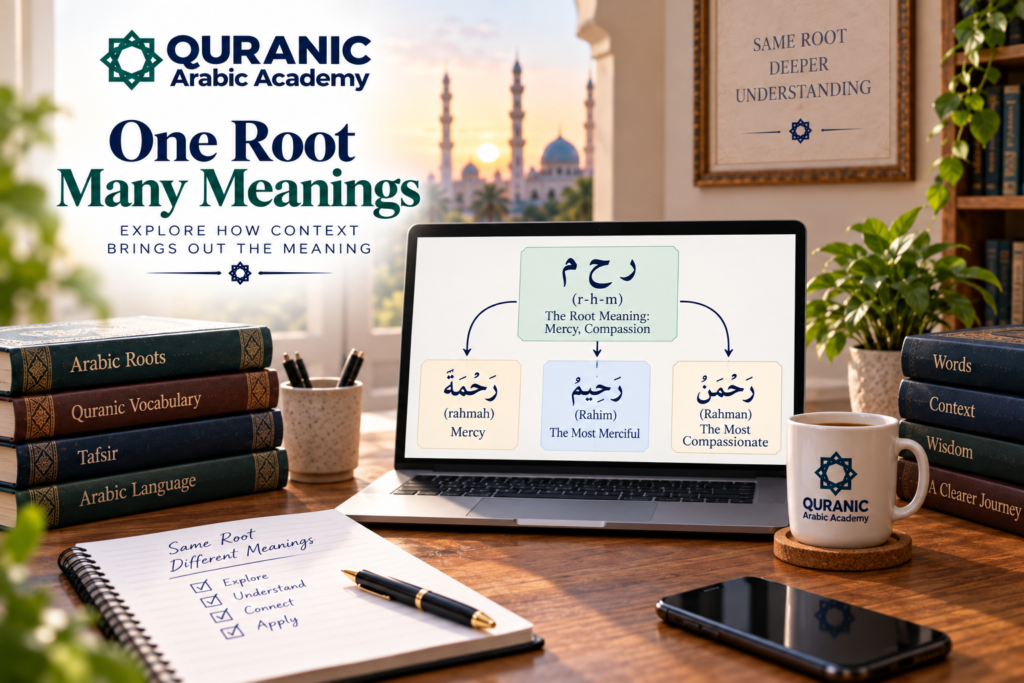
Arabic relies heavily on a root-and-pattern system, in which many words are formed from a small group of root letters, often three consonants. Words derived from the same root usually share a central area of meaning, even though their precise meanings can differ according to their morphological patterns and context.
For students of Quranic Arabic, identifying these roots makes vocabulary study more connected and systematic instead of treating every new word as completely separate.
For example, the root ر ح م (r-ḥ-m) connects words such as رحمة (rahmah), meaning mercy, رحيم (Rahim), and رحمن (Rahman). Although these words are not identical in meaning or grammatical form, recognizing their common root helps learners understand the semantic relationship between them.
As students become familiar with more roots, they can often recognize connections between unfamiliar Quranic words and vocabulary they have already studied.
Read also: How to Dispose of Quranic Verses the Right Way
Best Quranic Arabic Dictionary Resources
Students of Quranic Arabic can choose from several classical and modern resources, each designed for a slightly different purpose. Some dictionaries concentrate on explaining the meanings and nuances of Quranic vocabulary, while others help readers locate every occurrence of a particular word throughout the Quran.
Choosing the right resource therefore depends on whether your goal is vocabulary building, root analysis, contextual understanding, or detailed Quranic research.
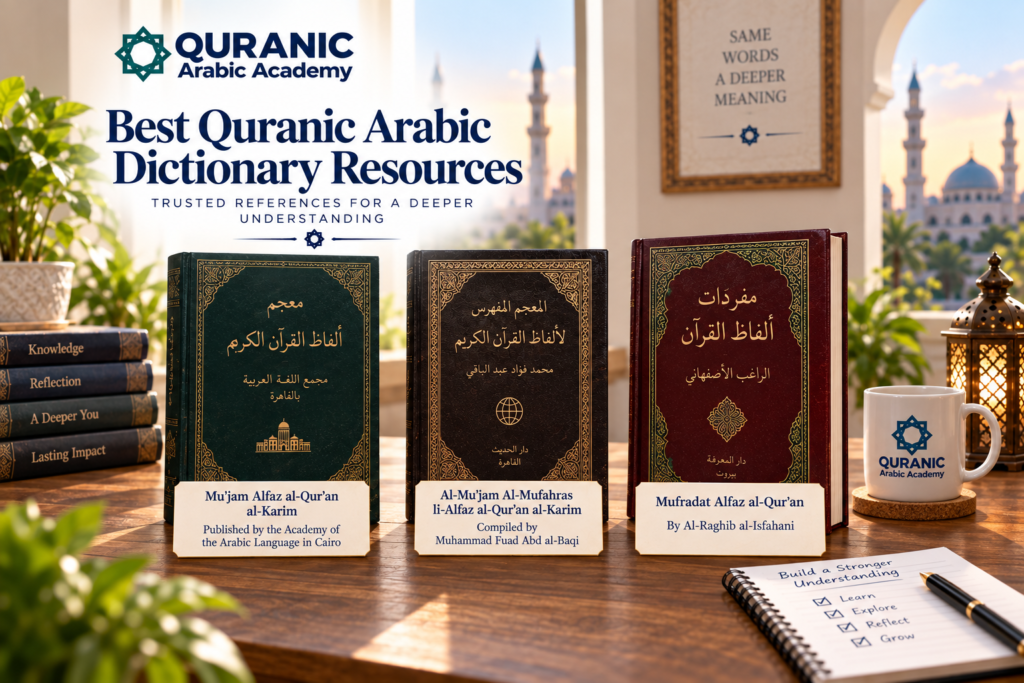
- Mu’jam Alfaz al-Qur’an al-Karim, published by the Academy of the Arabic Language in Cairo, organizes Quranic vocabulary with attention to precise meaning within its Quranic context.
- Al-Mu’jam Al-Mufahras li-Alfaz al-Qur’an al-Karim, compiled by Muhammad Fuad Abd al-Baqi, is a well-known concordance that indexes every occurrence of a word across the Quran.
- Mufradat Alfaz al-Qur’an, written by Al-Raghib al-Isfahani, is a classical reference focused specifically on explaining the meanings and linguistic nuance of Quranic vocabulary.
These works remain foundational references, and many modern learning tools build directly on the research found in them.
Read also: The Quranic View of Warfare: Objectives, Boundaries, and Moral Rules
Quranic Arabic Dictionary Online: What to Look For
Digital tools have made it much easier for students to search Quranic vocabulary, explore word meanings, and study recurring terms without relying entirely on printed dictionaries. A useful Quranic Arabic dictionary online should allow learners to search by the Arabic root rather than only by the complete word as it appears in a verse.
This is particularly helpful because many Quranic words are derived from the same root, and identifying that root can reveal connections between related words and meanings across different passages of the Quran.
A good online dictionary should also show where and how often a word or root occurs throughout the Quran, allowing learners to compare its use in different verses and contexts.
Features such as a basic grammatical or morphological breakdown can help explain whether a word is a noun, verb, adjective, or another form, as well as identify prefixes, suffixes, and variations derived from the same root.
For beginners who are still developing their Arabic reading skills, transliteration alongside the original Arabic text can also be useful as temporary support.
Ideally, the dictionary should combine these features with clear meanings and Quranic examples, making it easier for learners to move beyond simple translation and gradually understand how Arabic vocabulary functions within the Quran itself.
Read also: Building a Foundation in Quranic Knowledge: Meaning and Methods
| Go Beyond the DictionaryA dictionary gives you definitions, but understanding grammar, patterns, and context takes guided study. Explore our detailed breakdown of core Quranic Arabic concepts.Read More |
Building a Personal Quranic Vocabulary List
Creating a personal Quranic vocabulary list is a simple way to turn dictionary study into long-term learning. Each time you encounter a new word, record the Arabic term, its root letters, core meaning, the verse where it appears, and one or two related words from the same root. Reviewing this list regularly helps reinforce vocabulary, recognize recurring patterns, and gradually understand more of the Quran directly during recitation.
| Word | Root | Core Meaning | Related Words |
|---|---|---|---|
| رحمة (mercy) | ر ح م | Mercy and compassion | رحمن, رحيم, يرحم |
| هدى (guidance) | ه د ي | Guidance to the right path | يهدي, مهتدٍ |
| مغفرة (forgiveness) | غ ف ر | Covering over and pardoning sin | غفور, غفار, استغفر |
| صبر (patience) | ص ب ر | Steadfastness and self-restraint | صابر, صابرون |
Reviewing this kind of list regularly, rather than only during dictionary lookups, is what turns individual words into recognizable vocabulary during recitation.
خَيْرُكُمْ مَنْ تَعَلَّمَ الْقُرْآنَ وَعَلَّمَهُ
“The best among you are those who learn the Quran and teach it.”
This hadith highlights why the effort of learning Quranic vocabulary, including the disciplined use of a dictionary, is considered a valuable pursuit in itself.
Experience Our Teaching Style:
We believe in clarity and engagement. Watch these short highlights from our actual classes to see our teachers’ methodology and student interactions in real-time.
Ready to Begin Your Quranic Journey?
Start learning with professional instructors through our structured curriculum.
Book Your Free TrialLearn Quranic Arabic With the Quranic Arabic Academy
Understanding Quranic words through a dictionary is an excellent start, but structured learning can take your understanding much further.
With Quranic Arabic Academy, you can develop your Quranic vocabulary, recognize common roots, understand essential grammar, and learn how words function within real Quranic verses under guided instruction.
Start learning Quranic Arabic today and move beyond relying entirely on translations.
Join Quranic Arabic Academy and take your next step toward reading the Quran with greater understanding, confidence, and connection to its original language.

| Deepen Your Understanding of Quranic ArabicJoin structured courses designed to help you read and understand the Quran in its original language.Visit Quranic Arabic Academy |
Our Arabic Courses
- Quranic Arabic Classes
- Quranic Arabic Course for Beginners
- Online Quranic Arabic Courses for Advanced Learners
- Quranic Arabic Grammar Course
- Arabic Courses for Understanding the Quran
- Quranic Arabic Course for Sisters (Female)
- Quranic Arabic Course for Kids
- Online Quranic Arabic Classes for Adults
- Quranic Arabic Course UK
- Quranic Arabic Course London
- Quranic Arabic Course USA
- Quranic Arabic Course Canada
- Quranic Arabic Course Australia
- Quranic Arabic Course UAE
- Quranic Arabic Course Germany
Conclusion
A Quranic Arabic dictionary gives readers a direct path into the meaning of the Quran’s original words, rather than relying on translation alone.
By focusing on root letters, reviewing how a word is used across different verses, and returning to tafsir when deeper context is needed, a dictionary becomes far more than a lookup tool.
Whether you choose a classical reference, a modern quranic arabic dictionary online, or begin building your own personal word list, consistent and contextual study is what turns unfamiliar words into lasting understanding of the Quran.
Frequently Asked Questions
What is the best Quranic Arabic dictionary for beginners?
Beginners generally benefit most from a dictionary that clearly explains the root, core meaning, and Quranic usage of a word in simple language, rather than a purely classical reference.
As a learner progresses, classical works such as Mufradat Alfaz al-Qur’an become more useful additions.
Is there a reliable Quranic Arabic dictionary online?
Yes, several digital tools allow root-based searches of Quranic vocabulary along with the verses where each word appears. When choosing one, look for clear sourcing and the ability to search by root rather than only by whole word.
Do I need to know Arabic grammar before using a Quranic dictionary?
No, a dictionary can be used without advanced grammar knowledge, though basic familiarity with root letters makes the process much easier. Learning grammar alongside vocabulary generally produces faster, more accurate understanding.
What is the difference between a Quranic dictionary and Tafsir?
A Quranic dictionary explains the meaning of individual words, while tafsir explains the meaning and context of a verse as a whole. The two are complementary, and dictionary study often raises questions that tafsir is better suited to answer.
Can non-Arabic speakers benefit from a Quranic Arabic dictionary?
Yes, many non-Arabic speakers use a Quranic dictionary alongside transliteration and translation to gradually connect Arabic words to their meanings. Over time, this reduces dependence on translation alone.
Related Articles
Learn Quranic Arabic






Leave a Reply