 Quran
Quran
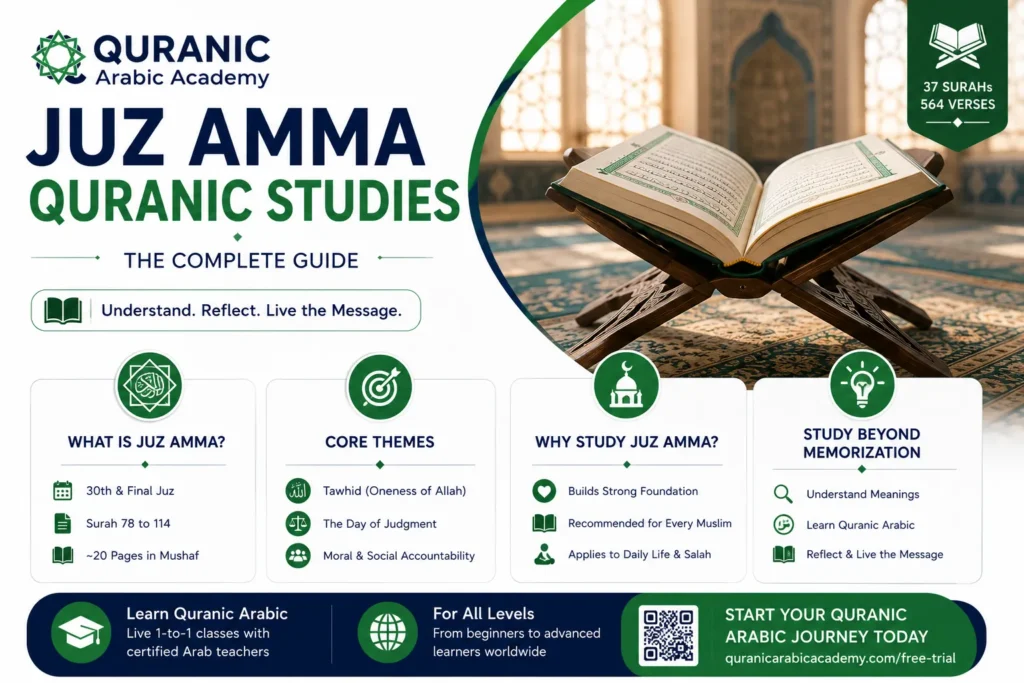
Many non-Arab Muslims memorize Surahs from Juz Amma and recite them daily without fully understanding their meanings. Juz Amma Quranic Studies offers a deeper approach, exploring this 30th section through its structure, themes, history, and language. This guide explains how non-Arab learners can study Juz Amma beyond memorization and gain a deeper understanding of its message.
Juz Amma Is the Final and Most Studied Section of the Quran
Juz Amma is the 30th and final section of the Quran. It begins with Surah An-Naba (chapter 78) and concludes with Surah An-Nas (chapter 114), containing 37 complete surahs across approximately 20 pages of the standard Medina Mushaf.
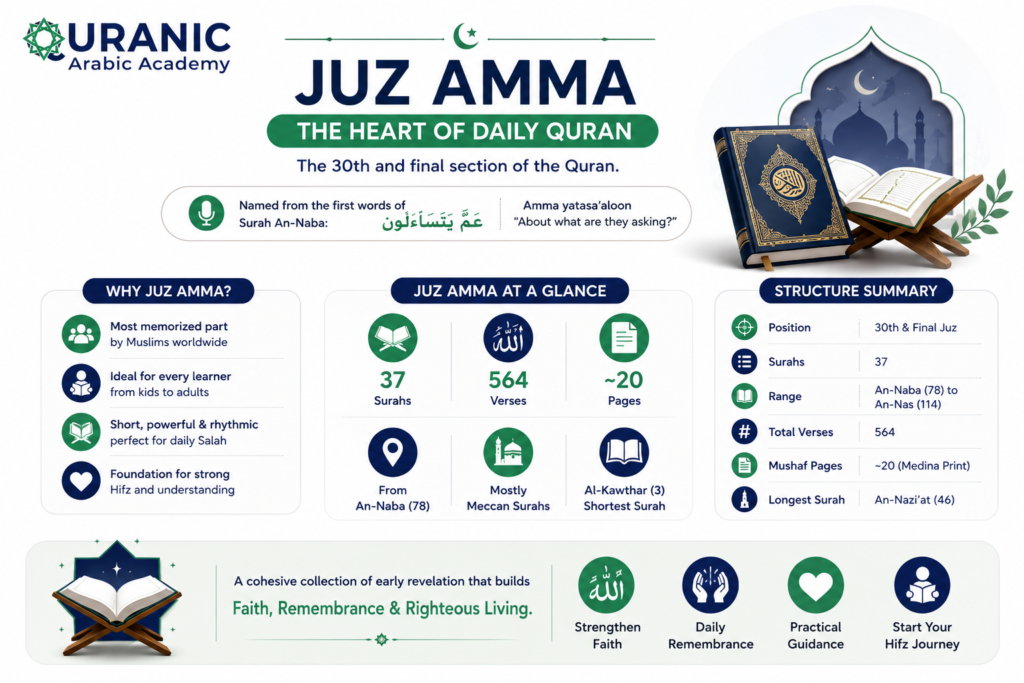
The name “Amma” comes directly from the opening word of the first surah. Surah An-Naba begins with the Arabic phrase “عَمَّ يَتَسَاءَلُونَ” — Amma yatasa’aloon — meaning “About what are they asking one another?” This naming convention follows the classical Islamic scholarly tradition of identifying a juz by its opening words, and the name has become universally recognized across the Muslim world.
Despite being the last of the 30 sections, Juz Amma is the most memorized section of the Quran globally. Its 37 surahs are short, rhythmically powerful, and immediately applicable to daily Salah — which is why every Hifz student, from the youngest child to the adult beginner, traditionally begins here.
The structural facts of Juz Amma clarify what a learner is working with:
| Feature | Detail |
| Position in the Quran | 30th and final juz |
| Number of surahs | 37 |
| Surah range | An-Naba (78) to An-Nas (114) |
| Total verses | 564 |
| Mushaf pages | Approximately 20 (standard Medina print) |
| Origin of most surahs | Meccan (revealed in Makkah before Hijra) |
| Shortest surah in the Quran | Al-Kawthar (3 verses) — found in Juz Amma |
| Longest surah in Juz Amma | An-Nazi’at (46 verses) |
Understanding this structure before memorizing or studying any individual surah gives the learner orientation. Juz Amma is not a random collection of short chapters. It is a cohesive body of early revelation with a unified theological framework.
The Quranic Arabic for Beginners course at The Quranic Arabic Academy is built specifically for non-Arab learners who want to begin engaging with Juz Amma in Arabic — starting from the foundational vocabulary and sentence structures that appear most frequently across these 37 surahs.
Read also: Quranic Injunction Meaning: What Every Muslim Needs to Know
[Start Reading Juz Amma in Arabic Today]
The Theological Themes of Juz Amma Form a Unified Framework
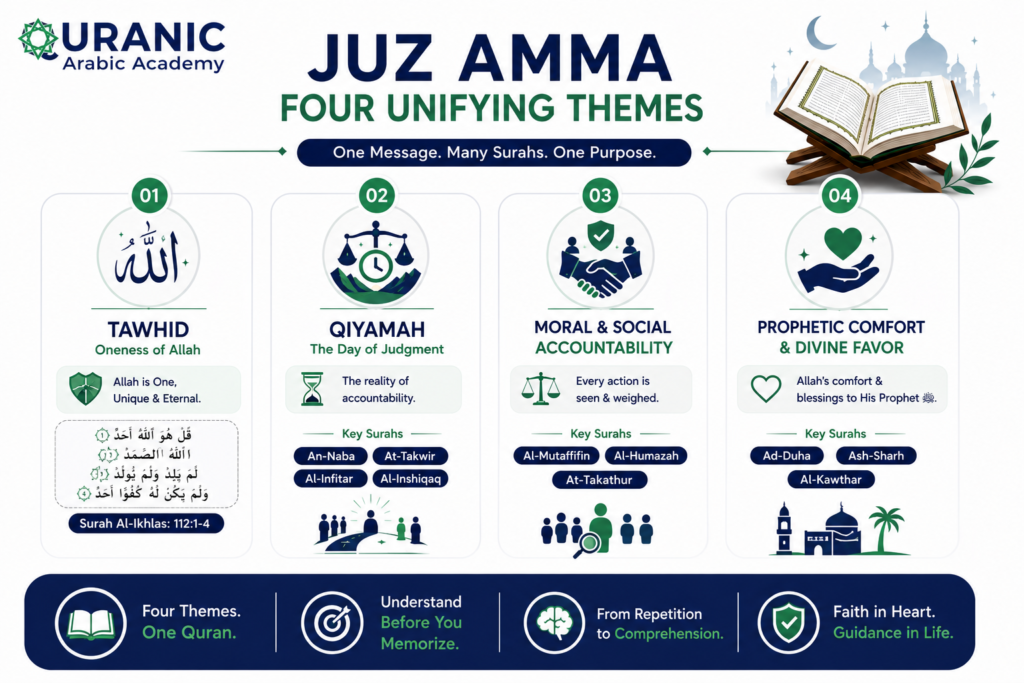
The surahs of Juz Amma are not isolated units. They share a unified theological framework built around three foundational themes that appear, in varying forms, across all 37 chapters. Understanding these themes before memorizing individual surahs transforms the learning process from mechanical repetition into structured comprehension.
Tawhid — The Oneness of Allah
The most foundational theme in Juz Amma is the absolute oneness and uniqueness of Allah. Surah Al-Ikhlas states this with a precision that four verses can contain nothing beyond:
“هُوَ اللَّهُ أَحَدٌ ﴿١﴾ اللَّهُ الصَّمَدُ ﴿٢﴾ لَمْ يَلِدْ وَلَمْ يُولَدْ ﴿٣﴾ وَلَمْ يَكُن لَّهُ كُفُوًا أَحَدٌ ﴿٤﴾”
Qul huwa Allāhu aḥad. Allāhu al-Ṣamad. Lam yalid wa-lam yūlad. Wa-lam yakun lahu kufu’an aḥad.
“Say, “He is Allah, [who is] One, (1) Allah, the Eternal Refuge. (2) He neither begets nor is born, (3) Nor is there to Him any equivalent.” (4).
” Surah Al-Ikhlas: 112:1-4
The Day of Judgment — Qiyamah
No theme appears more frequently or more vividly in Juz Amma than the reality of the Day of Judgment. Surahs including An-Naba, At-Takwir, Al-Infitar, and Al-Inshiqaq describe the cosmic upheaval of that Day with imagery that shakes the listener into awareness. These descriptions serve a precise theological function: they make the abstract reality of accountability concrete and immediate.
Moral and Social Accountability
Juz Amma does not stop at belief — it translates belief into behavioral consequence. Surah Al-Mutaffifin condemns those who give short measure in trade. Surah Al-Humazah warns those who mock and hoard wealth. Surah At-Takathur condemns competition for worldly accumulation. These surahs establish that faith without moral rectitude is incomplete — and that every action, however small, will be witnessed and weighed.
Prophetic Comfort and Divine Favor
A fourth theme runs through a cluster of surahs specifically: prophetic comfort and divine favor. Surahs Ad-Duha, Ash-Sharh, and Al-Kawthar were revealed as direct reassurance to the Prophet ﷺ during moments of difficulty.
Studying these surahs with knowledge of their occasions of revelation transforms them from comforting words into a window into the early years of Islamic history.
Read also: How to Dispose of Quranic Verses the Right Way
The Meccan Origin of Juz Amma Shapes Everything It Contains
Almost all surahs in Juz Amma are Makki — revealed before the Prophet’s ﷺ migration to Madinah. This is not a minor historical footnote. The Meccan context is the reason these surahs take the form they do.
In the early years of the mission, the Prophet ﷺ faced a Makkan society rooted in idol worship, tribalism, and rejection of the afterlife. The surahs revealed in this period had a specific purpose: to establish the foundational beliefs of Islam in the hearts of a community that had never considered them.
This is why Juz Amma is so concentrated on Tawhid and the Day of Judgment — these were precisely the beliefs the early Muslims needed to internalize before any detailed legal or social guidance was appropriate.
The short, rhythmically powerful form of the Makki surahs also reflects this context. These verses were designed to penetrate the ears and hearts of an oral culture — to be heard, remembered, and carried. Their rhythm is not a stylistic choice; it is a deliberate feature of revelation suited to the circumstances.
A small number of surahs in Juz Amma are Madani — revealed after the Hijra. These include Surah Al-Bayyinah and Surah An-Nasr. Their presence within the predominantly Makki Juz Amma reflects the Quranic arrangement by divine wisdom rather than strict chronology, as the Quran was arranged under the direct supervision of the Prophet ﷺ.
See It in Action:
Wondering what our interactive sessions look like? Click below to peek inside a live session and watch how our expert instructors make learning Quranic Arabic accessible and engaging.
Ready to Begin Your Quranic Journey?
Start learning with professional instructors through our structured curriculum.
Book Your Free TrialJuz Amma Contains Landmarks That Span the Entire Prophetic Mission
One of the most remarkable features of Juz Amma as a field of Quranic study is that it contains the historical bookends of the entire revelation — the first verses ever given to the Prophet ﷺ and the last complete surah he received.
Surah Al-Alaq — The First Revelation
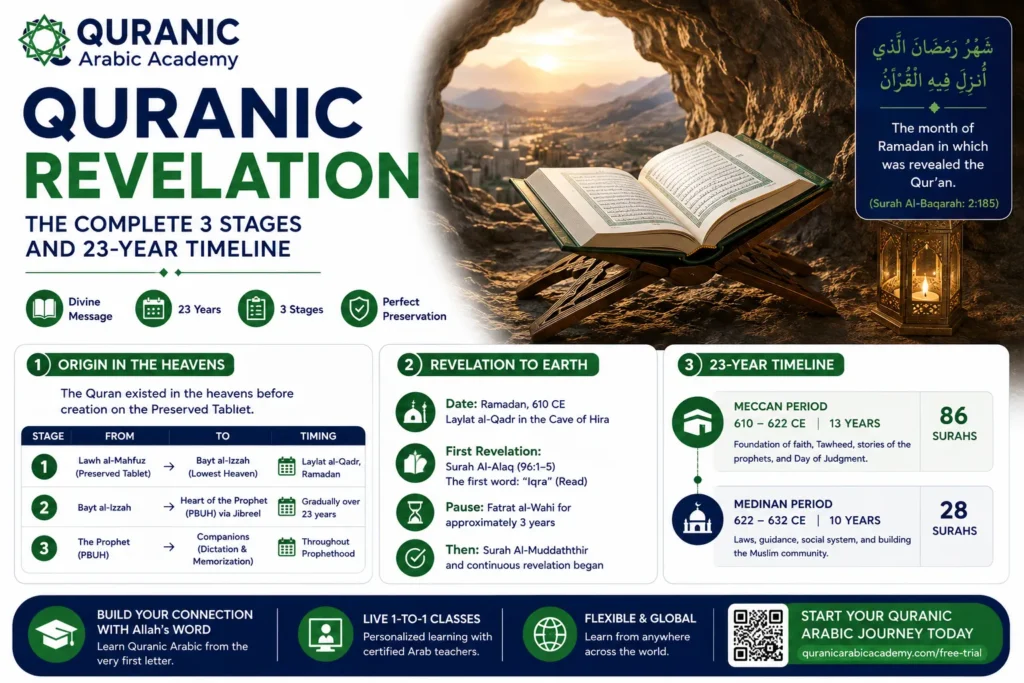
The first five verses of Surah Al-Alaq are the very first words revealed to the Prophet ﷺ in the Cave of Hira, in the month of Ramadan. The Angel Jibril appeared and commanded him with a single word:
“اقْرَأْ بِاسْمِ رَبِّكَ الَّذِي خَلَقَ ﴿١﴾ خَلَقَ الْإِنسَانَ مِنْ عَلَقٍ ﴿٢﴾”
Iqra’ bismi rabbika alladhī khalaq. Khalaqa al-insāna min ‘alaq.
“Recite in the name of your Lord who created – (1) Created man from a clinging substance. (2).”
Surah Al-Alaq: 96:1-2
This command — Iqra, Read — launched fourteen centuries of revelation, scholarship, memorization, and transmission. Every Muslim who studies the Quran is in some sense responding to this first command.
Read Also: Quranic Information
Surah An-Nasr — The Last Complete Revelation
Near the end of the Prophet’s ﷺ life, Surah An-Nasr was revealed, announcing the completion of the mission and calling the Prophet ﷺ to glorify and seek forgiveness from Allah. The Companion Ibn Abbas confirmed that An-Nasr was the last complete surah revealed to the Prophet ﷺ in its entirety, as recorded in Sahih Muslim.
A single juz that contains both the beginning and the practical conclusion of the Quranic revelation is, by any measure, an extraordinary field of study.
Read also: History of the Quranic Text: From the First Revelation to the Standard Mushaf
Key Surahs in Juz Amma Every Student Must Understand
Juz Amma contains 37 surahs. Some of them carry specific virtues confirmed in authenticated narrations, appear with highest frequency in daily worship, or cover theological content that every Muslim must know. These are the surahs that Quranic studies teachers across all traditions prioritize when beginning study of this juz.
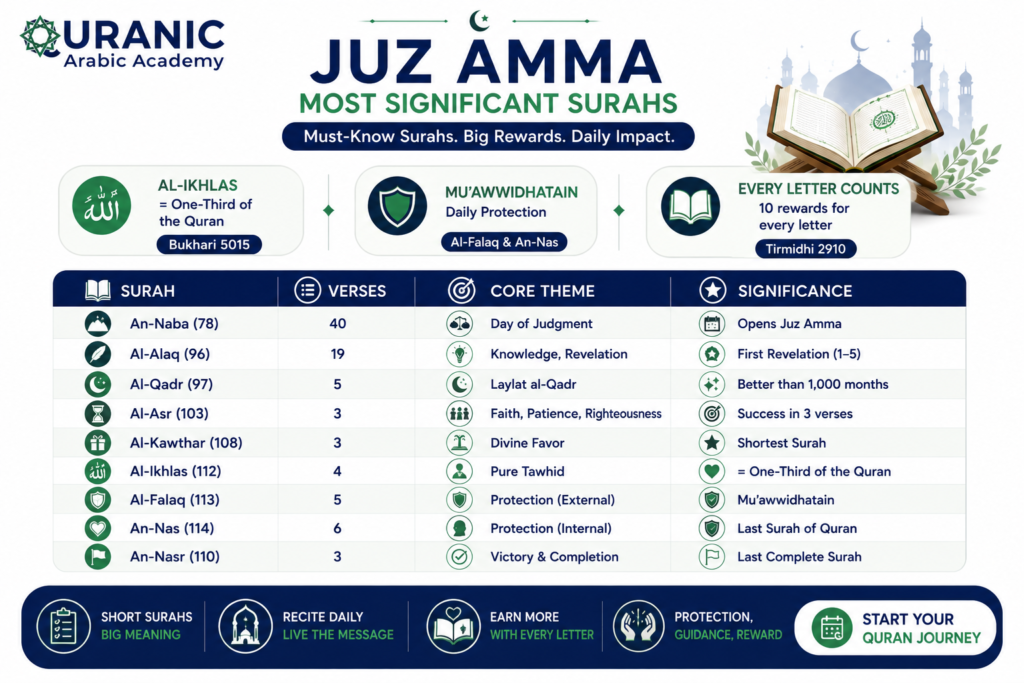
The Prophet ﷺ confirmed the exceptional standing of Surah Al-Ikhlas with a specific comparison:
“اللَّهُ الْوَاحِدُ الصَّمَدُ ثُلُثُ الْقُرْآنِ”
“Allah (the) One, the Self-Sufficient Master Whom all creatures need.’ (Surat Al-Ikhlas 112.1–to the End) is equal to one third of the Qur’an.”
The Mu’awwidhatain — Surah Al-Falaq and Surah An-Nas — hold a specific position in daily Islamic practice. These two surahs are recited together as protection and are recommended at specific times throughout the day, as established in the Sunnah.
The Prophet ﷺ also confirmed the universal importance of reciting the Quran:
“مَنْ قَرَأَ حَرْفًا مِنْ كِتَابِ اللَّهِ فَلَهُ بِهِ حَسَنَةٌ وَالْحَسَنَةُ بِعَشْرِ أَمْثَالِهَا”
“Man qara’a ḥarfan min kitābillāhi fa-lahu bihi ḥasanatun wa-al-ḥasanatu bi-‘ashri amthālihā.”
“[Whoever recites a letter] from Allah’s Book, then he receives the reward from it, and the reward of ten .”
TNon-Arab learners who recite these surahs in every Salah without understanding their Arabic are performing worship they cannot reflect upon. The Arabic Courses for Understanding the Quran at The Quranic Arabic Academy build the vocabulary and grammatical awareness that allow these surahs to be recited with comprehension.
[Understand What You Recite in Every Salah]
Understanding Juz Amma Requires Arabic — Translation Is Not Enough
Every non-Arab Muslim who has studied Juz Amma from translation alone has encountered the same limitation: the translation delivers the surface meaning but not the depth. The Arabic of Juz Amma carries meaning that no translation can fully convey — in its word choices, its grammatical structures, its rhetorical patterns, and its rhythmic impact.
This is not an opinion. It is a linguistic fact confirmed by every scholar who has engaged seriously with both the Arabic Quran and its translations.
The surahs of Juz Amma are among the most linguistically precise texts in Arabic literature. Consider Surah Al-Asr — three verses that classical scholars have said contain the entirety of what a human being needs to know to succeed:
“وَالْعَصْرِ ﴿١﴾ إِنَّ الْإِنسَانَ لَفِي خُسْرٍ ﴿٢﴾ إِلَّا الَّذِينَ آمَنُوا وَعَمِلُوا الصَّالِحَاتِ وَتَوَاصَوْا بِالْحَقِّ وَتَوَاصَوْا بِالصَّبْرِ ﴿٣﴾”
Wa-al-‘aṣr. Inna al-insāna la-fī khusr. Illā alladhīna āmanū wa-‘amilū al-ṣāliḥāti wa-tawāṣaw bi-al-ḥaqqi wa-tawāṣaw bi-al-ṣabr.
“By time, (1) Indeed, mankind is in loss, (2) Except for those who have believed and done righteous deeds and advised each other to truth and advised each other to patience. (3).”
The Arabic grammatical structure of this surah — the oath, the definitive statement of loss, the four exceptions — carries a precision that is visible only to a reader with basic Quranic Arabic. Each of those four conditions is a complete concept in Arabic that a translation can name but not fully convey.
The Quran itself confirms the necessity of its Arabic:
“إِنَّا أَنزَلْنَاهُ قُرْآنًا عَرَبِيًّا لَّعَلَّكُمْ تَعْقِلُونَ”
Innā anzalnāhu Qur’ānan ‘arabiyyan la’allakum ta’qilūn.
“Indeed, We have sent it down as an Arabic Qur’an that you might understand.”
Understanding — ta’qilun — requires Arabic. Recitation alone is not the ceiling the Quran sets for the believer.
Experience Our Teaching Style:
We believe in clarity and engagement. Watch these short highlights from our actual classes to see our teachers’ methodology and student interactions in real-time.
Ready to Begin Your Quranic Journey?
Start learning with professional instructors through our structured curriculum.
Book Your Free TrialBegin Your Juz Amma Studies with The Quranic Arabic Academy
Millions of Muslims worldwide have memorized Juz Amma without ever studying the Arabic that makes its meanings accessible. The Quranic Arabic Academy exists to close this gap — providing non-Arab learners across North America, Europe, Asia, and the Middle East with the Arabic foundation that turns recitation into understanding.
Every programme at The Quranic Arabic Academy includes:
- Certified Arab tutors holding Ijazah or degrees in Islamic studies from recognized institutions.
- One-on-one live sessions tailored to each student’s specific gaps and pace.
- Real-time Makharij correction using audio-visual feedback in every session.
- Structured progression from Noorani Qaida through Quranic Arabic Grammar and Tafsir-integrated study.
- Flexible scheduling across all global time zones — EST, PST, GMT, CET, IST, GST, and MYT.
- Affordable pricing with transparent packages and family enrollment discounts.
- Monthly progress reports and written feedback after every session.
The Online Quranic Arabic Classes for Adults at The Quranic Arabic Academy are specifically designed for adult learners who want to engage with the surahs of Juz Amma in Arabic — understanding what they recite in every Salah rather than simply producing sounds from memory.
Our Arabic Courses
- Quranic Arabic Classes
- Quranic Arabic Course for Beginners
- Online Quranic Arabic Courses for Advanced Learners
- Quranic Arabic Grammar Course
- Arabic Courses for Understanding the Quran
- Quranic Arabic Course for Sisters (Female)
- Quranic Arabic Course for Kids
- Online Quranic Arabic Classes for Adults
- Quranic Arabic Course UK
- Quranic Arabic Course London
- Quranic Arabic Course USA
- Quranic Arabic Course Canada
- Quranic Arabic Course Australia
- Quranic Arabic Course UAE
- Quranic Arabic Course Germany
[Book Your Free Trial at The Quranic Arabic Academy]
Ready to Begin Your Quranic Journey?
Start learning with professional instructors through our structured curriculum.
Book Your Free TrialConclusion
Juz Amma Quranic studies is not simply about memorizing 37 short surahs. It is the discipline of understanding the section of the Quran that contains the first and last revelations of the Prophetic mission, the clearest statements of Islamic monotheism, the most vivid descriptions of the Day of Judgment, and the surahs recited most frequently in the daily prayers of over a billion Muslims worldwide.
For any non-Arab Muslim serious about the Quran, studying Juz Amma with Arabic comprehension — not just memorization — is where that serious engagement begins.
Frequently Asked Questions
What is Juz Amma and how many surahs does it contain?
Juz Amma is the 30th and final section of the Quran. It contains 37 surahs, beginning with Surah An-Naba (chapter 78) and ending with Surah An-Nas (chapter 114), covering approximately 20 pages of the standard Medina Mushaf.
Why is Juz Amma the first section most students memorize?
Its surahs are short, rhythmically structured, and immediately usable in daily Salah. Most surahs contain fewer than 25 verses, and many contain fewer than 10, making them accessible for children and adult beginners without prior memorization experience.
What are the main themes of Juz Amma?
The three foundational themes running across all 37 surahs are the Oneness of Allah (Tawhid), the Day of Judgment and resurrection, and moral accountability. A secondary theme of prophetic comfort appears in surahs including Ad-Duha, Ash-Sharh, and Al-Kawthar.
Which surahs in Juz Amma are most important to understand deeply?
Al-Ikhlas, Al-Asr, Al-Alaq, Al-Qadr, Al-Falaq, An-Nas, and An-Nasr are among the most important for study due to their theological depth, confirmed virtues, frequency in daily worship, and historical significance in the Prophetic mission.
Can a non-Arab really understand Juz Amma without being a scholar?
Yes — but structured Arabic learning is required. Translation alone provides surface meaning. Basic Quranic Arabic grammar and vocabulary allow a non-Arab learner to access the actual structure of these surahs and recite them in Salah with genuine comprehension.
Why does Arabic matter specifically for studying Juz Amma?
The surahs of Juz Amma are among the most linguistically precise texts in classical Arabic. Their word choices, grammatical structures, and rhetorical patterns carry meaning that no translation fully captures. Engaging with them in Arabic is the difference between knowing what the Quran says and understanding how and why it says it.





Leave a Reply