 Quranic Dua

| Key Takeaways |
| Quranic duas are direct supplications drawn from Quranic verses, carrying the precise words Allah revealed and preserved. |
| Many short Quranic duas appear across multiple surahs, covering protection, guidance, forgiveness, and worldly and spiritual needs. |
| Understanding the Arabic of each dua deepens emotional connection and transforms supplication from ritual into conscious conversation with Allah. |
| Learning Quranic Arabic grammar opens the layered meanings embedded in dua vocabulary — insights unavailable through translation alone. |
There is a moment most of my students describe the same way: the first time they understood a dua in Arabic as they were saying it. Not translated — understood, word by word, in real time. Something shifts. The supplication stops being a recitation and starts being a conversation.
Quranic duas are supplications taken directly from the words of the Quran — the preserved speech of Allah.
From the opening of Surah Al-Fatiha to the closing duas of Surah Al-Baqarah, the Quran offers Muslims a treasury of supplications for every state of the heart. This article presents fourteen of the most beautiful, with their Arabic text, transliteration, translation, and tafsir commentary.
1. The Quranic Dua That Covers Every Need
This is perhaps the most frequently recited Quranic dua after Salah. It asks Allah for good in this world, good in the Hereafter, and protection from the Fire — and in doing so, covers the entirety of a believer’s needs in three short phrases. Its brevity is part of its miracle.
رَبَّنَا آتِنَا فِي الدُّنْيَا حَسَنَةً وَفِي الْآخِرَةِ حَسَنَةً وَقِنَا عَذَابَ النَّارِ
Rabbana atina fid-dunya hasanatan wa fil-akhirati hasanatan wa qina ‘adhaban-nar
“Our Lord, give us in this world that which is good and in the Hereafter that which is good, and protect us from the punishment of the Fire.” (Al-Baqarah 2:201)
Tafsir Commentary: The word حَسَنَة (hasanah) is grammatically indefinite (nakirah) — a deliberate choice that classical scholars note opens the meaning to encompass every form of good without restriction.
Scholars comment that this single dua gathers the goodness of both worlds. The scholars of Nahw observe that وَقِنَا uses the imperative form of the root و-ق-ي, meaning to shield and guard — a strong, active verb of protection, not merely avoidance.
Understanding Quranic Arabic grammar reveals exactly why the Prophet ﷺ recited this dua so frequently — its grammatical architecture makes it linguistically all-encompassing.
2. Our Lord, Do Not Impose Blame Upon Us If We Have Forgotten or Erred
One of the most moving features of Surah Al-Baqarah’s closing verses is that Allah Himself teaches His servants how to ask. These final duas were given directly to the Prophet ﷺ during the Mi’raj — a detail that makes their words carry unique spiritual weight among Muslims.
رَبَّنَا لَا تُؤَاخِذْنَا إِن نَّسِينَا أَوْ أَخْطَأْنَا
Rabbana la tu’akhidhna in-nasina aw akhta’na
“Our Lord, do not impose blame upon us if we have forgotten or erred.” (Al-Baqarah 2:286)
The verb تُؤَاخِذْنَا (tu’akhidhna) is in the jussive mood (majzum), triggered by the prohibitive particle لَا — a grammatical structure that makes the prohibition immediate and absolute.
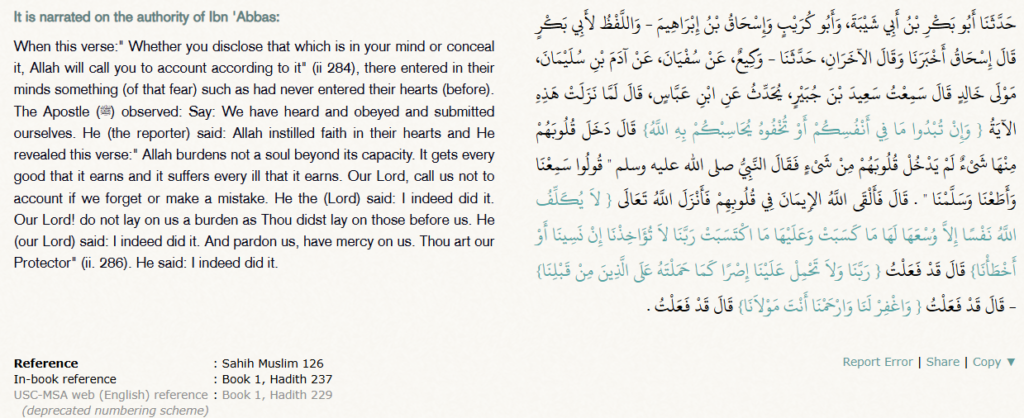
Scholars note that the Hadith in Sahih Muslim confirms Allah responded to this verse with “I have done so” — meaning forgetfulness and genuine error are already forgiven. This is one of the most comforting realities in the entire Quran.
Start Learning the Arabic of These Duas at The Quranic Arabic Academy
Before continuing, I want to pause on something I observe with almost every student who begins reading these duas in Arabic for the first time. They encounter the words, they can say them — but they cannot yet see them. The grammar remains invisible.
At The Quranic Arabic Academy, our online Quranic Arabic classes for adults are specifically designed to bridge exactly this gap — moving students from recitation to comprehension through structured, 1-on-1 instruction with certified Arabic linguists who specialize in Quranic Arabic for non-native speakers. A free trial lesson is available to get you started.
Join our Quranic Arabic Courses for Advanced Learners with a Free Trial

3. The Shortest and Most Powerful Quranic Dua for Mercy
Short Quranic duas are among the most potent supplications in the Quran precisely because their linguistic economy forces maximum meaning into minimum words. This two-verb dua from Surah Al-Mu’minun stands as one of the finest examples of that principle.
رَّبِّ اغْفِرْ وَارْحَمْ وَأَنتَ خَيْرُ الرَّاحِمِينَ
Rabbighfir warham wa anta khayru-rrahimin
“My Lord, forgive and have mercy, and You are the best of the merciful.” (Al-Mu’minun 23:118)
Notice that اغْفِرْ (forgive) precedes ارْحَمْ (have mercy) — a sequence the scholars of tafsir note is intentional. Forgiveness removes the sin; mercy then fills the space left behind.
The closing phrase خَيْرُ الرَّاحِمِينَ uses the superlative (af’al at-tafdhil) — grammatically elevating Allah’s mercy above all other mercy in creation.
Shots Videos from Our Courses
Ready to Begin Your Quranic Journey?
Start learning with professional instructors through our structured curriculum.
Book Your Free Trial4. The Quranic Dua of Those Who Long for Righteous Families
Among the most beautiful Quranic duas are those made by the servants of Al-Rahman described in the final verses of Surah Al-Furqan. These are not duas of crisis — they are the quiet, consistent supplications of people devoted to goodness.
رَبَّنَا هَبْ لَنَا مِنْ أَزْوَاجِنَا وَذُرِّيَّاتِنَا قُرَّةَ أَعْيُنٍ وَاجْعَلْنَا لِلْمُتَّقِينَ إِمَامًا
Rabbana hab lana min azwajina wa dhurriyyatina qurrata a’yunin waj’alna lil-muttaqina imama
“Our Lord, grant us from among our wives and offspring comfort to our eyes and make us an example for the righteous.” (Al-Furqan 25:74)
The phrase قُرَّةَ أَعْيُنٍ (qurrata a’yun — comfort of the eyes) is an Arabic idiom for profound joy and contentment. Linguistically, it refers to the coolness (qurr) that comes to the eye when it sees what it loves most.
Scholars note that this dua asks not merely for children, but for righteous children — ones who bring spiritual ease, not just presence.
5. The Dua of Prophet Musa for Inner Strength
This is the opening of Prophet Musa’s supplication in Surah Ta-Ha — and it is a dua many students instinctively reach for before difficult tasks without fully appreciating its grammatical depth.
رَبِّ اشْرَحْ لِي صَدْرِي وَيَسِّرْ لِي أَمْرِي وَاحْلُلْ عُقْدَةً مِّن لِّسَانِي يَفْقَهُوا قَوْلِي
Rabbi ishrah li sadri wa yassir li amri wahlul ‘uqdatan min lisani yafqahu qawli
“My Lord, expand for me my breast and ease for me my task and untie the knot from my tongue that they may understand my speech.” (Ta-Ha 20:25–28)
The verb اشْرَحْ (expand/open) comes from the root ش-ر-ح, which in Arabic conveys a sense of splitting open to make room — the same root used in the Surah Al-Inshirah.
Scholars note that Musa’s dua is sequential by design: first the internal (the chest/heart), then the external (the task), then the communicative (the tongue). The logical progression itself encodes a teaching about where transformation must begin.
6. The Quranic Dua of Complete Reliance on Allah
Few Quranic phrases carry the historical weight of this supplication. Recorded in Surah Al-Imran, it was declared by Prophet Ibrahim ﷺ when thrown into fire, and by Prophet Muhammad ﷺ when warned of a gathering army — and in both cases, it was followed by Allah’s protection.
حَسْبُنَا اللَّهُ وَنِعْمَ الْوَكِيلُ
Hasbunallahu wa ni’mal wakil
“Sufficient for us is Allah, and He is the best Disposer of affairs.” (Al-Imran 3:173)
حَسْبُ (hasbun) is a noun meaning “that which suffices” — its grammatical function here is as a predicate (khabar) with Allah as the subject (mubtada’).
The construction is a complete nominal sentence in Arabic, conveying a state of settled conviction rather than a request.
Ibn Al-Qayyim wrote extensively on this phrase, noting that it combines tawakkul (reliance) with tawfid (delegation) in its very grammatical form.
7. The Dua of Yunus in Darkness
This is the supplication Prophet Yunus ﷺ made from within the whale — three layers of darkness, no known path to rescue. And yet this dua became the means of his salvation. It is among the most beloved short Quranic duas for a believer in distress.
لَّا إِلَٰهَ إِلَّا أَنتَ سُبْحَانَكَ إِنِّي كُنتُ مِنَ الظَّالِمِينَ
La ilaha illa anta subhanaka inni kuntu mina-dh-dhalimin
“There is no deity except You; exalted are You. Indeed, I have been of the wrongdoers.” (Al-Anbiya 21:87)
Scholars of tafsir highlight three elements of this dua’s power: it begins with Tawhid (لَّا إِلَٰهَ إِلَّا أَنتَ), moves to Tanzih — declaring Allah free of all imperfection (سُبْحَانَكَ) — and closes with self-acknowledgment of wrongdoing (إِنِّي كُنتُ مِنَ الظَّالِمِينَ). This structure — honouring Allah first, accounting for oneself second — is a model of supplication etiquette (adab ad-dua) that classical scholars consistently highlight.
8. The Dua Adam and Hawwa Made
This is the first dua of repentance in the Quran — the supplication of our father and mother when they turned back to Allah after their error. It remains the model of sincere tawbah for every believer who follows them.
رَبَّنَا ظَلَمْنَا أَنفُسَنَا وَإِن لَّمْ تَغْفِرْ لَنَا وَتَرْحَمْنَا لَنَكُونَنَّ مِنَ الْخَاسِرِينَ
Rabbana dhalamna anfusana wa in lam taghfir lana wa tarhamna lanakuna minal-khasirin
“Our Lord, we have wronged ourselves, and if You do not forgive us and have mercy upon us, we will surely be among the losers.” (Al-A’raf 7:23)
The phrase ظَلَمْنَا أَنفُسَنَا (we wronged ourselves) is grammatically significant — the object of the verb is anfusana (our own selves), not “we wronged You.” This is theologically precise: sin, in the Quranic worldview, harms the sinner most.
The conditional إِن لَّمْ (if You do not) followed by the emphatic لَنَكُونَنَّ (we will surely be) intensifies the acknowledgment of utter dependence — the lam of emphasis and nun of emphasis stacked together.
9. The Dua for Patience Against Overwhelming Odds
This is the supplication of the small believing army that faced Jalut (Goliath) — vastly outnumbered, yet victorious through it. It is a Quranic dua drawn from one of the most instructive battles recorded in the Quran.
رَبَّنَا أَفْرِغْ عَلَيْنَا صَبْرًا وَثَبِّتْ أَقْدَامَنَا وَانصُرْنَا عَلَى الْقَوْمِ الْكَافِرِينَ
Rabbana afrigh alayna sabran wa thabbit aqdamana wansurna ‘alal-qawmil-kafirin
“Our Lord, pour upon us patience and plant firmly our feet and give us victory over the disbelieving people.” (Al-Baqarah 2:250)
The verb أَفْرِغْ (afrigh) is extraordinary — it means to pour out completely, as one empties a vessel entirely. They are not asking for a measure of patience; they are asking for patience to be poured over them without remainder.
This is an example of what Arabic linguists call mubalaghah — hyperbolic intensification used deliberately for rhetorical force.
Understanding Quranic Arabic at this level of nuance is only possible when you approach the text with grammatical tools.
Ready to Begin Your Quranic Journey?
Start learning with professional instructors through our structured curriculum.
Book Your Free Trial10. The Dua of Prophet Musa After a Moment of Regret
This is one of the most human duas in the Quran. Musa ﷺ — before prophethood — acted in anger and then turned immediately to Allah in honest, unadorned repentance. It carries no elaborate phrasing — only raw sincerity.
رَبِّ إِنِّي ظَلَمْتُ نَفْسِي فَاغْفِرْ لِي
Rabbi inni dhalamtu nafsi faghfir li
“My Lord, indeed I have wronged myself, so forgive me.” (Al-Qasas 28:16)
The فَ (fa) connecting ظَلَمْتُ (I wronged) to اغْفِرْ (forgive me) is a consequential fa — it links the acknowledgment directly to the request without pause.
There is no justification, no explanation — only admission followed immediately by supplication. Scholars of rhetoric note that this directness is itself a form of eloquence in Arabic. The shorter the dua, the more complete the surrender it expresses.
11. My Lord, Grant Me a Child From Among The Righteous
This is the supplication of Prophet Ibrahim ﷺ after leaving his people and homeland, asking Allah for righteous offspring. It is a dua that resonates deeply with Muslim parents who long for children grounded in faith.
رَبِّ هَبْ لِي مِنَ الصَّالِحِينَ
Rabbi hab li minas-salihin
“My Lord, grant me [a child] from among the righteous.” (As-Saffat 37:100)
The verb هَبْ comes from the root و-هـ-ب — to give as a gift, freely and without exchange. Ibrahim does not ask for a son; he asks for a gift.
The word مِنَ الصَّالِحِينَ (from the righteous) specifies not quantity but quality — a single righteous child is worth more than many.
12. The Quranic Dua for Gratitude
This dua, spoken by Sulayman ﷺ, is one of the most profound in the Quran. It asks not for more blessings — but for the ability to be grateful for the blessings already received. It is the dua of a person who understands that ingratitude is the greater deprivation.
رَبِّ أَوْزِعْنِي أَنْ أَشْكُرَ نِعْمَتَكَ الَّتِي أَنْعَمْتَ عَلَيَّ وَعَلَىٰ وَالِدَيَّ وَأَنْ أَعْمَلَ صَالِحًا تَرْضَاهُ
Rabbi awzi’ni an ashkura ni’mataka allati an’amta ‘alayya wa ‘ala walidayya wa an a’mala salihan tardah
“My Lord, enable me to be grateful for Your favor which You have bestowed upon me and upon my parents and to do righteousness of which You approve.” (An-Naml 27:19)
Tafsir Commentary: The verb أَوْزِعْنِي is from the root و-ز-ع, meaning to restrain, motivate, and direct inwardly. It is asking Allah to plant the impulse of gratitude from within — not merely to perform gratitude, but to be moved to it from the inside.
This is one of the subtlest verb choices in any Quranic dua, and it is only visible when you read the Arabic. Translating it as simply “enable me” misses the interior dimension entirely.
Read Also: Quranic Duas for Success
Why Does Learning Quranic Arabic Transform These Duas?
The table below illustrates the most commonly recurring grammatical structures across the Quranic duas in this article — structures that, once learned, allow you to recognise and understand new duas immediately:
The following table summarises the key grammatical patterns appearing across these Quranic duas, helping learners identify recurring structures in supplication language.
| Arabic Pattern | Example in Dua | Grammatical Term | Meaning Function |
| رَبَّنَا / رَبِّ | Rabbana / Rabbi | Vocative (نِدَاء) + Idafa | Intimate address to Allah |
| اغْفِرْ / هَبْ / اشْرَحْ | Imperative verb forms | فِعْل الأَمْر (Fi’l Amr) | Direct request/command |
| إِنِّي كُنتُ | Inni kuntu | Tawkid (emphasis particle إِنَّ) | Emphatic acknowledgment |
| لَا تُؤَاخِذْنَا | La tu’akhidhna | Jussive with prohibition لَا | Absolute prohibition request |
| خَيْرُ الرَّاحِمِينَ | Khayr ar-rahimin | Superlative (أَفْعَل التَّفْضِيل) | Supreme degree of a quality |
Students at The Quranic Arabic Academy who undertake our Quranic Arabic grammar course begin recognising these patterns within the first few weeks — and the shift in how they experience these duas is immediate.
Your First class is free. Join our Quranic Arabic Grammar Course now

Read Also: Quranic Duas for Marriage
13. The Dua That Guards the Heart After Guidance
This is among the most important duas for any person who has received guidance and fears losing it. It is the supplication of those described as possessing deep knowledge — the rasikhun fil-‘ilm — in Surah Al-Imran.
رَبَّنَا لَا تُزِغْ قُلُوبَنَا بَعْدَ إِذْ هَدَيْتَنَا وَهَبْ لَنَا مِن لَّدُنكَ رَحْمَةً إِنَّكَ أَنتَ الْوَهَّابُ
Rabbana la tuzigh qulubana ba’da idh hadaytana wa hab lana mil-ladunka rahmatan innaka antal-wahhab
“Our Lord, let not our hearts deviate after You have guided us and grant us from Yourself mercy. Indeed, You are the Bestower.” (Al-Imran 3:8)
The verb تُزِغْ (tuzigh) comes from the root ز-ي-غ — to incline, deviate, or swerve from the straight path. Scholars note this is not a dua against disbelief — it is a dua against subtle deviation after guidance.
The closing Divine Name الْوَهَّابُ (Al-Wahhab — the Bestower) is in the mubalaghah form, indicating one who gives abundantly and repeatedly. The connection between asking for mercy and using this name is a deliberate rhetorical alignment.
Read Also: Quranic Dua for Parents
14. The Shortest Quranic Dua for Knowledge
Of all the short Quranic duas, this may be the most directly applicable to every person seeking to understand the Quran in its original Arabic. It appears in Surah Ta-Ha and stands as one of only two instances in the Quran where Allah commands the Prophet ﷺ to ask for more of something.
رَّبِّ زِدْنِي عِلْمًا
Rabbi zidni ‘ilma
“My Lord, increase me in knowledge.” (Ta-Ha 20:114)
The grammatical structure here is perfectly minimal: vocative (Rabbi) + verb (zidni — increase me) + object (‘ilman — knowledge). The indefiniteness of عِلْمًا (without al) is significant — it means any knowledge, all knowledge, more knowledge without restriction.
Our Students Reviews
Ready to Begin Your Quranic Journey?
Start learning with professional instructors through our structured curriculum.
Book Your Free TrialRead Also: Quranic Dua for Solar Eclipse
Begin Understanding These Duas in Arabic at The Quranic Arabic Academy
Every dua in this article carries meaning that translation alone cannot fully deliver. The lataif — the subtle grammatical and rhetorical insights — are only visible in the original Arabic.
At The Quranic Arabic Academy, our expert instructors with 25+ years of teaching experience help non-Arabic speakers move from passive recitation to genuine comprehension through:
- Personalised 1-on-1 sessions tailored to your pace and level
- Flexible scheduling available 24/7 for students worldwide
- Structured study through the proprietary Al-Menhaj curriculum
- Dedicated courses for beginners, adults, kids, and advanced learners
Book your free trial lesson today and experience the difference understanding Arabic makes.
Check out our top courses to start learning Quranic Arabic today:
- Quranic Arabic Grammar Course
- Arabic Courses for Understanding the Quran
- Quranic Arabic for Beginners
- Online Quranic Arabic Classes for Adults
- Quranic Arabic Course for Kids
- Quranic Arabic Course for Sisters
- Online Quranic Arabic Courses for Advanced Learners
Your first class is completely free. Start Learning Quranic Arabic courses Today.

Conclusion
Every time you recite one of these duas, you are using the preserved words of Allah — words that have been recited by believers across fourteen centuries. The Arabic you speak in supplication is the same Arabic that was revealed.
Learning that Arabic is not about scholarship for its own sake. It is about standing before Allah and knowing — not just feeling — what you are saying. That shift changes everything about how dua feels.
If even one of these insights has made a dua more alive for you today, then the Arabic behind it is worth pursuing. Insha’Allah, it will be among the most rewarding steps you take.
Read Also: Quranic Dua for Shifa and Healing
Frequently Asked Questions About Quranic Duas
What Is the Difference Between a Quranic Dua and a Regular Dua?
A Quranic dua is a supplication whose exact wording appears within the Quran itself — the verbatim speech of Allah. A regular dua may be drawn from hadith or composed by the believer personally. Quranic duas carry the added distinction of being Allah’s own revealed words, making them linguistically precise and spiritually unmatched in authority and depth.
Can I Make Quranic Duas in English If I Do Not Know Arabic?
Yes — making dua in your native language is entirely valid in Islam. However, learning even the basic Arabic vocabulary of Quranic duas transforms your experience. When you understand what رَبِّ (Rabbi — My Lord), اغْفِرْ (forgive), or ارْحَمْ (have mercy) mean as you say them, the supplication shifts from recitation into conscious conversation. Even partial understanding creates a meaningful difference.
Which Quranic Dua Is Best for Times of Distress?
According to classical scholars, the dua of Yunus ﷺ — La ilaha illa anta subhanaka inni kuntu mina-dh-dhalimin (Al-Anbiya 21:87) — is specifically recommended for times of distress. A hadith in Tirmidhi indicates that no Muslim supplicated with it sincerely except that Allah responded. It combines Tawhid, glorification of Allah, and honest self-accountability in a single, short supplication.
How Does Learning Quranic Arabic Deepen the Experience of Making Dua?
When you understand why learn Quranic Arabic, the answer becomes clear from experience. Arabic grammar reveals the precise intensity, mood, and emphasis embedded in each dua — distinctions that translation necessarily flattens. The verb form, the grammatical case of a noun, the choice between definite and indefinite — each carries meaning. Students at The Quranic Arabic Academy consistently report that comprehension transforms dua from ritual into presence.
How Long Does It Take to Understand Quranic Duas in Arabic?
With structured instruction, most students begin recognising recurring dua vocabulary within four to eight weeks. The vocative Rabbi / Rabbana, the imperative verb forms, and common roots like غ-ف-ر (forgiveness) and ر-ح-م (mercy) appear so frequently that early recognition is achievable quickly. For a fuller answer to this question, see our guide on how long to learn Quranic Arabic — the timeline is more accessible than most students initially expect.
Related Articles
Quranic Dua






Leave a Reply