 Quran
Quran

Quranic linguistics is the scientific study of the language of the Quran using the tools and theories of modern linguistics. Instead of asking what is permissible or obligatory, this field asks how meaning is built, structured, and transmitted through the Quranic text itself.
For Muslims, new Muslims, and anyone curious about the Arabic of the Quran, understanding Quranic linguistics opens a deeper appreciation of the precision behind the Quran’s wording, and connects naturally to the practical goal of learning to read the Quran in its original language.
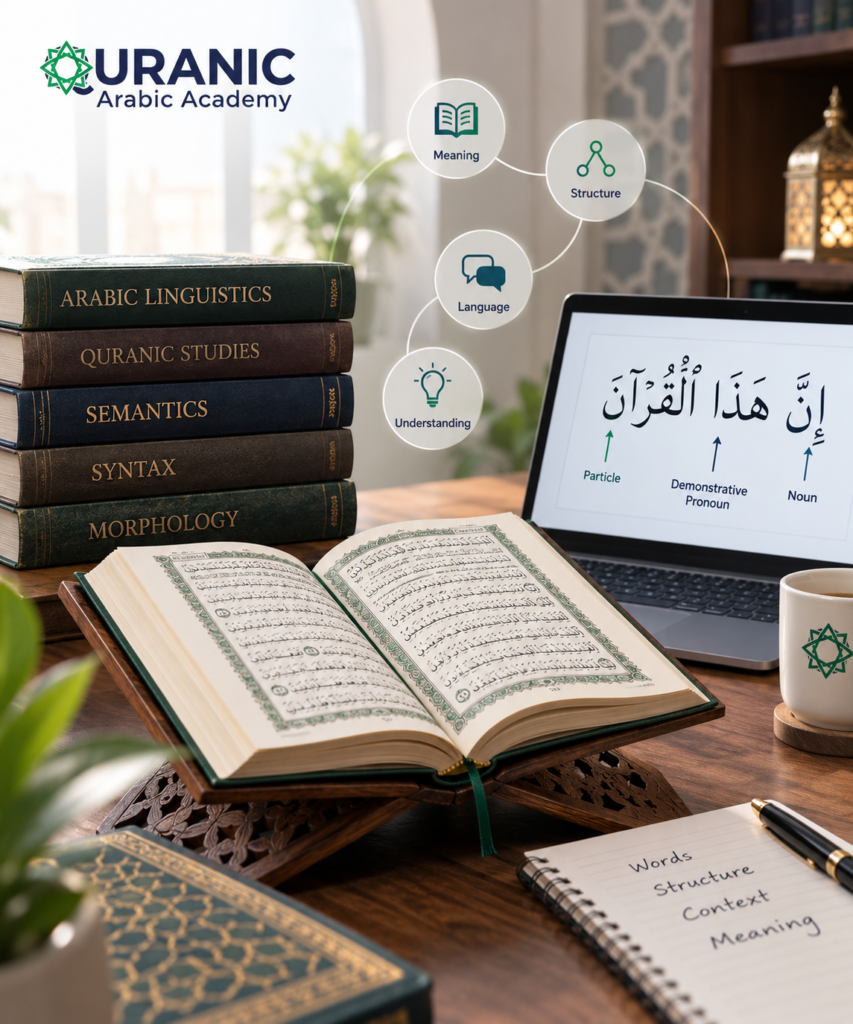
What You Will Learn
- What Quranic linguistics means and how it differs from traditional tafsir.
- The main branches of Quranic linguistics: phonetics, semantics, pragmatics, and textual analysis.
- How classical and modern scholars have approached the linguistic study of the Quran.
- Why the Quran’s linguistic structure is considered part of its i’jaz (inimitability).
- How learning Quranic Arabic can help you engage with these studies directly.
What Is Quranic Linguistics?
Quranic linguistics is a field of knowledge that applies the methods and tools of modern linguistics to the Quranic text, analyzing its linguistic structure and layers of meaning. It relies on description and structural, phonetic, grammatical, and semantic analysis, rather than on normative religious rulings alone.
The goal of Quranic linguistics is not to replace traditional tafsir (Quranic exegesis) but to complement it. Where classical tafsir often explains meaning through narration, jurisprudence, and grammar, Quranic linguistics adds a systematic, descriptive lens borrowed from general linguistic theory.
This distinction matters for readers: a linguistic study can describe how a sentence is built, but it does not by itself issue a religious ruling. Religious rulings remain the domain of qualified scholars working within established interpretive tradition.
The Main Branches of Quranic Linguistics
Quranic linguistics is a broad field of study concerned with understanding the language of the Qur’an and the linguistic features through which its meanings are expressed.
Because the Quranic text contains rich vocabulary, precise grammatical structures, distinctive rhetorical patterns, and carefully constructed expressions, studying its language requires attention to several interconnected areas rather than relying on a single linguistic approach.
Each branch of Quranic linguistics examines the text from a different perspective. Some focus on the structure and formation of individual words, while others examine grammatical relationships within sentences, the meanings of vocabulary in context, rhetorical devices, or the ways particular expressions communicate emphasis and nuance.
Together, these disciplines help students move beyond a surface-level understanding of Quranic Arabic and recognize how linguistic choices contribute to meaning.

Phonetic Analysis of Quranic Sounds and Recitation
Phonetic analysis studies the sounds of Arabic letters, their articulation points (makharij), and their intonation, including how these apply to the different Quranic recitations (qira’at). This branch connects closely to the practical science of tajweed, which governs how the Quran is correctly pronounced.
Semantics and Meaning in Quranic Vocabulary
Semantics examines the meanings of Quranic words and how those meanings form and shift within context. A single Arabic root can carry different shades of meaning depending on the surrounding verses, and semantic analysis traces these patterns systematically across the text.
Pragmatics and the Purpose of Quranic Speech
Pragmatic analysis studies the purposes behind Quranic speech: how the speaker communicates with the listener, and how the text affects its audience beyond the literal wording. This includes studying rhetorical questions, commands, and the different forms of address used throughout the Quran.
Textual Coherence and Nazm in the Quran
Textual analysis examines the connections and cohesion between verses and surahs, showing how a surah functions as a unified thematic whole rather than a collection of unrelated statements. This branch is closely tied to the classical Arabic concept of nazm, meaning linguistic order and arrangement.
See It in Action:
Wondering what our interactive sessions look like? Click below to peek inside a live session and watch how our expert instructors make learning Quranic Arabic accessible and engaging.
Ready to Begin Your Quranic Journey?
Start learning with professional instructors through our structured curriculum.
Book Your Free TrialWhy Linguistic Analysis Matters in Quranic Studies
Scholars study Quranic linguistics because language is fundamental to understanding how the Qur’an communicates its meanings. The Quranic text uses vocabulary, grammatical structures, rhetorical patterns, word order, repetition, emphasis, and context with remarkable precision.
Examining these linguistic features can therefore help scholars understand not only what a verse says at a basic level, but also how its wording contributes to emphasis, nuance, coherence, and interpretation.
The importance of this field extends beyond purely academic or theoretical interest. Linguistic analysis has long played an important role in the study of tafsir and the Arabic sciences associated with the Qur’an.
By examining words and expressions within their grammatical, semantic, rhetorical, and textual contexts, scholars can evaluate possible meanings more carefully and avoid interpretations that are inconsistent with the language of the text.
Contemporary linguistic approaches may also provide additional analytical tools, provided that they are applied carefully alongside the established disciplines of Quranic interpretation.
Among the main reasons scholars study Quranic linguistics are:
- Deeper understanding: it uncovers the expressive capacities of the Arabic language and the subtleties of Quranic rhetoric.
- Developing tafsir: it offers contemporary analytical tools that can illuminate meanings consistent with the spirit of the language.
- Structured reading: it provides an organized, systematic description of how verses and structures are built.
This ties closely to how the Quran’s language shapes its ethical teachings, a connection explored further in this article on Quranic ethics.

Because these tools rely on close reading of Arabic grammar, vocabulary, and rhetorical structure, building a solid foundation in Quranic Arabic is usually the first step before engaging seriously with Quranic linguistics.
This is exactly the kind of foundation programs like The Quranic Arabic Academy are designed to build, guiding students from basic grammar toward reading Quranic texts with real comprehension. The easiest way to see if this style of learning suits you is to book a free trial class before committing to a course.
How Quranic Linguistic Studies Developed Over Time
The linguistic study of the Qur’an developed gradually alongside the growth of Arabic and Islamic scholarship. Early scholars recognized that understanding the Quranic text required careful study of its vocabulary, grammar, morphology, rhetoric, and context.
This contributed to the development of disciplines such as nahw (syntax), sarf (morphology), balaghah (rhetoric), and i’rab al-Qur’an (grammatical analysis of the Qur’an).
In the modern period, researchers began applying approaches such as semantics, pragmatics, discourse analysis, and textual linguistics to the Quranic text.
As a result, Quranic linguistic studies today often bring classical Arabic scholarship into conversation with contemporary linguistic methods, providing additional ways to examine the structure, meaning, and rhetorical features of the Qur’an.
Classical Arabic Scholarship and Quranic Language
Early Arab scholars devoted extensive effort to studying the Quran’s language and meaning, and later generations largely preserved and transmitted this inherited knowledge.
This classical tradition in grammar, rhetoric (‘ilm al-balagha), and exegesis forms the foundation on which later linguistic studies were built.
For readers who want more background on how the Quranic text itself was preserved and transmitted, see this overview of the history of the Quranic text.

Modern Linguistic Approaches to the Quran
In the modern period, some scholars began applying Western linguistic, semiotic, and hermeneutic approaches to the study of the Quranic text.
This trend examined Quranic language and discourse through contemporary analytical frameworks while generating considerable discussion about their relationship with traditional methods of tafsir.
- Mohammed Arkoun (Algeria): Applied modern linguistic, semiotic, and critical approaches to Islamic and Quranic discourse, seeking to examine religious texts through methods influenced by contemporary Western thought.
- Nasr Hamid Abu Zayd (Egypt): Focused on the linguistic and textual dimensions of the Qur’an and its relationship to historical and cultural context, drawing particularly on hermeneutics and modern theories of textual analysis.
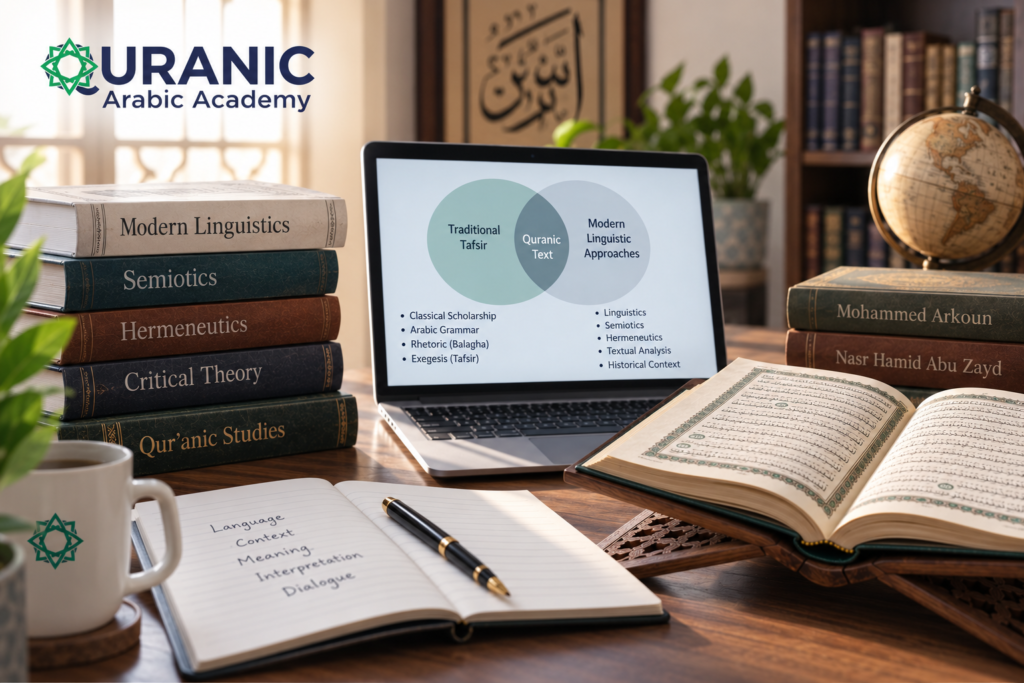
Combining Modern Linguistics with Classical Quranic Studies
Other scholars combined modern linguistic tools with the classical Arabic rhetorical tradition.
- Fadel Saleh al-Samarrai (Iraq), working from a traditional rhetorical foundation, produced precise analyses of Quranic structures, word forms, and word order in his book “Linguistic Touches in the Noble Revelation,” which intersects with modern text linguistics and structural stylistics.
- Ahmad Mukhtar Umar (Egypt) applied semantics and modern linguistics to the study of Quranic vocabulary and its variant readings (qira’at), notably in “Linguistic Studies in the Language of the Quran and Its Readings.”
- Ahmad al-Mutawakkil (Morocco), a pioneer of the functional school in the Arab world, applied functional linguistics to the structure of Arabic discourse, contributing to the understanding of Quranic sentence construction.
If you have questions about which course level fits you best, you can get in touch with the academy’s team
International Contributions to Quranic Linguistic Studies
Quranic linguistics has also attracted researchers from universities and academic institutions outside the Arab and Islamic world. Their studies approach the Quranic text from various perspectives, including Arabic linguistics, semantics, rhetoric, discourse analysis, and historical language studies.
This international scholarship has broadened academic discussion of Quranic language and introduced additional methods for examining its vocabulary, structure, style, and textual features.
- Toshihiko Izutsu (Japan) presented an early, influential study of the Quran using structural semantics. His books “God and Man in the Qur’an” and “Ethico-Religious Concepts in the Qur’an” are considered classics in the field.
- Michel Cuypers (France, based in Egypt) specialized in studying the structure of the Quranic text using Semitic rhetorical analysis. In his book “The Composition of the Quran,” he argues that Quranic surahs are built according to a precise structure based on symmetry and strong textual cohesion, countering earlier orientalist claims of randomness.
- Angelika Neuwirth (Germany) focused her research on the text linguistics of the Quran and its historical, oral, and written development, studying the rhythmic and semantic coherence within surahs.
How Quranic Language Relates to I’jaz and Inimitability
The linguistic structure of the Qur’an occupies an important place in discussions of i’jaz al-Qur’an, or the inimitability of the Qur’an. Muslim scholars have examined features such as its vocabulary, sentence structure, rhetorical techniques, rhythm, imagery, and precision of expression to understand how its language communicates meaning in a distinctive way.
This subject is closely connected to the Quranic challenge (tahaddi), in which those who doubted the divine origin of the revelation were challenged to produce something comparable to it.
For this reason, the study of the Quranic language is not limited to grammar or vocabulary; it also explores how linguistic and rhetorical features contribute to the Qur’an’s distinctive style and its traditional understanding as an inimitable revelation.
وَإِن كُنتُمْ فِي رَيْبٍ مِّمَّا نَزَّلْنَا عَلَىٰ عَبْدِنَا فَأْتُوا بِسُورَةٍ مِّن مِّثْلِهِ وَادْعُوا شُهَدَاءَكُم مِّن دُونِ اللَّهِ إِن كُنتُمْ صَادِقِينَ
“And if you are in doubt about what We have sent down upon Our Servant [Muhammad], then produce a surah the like thereof and call upon your witnesses other than Allah, if you should be truthful.”
Source: Surah Al-Baqarah (2:23)
This challenge verse (ayat al-tahaddi) is one of the reasons scholars, both classical and modern, have spent centuries analyzing the Quran’s language: its word choice, sentence order, and textual cohesion are treated as central to understanding why the text is considered inimitable.
If you’d like to go beyond the linguistic analysis and explore personal, reflective readings of the Quran, this piece on Quranic reflections is a good next step.
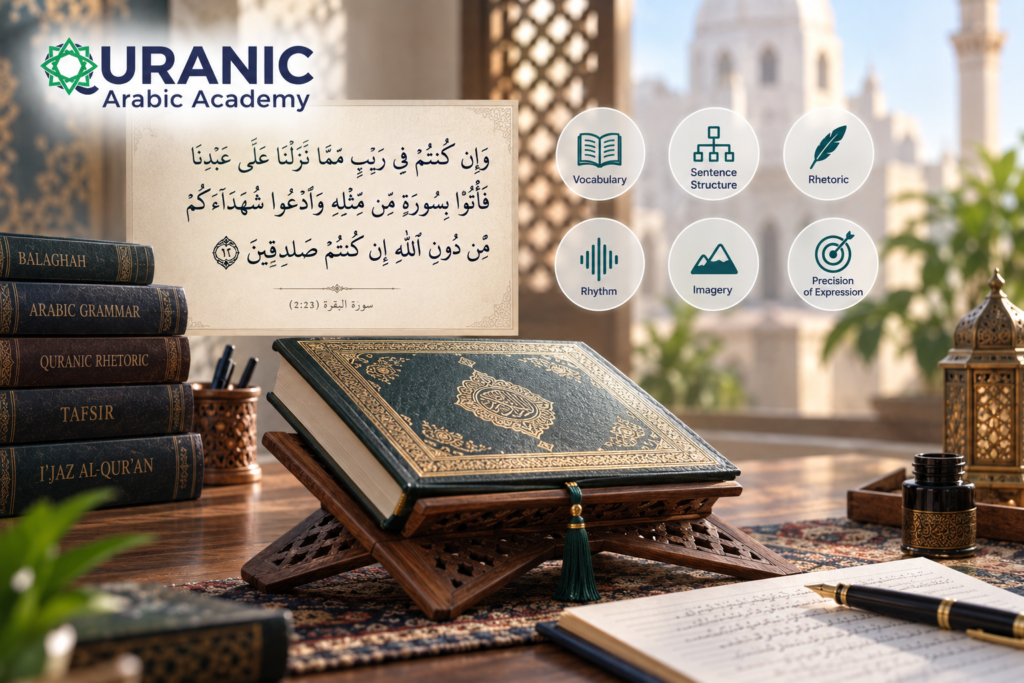
Understanding a verse like this fully requires reading it in the original Arabic, since translation can capture the meaning but not the precise grammatical structure being discussed.
This is one of the main reasons students of Quranic linguistics are encouraged to build real Arabic reading skills, something that structured courses such as those offered by The Quranic Arabic Academy focus on directly.

Why Learning Quranic Arabic Deepens Understanding
Beyond academic and linguistic study, engaging with the language of the Qur’an has important personal and spiritual value for Muslims. Learning Quranic vocabulary, pronunciation, and basic grammatical structures can help a reader develop a more direct connection with the text and recognize meanings that may be less apparent when relying entirely on translation.
It can also deepen reflection during recitation and make frequently repeated Quranic expressions easier to understand.
The Sunnah further emphasizes the virtue of engaging with the Qur’an through learning, recitation, and teaching. Rather than treating Quranic study as purely an intellectual exercise, the Prophetic tradition connects learning the Book of Allah with personal growth and religious excellence.
A well-known hadith expresses this principle clearly:
خَيْرُكُمْ مَنْ تَعَلَّمَ الْقُرْآنَ وَعَلَّمَهُ
“The best among you are those who learn the Quran and teach it.”
This hadith shows that learning the Quran’s language is not only an academic pursuit but also a recognized and rewarded act of devotion, connecting the technical study of Quranic linguistics to a clear spiritual purpose.
Scholarly Views on Using Modern Linguistics to Study the Quran
Applying modern linguistic methods to the Qur’an remains a subject of ongoing academic and religious discussion. The debate is not simply about whether linguistic analysis is useful, but also about which methods are appropriate for a sacred text and how they should relate to the established principles of Arabic language and Quranic interpretation.
Contemporary approaches such as semantics, pragmatics, discourse analysis, and textual linguistics may provide additional tools for examining Quranic language, yet scholars differ over their limits and underlying assumptions.
| Position | Core View |
| Acceptance and application | Linguistics is a useful human tool for understanding the text, as long as it respects the fixed principles of the religion. |
| Caution and critique | Uncritically applying Western theories may clash with core beliefs or be used to push ideologically driven readings far from objective interpretation. |
Both positions agree on one point: any linguistic method applied to the Quran must be handled carefully, since its conclusions can shape how people understand religious meaning.
Experience Our Teaching Style:
We believe in clarity and engagement. Watch these short highlights from our actual classes to see our teachers’ methodology and student interactions in real-time.
Ready to Begin Your Quranic Journey?
Start learning with professional instructors through our structured curriculum.
Book Your Free TrialHow Quranic Linguistics Can Improve Your Understanding of the Quran
Quranic linguistics is not only a field for scholars and specialists. Even a basic understanding of Quranic language can help students and general readers engage with the Qur’an more thoughtfully, notice details that may otherwise be overlooked, and connect recitation with a deeper awareness of meaning and structure.
- It helps you notice why a particular word, not a synonym, was chosen in a verse.
- It shows you how surahs form connected wholes rather than disconnected statements.
- It builds a bridge between memorizing recitation and actually understanding structure.
Reaching this level of reading, however, depends on a real grounding in Quranic Arabic grammar and vocabulary. This is exactly the gap that structured, guided learning is meant to close.
Students based in Australia can also join live sessions through the academy’s Quranic Arabic classes for students in Australia, while parents looking to introduce these foundations early can explore the academy’s dedicated Quranic Arabic classes for kids.

Deepen Your Understanding of the Quran’s Language
If this overview of Quranic linguistics has sparked your interest in reading the Quran in its original language, The Quranic Arabic Academy offers structured courses that take students from foundational Arabic grammar to reading and understanding Quranic verses directly, step by step, with qualified teachers guiding the process.
If you have questions about which course level fits you best, you can get in touch with the academy’s team directly.
Our Arabic Courses
- Quranic Arabic Classes
- Quranic Arabic Course for Beginners
- Online Quranic Arabic Courses for Advanced Learners
- Quranic Arabic Grammar Course
- Arabic Courses for Understanding the Quran
- Quranic Arabic Course for Sisters (Female)
- Quranic Arabic Course for Kids
- Online Quranic Arabic Classes for Adults
- Quranic Arabic Course UK
- Quranic Arabic Course London
- Quranic Arabic Course USA
- Quranic Arabic Course Canada
- Quranic Arabic Course Australia
- Quranic Arabic Course UAE
- Quranic Arabic Course Germany
Conclusion
Quranic linguistics is the scientific study of the Quran’s language using the tools of modern linguistics, covering phonetics, semantics, pragmatics, and textual coherence.
Classical Arab scholarship laid the foundation, modern critical scholars introduced Western linguistic theory, and a reconciliatory trend has worked to combine both approaches with the classical rhetorical tradition.
International researchers have added further depth, especially in studying the Quran’s textual structure and cohesion. Across all these approaches, the Quran’s linguistic precision remains closely tied to its recognized inimitability, and genuine engagement with these studies begins with a solid foundation in Quranic Arabic itself.
Frequently Asked Questions
What is the difference between Quranic linguistics and tafsir?
Quranic linguistics uses modern linguistic tools to describe the structure and meaning of the Quranic text, while tafsir is the traditional discipline of Quranic exegesis, drawing on narration, jurisprudence, grammar, and scholarly interpretation. The two fields can complement each other but are not the same discipline.
Is studying Quranic linguistics considered controversial?
Some scholars fully support using linguistic methods to study the Quran, while others caution against uncritically applying Western theories without respecting Islamic belief and interpretive tradition.
Both views exist within current scholarship, and there is no single universally accepted position on every method.
Do I need to know Arabic to study Quranic linguistics?
Yes, a solid foundation in Arabic grammar, vocabulary, and rhetoric is necessary to meaningfully engage with Quranic linguistics, since most of its analysis works directly with the original Arabic text and structure.
What does i’jaz al-Quran mean?
I’jaz al-Quran refers to the Quran’s inimitability, the belief that no one can produce a text comparable to it. This concept is closely connected to Quranic linguistics because much of the argument for i’jaz rests on the precision of the Quran’s language and structure.
Who are some well-known scholars of Quranic linguistics?
Notable names include Mohammed Arkoun and Nasr Hamid Abu Zayd from the modern critical trend, Fadel Saleh al-Samarrai and Ahmad Mukhtar Umar from the reconciliatory Islamic trend, and international scholars such as Toshihiko Izutsu, Michel Cuypers, and Angelika Neuwirth.






Leave a Reply