 Learn Quranic Arabic

| Key Takeaways |
| Tajweed consists of precise phonetic rules governing how every letter and vowel in the Quran must be pronounced correctly. |
| The four rules of Noon Saakinah and Tanween — Idh-haar, Idghaam, Iqlaab, and Ikhfaa — apply whenever these sounds meet other letters. |
| Madd (elongation) rules require specific counts of beats ranging from two to six, depending on the type and trigger involved. |
| Makhaarij al-Huroof (articulation points) defines five exit zones for Arabic letters, making accurate pronunciation physically learnable. |
| Learning Tajweed alongside Quranic Arabic grammar deepens comprehension far beyond recitation mechanics alone. |
You hear a sheikh recite and something in the sound stops you — the letters feel alive, precise, and unlike anything you have heard before. That experience points directly to Tajweed, the science of Quranic pronunciation that transforms recitation from reading into something altogether different.
Quranic Tajweed rules are a structured system of phonetic and articulation laws that govern how every letter, vowel, and sound in the Quran must be pronounced. Mastering these rules is an obligation upon every Muslim who recites — and understanding them opens a deeper connection to the words of Allah.
1. Makhaarij al-Huroof Rules in Tajweed
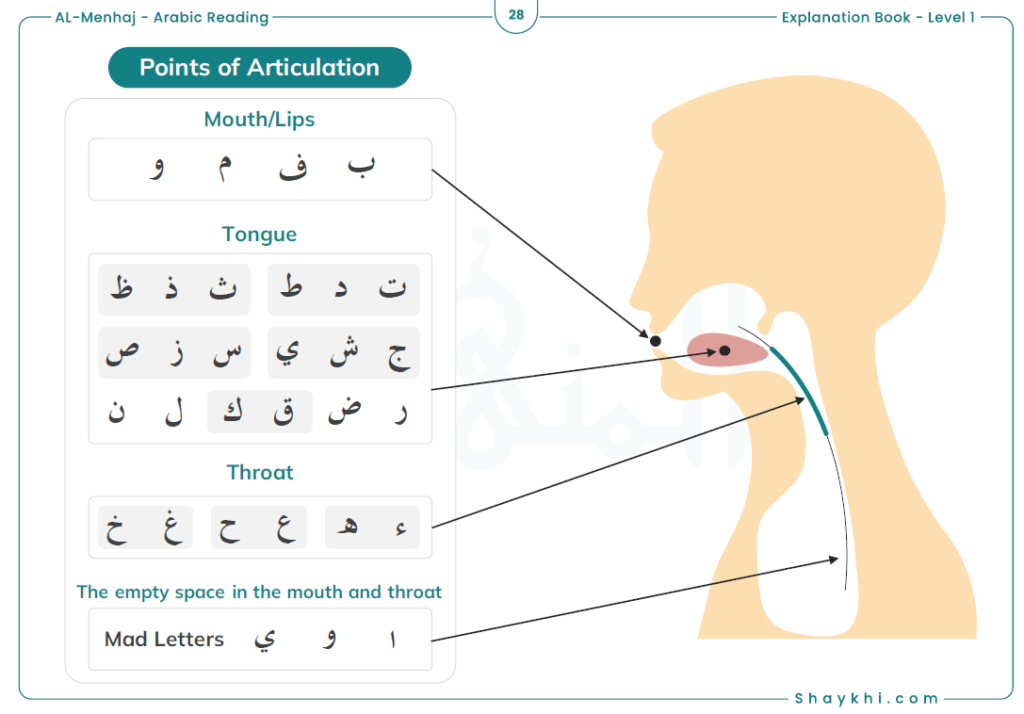
Makhaarij al-Huroof (مخارج الحروف) — the articulation points of Arabic letters — defines precisely where in the mouth, throat, or nasal passage each Arabic letter originates. There are five primary exit zones, and every Arabic letter belongs to one of them.
| Exit Zone | Arabic Name | Letters Produced |
| The Throat (Halq) | الحلق | ء ه ع ح غ خ |
| The Tongue (Lisaan) | اللسان | ق ك ج ش ي ض ل ن ر ط د ت ص س ز ث ذ ظ |
| The Lips (Shafataan) | الشفتان | ب و م ف |
| The Nasal Passage (Khayshoom) | الخيشوم | Ghunnah sounds |
| The Open Mouth (Jawf) | الجوف | Long vowel letters ا و ي |
Explore and study Al-Menhaj for FREE
Many non-Arabic speakers attempt Tajweed without first anchoring these physical articulation points. The result is pronunciation that sounds approximately correct but never quite lands.
Understanding the Quranic Arabic alphabet through the lens of Makhaarij transforms letters from symbols into physical experiences.
Our Online Quranic Arabic Classes for Adults spend dedicated time on articulation exercises before introducing Tajweed rules — because correct Makhaarij is the physical foundation everything else rests upon.
Join our Quranic Arabic Courses for Advanced Learners with a Free Trial

2. Tafkheem and Tarqeeq (Heavy and Light Sounds) Rules?
Tafkheem (تفخيم) means heavy, full-mouth pronunciation. Tarqeeq (ترقيق) means light, fine pronunciation. Every Arabic letter in the Quran falls into one of three categories: always heavy, always light, or variable depending on context.
- Always heavy (Isti’laa letters): خ ص ض غ ط ق ظ — gathered in the phrase “خص ضغط قظ”
- Always light: All remaining letters except Raa, Laam, and Alif
- Variable — Raa (ر): Heavy when carrying Fathah or Dhammah; light when carrying Kasrah
- Variable — Laam (ل): Light in all positions except in the Divine Name اللَّـه when preceded by Fathah or Dhammah
- Variable — Alif (ا): Takes its weight from the letter immediately before it
The Laam of the Divine Name deserves particular attention. In بِسْمِ اللَّـهِ the Laam is light because the Kasrah precedes it. In إِنَّ اللَّـهَ the Laam is heavy because the Fathah precedes it.
This single rule, when consistently applied, dramatically changes the reverence and accuracy of recitation.
3. The Rules of Noon Saakinah and Tanween in Tajweed
The rules of Noon Saakinah (نْ) and Tanween (ـً ـٍ ـٌ) are among the most foundational quranic tajweed rules a student encounters. Four distinct rulings apply whenever these sounds meet other Arabic letters: Idh-haar, Idghaam, Iqlaab, and Ikhfaa. Identifying which ruling applies depends entirely on the letter that follows.
The table below summarizes all four rulings at a glance. Internalize this table first — everything else builds from it.
| Ruling | Trigger Letters | What Happens | Example |
| Idh-haar (إظهار) | ء ه ع ح غ خ | Noon pronounced clearly | مَنْ آمَنَ |
| Idghaam (إدغام) | ي ر م ل و ن | Noon merges into next letter | مَن يَعمَل |
| Iqlaab (إقلاب) | ب only | Noon converts to Meem sound | أَنبَتْنَا |
| Ikhfaa (إخفاء) | Remaining 15 letters | Noon hidden with nasal tone | رِيحاً صَرصَراً |
A. Idh-haar: When the Noon Is Fully Clear
Idh-haar means the Noon Saakinah or Tanween is pronounced with complete clarity when followed by one of six throat letters: Hamzah, Haa, ‘Ain, Haa, Ghain, or Khaa — gathered in the mnemonic phrase “أخي هاك علما حازه غير خاسر.”
In مَنْ آمَنَ, the Noon meets the Hamzah, producing a fully audible Noon before continuing. No merging, no hiding — pure, clean sound.
B. Idghaam: When the Noon Disappears Into the Next Letter
Idghaam divides into two types. Idghaam with Ghunnah (nasal resonance) applies to four letters gathered in “ينمو” — Yaa, Noon, Meem, Waaw. Idghaam without Ghunnah applies only to Raa and Laam.
In مِن لَدُنهُ (Al-Kahf 18:2), the Noon merges silently into the Laam — no nasal tone, no pause.
Students at The Quranic Arabic Academy consistently need additional drilling on this distinction because the absence of Ghunnah feels counterintuitive after learning the nasal Idghaam first.
Shots Videos from Our Courses
Ready to Begin Your Quranic Journey?
Start learning with professional instructors through our structured curriculum.
Book Your Free TrialC. Iqlaab: The Noon That Becomes a Meem
Iqlaab has exactly one trigger letter: Baa (ب). When Noon Saakinah or Tanween meets Baa, the Noon converts into a Meem sound accompanied by Ghunnah.
وَأَنبَتْنَا (Qaaf 50:7) demonstrates this within a single word — the Noon shifts to a Meem before the Baa.
زَوْجٍ بَهِيجٍ in the same verse shows the Tanween version across two words.
Our instructors find this the easiest rule for beginners to remember precisely because it has only one trigger.
D. Ikhfaa: The Hidden Noon With a Nasal Tone
Ikhfaa applies to the remaining fifteen Arabic letters not covered by the other three rulings. The Noon is neither fully pronounced nor fully merged — it is concealed while a subtle nasal resonance continues.
The fifteen Ikhfaa letters are gathered in a classical Arabic couplet beginning “صف ذا ثنا كم جاد شخص قد سما.” If you are working through how to read Quranic Arabic for the first time, Ikhfaa typically requires the most ear-training because the sound lives between two extremes.
4. The Rules of the Meem Saakinah in Tajweed
The Meem Saakinah (مْ) carries three rulings that parallel those of Noon Saakinah but operate through a different articulation zone — the lips rather than the throat or nasal cavity.
| Ruling | Trigger | Technical Name | Example |
| Ikhfaa Shafawi | Baa (ب) | Labial concealment | رَبَّهُم بِالْغَيْبِ |
| Idghaam Shafawi | Meem (م) | Labial merging | لَكُم مَّا فِي الْأَرْضِ |
| Idh-haar Shafawi | All other letters | Labial clarity | لَعَلَّكُمْ تَتَّقُونَ |
The term Shafawi (شفوي) means “labial” — both Meem and Baa are produced at the lips, which is why these rulings carry that designation. This physical connection is what makes the Ikhfaa here distinctly different from the nasal Ikhfaa of the Noon.
At The Quranic Arabic Academy, our Quranic Arabic Grammar Course integrates Tajweed mechanics directly with grammatical structure, so students understand why these sounds interact — not merely how to perform them.
Your First class is free. Join our Quranic Arabic Grammar Course now

5. The Rules of Madd (Elongation)
Madd refers to the elongation of sound through one of three vowel letters — the Alif (ا), Waaw (و), and Yaa (ي) — when specific conditions are met. The duration of elongation varies from two to six beats depending on the type of Madd and its trigger.
Understanding Quranic Arabic at even a basic level requires grasping Madd, because incorrect elongation changes the acoustic integrity of entire verses.
Madd Tabee’i: The Natural Baseline Elongation
Madd Tabee’i (المد الطبيعي) is the foundational Madd — two beats, always, with no exceptions. It occurs when a Madd letter is present without any Hamzah before it or Sukoon after it.
بَلَى إِنَّ رَبَّهُ كَانَ بِهِ بَصِيرًا (Al-Inshiqaaq 84:15)
contains multiple Madd Tabee’i letters. Every other Madd type is measured relative to this two-beat baseline.
Madd Far’ee: The Extended Elongations and Their Triggers
Madd Farc’ee (المد الفرعي) divides into two main categories based on what causes the extension — either a Hamzah or a Sukoon.
Madd caused by Hamzah includes:
A. Madd Muttasil
Hamzah follows the Madd letter within one word. Elongated four to five beats. Ruling: obligatory. Example: قُرُوءٍ (Madd then Hamzah, single word)
Ready to Begin Your Quranic Journey?
Start learning with professional instructors through our structured curriculum.
Book Your Free TrialB. Madd Munfasil
Madd letter ends one word; Hamzah begins the next. Four beats (preferred). Ruling:
permissible. إِنَّا أَعْطَيْنَاكَ الْكَوْثَرَ (Al-Kawthar 108:1) — the Alif in Innaa extends before the Hamzah of A’taynaa.
Madd caused by Sukoon includes:
C. Madd Laazim
A permanent Sukoon follows a Madd letter. Six beats. Ruling:
obligatory. وَلَا الضَّآلِّينَ (Al-Faatihah 1:7) — the Alif extends six beats before the doubled Laam.
Read Also: How to Create a Safe and Private Online Environment for Quranic Studies?
D. Madd ‘Aarid lil-Sukoon
Sukoon arises only when pausing on a word. Two, four, or six beats. Ruling: permissible.
In our experience at The Quranic Arabic Academy, students most frequently make errors on Madd Muttasil and Madd Munfasil — confusing the obligatory status of the former with the permissible flexibility of the latter.
One-on-one instruction with our certified Arabic linguists resolves this quickly through targeted listening and repetition.
Meet our certified Quranic Arabic teachers

If you are exploring how to learn Quranic Arabic systematically, pairing Madd rules with active recitation practice — not passive reading — is what produces real retention.
Read Also: Quranic Root Words
6. The Rules of Idghaam in Quranic Tajweed
Beyond the Idghaam of Noon Saakinah, classical Tajweed scholarship identifies broader categories of letter merging that apply across different contexts.
Idghaam al-Mutamaathayn (إدغام المتماثلين) merges two identical letters — same articulation point, same characteristics. When the first is Saakin and the second is voweled, they become one doubled letter.
اذْهَب بِكِتَابِيَ — the Baa of ith-hab merges into the Baa of bi-kitaabiy.
Idghaam al-Mutajaanisayn (إدغام المتجانسين) merges two letters that share the same articulation point but differ in characteristics.
يَا بُنَيَّ ارْكَب مَّعَنَا (Hud 11:42)
— Baa merges into Meem, both labial letters despite different sound qualities.
Understanding these merging patterns is one area where Quranic grammar and Tajweed intersect directly — a reminder that recitation and comprehension are never truly separate disciplines.
Read Also: Quranic Symbols Explained
Our Students Reviews
Ready to Begin Your Quranic Journey?
Start learning with professional instructors through our structured curriculum.
Book Your Free TrialRead Also: Quranic Verbs
Start Reciting the Quran with Correct Tajweed at The Quranic Arabic Academy
Tajweed is a science — and like every science, it requires a qualified teacher, not just a textbook. The Quranic Arabic Academy offers:
- Certified instructors with 25+ years of Arabic teaching experience
- Personalized 1-on-1 sessions tailored to your pace and level
- Specialized programs for kids,adults, and beginners
- Flexible scheduling available 24/7 globally
- A free trial lesson — no commitment required
The benefits of reading the Quran daily multiply when every word is recited as it was revealed. Take your first step today.
Check out our top courses to start learning Quranic Arabic today:
- Quranic Arabic Grammar Course
- Arabic Courses for Understanding the Quran
- Quranic Arabic for Beginners
- Online Quranic Arabic Classes for Adults
- Quranic Arabic Course for Kids
- Quranic Arabic Course for Sisters
- Online Quranic Arabic Courses for Advanced Learners
Your first class is completely free. Start Learning Quranic Arabic courses Today.

Conclusion
Tajweed is not a barrier between you and the Quran — it is the bridge that brings you closer to it. Every rule exists to preserve the exact sound of revelation, letter by letter and breath by breath.
The rules in this guide are interconnected. Mastering Makhaarij gives your Madd accuracy. Mastering Tafkheem gives your letters weight and truth. Each layer builds on the one before it.
Those who learn Tajweed correctly report something that no worksheet can predict — the Quran begins to sound different, as though hearing it for the first time. That transformation is available to every sincere student, regardless of native language or starting point.
Ready to Begin Your Quranic Journey?
Start learning with professional instructors through our structured curriculum.
Book Your Free TrialRead Also: Quranic Vocabulary
Frequently Asked Questions About Quranic Tajweed Rules
How Long Does It Take to Learn the Basic Quranic Tajweed Rules?
Most students grasp the core rules — Noon Saakinah, Meem Saakinah, and basic Madd — within three to six months of consistent practice with a qualified teacher. Applying those rules fluently during recitation typically requires an additional three to six months of guided recitation. Individual pace varies significantly based on prior Arabic exposure.
Can I Learn Tajweed Without Knowing Arabic Grammar?
You can learn to recite with Tajweed without formal grammar study. However, students who also develop Quranic Arabic grammar skills retain Tajweed rules more accurately because they understand why certain sounds interact. Grammar awareness also prevents meaning-altering mistakes that purely phonetic study can miss.
What Is the Difference Between Ikhfaa and Idghaam?
Ikhfaa conceals the Noon while maintaining a nasal resonance — the Noon is neither fully pronounced nor fully merged. Idghaam fully absorbs the Noon into the following letter, producing one stressed letter with no remaining Noon sound. The distinction is degree: Ikhfaa is partial concealment; Idghaam is complete assimilation.
Where Should a Complete Beginner Start with Tajweed?
Begin with the Arabic alphabet and its articulation points (Makhaarij), then progress to short vowels and Sukoon, then Madd Tabee’i, then the four rules of Noon Saakinah. This sequence mirrors the progression used in the Al-Menhaj Book curriculum at The Quranic Arabic Academy — designed specifically for non-native speakers building from zero. Explore our Quranic Arabic for Beginners course to start on solid ground.
Related Articles
Learn Quranic Arabic







Leave a Reply