 Quranic Verses
| Key Takeaways |
| The Quran contains numerous verses about knowledge, establishing ‘ilm as one of Islam’s most honored obligations for every Muslim. |
| Allah’s first revelation to Prophet Muhammad ﷺ began with the word “Iqra'” — Read — making knowledge the foundation of the Islamic message. |
| Several knowledge verses use specific Arabic grammatical structures — such as raf’ of the scholar — that reveal layers of meaning invisible in translation. |
| Understanding these verses in their original Arabic transforms passive Quran recitation into active, living comprehension of Allah’s direct speech. |
Imagine reading a letter from someone you love deeply — but only through someone else’s translation. You understand the message, but you sense something profound is slipping through your fingers. That is precisely what millions of Muslims experience every time they recite the Quran without Arabic comprehension.
The Quranic verses on education in Arabic are among the most cited and most misunderstood passages in the entire Quran — not because the translations are poor, but because the Arabic original carries dimensions of meaning that no translation can fully capture.
1. The Quran Begins With a Command That Defines the Entire Religion’s Relationship With Knowledge
The very first word revealed to Prophet Muhammad ﷺ was not a statement of doctrine or a ritual command — it was an imperative: اقْرَأْ — Read or Recite. This single opening establishes that Islam’s relationship with knowledge is not incidental. It is foundational, structural, and inseparable from the act of receiving revelation itself.
اقْرَأْ بِاسْمِ رَبِّكَ الَّذِي خَلَقَ خَلَقَ الْإِنسَانَ مِنْ عَلَقٍ اقْرَأْ وَرَبُّكَ الْأَكْرَمُ الَّذِي عَلَّمَ بِالْقَلَمِ عَلَّمَ الْإِنسَانَ مَا لَمْ يَعْلَمْ
Iqra’ bismi Rabbika alladhī khalaq. Khalaqa al-insāna min ‘alaq. Iqra’ wa Rabbuka al-Akram. Alladhī ‘allama bil-qalam. ‘Allama al-insāna mā lam ya’lam.
“Recite in the name of your Lord who created — created man from a clinging substance. Recite, and your Lord is the most Generous — Who taught by the pen — taught man that which he knew not.” (Al-‘Alaq 96:1–5)
Notice the verb عَلَّمَ (‘allama) — the causative Form II verb meaning “He taught.” This is not passive learning. It is Allah positioning Himself as the active teacher of humanity.
The repetition of اقْرَأْ (Iqra’) twice in five verses is a deliberate rhetorical reinforcement — a technique in Quranic Arabic grammar called tikrār li-t-ta’kīd (repetition for emphasis).
The verse does not say “read if you can” — it is an unqualified, unconditional command addressed to all of humanity through the Prophet ﷺ.
Shots Videos from Our Courses
Ready to Begin Your Quranic Journey?
Start learning with professional instructors through our structured curriculum.
Book Your Free Trial2. The Verse That Elevated Scholars Above All Others in Allah’s Sight
If you have ever wondered what rank Allah assigns to those who pursue knowledge, this verse answers with a directness that leaves no ambiguity.
It is among the most frequently cited Quranic verses about knowledge — and its grammatical structure contains a linguistic precision that students of Arabic immediately recognize as extraordinary.
يَرْفَعِ اللَّهُ الَّذِينَ آمَنُوا مِنكُمْ وَالَّذِينَ أُوتُوا الْعِلْمَ دَرَجَاتٍ
Yarfa’i Allāhu alladhīna āmanū minkum walladhīna ūtū al-‘ilma darajāt.
“Allah will raise those who have believed among you and those who were given knowledge, by degrees.” (Al-Mujadila 58:11)
The word دَرَجَاتٍ (darajāt) — “degrees” or “ranks” — appears here in the indefinite accusative, functioning as a tamyīz (specification of distinction) in classical Nahw analysis. It signals not just one elevation, but multiple, ascending levels of honor.
Scholars note that the scholars referenced here are those who combine īmān with ‘ilm — faith grounded in knowledge. The verse thus frames Islamic scholarship not as an academic achievement but as a spiritual elevation with divine authorization.
If you want to understand why learning Quranic Arabic unlocks entirely new dimensions of Quranic meaning — this verse is the perfect illustration.
At The Quranic Arabic Academy, our Arabic Courses for Understanding the Quran are specifically designed to help non-Arabic speakers move from passive recitation to active comprehension, exactly at the level this verse demands.
Join our Arabic courses for understanding the Quran and get a free lesson
3. The Du’a on Seeking Knowledge That Allah Taught the Prophet ﷺ
Among all the Quranic verses about knowledge, this one holds a uniquely intimate position. It records a direct divine instruction — Allah teaching His Prophet ﷺ a supplication for more knowledge.
The implication is clear: even the greatest human recipient of divine revelation was instructed to keep asking for more ‘ilm.
وَقُل رَّبِّ زِدْنِي عِلْمًا
Wa qul Rabbi zidnī ‘ilmā.
“And say: My Lord, increase me in knowledge.” (Ta-Ha 20:114)
This five-word du’a is perhaps the most concentrated expression of Islamic epistemology in the entire Quran. The verb زِدْنِي (zidnī) — “increase me” — comes from the root ز-ي-د (z-y-d), which in classical Arabic conveys an ongoing, additive growth.
It is not a one-time request — it is a request for continuous expansion. The word عِلْمًا (‘ilmā) appears in the indefinite accusative, indicating not a specific type of knowledge, but knowledge in its broadest possible sense.
In our experience at The Quranic Arabic Academy, students who first encounter this grammatical layer often describe a moment of genuine emotional recognition — the Arabic is not just saying “give me knowledge,” it is saying “keep adding to what I have, without limit.”
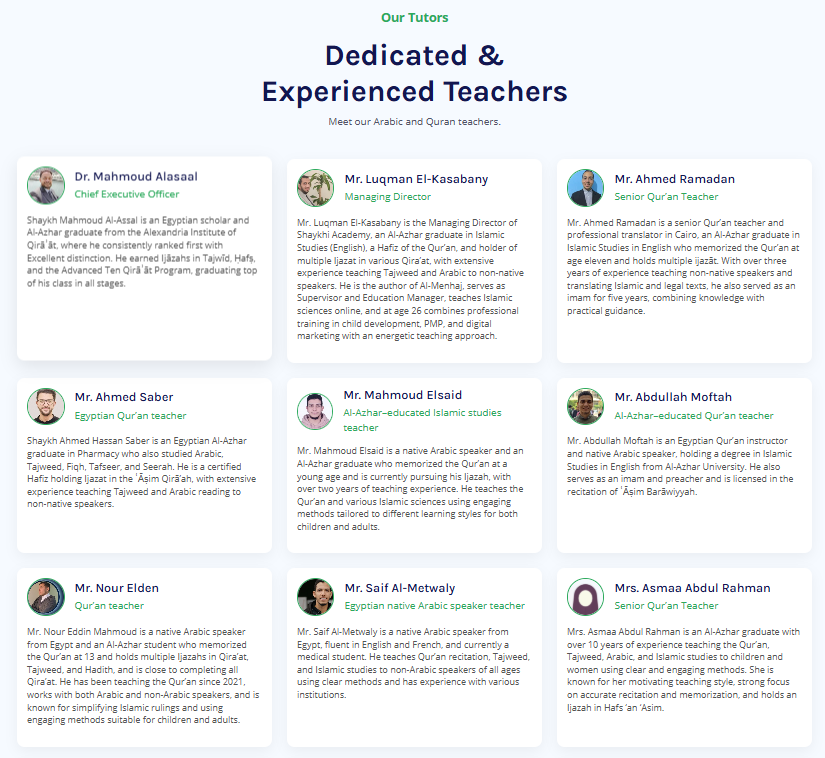
Meet our certified Quranic Arabic teachers
4. Surah Az-Zumar 39:9 Poses a Question: Are Those Who Know Equal To Those Who Do Not Know?
Some Quranic verses about knowledge do not argue their point — they simply ask a question and let the reader’s own conscience supply the answer. This verse is perhaps the most rhetorically powerful example of that technique.
أَمَّنْ هُوَ قَانِتٌ آنَاءَ اللَّيْلِ سَاجِدًا وَقَائِمًا يَحْذَرُ الْآخِرَةَ وَيَرْجُو رَحْمَةَ رَبِّهِ ۗ قُلْ هَلْ يَسْتَوِي الَّذِينَ يَعْلَمُونَ وَالَّذِينَ لَا يَعْلَمُونَ ۗ إِنَّمَا يَتَذَكَّرُ أُولُو الْأَلْبَابِ
Amman huwa qānitun ānā’a al-layli sājidan wa qā’iman yaḥdharu al-ākhirata wa yarjū raḥmata Rabbih. Qul hal yastawī alladhīna ya’lamūna walladhīna lā ya’lamūn. Innamā yatadhakkaru ūlū al-albāb.
“Is one who is devoutly obedient during periods of the night, prostrating and standing [in prayer], fearing the Hereafter and hoping for the mercy of his Lord, [like one who does not]? Say: Are those who know equal to those who do not know? Only they will remember [who are] people of understanding.” (Az-Zumar 39:9)
The rhetorical question هَلْ يَسْتَوِي (hal yastawī — “are they equal?”) is a form of istifhām inkārī — a negating rhetorical question in Arabic that implies a definitive “no” without needing to state it.
The closing phrase أُولُو الْأَلْبَابِ (ūlū al-albāb — “people of understanding/cores”) uses a construct noun (mudāf) referring to those with sound intellects.
This phrase appears multiple times in the Quran and consistently marks the audience of the deepest Quranic reflections — those capable of deriving meaning beyond the literal surface.
The table below summarizes the key Arabic vocabulary from this verse for learners building their foundational Quranic lexicon:
| Arabic Term | Transliteration | Root | Meaning |
| يَعْلَمُونَ | ya’lamūna | ع-ل-م | They know |
| لَا يَعْلَمُونَ | lā ya’lamūna | ع-ل-م | They do not know |
| يَتَذَكَّرُ | yatadhakkaru | ذ-ك-ر | He remembers / reflects |
| أُولُو الْأَلْبَابِ | ūlū al-albāb | ل-ب-ب | People of deep understanding |
Ready to Begin Your Quranic Journey?
Start learning with professional instructors through our structured curriculum.
Book Your Free Trial5. Knowledge Was One of Reasons Humanity Was Honored Above the Angels
This verse carries one of the most profound theological implications in the entire Quran — and it is centered entirely on the concept of ‘ilm. It is the passage in which Allah demonstrates Adam’s superiority by testing his knowledge against the angels.
وَعَلَّمَ آدَمَ الْأَسْمَاءَ كُلَّهَا ثُمَّ عَرَضَهُمْ عَلَى الْمَلَائِكَةِ فَقَالَ أَنبِئُونِي بِأَسْمَاءِ هَٰؤُلَاءِ إِن كُنتُمْ صَادِقِينَ
Wa ‘allama Ādama al-asmā’a kullahā thumma ‘araḍahum ‘ala al-malā’ikati faqāla anbi’ūnī bi-asmā’i hā’ulā’i in kuntum ṣādiqīn.
“And He taught Adam the names of all things. Then He showed them to the angels and said: Inform Me of the names of these, if you are truthful.” (Al-Baqarah 2:31)
The word الْأَسْمَاءَ (al-asmā’ — “the names”) is the broken plural of اسْم (ism — “name”), one of the most common words in the Quran. Classical commentators explain that “names” here refers to the names of all things — their natures, properties, and realities.
Knowledge of names in classical Arabic epistemology means knowledge of essence.
Allah’s choice to distinguish Adam through this specific gift — not strength, not beauty, but knowledge — is the Quran’s foundational statement about the relationship between humanity and ‘ilm.
Read also: What Is Quranic Knowledge? Core Principles and How to Develop It
6. True Khashya of Allah Can Only Come From Knowledge
This verse is often quoted partially — but its full grammatical and semantic context reveals something even more striking. It positions khashya (reverent awe of Allah) as the exclusive product of genuine knowledge — not emotion, not ritual, but deep ‘ilm.
إِنَّمَا يَخْشَى اللَّهَ مِنْ عِبَادِهِ الْعُلَمَاءُ
Innamā yakhsha Allāha min ‘ibādihi al-‘ulamā’.
“Only those fear Allah, from among His servants, who have knowledge.” (Fatir 35:28)
The particle إِنَّمَا (innamā) is one of the most important words in Quranic Arabic. It functions as a hasr particle — meaning it restricts and limits the preceding statement exclusively to what follows.
The sentence structure deliberately places اللَّهَ (Allāha) — the object — before the subject الْعُلَمَاءُ (al-‘ulamā’ — “the scholars”) to create a powerful emphasis: it is specifically Allah — not just any object of awe — whom the scholars alone truly fear.
This inversion of the standard Arabic sentence order (taqdīm al-maf’ūl) is a hallmark of Quranic eloquence that remains invisible until you study Quranic grammar directly.
At The Quranic Arabic Academy, students enrolled in our Quranic Arabic Grammar Course consistently report that this verse — once analyzed grammatically — becomes one of the most memorable moments in their learning.
Your First class is free. Join our Quranic Arabic Grammar Course now

The shift from “scholars fear Allah” to the actual Quranic emphasis, which means “the ones who truly fear Allah are precisely the scholars” — is a distinction that only the Arabic reveals.
7. Placing the People of Knowledge Alongside Allah and the Angels as Witnesses
Few Quranic verses about knowledge carry the theological weight of this one. Allah opens this verse by bearing witness to Himself — and then places the ahl al-‘ilm (people of knowledge) in the company of the angels as co-witnesses to the same divine testimony.
شَهِدَ اللَّهُ أَنَّهُ لَا إِلَٰهَ إِلَّا هُوَ وَالْمَلَائِكَةُ وَأُولُو الْعِلْمِ قَائِمًا بِالْقِسْطِ
Shahida Allāhu annahu lā ilāha illā huwa wal-malā’ikatu wa ūlū al-‘ilmi qā’iman bil-qisṭ.
“Allah witnesses that there is no deity except Him, and [so do] the angels and those of knowledge — [maintaining His creation] in justice.” (Al-Imran 3:18)
The phrase أُولُو الْعِلْمِ (ūlū al-‘ilm — “those possessed of knowledge”) appears here in the same grammatical position — ‘atf (conjunction) — as الْمَلَائِكَةُ (al-malā’ika — “the angels”). This syntactic equivalence is not accidental.
Classical scholars noted that this sequencing — Allah, then the angels, then the people of knowledge — represents a deliberate divine ordering.
Understanding this verse in its Arabic structure is one of the clearest illustrations of why learning Quranic Arabic transforms how a Muslim reads, understands, and relates to the Book of Allah.
Read Also: Quranic Verses on Child Upbringing
Our Students Reviews
Ready to Begin Your Quranic Journey?
Start learning with professional instructors through our structured curriculum.
Book Your Free TrialRead Also: Quranic Verses About Parents
Begin Your Path to Understanding These Verses in Their Original Arabic With The Quranic Arabic Academy
Every verse explored in this article carries layers of meaning that translation alone cannot convey. Understanding what إِنَّمَا restricts, why عَلَّمَ matters, or how أُولُو الْعِلْمِ is grammatically positioned — these are insights reserved for those who approach the Quran in its original language.
The Quranic Arabic Academy offers:
- Certified instructors with 25+ years of Arabic teaching experience
- Personalized 1-on-1 sessions tailored to your pace and level
- Flexible scheduling available 24/7 for global students
- Programs for every level — from absolute beginners to advanced learners
- The proprietary Al-Menhaj Book curriculum — designed exclusively for non-native speakers
Whether you are beginning with the Quranic Arabic for Beginners course or advancing through our Quranic Arabic Grammar Course, the path begins with one step. Book your free trial lesson today — and start hearing what Allah is actually saying.
Your first class is completely free. Start Learning Quranic Arabic courses Today.
Conclusion
These verses together form a coherent Quranic theology of knowledge — one that honors scholars, obligates seeking ‘ilm, and positions knowledge as humanity’s most dignified gift. The Quran does not treat knowledge as a luxury or an academic pursuit. It treats it as an act of worship.
What moves students most, in our experience, is not the quantity of verses about ‘ilm — it is the precision with which the Arabic delivers each one. A particle here, a word-order inversion there, a broken plural that carries theological weight — all of it remains sealed until you engage the Arabic directly.
The scholars of Islam did not elevate ‘ilm because they prized academia. They elevated it because the Quran — in its original tongue — commands nothing less. Insha’Allah, may these verses inspire you not just to recite them, but to understand them as Allah revealed them.
Ready to Begin Your Quranic Journey?
Start learning with professional instructors through our structured curriculum.
Book Your Free TrialRead Also: Quranic Verses About the Arabic Language
Frequently Asked Questions About Quranic Verses on Knowledge
What Is the First Quranic Verse Revealed About Knowledge?
The first revelation was Surah Al-‘Alaq 96:1–5, beginning with اقْرَأْ (Iqra’ — Read). This passage explicitly introduces Allah as the one who “taught by the pen” and “taught man what he knew not,” making knowledge the opening theme of the entire Quranic revelation. It establishes ‘ilm as foundational to Islam from the very first moment of revelation.
How Many Times Does the Root ‘Ain-Lam-Mim Appear in the Quran?
The triliteral root ع-ل-م (‘ayn-lam-mim), from which ‘ilm (knowledge) derives, appears in the Quran over 750 times across its many derived forms — including ‘alima, ‘allama, ‘ilm, ‘ulamā’, and the divine attribute Al-‘Alīm. This makes it one of the highest-frequency root families in the entire Quran, reflecting the centrality of knowledge in Islam.
Why Can’t These Verses Be Fully Understood Through Translation Alone?
English translations convey the surface meaning of Quranic verses but cannot render Arabic grammatical structures — such as hasr particles like إِنَّمَا, rhetorical word-order inversions, or the distinction between Form I and Form II verbs. These structural elements carry layers of theological meaning only accessible through Quranic Arabic grammar study.
What Du’a Did Allah Teach the Prophet ﷺ for Seeking Knowledge?
The du’a is found in Surah Ta-Ha 20:114: رَّبِّ زِدْنِي عِلْمًا (Rabbi zidnī ‘ilmā — “My Lord, increase me in knowledge”). It is the only supplication in the Quran that Allah directly instructed the Prophet ﷺ to recite specifically for ‘ilm, making it the most authentically prescribed du’a for knowledge in Islamic tradition.
How Can I Start Learning Quranic Arabic as a Complete Beginner in 2026?
As of 2026, structured online instruction has made Quranic Arabic accessible to non-Arabic speakers worldwide. The most effective starting point is a program built for non-native speakers with qualified instructors — such as The Quranic Arabic Academy’s online Quranic Arabic classes for adults or the foundational Quranic Arabic for Beginners course, both available with a free trial.
Related Articles
Quranic Verses

Leave a Reply