 Quranic Grammar
The small marks found throughout the Mushaf are Quranic Arabic diacritics, and each provides a precise pronunciation instruction. Because Arabic is a consonantal writing system, diacritics indicate short vowels that can affect a word’s pronunciation, grammatical case, and meaning.
The Quran is fully vocalized to preserve accurate recitation. This guide explains the primary Quranic Arabic diacritics, their function, historical development, and how to apply them correctly during recitation.
The History of Quranic Arabic Diacritics Begins With a Crisis of Pronunciation
The original Mushaf compiled during the caliphate of Uthman ibn Affan (may Allah be pleased with him) contained no diacritical marks whatsoever. The Arabic script of that era was purely consonantal, written for native Arab speakers who knew instinctively which vowels to supply.
As Islam expanded into Persia, Egypt, and beyond, non-Arab Muslims began reciting the Quran with pronunciation errors that could distort meaning. The scholars recognized that a written protection system was urgently needed.
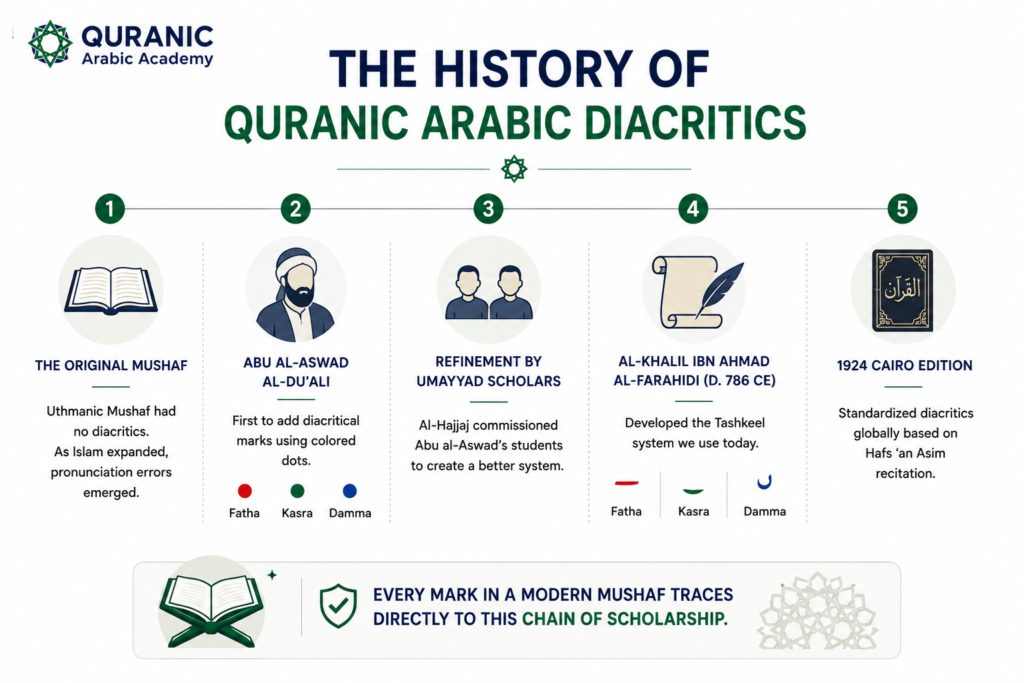
The first person to introduce diacritical marks was Abu al-Aswad al-Du’ali, a companion and student of Ali ibn Abi Talib (may Allah be pleased with him). His original system used large colored dots placed in different positions around letters to indicate vowel sounds: a dot above the letter indicated a Fatha sound, a dot below indicated a Kasra, and a dot beside the letter indicated a Damma.
The Umayyad governor al-Hajjaj ibn Yusuf al-Thaqafi commissioned two of Abu al-Aswad’s students to develop a more efficient system. The result was the refined Tashkeel framework developed by al-Khalil ibn Ahmad al-Farahidi (d. 786 CE), which replaced colored dots with distinct shapes: a horizontal stroke for Fatha, a stroke below for Kasra, and a small curl resembling a miniature Waw for Damma.
The 1924 Cairo edition, published under the supervision of King Fuad I and based on the Hafs ‘an Asim recitation, standardized these diacritics across printed Mushafs globally. Every mark in a modern Mushaf traces directly to this chain of scholarship.
Many students see these marks without knowing what they represent. The Quranic Arabic for Beginners course at The Quranic Arabic Academy teaches Quranic Arabic diacritics from absolute zero through structured, live one-on-one sessions with certified Arab instructors who correct every mark from the very first lesson.
Read also: Quranic Fruits: Every Fruit Allah Mentions in the Quran
Build your foundation with the right teacher today.
The Three Core Quranic Arabic Diacritics Are the Foundation of All Pronunciation
Every word in the Quran is built on three primary vowel diacritics. These three marks control the basic sound of every Arabic letter in every Quranic word. Understanding them is the entry point to all further diacritical knowledge.
| Diacritic | Arabic Name | Symbol | Position | Sound Produced | Example |
| Fatha | فَتْحَة | ـَ | Above the letter | Short “a” sound | بَ = “ba” |
| Kasra | كَسْرَة | ـِ | Below the letter | Short “i” sound | بِ = “bi” |
| Damma | ضَمَّة | ـُ | Above the letter | Short “u” sound | بُ = “bu” |
In Tajweed, each of these three diacritics requires a specific physical articulation. Fatha requires a vertically open mouth with the tongue in a neutral position. Kasra requires the jaw to lower while the tongue rises toward the palate.
Damma requires the lips to round and push slightly forward. These are not aesthetic preferences. They are the precise mouth movements that produce the vowel sounds exactly as the Quran was revealed.
Each of the three core Quranic Arabic diacritics must also be held for exactly one count in recitation. Extending a Fatha beyond one count produces a long “aa” vowel, which is a different sound entirely and is governed by the rules of Madd. Shortening it produces a rushed, clipped sound that erases the vowel. Both errors are classified in classical Tajweed as mistakes in recitation that must be corrected.
The difference between these three diacritics is never cosmetic. In the Quran, the same set of consonants with different diacritics can produce completely different words with different meanings.
Read also: Early Quranic Manuscripts: History, Scripts, and Oldest Surviving Copies
Sukun and Shadda Are the Two Most Consequential Quranic Arabic Diacritics
Beyond the three vowel diacritics, two further marks complete the core system of Quranic Arabic diacritics. These two marks do not indicate vowel sounds. They indicate the absence of a vowel and the doubling of a consonant respectively.
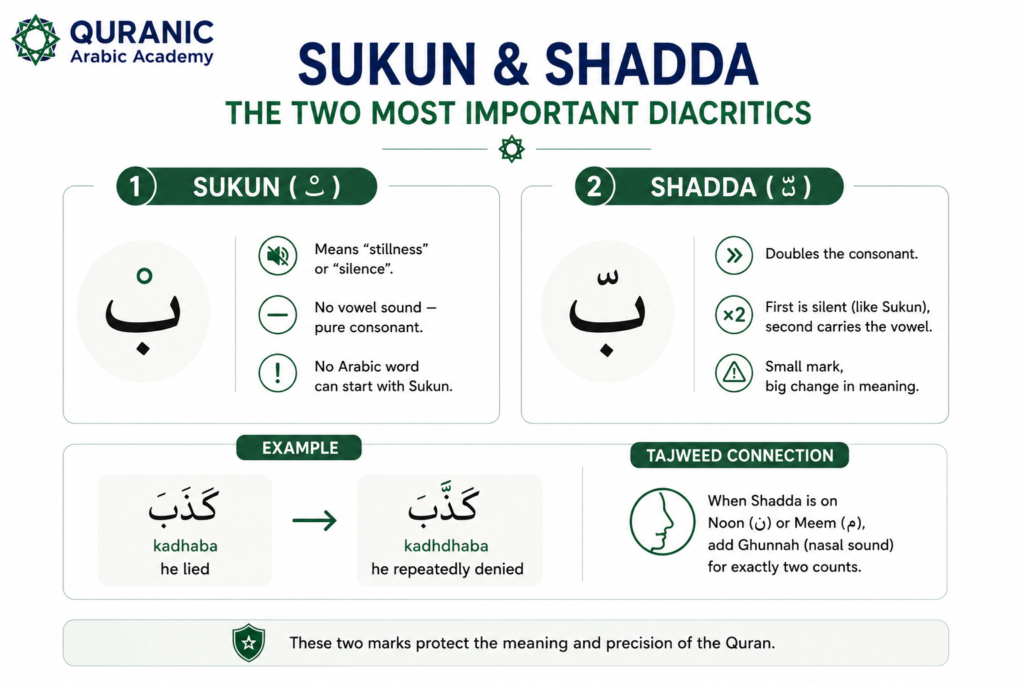
Sukun (ـْ)
The Sukun appears as a small open circle above a letter. Its name comes from the Arabic root meaning “stillness” or “silence,” and its function is precisely that: it signals that the letter beneath it carries no vowel at all.
The letter is pronounced as a pure consonant sound with no following vowel. No Arabic word can begin with a Sukun, because the consonant must be voiced before it can be silenced.
Shadda (ـّ)
The Shadda appears as a small shape resembling the letter Waw above a letter. It is the only Quranic Arabic diacritic that doubles a consonant rather than indicating a vowel sound. When a letter carries a Shadda, it is pronounced twice in a single continuous articulation: the first occurrence is silent (as if it carried a Sukun), and the second carries the accompanying vowel diacritic.
The Shadda is the most commonly missed diacritic in beginner recitation. Its consequence in the Quran is serious. The word كَذَبَ (kadhaba) means “he lied.” Add a Shadda to the middle letter and it becomes كَذَّبَ (kadhdhaba), meaning “he repeatedly denied.” The same consonants, the same vowels, but a Shadda changes the action entirely.
Classical Tajweed teachers identify this as one of the most frequent errors across all nationalities and age groups learning Quranic Arabic diacritics.
The Shadda also carries a specific Tajweed rule when it falls on the letters Noon (ن) or Meem (م): the reciter must add a nasal resonance called Ghunnah, held for exactly two counts. This intersection between diacritics and Tajweed rules is one reason why learning Quranic Arabic diacritics cannot be separated from learning Tajweed as a whole.
See It in Action:
Wondering what our interactive sessions look like? Click below to peek inside a live session and watch how our expert instructors make learning Quranic Arabic accessible and engaging.
Ready to Begin Your Quranic Journey?
Start learning with professional instructors through our structured curriculum.
Book Your Free TrialTanween Adds a Final Nasal Sound and Carries Grammatical Information
The three forms of Tanween are each produced by doubling one of the three core vowel diacritics. They appear exclusively on the final letter of a word and add a soft nasal “n” sound that is heard but not written as a separate letter.
The following table covers the complete Tanween system in Quranic Arabic diacritics:
| Type | Symbol | Sound | Grammatical Function | Example |
| Tanween Fatha (Fathatain) | ـً | “-an” | Accusative case (indefinite noun) | كِتَابًا = “a book” (as object) |
| Tanween Kasra (Kasratain) | ـٍ | “-in” | Genitive case (after prepositions) | بِكِتَابٍ = “with a book” |
| Tanween Damma (Dammatain) | ـٌ | “-un” | Nominative case (subject of sentence) | كِتَابٌ = “a book” (as subject) |
Tanween appears only on indefinite nouns. A definite noun, one beginning with the article “ال,” never carries Tanween. This grammatical precision is built into the diacritical system itself, making Tanween both a pronunciation guide and a grammatical marker simultaneously.
In Tajweed, the “n” sound that Tanween produces is governed by the same rules as the Noon Sakinah: depending on the letter that follows in recitation, this nasal sound may be fully pronounced, merged into the next letter, converted to another sound, or silenced entirely. Tanween therefore connects directly to four of the most important rules in classical Tajweed.
Mastering these diacritics requires reciting under a qualified teacher who can identify every error in real time. The Quranic Arabic Grammar Course at The Quranic Arabic Academy combines systematic Quranic Arabic diacritics instruction with live Makharij correction in every session.
Recite every diacritic with precision from your very next lesson.
Read also: Quranic Tarbiyah: The Complete Practical Guide for Parents and Learners
Special Quranic Arabic Diacritics Appear Only in the Mushaf
Beyond the eight primary diacritics, the Mushaf contains three additional marks that are specific to Quranic Arabic and do not appear in ordinary Arabic writing. These marks reflect the unique precision of the Quranic text and its preserved oral tradition.
Maddah (ـٓ)
The Maddah appears as a tilde-like wave above an Alif. It indicates a glottal stop followed by a long “aa” vowel and appears specifically in words like “القُرْآن” (Al-Quran). This is one of the most recognizable marks in the Mushaf and one of the first special diacritics students encounter.
Dagger Alif (ـٰ)
The Dagger Alif is a small vertical stroke written above certain letters. It represents a long “aa” vowel that is not written as a full Alif in the Uthmanic script of the Mushaf. This mark appears frequently in core Quranic words including “الرَّحْمَٰن” (Al-Rahman) and “هَٰذَا” (Hatha). Students who do not know this mark often undervalue the length of the vowel, shortening a sound that must be elongated.
Standing Kasra and Inverted Damma
These are visual variants of the standard Kasra and Damma that indicate long vowels. The Standing Kasra extends to a long “ee” sound, and the Inverted Damma extends to a long “oo” sound. Both appear in specific Quranic words to preserve the oral tradition that was transmitted from the Prophet (PBUH) through the chain of reciters.
A Single Diacritic Can Change the Entire Meaning of a Quranic Word
The most important practical lesson in Quranic Arabic diacritics is that these marks are not interchangeable. They are not stylistic. Every mark in the Mushaf is the result of centuries of scholarly consensus on exact pronunciation.
Changing or missing a single diacritic in recitation is classified in classical Tajweed as a major error (Lahn Jali) when it distorts meaning, and as a minor error (Lahn Khafi) when it disrupts the rules of recitation without changing meaning. The following examples from Quranic vocabulary demonstrate how diacritics determine meaning:
| Word with Diacritics | Pronunciation | Meaning |
| عَلِمَ | alima | He knew |
| عُلِمَ | ulima | He was made known (passive) |
| عَلَّمَ | allama | He taught (with Shadda on Lam) |
| كَذَبَ | kadhaba | He lied |
| كَذَّبَ | kadhdhaba | He repeatedly denied (with Shadda) |
These are not rare edge cases. They are everyday Quranic vocabulary that appear across multiple Surahs. A student who recites without mastering Quranic Arabic diacritics is not simply mispronouncing. They are potentially reciting a completely different word from the one Allah revealed.
The Quran is the only Arabic text in widespread use that maintains full Tashkeel on every word across its entire length. This completeness is a deliberate preservation of the oral tradition that no other Arabic text matches.
Read also: How to Use a Quranic Arabic Dictionary: A Comprehensive Guide
Quranic Arabic Diacritics Connect Directly to Four Core Tajweed Rules
Quranic Arabic diacritics are not a separate subject from Tajweed. They are its foundation. Four of the most essential Tajweed rules operate entirely through diacritics:
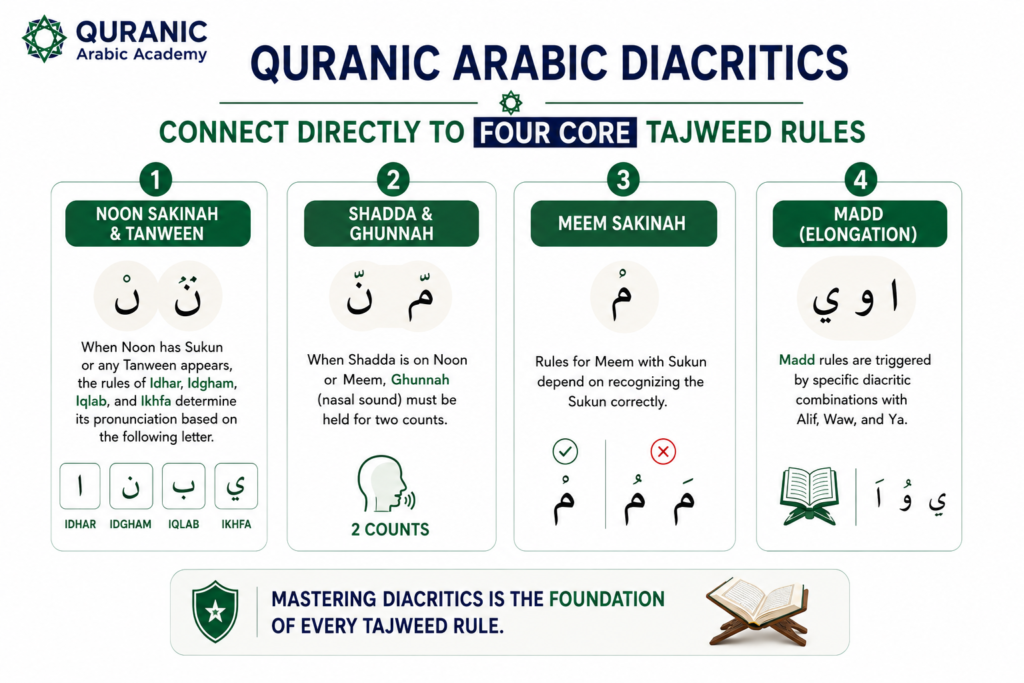
Noon Sakinah and Tanween
When a Noon carries a Sukun, or when any Tanween appears, the rules of Idhar, Idgham, Iqlab, and Ikhfa determine how the nasal sound is pronounced depending on the following letter. None of these rules can be applied without first identifying the Sukun or Tanween diacritics correctly.
Shadda and Ghunnah
When Shadda falls on Noon or Meem, the reciter must produce Ghunnah for two counts. This rule is one of the most frequently corrected in live Tajweed instruction and depends entirely on correctly identifying the Shadda mark.
Meem Sakinah
The rules governing a Meem that carries a Sukun depend on recognizing the Sukun precisely. Confusing a Sukun with a Damma or Fatha on a Meem eliminates the entire rule structure that follows.
Madd (Elongation)
The rules of Madd, which govern when and how long vowels are extended, are triggered by specific combinations of core diacritics and the long vowel letters Alif, Waw, and Ya. Without accurate diacritic recognition, no Madd rule can be applied correctly.
Mastering Quranic Arabic diacritics is therefore not a beginner-only task. It is the foundation that every advanced Tajweed rule is built upon.
Correct recitation of the Quran as a complete act of worship requires both diacritics and Tajweed mastered together. The Arabic Courses for Understanding the Quran at The Quranic Arabic Academy teaches both in one structured program through certified Arab instructors, one-on-one live sessions, and real-time correction of every error.
Master every mark in the Mushaf with the right teacher.
Experience Our Teaching Style:
We believe in clarity and engagement. Watch these short highlights from our actual classes to see our teachers’ methodology and student interactions in real-time.
Ready to Begin Your Quranic Journey?
Start learning with professional instructors through our structured curriculum.
Book Your Free TrialStart Learning Quranic Arabic Diacritics With Certified Instruction
Every mark in the Mushaf has a purpose. Every Fatha, every Sukun, every Shadda is the result of centuries of scholarship aimed at preserving exactly what was revealed to the Prophet (PBUH).
The Quran Reading Academy provides certified Arab tutors holding Ijazah in recitation, real-time Makharij correction in every session, one-on-one live classes tailored to each student’s exact level, and flexible scheduling across all global time zones.
Whether you are reading the Quran for the first time or correcting years of accumulated errors, a structured curriculum and a qualified teacher make the difference between approximate recitation and precise recitation.
Our Arabic Courses
- Quranic Arabic Classes
- Quranic Arabic Course for Beginners
- Online Quranic Arabic Courses for Advanced Learners
- Quranic Arabic Grammar Course
- Arabic Courses for Understanding the Quran
- Quranic Arabic Course for Sisters (Female)
- Quranic Arabic Course for Kids
- Online Quranic Arabic Classes for Adults
- Quranic Arabic Course UK
- Quranic Arabic Course London
- Quranic Arabic Course USA
- Quranic Arabic Course Canada
- Quranic Arabic Course Australia
- Quranic Arabic Course UAE
- Quranic Arabic Course Germany
Start your journey with a free trial today
Ready to Begin Your Quranic Journey?
Start learning with professional instructors through our structured curriculum.
Book Your Free TrialConclusion
Quranic Arabic diacritics are a key part of preserving the Quran’s precise pronunciation. The system developed through the work of scholars such as Abu al-Aswad al-Du’ali and al-Khalil ibn Ahmad al-Farahidi helped preserve the written representation of the Quran’s oral tradition across generations.
Mastering Fatha, Kasra, Damma, Sukun, Shadda, and Tanween is a foundation for accurate recitation, not an advanced Tajweed skill. Learning these marks in context with qualified guidance helps ensure precise Quran reading.
Frequently Asked Questions
What are Quranic Arabic diacritics?
Quranic Arabic diacritics are small marks placed above and below Arabic letters in the Mushaf to indicate exact vowel sounds, consonant doubling, and the absence of vowels, ensuring precise pronunciation of every word Allah revealed.
What is the difference between Harakat and Tashkeel?
Harakat refers specifically to the three short vowel marks: Fatha, Kasra, and Damma. Tashkeel is the broader system that includes all diacritics: Harakat, Sukun, Shadda, Tanween, Maddah, and the Dagger Alif.
Who developed the Quranic Arabic diacritics system?
Abu al-Aswad al-Du’ali introduced the first system using colored dots. Al-Khalil ibn Ahmad al-Farahidi (d. 786 CE) refined it into the distinct shapes used universally today in all printed Mushafs.
Why does the Quran have full diacritics when other Arabic texts do not?
The Quran requires full diacritics because mispronouncing a single vowel or consonant can alter the meaning of a word. Correct Quranic recitation is a religious obligation, making precision a requirement rather than a preference.
What happens if a Shadda is missed during recitation?
Missing a Shadda in Quranic recitation can change the word’s meaning entirely. For example, كَذَبَ (he lied) becomes كَذَّبَ (he repeatedly denied) with a Shadda. Classical Tajweed classifies this as a major error when it distorts meaning.
How do Quranic Arabic diacritics connect to Tajweed rules?
Diacritics are the foundation of Tajweed. The Sukun triggers Noon Sakinah rules. The Shadda on Noon or Meem requires Ghunnah. The Tanween governs four pronunciation rules. No Tajweed rule can be applied correctly without first mastering the diacritical system.
Related Articles
Quranic Grammar






Leave a Reply