 Quranic Verses
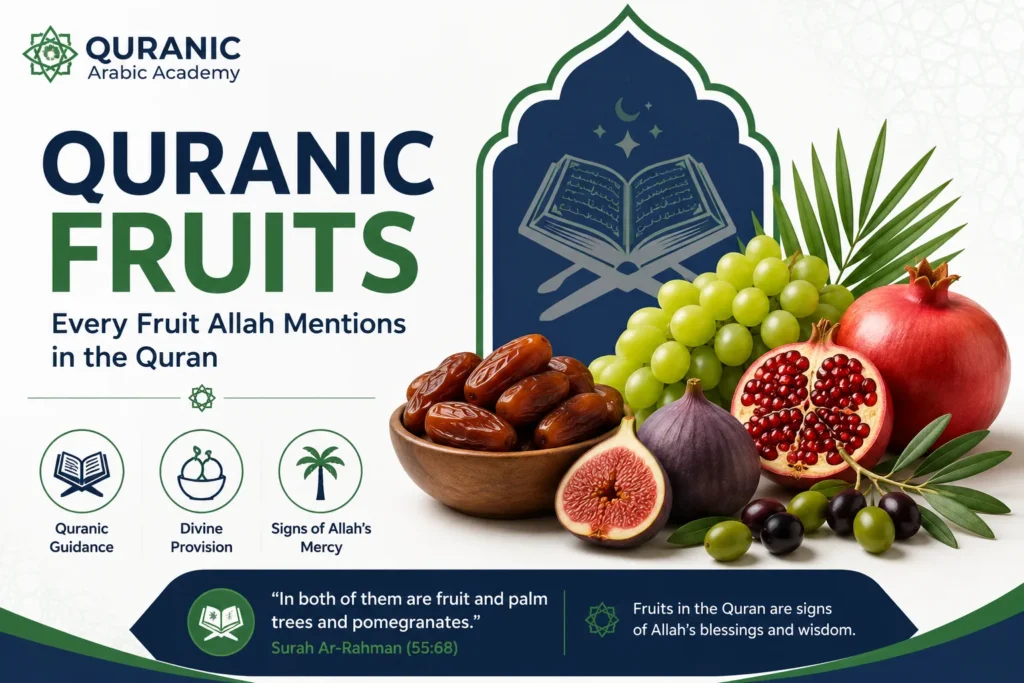
The Quran names specific fruits with deliberate precision. Each one appears not merely as a detail of diet, but as a sign — pointing to divine provision, the reality of Jannah, and the power of Allah over creation. Non-Arab Muslim learners often encounter these fruits in recitation without knowing their Arabic names or the full weight of the verses in which they appear.
This guide covers every Quranic fruit with its Arabic name, its Quranic verses, and its significance in Islam — drawn exclusively from the Quranic text and authenticated narrations.
1- Dates Are the Most Frequently Mentioned Quranic Fruit
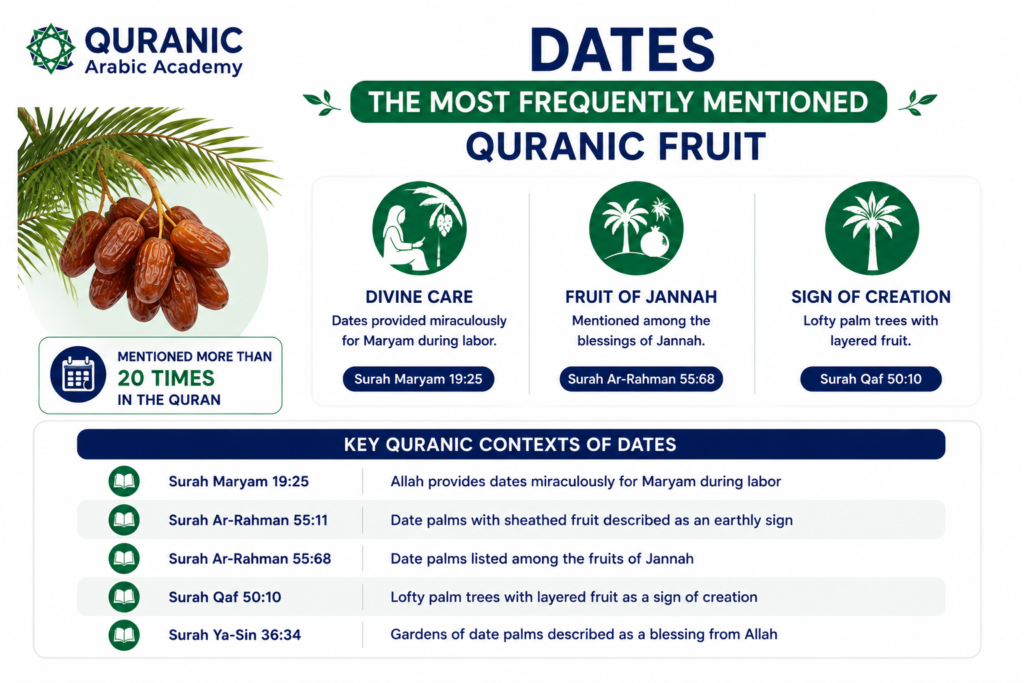
Dates — At-Tamr (التَّمْر) in Arabic — appear more than twenty times in the Quran, making them the most prominent Quranic fruit by frequency. Allah mentions the date palm as a worldly provision, a miraculous gift, and a fruit of Jannah, giving it a standing no other Quranic fruit matches.
The most striking mention connects dates to direct divine care. When Maryam (peace be upon her) was alone and in labor, Allah instructed her:
“وَهُزِّي إِلَيْكِ بِجِذْعِ النَّخْلَةِ تُسَاقِطْ عَلَيْكِ رُطَبًا جَنِيًّا ﴿٢٥﴾”
Wa huzzī ilayki bijidhi n-nakhlati tusāqiṭ ‘alayki ruṭaban janiyyā
“And shake toward you the trunk of the palm tree; it will drop upon you ripe, fresh dates. (25).”
Dates also appear directly among the fruits of Jannah alongside pomegranates:
“فِيهِمَا فَاكِهَةٌ وَنَخْلٌ وَرُمَّانٌ ﴿٦٨﴾”
Fīhimā fākihatun wa nakhlun wa rummān
“In both of them are fruit and palm trees and pomegranates. (68).”
The date palm also appears in the description of Allah’s power over creation:
“وَالنَّخْلَ بَاسِقَاتٍ لَّهَا طَلْعٌ نَّضِيدٌ ﴿١٠﴾ “
Wa n-nakhla bāsiqātin lahā ṭal’un naḍīd
“And lofty palm trees having fruit arranged in layers – (10).”
Read also: Early Quranic Manuscripts: History, Scripts, and Oldest Surviving Copies
The following table summarizes the key Quranic contexts in which dates appear:
| Verse | Context |
| Surah Maryam 19:25 | Allah provides dates miraculously for Maryam during labor |
| Surah Ar-Rahman 55:11 | Date palms with sheathed fruit described as an earthly sign |
| Surah Ar-Rahman 55:68 | Date palms listed among the fruits of Jannah |
| Surah Qaf 50:10 | Lofty palm trees with layered fruit as a sign of creation |
| Surah Ya-Sin 36:34 | Gardens of date palms described as a blessing from Allah |
The Best Quranic Arabic Classes at The Quranic Arabic Academy teach non-Arab learners to read verses like these directly in Arabic, building the vocabulary and grammar needed to understand the Quran’s descriptions of provision and Jannah without relying on translation alone.
Start Your Quranic Arabic Journey Today
2- Olives Are Described in the Quran as a Blessed and Sacred Tree
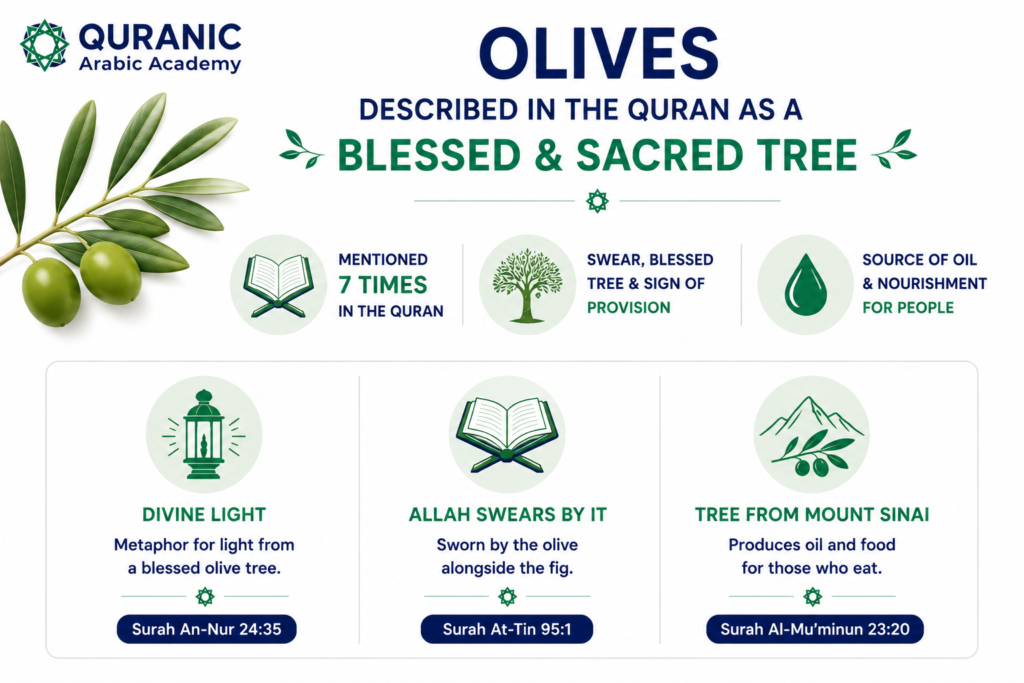
Olives — Az-Zaytun (الزَّيْتُون) in Arabic — appear seven times in the Quran. Allah swears by the olive in Surah At-Tin, describes it as a blessed tree in Surah An-Nur, and lists it alongside dates and grapes as a sign of His provision across multiple verses.
The most theologically significant mention uses the olive as a metaphor for divine light:
“يُوقَدُ مِن شَجَرَةٍ مُّبَارَكَةٍ زَيْتُونَةٍ لَّا شَرْقِيَّةٍ وَلَا غَرْبِيَّةٍ”
Yūqadu min shajaratin mubārakatin zaytūnatin lā sharqiyyatin wa lā gharbiyyah
“lit from [the oil of] a blessed olive tree, neither of the east nor of the west.”
Allah also swears by the olive directly at the opening of Surah At-Tin, alongside the fig:
“وَالتِّينِ وَالزَّيْتُونِ ﴿١﴾”
Wa t-tīni wa z-zaytūn
“By the fig and the olive (1).”
When Allah swears by something in the Quran, it signals the exceptional standing of that thing in creation. The olive is also mentioned as a tree that grows oil and serves as nourishment for those who eat:
“وَشَجَرَةً تَخْرُجُ مِن طُورِ سَيْنَاءَ تَنبُتُ بِالدُّهْنِ وَصِبْغٍ لِّلْآكِلِينَ ﴿٢٠﴾”
Wa shajaratan takhruju min ṭūri saynā’a tanbutu bi d-duhni wa ṣibghin lil-ākilīn
“And [We brought forth] a tree issuing from Mount Sinai which produces oil and food for those who eat. (20).”
Read also: Quranic Tarbiyah: The Complete Practical Guide for Parents and Learners
See It in Action:
Wondering what our interactive sessions look like? Click below to peek inside a live session and watch how our expert instructors make learning Quranic Arabic accessible and engaging. .
Ready to Begin Your Quranic Journey?
Start learning with professional instructors through our structured curriculum.
Book Your Free Trial3- Grapes Are Mentioned Eleven Times as a Sign of Divine Generosity
Grapes — Al-Inab (الْعِنَب) in Arabic — are referenced eleven times in the Quran, consistently appearing alongside dates and other fruits as evidence of Allah’s generosity toward humanity. Though alcohol is forbidden in Islam, the grape itself is never condemned — it is described throughout the Quran as a blessing and a provision.
Allah says:
“وَجَعَلْنَا فِيهَا جَنَّاتٍ مِّن نَّخِيلٍ وَأَعْنَابٍ وَفَجَّرْنَا فِيهَا مِنَ الْعُيُونِ ﴿٣٤﴾ “
Wa ja’alnā fīhā jannātin min nakhīlin wa a’nābin wa fajjarnā fīhā mina l-‘uyūn
“And We placed therein gardens of palm trees and grapevines and caused to burst forth therefrom some springs – (34).”
Grapes also appear among the blessings of Jannah for the righteous:
“إِنَّ لِلْمُتَّقِينَ مَفَازًا ﴿٣١﴾ حَدَائِقَ وَأَعْنَابًا ﴿٣٢﴾”
Inna lil-muttaqīna mafāzan ḥadā’iqa wa a’nābā
“Indeed, for the righteous is attainment – (31) Gardens and grapevines (32).”
Allah also uses grapes alongside other Quranic fruits to call humanity toward reflection:
“فَأَنبَتْنَا فِيهَا حَبًّا ﴿٢٧﴾ وَعِنَبًا وَقَضْبًا ﴿٢٨﴾ وَزَيْتُونًا وَنَخْلًا ﴿٢٩﴾”
Fa-anbatnā fīhā ḥabban wa ‘inaban wa qaḍban wa zaytūnan wa nakhlā
“And caused to grow within it grain (27) And grapes and herbage (28) And olive and palm trees (29).”
The Arabic Courses for Understanding the Quran at The Quranic Arabic Academy connect learners directly to the Arabic vocabulary of verses like these, building a working understanding of the language that makes Quranic recitation meaningful rather than purely phonetic.
Read also: Quranic Revelation: The Complete 3 Stages and 23-Year Timeline

Join the Program and Begin Today
4- Pomegranates Are Singled Out Among the Fruits of Jannah
Pomegranates — Ar-Rumman (الرُّمَّان) in Arabic — appear three times in the Quran, each time in a context of divine provision or the blessings of Jannah. Scholars have noted that the date palm and pomegranate are singled out for mention in the description of Jannah precisely because of their superiority over other fruits.
The pomegranate appears in Surah Al-An’am as part of a comprehensive description of Allah’s creation:
“وَهُوَ الَّذِي أَنزَلَ مِنَ السَّمَاءِ مَاءً فَأَخْرَجْنَا بِهِ نَبَاتَ كُلِّ شَيْءٍ”
Wa huwa alladhī anzala mina s-samā’i mā’an fa-akhrajnā bihi nabāta kulli shay’
“And it is He who sends down rain from the sky, and We produce thereby the growth of all things.”
Pomegranates also appear alongside dates in Surah Ar-Rahman in the description of Jannah, as covered in section one of this article. The Prophet ﷺ described the pomegranate’s connection to Jannah in a narration reported by Anas ibn Malik:
“مَا مِنْ رُمَّانَةٍ إِلَّا وَفِيهَا حَبَّةٌ مِنْ رُمَّانِ الْجَنَّةِ”
“There is not a pomegranate which does not have a seed from one of the pomegranates of Jannah in it.”
Reported by Anas ibn Malik — cited in classical Islamic sources on Quranic fruits.
5- Figs Are the Only Quranic Fruit by Which Allah Swears Directly
Figs — At-Tin (التِّين) in Arabic — receive the most concentrated honor of any Quranic fruit. Allah opens an entire Surah with an oath by the fig and names that chapter after it. No other Quranic fruit has an entire Surah of the Quran named after it.
“وَالتِّينِ وَالزَّيْتُونِ ﴿١﴾ وَطُورِ سِينِينَ ﴿٢﴾ وَهَٰذَا الْبَلَدِ الْأَمِينِ ﴿٣﴾”
Wa t-tīni wa z-zaytūni wa ṭūri sīnīna wa hādhā l-baladi l-amīn
“By the fig and the olive (1) And [by] Mount Sinai (2) And [by] this secure city [Makkah], (3).”
When Allah swears by something in the Quran, it signals its exceptional importance in creation. The fig shares this distinction with the olive — the only two Quranic fruits that appear in a direct Quranic oath.
The Prophet ﷺ is reported to have said of the fig: “If I had to mention a fruit that descended from Jannah, I would say it is this, because the fruits of Jannah have no pits.” This narration is reported in classical Islamic sources on Prophetic medicine.
The Quranic Arabic Course for Sisters at The Quranic Arabic Academy is designed for non-Arab women who want to read and understand these verses in their original Arabic, with certified female instructors delivering one-on-one sessions structured around each student’s level and schedule.

Book Your Free Trial Session Now
6- Bananas Are Described as a Fruit Reserved for the People of Jannah
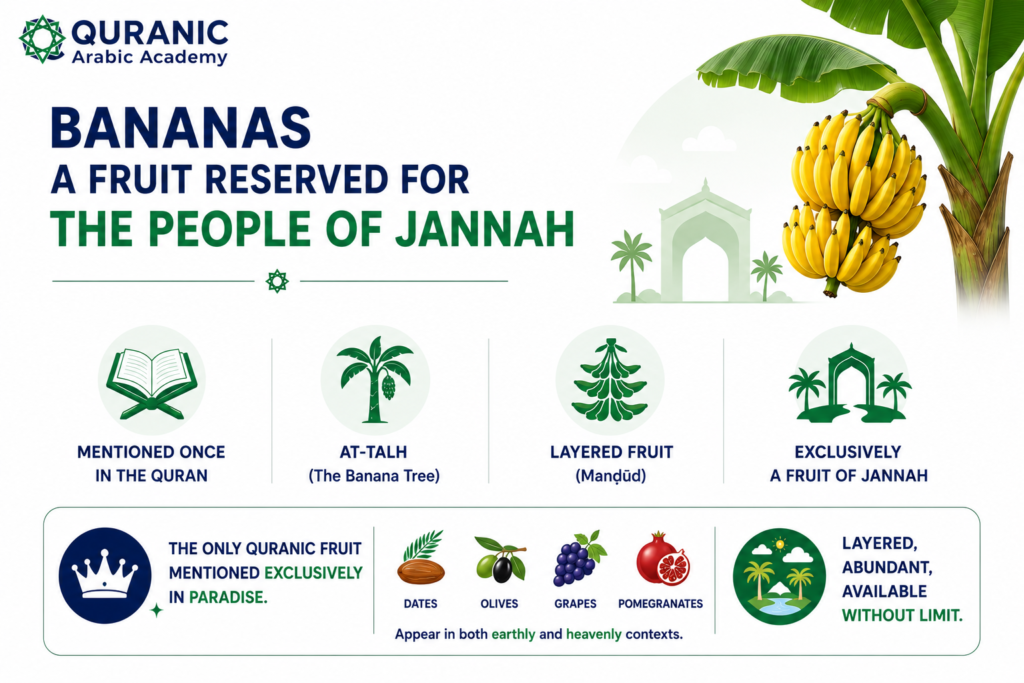
Bananas — referred to as At-Talh (الطَّلْح) in Arabic — appear once in the Quran, in a description of the blessings that await the People of the Right (Ashaab al-Yameen) in Jannah. Classical commentators identify At-Talh as the banana tree, recognized by its layered fruit arrangement.
It is important to clarify for non-Arab learners that At-Talh does not mean banana in modern everyday Arabic. It is the classical Quranic term for a tree identified by the majority of classical commentators as bearing fruit in layers — consistent with the banana plant.
This has been the majority position among scholars of Quranic exegesis when interpreting this verse.
“فِي سِدْرٍ مَّخْضُودٍ ﴿٢٨﴾ وَطَلْحٍ مَّنضُودٍ ﴿٢٩﴾ وَظِلٍّ مَّمْدُودٍ ﴿٣٠﴾ وَمَاءٍ مَّسْكُوبٍ ﴿٣١﴾ وَفَاكِهَةٍ كَثِيرَةٍ ﴿٣٢﴾”
Fī sidrin makhḍūdin wa ṭalḥin manḍūdin wa ẓillin mamdūdin wa mā’in maskūbin wa fākihatin kathīrah
“[They will be] among lote trees with thorns removed (28) And [banana] trees layered [with fruit] (29) And shade extended (30) And water poured out (31) And fruit, abundant [and varied], (32)”
The banana is the only Quranic fruit whose mention is exclusively paradisiacal. Unlike dates, olives, grapes, and pomegranates — which appear in both earthly and heavenly contexts — the banana appears in the Quran solely as a fruit of Jannah, described as layered, abundant, and available without limitation or season.
7- All Quranic Fruits Together Form a Complete Picture of Divine Provision
The six Quranic fruits are not mentioned in isolation. In Surah An-Nahl, Allah brings several of them together in a single verse that calls humanity toward reflection:
“يُنبِتُ لَكُم بِهِ الزَّرْعَ وَالزَّيْتُونَ وَالنَّخِيلَ وَالْأَعْنَابَ وَمِن كُلِّ الثَّمَرَاتِ”
Yunbitu lakum bihi z-zar’a wa z-zaytūna wa n-nakhīla wa l-a’nāba wa min kulli th-thamarāt
“He causes to grow for you thereby the crops, olives, palm trees, grapevines, and from all the fruits.”
This verse ends with “and every kind of fruit” — meaning the six named fruits are the most prominent representatives of divine provision, not its limit. The following table presents all six Quranic fruits side by side:
| Fruit | Arabic Name | Times Referenced | Appears in Jannah |
| Dates | التَّمْر (At-Tamr) | 20+ times | Yes — Surah Ar-Rahman 55:68 |
| Olives | الزَّيْتُون (Az-Zaytun) | 7 times | Not explicitly |
| Grapes | الْعِنَب (Al-Inab) | 11 times | Yes — Surah An-Naba 78:32 |
| Pomegranates | الرُّمَّان (Ar-Rumman) | 3 times | Yes — Surah Ar-Rahman 55:68 |
| Figs | التِّين (At-Tin) | 1 time | Not explicitly |
| Bananas | الطَّلْح (At-Talh) | 1 time | Yes — Surah Al-Waqi’ah 56:29 |
The Quranic Arabic Grammar Course at The Quranic Arabic Academy is built for non-Arab learners who want to move beyond translation and develop a direct grammatical and lexical relationship with the Arabic text of the Quran, understanding exactly why Allah chose each word He used.

Get Started with a Free Trial.
Experience Our Teaching Style:
We believe in clarity and engagement. Watch these short highlights from our actual classes to see our teachers’ methodology and student interactions in real-time.
Ready to Begin Your Quranic Journey?
Start learning with professional instructors through our structured curriculum.
Book Your Free TrialBegin Your Journey with The Quranic Arabic Academy
Every fruit Allah names in the Quran is a doorway into the Arabic text. Reading “At-Tamr” and understanding its grammatical role in a verse is a different experience from reading “dates” in translation.
The Quranic Arabic Academy gives non-Arab Muslim learners worldwide the tools to engage with the Quran in its original language — through one-on-one live sessions with certified Arab tutors, structured from the ground up for non-native speakers.
Every program at The Quranic Arabic Academy includes:
- Certified Arab tutors holding Ijazah in recitation or degrees in Islamic studies from recognized institutions.
- One-on-one live sessions tailored specifically to each student’s individual level and goals.
- Real-time Makharij correction using audio-visual feedback during every session.
- Tafseer-integrated learning — Nahw and Sarf taught through actual ayat analysis.
- Flexible scheduling covering all global time zones, including EST, PST, GMT, CET, IST, GST, and MYT.
- Affordable pricing with transparent packages and family enrollment discounts.
- Monthly progress reports and written feedback provided after every session.
- Serves students across North America, Europe, Asia, and the Middle East.
Our Arabic Courses
- Quranic Arabic Classes
- Quranic Arabic Course for Beginners
- Online Quranic Arabic Courses for Advanced Learners
- Quranic Arabic Grammar Course
- Arabic Courses for Understanding the Quran
- Quranic Arabic Course for Sisters (Female)
- Quranic Arabic Course for Kids
- Online Quranic Arabic Classes for Adults
- Quranic Arabic Course UK
- Quranic Arabic Course London
- Quranic Arabic Course USA
- Quranic Arabic Course Canada
- Quranic Arabic Course Australia
- Quranic Arabic Course UAE
- Quranic Arabic Course Germany
Book Your Free Trial and Start Today
Conclusion
Quranic fruits number six named explicitly: dates, olives, grapes, pomegranates, figs, and bananas. Each appears as a deliberate divine sign pointing to Allah’s provision in this world and the reality of Jannah. Fruits mentioned in Quran in Arabic carry names and grammatical structures that deepen in meaning the more a reader engages with the Arabic text directly.
Fruits of Jannah in the Quran are specific and named — dates and pomegranates in Surah Ar-Rahman, grapes in Surah An-Naba, and bananas in Surah Al-Waqi’ah. How many fruits are mentioned in the Quran? Six by name, and every kind of fruit by the phrase Allah uses in Surah An-Nahl. Fruits of heaven in Islam are both a description of the reward awaiting the believers and a reminder that every fruit of this world is itself a sign pointing toward that eternal reward.
FAQ
How many fruits are mentioned in the Quran by name?
Six fruits are named explicitly: dates, olives, grapes, pomegranates, figs, and bananas. Additional verses reference all fruits generally as signs of Allah’s provision and creative power.
Which Quranic fruit has an entire Surah named after it?
The fig (At-Tin) has an entire Surah named after it — Surah At-Tin — making it the only Quranic fruit with this distinction in the entire Quran.
Which fruits of Jannah in the Quran are mentioned by name?
Dates, grapes, pomegranates, and bananas are all explicitly mentioned as fruits of Jannah. The banana is the only one mentioned exclusively in a paradisiacal context with no earthly reference.
What does At-Talh mean and why is it identified as banana?
At-Talh is a classical Quranic term for a tree identified by the majority of classical commentators as bearing layered fruit, consistent with the banana plant. It does not mean banana in modern Arabic but refers to this tree in the Quranic context of Surah Al-Waqi’ah.
Why does Allah swear by fruits in the Quran?
Allah swears by the fig and the olive in Surah At-Tin to signal their exceptional significance in creation. In Quranic usage, an oath by Allah elevates what He swears by above other things in its category — giving the fig and olive a distinction no other Quranic fruits share.
Related Articles
Quranic Verses






Leave a Reply