 Quran
Quran

Many Muslims know the Quran as a book of worship, but its Quranic principles also guide decisions in daily life. They address speech, leadership, responsibilities, trust in Allah, family, trade, and governance. These principles were practiced by the Companions in real-life situations, not treated as abstract theories. This article presents eight foundational Quranic principles, connects each to authentic Quranic verses, and explains how they can be applied today.
1. Tawheed Is the Root From Which Every Quranic Principle Grows
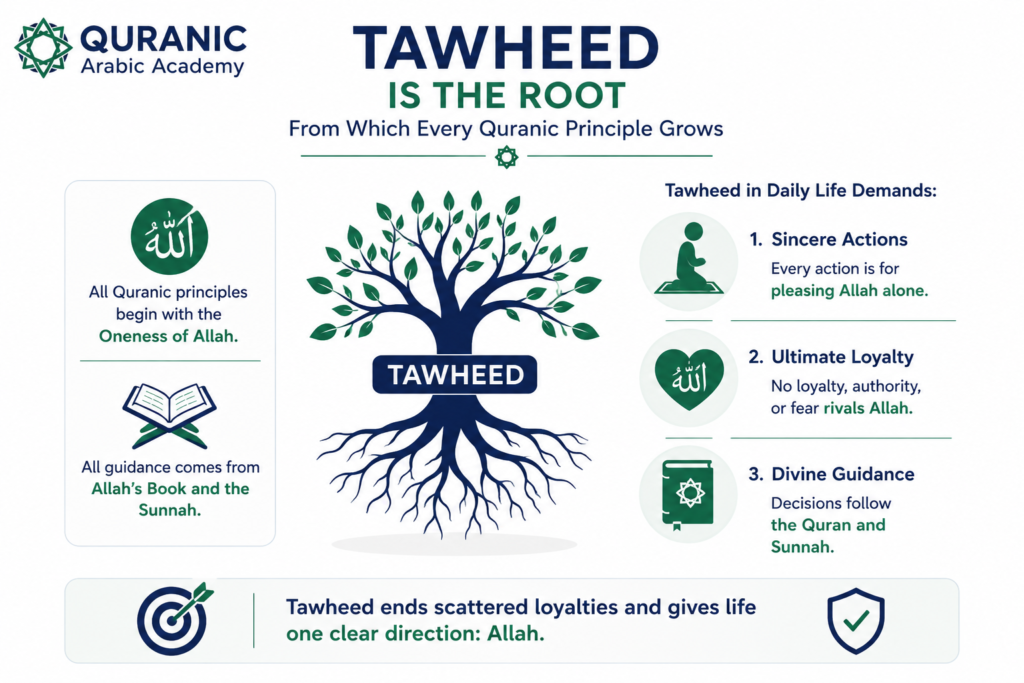
Every Quranic principle begins at the same point: the absolute oneness of Allah. Tawheed is not one principle among many. It is the foundation beneath all of them. Ibn Kathir and al-Tabari, in their respective works of Tafsir, established that all moral coherence flows from Tawheed.
When a person’s conviction in the oneness of Allah is sound, their ethical priorities align naturally. When it is weak, every other principle becomes unstable. Allah declares this with total precision:
“قُلْ هُوَ اللَّهُ أَحَدٌ ﴿١﴾ اللَّهُ الصَّمَدُ ﴿٢﴾”
Qul huwa Allahu ahad. Allahu al-samad.
“Say, “He is Allah, [who is] One, (1) Allah, the Eternal Refuge. (2).”
The Quranic principle of Tawheed demands three things in practical daily life:
- That every action, from Salah to trade to parenting, is oriented toward pleasing Allah alone.
- That no loyalty, no authority, and no fear rivals the loyalty, authority, and fear owed to Allah.
- That the source of all guidance in decisions, large and small, is Allah’s Book and the Sunnah of His Messenger.
Tawheed resolves what Ibn Kathir called the problem of “scattered loyalties.” When a person serves many masters simultaneously, every decision becomes a conflict. Tawheed makes the direction of life singular and stable. This is the first and most fundamental of all Quranic principles.
Many Muslims recite the words of Tawheed daily but do not know the meanings behind them. The Quranic Arabic for Beginners course at The Quranic Arabic Academy builds the vocabulary and grammatical understanding that transforms recitation into genuine comprehension of Allah’s address.
Read also: Qur’anic Punctuation: The Complete Guide to Waqf Signs and Recitation Rules
Understand what you declare every day.
2. Adl (Justice) Is a Quranic Principle That Allows No Exceptions
The Quran does not present justice as a noble aspiration. It presents it as a binding command. Allah states in a single verse what every generation of scholars has recognized as one of the most comprehensive legal and moral declarations in the Quran:
إِنَّ اللَّهَ يَأْمُرُ بِالْعَدْلِ وَالْإِحْسَانِ وَإِيتَاءِ ذِي الْقُرْبَىٰ وَيَنْهَىٰ عَنِ الْفَحْشَاءِ وَالْمُنكَرِ وَالْبَغْيِ ۚ يَعِظُكُمْ لَعَلَّكُمْ تَذَكَّرُونَ”
Inna Allaha ya’muru bil-‘adli wal-ihsani wa ita’i dhi al-qurba wa yanha ‘anil-fahsha’i wal-munkari wal-baghi.
“Indeed, Allah orders justice and good conduct and giving to relatives and forbids immorality and bad conduct and oppression. He admonishes you that perhaps you will be reminded.”
The scholars of Ahl al-Sunnah noted that this verse combines the command for justice with Ihsan (excellence in conduct), making clear that bare minimum fairness is insufficient. The Quranic principle of Adl demands proactive, consistent justice even when it costs the person giving it.
Allah states the full scope of this Quranic principle without ambiguity in Surah An-Nisa:
“يَا أَيُّهَا الَّذِينَ آمَنُوا كُونُوا قَوَّامِينَ بِالْقِسْطِ شُهَدَاءَ لِلَّهِ وَلَوْ عَلَىٰ أَنفُسِكُمْ أَوِ الْوَالِدَيْنِ وَالْأَقْرَبِينَ”
Ya ayyuha alladhina amanu kunu qawwamina bil-qisti shuhada’a lillahi walaw ‘ala anfusikum aw al-walidayni wal-aqrabin.
“O you who have believed, be persistently standing firm in justice, witnesses for Allah, even if it be against yourselves or parents and relatives.”
The Quranic principle of justice applies across every domain of life:
| Domain | Application of the Quranic Principle of Justice |
| Personal testimony | Bearing witness honestly even when it harms yourself or your family |
| Family | Fair treatment of spouses, children, and relatives without favoritism |
| Leadership | Distributing responsibilities and resources without tribal or personal bias |
| Commerce | Giving full measure, avoiding fraud and concealment in transactions |
| Community | Standing with the oppressed even when the oppressor has social power |
Read also: Quranic Arabic Diacritics: The Complete Guide to Harakat, Tashkeel, and Tajweed
3. Amanah (Trustworthiness) Is the Principle Humanity Alone Accepted
The Quranic principle of Amanah carries a weight unlike any other. Allah described it as a trust so heavy that the heavens, the earth, and the mountains all refused to carry it:
“إِنَّا عَرَضْنَا الْأَمَانَةَ عَلَى السَّمَاوَاتِ وَالْأَرْضِ وَالْجِبَالِ فَأَبَيْنَ أَن يَحْمِلْنَهَا وَأَشْفَقْنَ مِنْهَا وَحَمَلَهَا الْإِنسَانُ”
Inna ‘aradna al-amanata ‘ala al-samawati wal-ardi wal-jibali fa-abayna an yahmilnaha wa ashfaqna minha wa hamalaha al-insan.
“Indeed, we offered the Trust to the heavens and the earth and the mountains, and they declined to bear it and feared it.”
The majority of Muslim scholars, as recorded in Ma’arif al-Quran, understood Amanah in this verse to encompass the entire framework of divine obligations: every command and prohibition, every act of worship, and every moral responsibility a Muslim carries. Al-Ghazali linked this directly to Iman itself, stating that faith cannot be complete without Amanah.
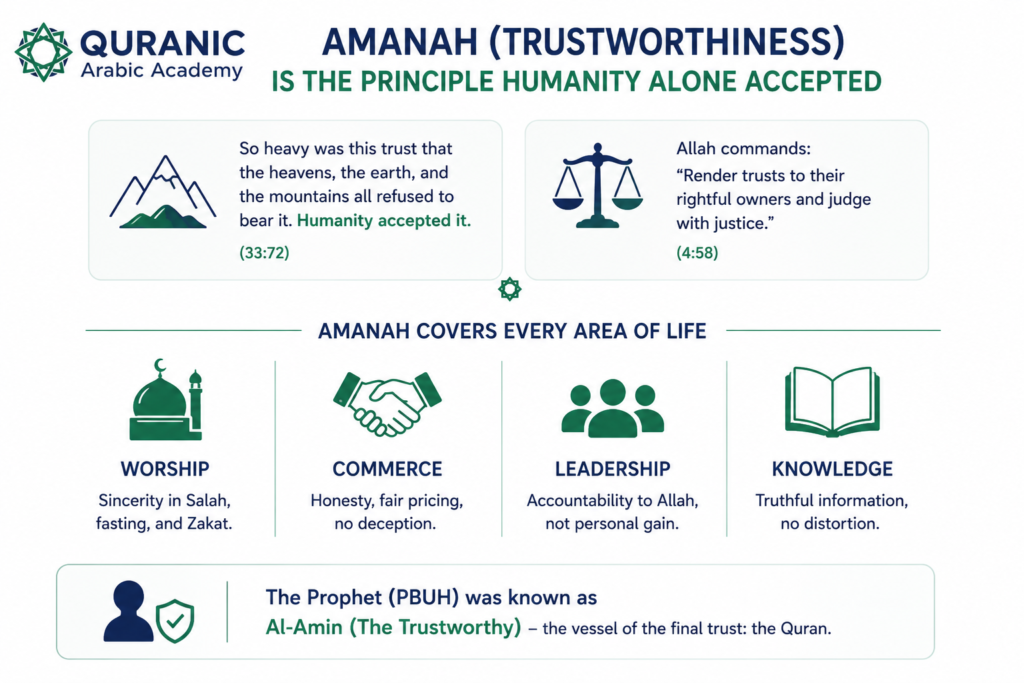
Allah also commands the immediate practical application of this Quranic principle:
” إِنَّ اللَّهَ يَأْمُرُكُمْ أَن تُؤَدُّوا الْأَمَانَاتِ إِلَىٰ أَهْلِهَا وَإِذَا حَكَمْتُم بَيْنَ النَّاسِ أَن تَحْكُمُوا بِالْعَدْلِ ۚ “
Inna Allaha ya’murukum an tu’addu al-amanati ila ahliha wa idha hakamtum bayna al-nasi an tahkumu bil-‘adl.
“Indeed, Allah commands you to render trusts to whom they are due and when you judge between people to judge “
This verse was revealed in the specific context of returning the keys of the Ka’bah. The scholars universalized its application to every trust in every context.
The Quranic principle of Amanah covers every dimension of Muslim life:
- Worship: performing Salah, fasting, and Zakat with sincerity rather than habit or social performance.
- Commerce: delivering what was promised, pricing honestly, and avoiding concealment of defects.
- Leadership: governing with accountability to Allah rather than to personal interest or tribal loyalty.
- Knowledge: conveying information truthfully and refusing to distort facts for convenience.
The Prophet (PBUH) was known throughout Mecca before prophethood by a single title: Al-Amin, the Trustworthy. This was not a coincidence. It was the character that made him the vessel of the final Amanah: the Quran itself.
Teaching the Quran to your children with correct pronunciation is itself an act of Amanah. The Quranic Arabic Course for Kids at The Quranic Arabic Academy provides a structured, one-on-one learning environment with certified Arab instructors who correct every letter from the very first lesson.
Fulfill your Amanah as a parent today.
Read also: Quranic Fruits: Every Fruit Allah Mentions in the Quran
See It in Action:
Wondering what our interactive sessions look like? Click below to peek inside a live session and watch how our expert instructors make learning Quranic Arabic accessible and engaging.
Ready to Begin Your Quranic Journey?
Start learning with professional instructors through our structured curriculum.
Book Your Free Trial4. Rahmah (Mercy) Is a Quranic Principle That Governs Every Interaction
Every chapter of the Quran except one opens with the declaration of two divine names: Al-Rahman and Al-Raheem. This is not a formality. It establishes mercy as the operating context of every Quranic principle that follows. The Prophet (PBUH) said in the hadith recorded in Sahih al-Bukhari:
“إِنَّ اللَّهَ رَفِيقٌ يُحِبُّ الرِّفْقَ فِي الْأَمْرِ كُلِّهِ”
“Allah is Forbearer and loves forbearance in all matters.”
The Quranic principle of Rahmah does not mean the absence of firmness. It means that every correction, every leadership decision, every response to wrongdoing passes through the filter of mercy before it is delivered.
The Prophet (PBUH) himself received this instruction directly after the setback at Uhud:
“فَبِمَا رَحْمَةٍ مِّنَ اللَّهِ لِنتَ لَهُمْ ۖ وَلَوْ كُنتَ فَظًّا غَلِيظَ الْقَلْبِ لَانفَضُّوا مِنْ حَوْلِكَ”
Fabima rahmatin mina Allahi linta lahum. Walaw kunta fadhdhan ghalidha al-qalbi la-anfaddu min hawlik.
So by mercy from Allah, [O Muhammad], you were lenient with them. And if you had been rude [in speech] and harsh in heart, they would have disbanded from about you.”
Ibn Kathir commented on this verse that the Prophet’s mercy toward his companions after a military defeat, a moment when harshness might seem justified, was itself a divine instruction for all leaders and teachers after him. Mercy is not weakness. It is a Quranic principle that preserves communities.
The practical application of Rahmah in daily life includes:
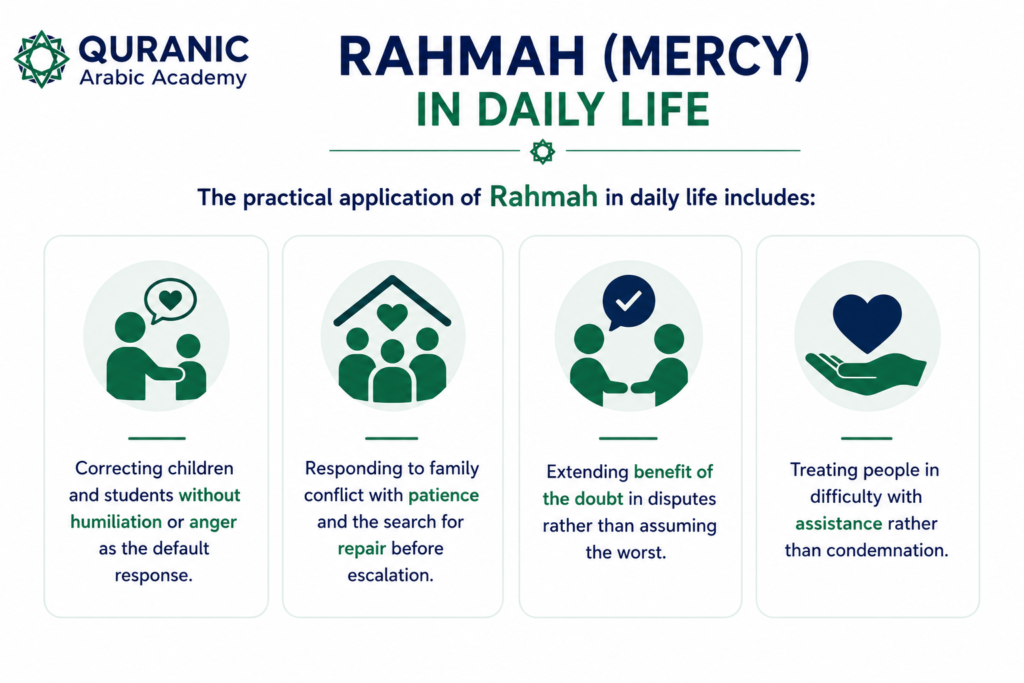
- Correcting children and students without humiliation or anger as the default response.
- Responding to family conflict with patience and the search for repair before escalation.
- Extending benefit of the doubt in disputes rather than assuming the worst.
- Treating people in difficulty with assistance rather than condemnation.
5. Sabr (Patience) Is a Quranic Principle With Three Distinct Forms
The word Sabr appears in the Quran in more than 90 verses. No other character trait receives this level of sustained emphasis in the Quranic principles. The scholars of Ahl al-Sunnah identified three distinct forms that together define the full scope of this principle:
| Form of Sabr | Meaning | Example |
| Patience in obedience | Bearing the effort and cost of worship consistently | Maintaining the five prayers despite fatigue or busy schedules |
| Patience in abstaining from sin | Holding back from what Allah forbade when desire is strong | Refusing dishonest gain when legal alternatives are harder |
| Patience under affliction | Accepting hardship without despair or complaint against Allah | Responding to loss with “Inna lillahi wa inna ilayhi raji’un” |
Allah links Sabr directly to His love and support:
“وَاصْبِرُوا ۚ إِنَّ اللَّهَ مَعَ الصَّابِرِينَ ”
Wasbiru. Inna Allaha ma’a al-sabirin.
“and be patient. Indeed, Allah is with the patient.”
Imam al-Nawawi, in his commentary on Sahih Muslim, described patience in affliction as a form of worship that earns a reward without limit. He connected this directly to the believer’s understanding that every decree of Allah contains wisdom, even when that wisdom is not immediately visible.
The Quranic principle of Sabr is not passive endurance. It is active, conscious, and deliberate holding of the self within the boundaries Allah set, regardless of what the moment demands.
6. Tawakkul (Reliance on Allah) Is a Quranic Principle That Follows Action
One of the most misunderstood Quranic principles is Tawakkul. Many assume it means inaction, leaving everything to Allah without effort. The Quran itself corrects this directly in the same verse that commands Tawakkul:
“فَإِذَا عَزَمْتَ فَتَوَكَّلْ عَلَى اللَّهِ ۚ إِنَّ اللَّهَ يُحِبُّ الْمُتَوَكِّلِينَ ”
Fa-idha ‘azamta fatawakkal ‘ala Allah. Inna Allaha yuhibbu al-mutawakkilin.
“And when you have decided, then rely upon Allah. Indeed, Allah loves those who rely [upon Him].”
The sequence in this verse is the scholarly definition of correct Tawakkul: consult, decide, act, then entrust the outcome to Allah. Ibn Kathir wrote in his Tafsir of Surah Al-Talaq that whoever genuinely entrusts his affairs to Allah, Allah will be sufficient for him in both his worldly and his religious affairs.
This is not vague comfort. It is a theological statement about divine providence for the sincere believer.
The scholars also clarified that Tawakkul does not eliminate the use of means. The Prophet (PBUH) said in authentic narrations: “Tie your camel, then put your trust in Allah.” Effort and reliance are not opposites in this Quranic principle. They are sequential steps in a single act of worship.
Allah confirms the absolute sufficiency of this Quranic principle:
“وَمَن يَتَوَكَّلْ عَلَى اللَّهِ فَهُوَ حَسْبُهُ”
Wa man yatawakkal ‘ala Allahi fahuwa hasbuhu.
“And whoever relies upon Allah – then He is sufficient for him.”
Applying Tawakkul correctly means working to the fullest of your ability in every matter, then releasing the outcome to Allah with genuine contentment at whatever He decrees.
Applying Tawakkul to your Quranic journey means beginning with full effort and correct guidance. The Quranic Arabic Grammar Course at The Quranic Arabic Academy combines structured reading practice with precise grammatical instruction in one-on-one live sessions with certified Arab tutors.
Take the step, then trust in Allah for the rest.
7. Shura (Consultation) Is a Quranic Principle for Every Level of Decision
The Quranic principle of Shura is established in two distinct verses. The first describes it as a defining quality of the believing community:
“وَالَّذِينَ اسْتَجَابُوا لِرَبِّهِمْ وَأَقَامُوا الصَّلَاةَ وَأَمْرُهُمْ شُورَىٰ بَيْنَهُمْ”
Walladhina istajabu lirabbihim wa aqamu al-salata wa amruhum shura baynahum.
“And those who have responded to their lord and established prayer and whose affair is [determined by] consultation.”
Ibn Kathir established from this verse that conducting collective affairs without consultation is not merely poor leadership. It is a violation of the law prescribed by Allah. The classical scholar Ibn ‘Atiyyah went further, stating that consultation is among the foundations and most binding precepts of Islamic law, and that any leader who abandons it must be removed from authority.
The second verse commands the Prophet (PBUH) himself to practice Shura, establishing it as a precedent for all leaders after him. Ibn Kathir noted that this command was addressed to the most authoritative figure in the community precisely so that no leader after him could claim exemption from the Quranic principle of consultation.
Al-Tabari explained linguistically that the Arabic root of Shura means to extract the best opinion, the way one extracts pure honey from a comb. The process is not a formality. It is a deliberate pursuit of the strongest available wisdom before making a binding decision.
The Quranic principle of Shura applies at every level of Muslim life:
- In the family: spouses consult each other on decisions affecting the household.
- In the community: leaders seek the input of qualified people before decisions that affect others.
- In institutions: no significant policy is imposed without a genuine process of deliberation.
8. Ihsan (Excellence) Is the Quranic Principle That Elevates Every Act
The final Quranic principle ties all the others together. Ihsan is not a separate category of worship. It is the standard of quality that every other Quranic principle must meet. The Prophet (PBUH) defined it in Sahih al-Bukhari and Muslim in a single sentence:
“الإِحْسَانُ أَنْ تَعْبُدَ اللَّهَ كَأَنَّكَ تَرَاهُ فَإِنْ لَمْ تَكُنْ تَرَاهُ فَإِنَّهُ يَرَاكَ”
“Ihsan is to worship Allah as if you see Him, and if you do not achieve this state of devotion, then (take it for granted that) Allah sees you.”
Allah commands Ihsan alongside justice in Surah An-Nahl (16:90), linking the two inseparably. Justice sets the minimum threshold. Ihsan demands the maximum possible excellence in every act performed.
The Quranic principle of Ihsan transforms routine actions into worship:
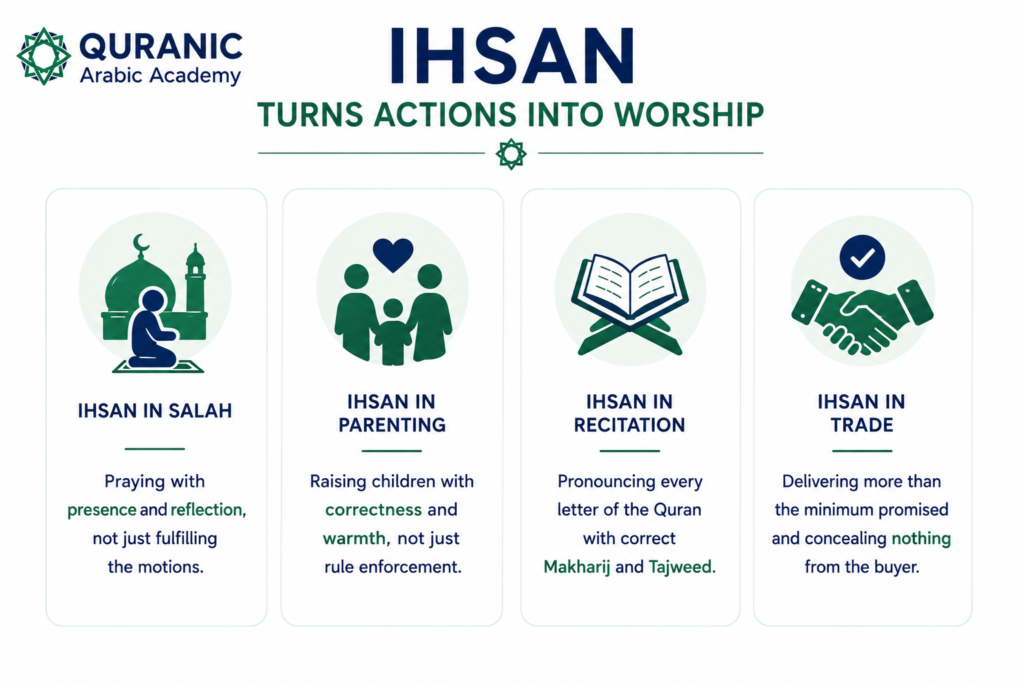
- Ihsan in Salah means praying with presence and reflection, not just fulfilling the required motions.
- Ihsan in parenting means raising children with both correctness and warmth, not just rule enforcement.
- Ihsan in recitation means pronouncing every letter of the Quran with its correct Makharij and Tajweed rules.
- Ihsan in trade means delivering more than the minimum promised and concealing nothing from the buyer.
The scholars understood Ihsan as the quality that makes a believer’s entire life an act of worship. When a person works, speaks, eats, and rests with awareness of Allah’s sight, every moment becomes a transaction with the Most Generous.
Experience Our Teaching Style:
We believe in clarity and engagement. Watch these short highlights from our actual classes to see our teachers’ methodology and student interactions in real-time.
Ready to Begin Your Quranic Journey?
Start learning with professional instructors through our structured curriculum.
Book Your Free TrialBuild Your Recitation of the Quran to the Standard of Ihsan
You have just read eight Quranic principles that govern every dimension of a believer’s life. Applying them begins with a living connection to the Book that contains them.
The Quran Reading Academy provides certified Arab tutors holding Ijazah in recitation, real-time Makharij correction in every session, one-on-one live classes tailored to your exact mistakes, and flexible scheduling covering all global time zones.
Every student progresses from their current level, whether absolute beginner or experienced reciter, through a structured curriculum that builds toward genuine fluency.
Our Arabic Courses
- Quranic Arabic Classes
- Quranic Arabic Course for Beginners
- Online Quranic Arabic Courses for Advanced Learners
- Quranic Arabic Grammar Course
- Arabic Courses for Understanding the Quran
- Quranic Arabic Course for Sisters (Female)
- Quranic Arabic Course for Kids
- Online Quranic Arabic Classes for Adults
- Quranic Arabic Course UK
- Quranic Arabic Course London
- Quranic Arabic Course USA
- Quranic Arabic Course Canada
- Quranic Arabic Course Australia
- Quranic Arabic Course UAE
- Quranic Arabic Course Germany
Ready to Begin Your Quranic Journey?
Start learning with professional instructors through our structured curriculum.
Book Your Free TrialConclusion
Quranic principles form the framework of a Muslim’s life. Tawheed guides intentions, Justice governs relationships, Amanah shapes responsibilities, Mercy guides correction, Sabr sustains hardship, Tawakkul teaches trust in Allah, Shura strengthens decisions, and Ihsan elevates actions into worship.
The Companions applied these principles in real situations and built their lives around them. Muslims today can do the same by reciting the Quran, understanding its guidance, and applying these principles daily.
Frequently Asked Questions
What are the Quranic principles?
Quranic principles are the foundational values Allah established in the Quran to govern belief, character, worship, and community life, including Tawheed, justice, Amanah, mercy, patience, Tawakkul, Shura, and Ihsan.
How do Quranic principles apply to daily life?
Each Quranic principle has a direct practical application: Tawheed governs intentions, justice governs dealings, Amanah governs responsibilities, and Ihsan governs the quality of every act of worship and conduct.
What do scholars say about the Quranic principle of justice?
Ibn Kathir and al-Tabari both established that the Quranic principle of justice applies universally, extending even to testimony against oneself or one’s parents, without any exception based on relationship or social position.
What is the correct understanding of Tawakkul as a Quranic principle?
Tawakkul means entrusting outcomes to Allah after full effort. Ibn Kathir clarified that it follows decision and action, not replaces them. The Prophet (PBUH) commanded believers to take all necessary means first.
Why is Shura considered a binding Quranic principle?
Ibn Kathir established that because Allah commanded even the Prophet (PBUH) to practice Shura, no leader after him can claim exemption. Ibn ‘Atiyyah classified it among the most binding precepts of Islamic law.
How does Ihsan relate to the other Quranic principles?
Ihsan is the quality standard that elevates every other Quranic principle from minimum compliance to genuine excellence. It transforms justice into generosity, patience into contentment, and recitation into a living act of worship.





Leave a Reply