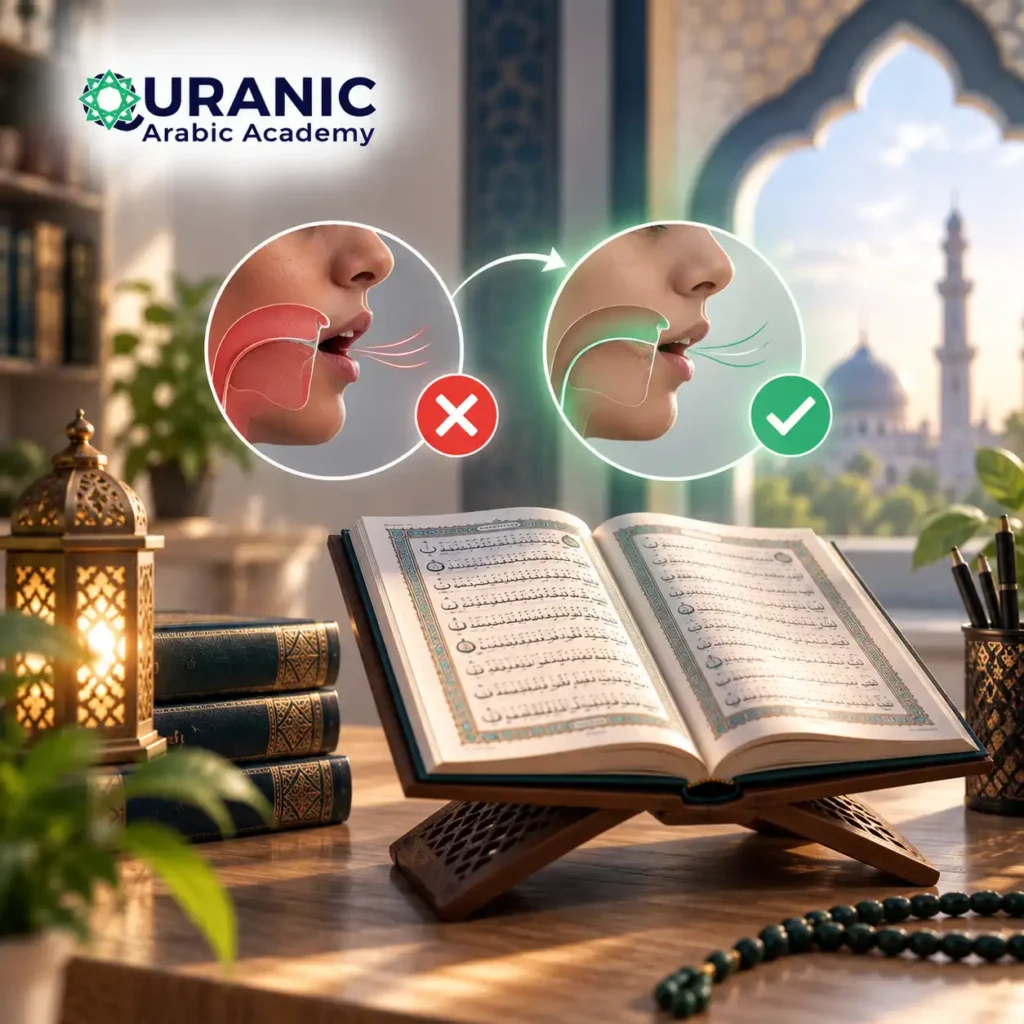
 Quran
Quran
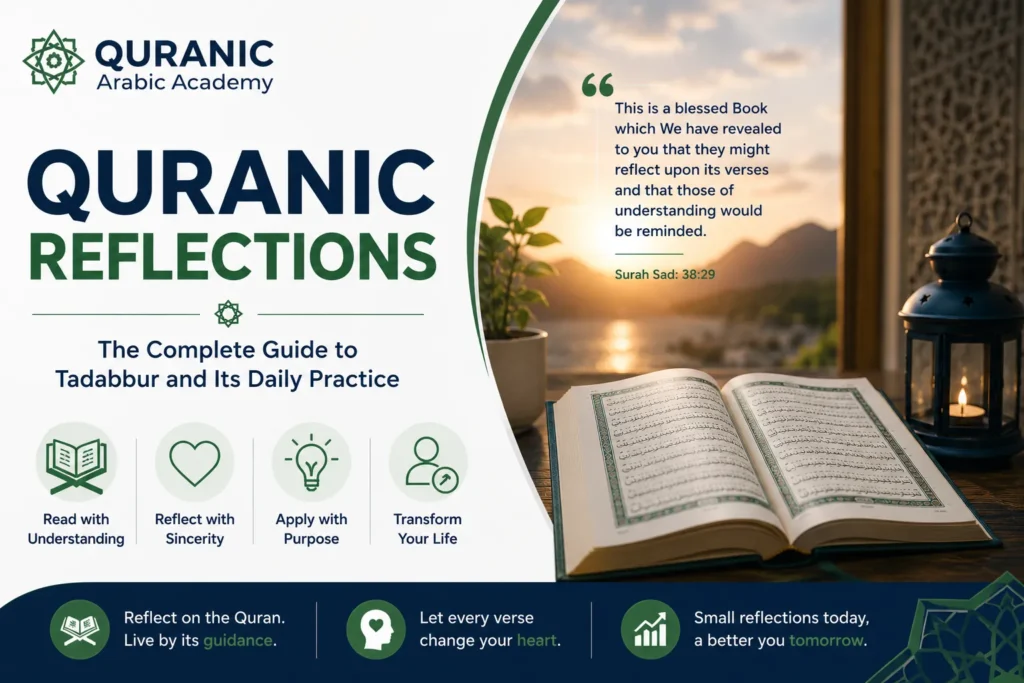
Quranic reflections are central to the purpose of the Quran’s revelation. Allah revealed the Quran so its verses would be contemplated, its lessons understood, and its guidance applied to daily life. The Companions lived by this approach, and scholars preserved it in works available to Muslims today.
Quranic reflections do not require special scholarship or permission; they require slower recitation, an attentive heart, honest reflection, and a willingness to change. Begin with one verse and allow its guidance to shape your actions..
Allah Commands Quranic Reflections Directly in the Quran
The command to practice Quranic reflections is not buried in a single verse. Allah repeats it across multiple Surahs in language ranging from an invitation to a warning. The clearest statement of the Quran’s purpose comes from Surah Sad:
“كِتَابٌ أَنزَلْنَاهُ إِلَيْكَ مُبَارَكٌ لِّيَدَّبَّرُوا آيَاتِهِ وَلِيَتَذَكَّرَ أُولُو الْأَلْبَابِ”
Kitabun anzalnahu ilayka mubarakun liyaddabbaru ayatihi waliyatadhakkara ulu al-albab.
“[This is] a blessed Book which We have revealed to you, [O Muhammad], that they might reflect upon its verses and that those of understanding would be reminded.”
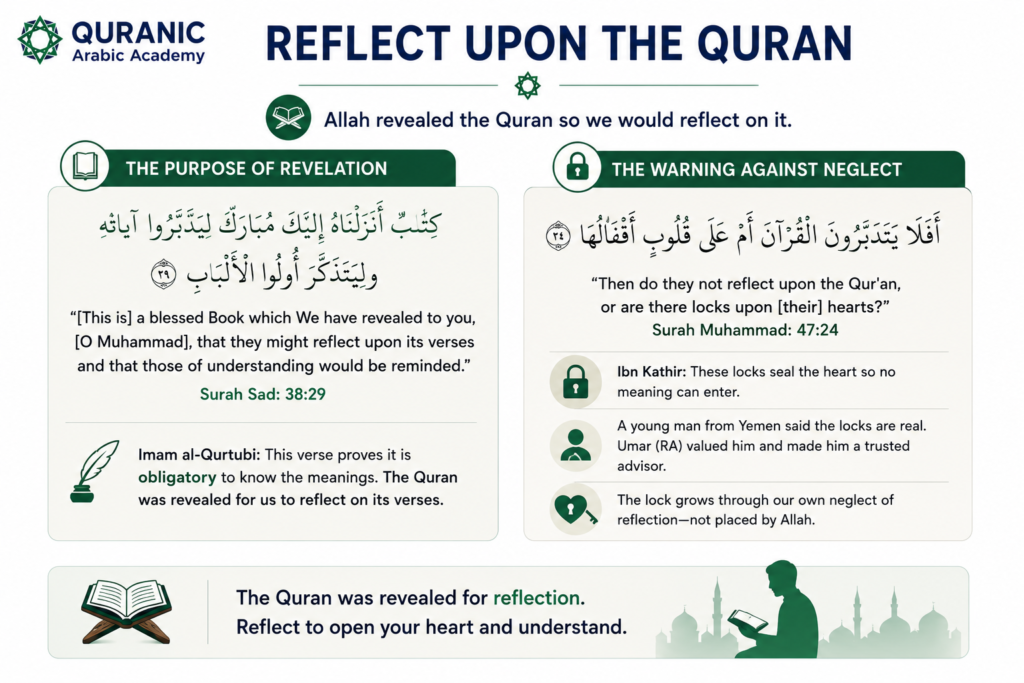
Imam al-Qurtubi wrote in his Tafsir that this verse contains proof of the obligation of knowing the Quran’s meanings. The word “liyaddabbaru” is a purpose clause: the Quran was revealed precisely so that Quranic reflections happen. This is not a suggested use. It is the stated reason for the revelation’s descent.
The warning against abandoning Quranic reflections is equally direct:
“أَفَلَا يَتَدَبَّرُونَ الْقُرْآنَ أَمْ عَلَىٰ قُلُوبٍ أَقْفَالُهَا”
Afala yatadabbarun al-qur’ana am ‘ala qulubin aqfaluha.
“Then do they not reflect upon the Qur’an, or are there locks upon [their] hearts?”
Ibn Kathir explained in his Tafsir that these locks are real: they seal the heart firmly so that none of the Quran’s meanings can enter.
When the Prophet (PBUH) recited this verse, a young man from Yemen observed that the locks on hearts are real, and Umar ibn al-Khattab (may Allah be pleased with him) valued that young man so highly he later made him a trusted consultant in governance.
The lock is not placed by Allah on the heart of the believer as a punishment. It grows through the believer’s own neglect of Quranic reflections.
Many students who want to practice Quranic reflections lack the Arabic foundation to engage with the text directly. The Quranic Arabic for Beginners course at The Quranic Arabic Academy builds vocabulary and grammar through live one-on-one sessions, giving every verse a meaning you carry after the Mushaf is closed.
Read also: Quranic Principles – The 8 Foundational Values
Build the foundation that makes Tadabbur possible.
Tadabbur Is Different From Tafsir and From Recitation
Many Muslims conflate three distinct acts: recitation, Tafsir, and Tadabbur. Understanding the difference between them is the starting point for practicing Quranic reflections correctly.
| Act | Definition | Who It Is For | Goal |
| Tilawah (Recitation) | Pronouncing the Quran correctly with Tajweed | Every Muslim | Correct pronunciation and worship through sound |
| Tafsir (Exegesis) | Extracting the technical linguistic and legal meanings of verses | Scholars with specific training | Determining the meaning of the text accurately |
| Tadabbur (Reflection) | Thinking through the meaning to extract personal guidance | Every Muslim without exception | Transformation of the heart and alignment of life with the Quran |
The scholars were explicit on this distinction. Tadabbur is not limited to those with scholarly credentials. The disbelievers themselves were condemned in Surah Muhammad for abandoning it, which confirms it is an obligation upon every Muslim who can think. As the scholars of Usal al-Fiqh noted: a command addressed to disbelievers as a rebuke is in effect a command addressed to all.
Ibn al-Qayyim wrote in Madarij al-Salikin with a directness that no other scholar matched on this subject: “There is nothing more beneficial for the heart than reciting the Quran with contemplation and reflection. Doing so takes us through all of the stages and stations of the spiritual journey.
It inspires love and longing for Allah, generates fear of Him and hope in Him, and makes one turn in repentance to Him and rely on Him. It causes one to fully submit to Him, leave matters in His Hands, and be pleased with His decree.”
He then added the statement that explains why most Muslims never experience this: “If people knew what reciting the Quran with contemplation contains, they would devote themselves to it at the expense of anything else.”
Read also: Qur’anic Punctuation: The Complete Guide to Waqf Signs and Recitation Rules
The Companions Practiced Quranic Reflections as a Way of Life
The companions of the Prophet (PBUH) did not practice Tadabbur as a scheduled activity. For them, Quranic reflections were woven into every hour. Their responses to verses demonstrate what it looks like when the Quran actually reaches the heart.
Umar ibn al-Khattab (may Allah be pleased with him) had two dark lines permanently marked on his face from excessive weeping during recitation. He would pass by verses describing punishment or accountability and be overcome to the point of physical illness.
It was narrated that during one of his night patrols of Madinah, he heard a man reciting Surah Al-Tur in his prayer. When he reached the verse about the punishment of Allah being certain, Umar leaned against the wall, unable to move. He returned home ill and remained so for days. People visited him without understanding why, because he could not explain that a verse of the Quran had dismantled him.
This is not described in the books of the scholars as an extreme or unusual response. It is described as the natural consequence of Quranic reflections practiced with a present heart. The Quran produces in the reflecting heart exactly what it promises to produce: awareness of Allah, consciousness of the Hereafter, and a reshaping of priorities.
The Prophet (PBUH) himself demonstrated the standard for Quranic reflections in the most direct way. It was narrated that he once spent an entire night in prayer repeating a single verse from Surah Al-Maidah. He did not move to the next verse until that verse had exhausted everything it had to give.
See It in Action:
Wondering what our interactive sessions look like? Click below to peek inside a live session and watch how our expert instructors make learning Quranic Arabic accessible and engaging.
Ready to Begin Your Quranic Journey?
Start learning with professional instructors through our structured curriculum.
Book Your Free TrialWhat Imam al-Ghazali and Ibn al-Qayyim Taught About Quranic Reflections
Two scholars whose works on Quranic reflections remain foundational across all levels of Islamic education are Imam al-Ghazali in Ihya Ulum al-Din and Ibn al-Qayyim in Madarij al-Salikin. Their instructions are practical, not theoretical.
Imam al-Ghazali taught that correct Quranic reflections require the reader to assume at every moment that they are the one being addressed. If the verse contains a command, it is your command. If it contains a prohibition, it is your prohibition. If it contains a promise, it is your promise.
If it contains a story of a past people, its lesson is your lesson. He wrote: “Entertainment is not the objective of the Quran’s stories. The objective is for the reader to extract from its content what they need.”
He also taught that the heart must be clear of competing concerns before Tadabbur can begin. A heart occupied with worldly distraction approaches the Quran but does not enter it. The words pass through the mind without landing in the soul.
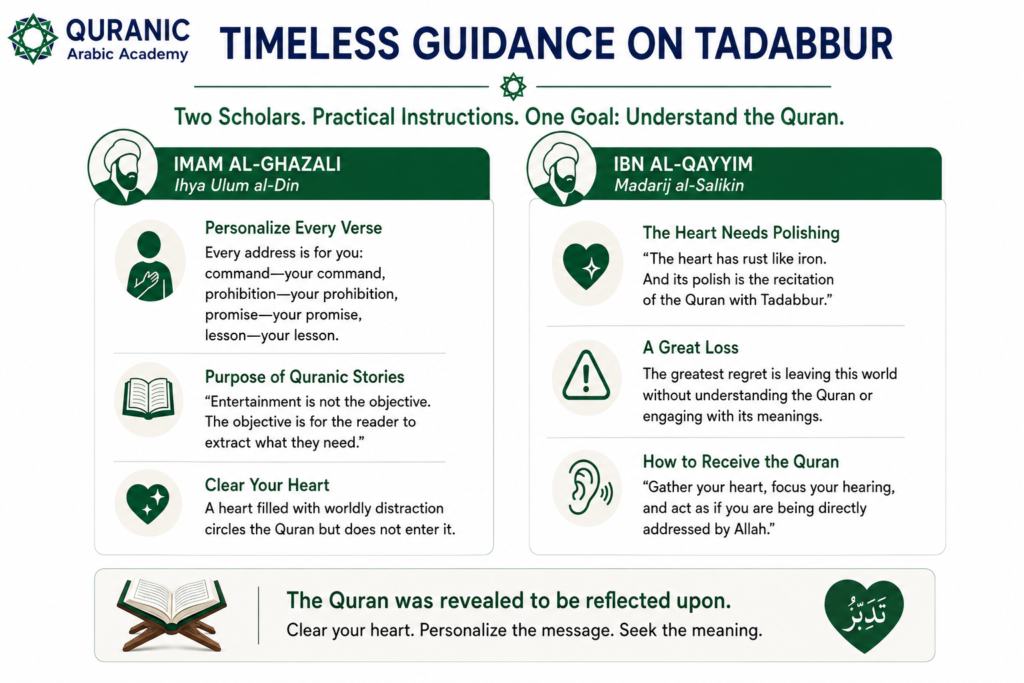
Ibn al-Qayyim added in Madarij al-Salikin: “The heart has rust like iron. And its polish is the recitation of the Quran with Tadabbur.” He warned of a catastrophe that he considered among the greatest losses a person could suffer:
“What a profound regret and immense loss for the one who spends his life seeking knowledge, yet leaves this world without understanding the realities of the Quran, nor has his heart ever truly engaged with its secrets and meanings.”
Ibn al-Qayyim’s instruction on personalizing Quranic reflections was equally specific. He said: “Gather your heart when the Quran is recited, focus your hearing, and act like you are being directly addressed by Allah, because it is an address from Him to you upon the tongue of His Messenger.” This is not a description of an advanced spiritual state. It is the description of how the Quran was always meant to be received.
Applying these Quranic reflections in Salah requires reciting correctly and slowly. The Quranic Arabic Grammar Course at The Quranic Arabic Academy teaches the art of Tarteel through live, one-on-one sessions with certified instructors who build the pace and precision that Tadabbur requires.
Recite the Quran the way Tadabbur demands.
Read also: Quranic Arabic Diacritics: The Complete Guide to Harakat, Tashkeel, and Tajweed
Five Practical Steps to Begin Quranic Reflections Today
Quranic reflections are not reserved for Ramadan or for scholars. They are available to every Muslim in every daily session with the Mushaf. The following five steps are drawn from the teachings of the scholars and can be applied immediately.
Step 1: Purify the intention before opening the Mushaf
Begin every session of Quranic reflections with the explicit intention of seeking guidance, not completing pages. The companions did not measure their recitation in Juz. They measured it in transformation. Even one verse reflected upon completely is worth more than ten pages recited without presence.
Step 2: Slow down to the speed of understanding
Allah commanded Tarteel, measured and deliberate recitation, specifically because the heart needs time to receive what the tongue is producing. Ibn al-Qayyim noted that the Prophet (PBUH) would repeat a verse throughout an entire night when that verse contained something his heart needed. There is no obligation to move forward until the verse has given what it has to give.
Step 3: Ask three questions of every verse
These three questions are the practical framework for Quranic reflections:
- What is Allah telling me about Himself, His creation, or the Hereafter in this verse?
- What does this verse require me to do or stop doing?
- What in my current life does this verse directly address?
Step 4: Personalize and visualize
Imam al-Ghazali taught that the reader must see themselves in every verse. When reading about the people of Jannah, visualize yourself seeking their qualities. When reading about the people of punishment, measure yourself against what separated them from guidance. Quranic reflections become transformative the moment they stop being about others and start being about you.
Step 5: Memorize the verse you reflected on, then recite it in Salah
The scholars unanimously taught that the highest application of Quranic reflections is carrying the verse into prayer. When you recite in Salah a verse you have reflected upon, the prayer changes completely. The verse is no longer a recitation. It is a conversation.
6. The Obstacles That Prevent Quranic Reflections and How to Remove Them
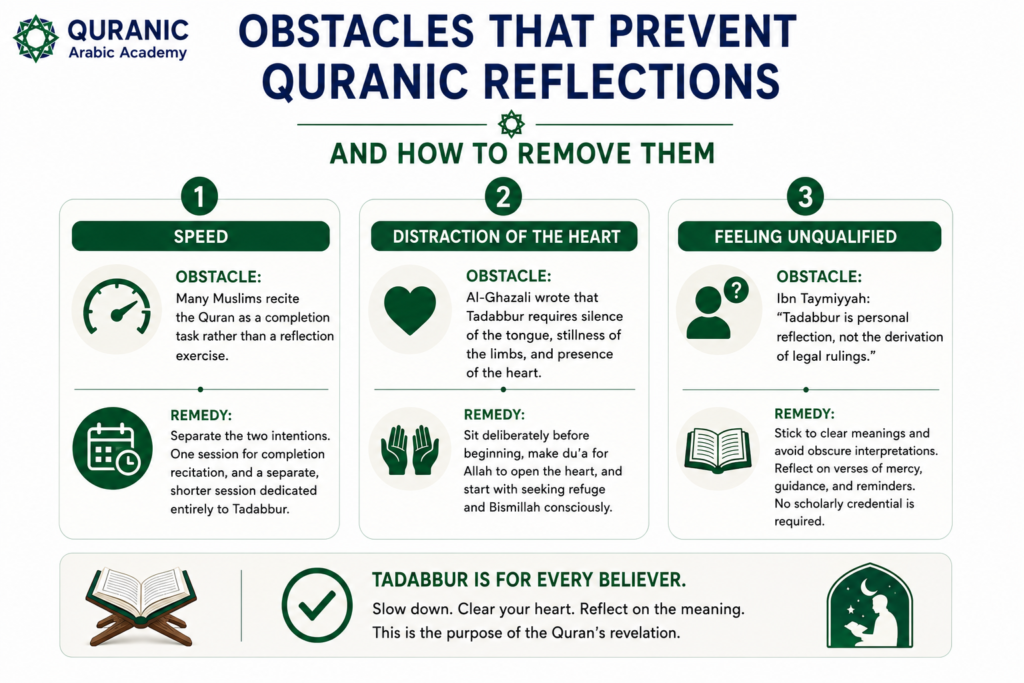
The scholars identified three obstacles that prevent Muslims from practicing Quranic reflections, and provided a remedy for each.
Speed
Many Muslims recite the Quran as a completion task rather than a reflection exercise. The remedy is to separate the two intentions completely. Designate one session for completion recitation and a separate, shorter session dedicated entirely to Tadabbur on a small number of verses.
Distraction of the heart
Al-Ghazali wrote that Tadabbur requires three things: silence of the tongue in the moments before recitation, stillness of the limbs, and presence of the heart. The remedy is to sit deliberately before beginning, make du’a for Allah to open the heart, and begin with the seeking of refuge and Bismillah consciously rather than mechanically.
Feeling unqualified
Ibn Taymiyyah addressed this directly: “Tadabbur is personal reflection, not the derivation of legal rulings. Stick to the clear meanings and avoid obscure interpretations.” The Muslim who reflects on a clear verse of mercy and feels hope in Allah has practiced Tadabbur correctly.
The Muslim who reads a verse about Salah and resolves to guard their prayers more carefully has practiced Tadabbur correctly. No scholarly credential is required for personal guidance drawn from clear meanings.
Quranic reflections require a correct Arabic foundation for those who want to engage directly with the text. The Arabic Courses for Understanding the Quran at The Quranic Arabic Academy combines structured reading with Makharij precision in live sessions, building the recitation quality that supports genuine Tadabbur.
Recite every verse the way it deserves to be recited.
Experience Our Teaching Style:
We believe in clarity and engagement. Watch these short highlights from our actual classes to see our teachers’ methodology and student interactions in real-time.
Ready to Begin Your Quranic Journey?
Start learning with professional instructors through our structured curriculum.
Book Your Free TrialStart Your Journey of Quranic Reflections With Certified Guidance
Tadabbur requires both a correct relationship with the Quran’s sound and a living connection to its meaning. The Quran Reading Academy provides certified Arab tutors holding Ijazah in recitation, one-on-one live sessions tailored to each student’s exact level, real-time Makharij correction in every class, and flexible scheduling across all global time zones.
Whether you are a complete beginner building the Arabic foundation for Tadabbur or an experienced reciter deepening your engagement with the text, a structured curriculum and a qualified teacher make the difference between recitation and reflection.
Our Arabic Courses
- Quranic Arabic Classes
- Quranic Arabic Course for Beginners
- Online Quranic Arabic Courses for Advanced Learners
- Quranic Arabic Grammar Course
- Arabic Courses for Understanding the Quran
- Quranic Arabic Course for Sisters (Female)
- Quranic Arabic Course for Kids
- Online Quranic Arabic Classes for Adults
- Quranic Arabic Course UK
- Quranic Arabic Course London
- Quranic Arabic Course USA
- Quranic Arabic Course Canada
- Quranic Arabic Course Australia
- Quranic Arabic Course UAE
- Quranic Arabic Course Germany
Ready to Begin Your Quranic Journey?
Start learning with professional instructors through our structured curriculum.
Book Your Free TrialConclusion
Quranic reflections are central to the purpose of the Quran’s revelation. Allah revealed the Quran so its verses would be contemplated, its lessons understood, and its guidance applied to daily life. The Companions lived by this approach, and scholars preserved it in works available to Muslims today. Quranic reflections do not require special scholarship or permission; they require slower recitation, an attentive heart, honest reflection, and a willingness to change. Begin with one verse and allow its guidance to shape your actions.
Frequently Asked Questions
What are Quranic reflections?
Quranic reflections refer to Tadabbur: the deliberate act of pondering the Quran’s verses to understand their deeper meanings and extract personal, practical, and spiritual guidance from them.
Is Tadabbur only for scholars?
No. Allah condemned the disbelievers for abandoning Tadabbur, which confirms it is an obligation for every Muslim. Ibn al-Qayyim and Ibn Taymiyyah both clarified that personal reflection on clear meanings requires no scholarly qualification.
What is the difference between Tadabbur and Tafsir?
Tafsir is the technical science of extracting the linguistic and legal meaning of the Quran and is the domain of trained scholars. Tadabbur is the personal reflection on those meanings to gain guidance, and is accessible to every Muslim.
How did the companions practice Quranic reflections?
The companions recited slowly, wept frequently, repeated single verses throughout the night, and allowed the Quran to physically affect them. Umar ibn al-Khattab carried marks on his face from years of weeping during recitation and became ill from reflecting on a single verse about punishment.
What did Ibn al-Qayyim say about Quranic reflections?
Ibn al-Qayyim wrote in Madarij al-Salikin that nothing is more beneficial for the heart than reading the Quran with contemplation, and that this practice alone traverses all the spiritual stations on the journey to Allah.
How long should a Quranic reflections session last?
Even five minutes of deliberate reflection on a single verse produces more transformation than an hour of mechanical recitation. The scholars valued depth over length. Begin with three verses per session and expand as the habit strengthens.







Leave a Reply