 Quranic Arabic

Many adults wonder: can adults learn to read the Quran if they did not have the opportunity to learn as children? The answer is yes. Age does not prevent you from learning Quran reading or developing accurate recitation.
Although starting with unfamiliar Arabic letters and sounds may feel challenging at first, adults can make steady progress with sincere intention, consistent practice, the right learning method, and guidance from a qualified teacher.
With patience and realistic goals, even complete beginners can gradually build stronger pronunciation, fluency, and confidence when reading the Quran.
The key is to start with the basics, practice regularly, and improve one skill at a time rather than expecting to master everything at once.
What You Will Learn
- Whether adult age genuinely limits the ability to learn Quran reading.
- The realistic starting point for adult beginners with no prior Arabic background.
- Core building blocks: Arabic letters, articulation points (makharij), and tajweed rules.
- Practical study habits that help adults stay consistent.
- Where structured, guided classes can accelerate progress.
Can Adults Learn to Read the Quran?
Yes, adults can learn to read the Quran at any age, and beginning later in life should not be seen as a barrier to becoming a confident reader. Children may sometimes absorb unfamiliar sounds more quickly through repetition and imitation, but adults bring other valuable strengths to the learning process, including focus, reasoning, patience, self-discipline, and a clearer understanding of their learning goals.
These strengths can be especially useful when studying Tajweed, the rules that govern correct Quran recitation. Adult learners can often understand why a particular sound is pronounced in a certain way, how Makharij affect letter pronunciation, and when rules such as Madd, Ghunnah, or Ikhfa should be applied.
Historically, many of the companions of Prophet Muhammad ﷺ embraced Islam as adults and then learned the Quran and the teachings of Islam. Some went on to become respected reciters, teachers, and transmitters of Quranic knowledge. Their example demonstrates that Quran learning has never been limited to childhood or dependent on beginning at a particular age.
Why Age Is Not the Real Obstacle
Age is rarely the main barrier to learning the Quran. Adults are more likely to struggle with limited time, busy work or family schedules, unfamiliarity with Arabic letters and sounds, or difficulty maintaining a regular routine.
Some learners may also feel discouraged when progress seems slow, especially if they compare themselves with people who started learning at a younger age. However, these challenges can be managed with a clear learning plan, realistic goals, and short, consistent practice sessions.
Even 15–20 focused minutes each day can make a meaningful difference when used consistently. Learners can spend this time reviewing Arabic letters, practicing difficult sounds, reading a few Quranic words or verses, and applying basic Tajweed rules.
Combined with regular correction from a qualified teacher, this routine can gradually strengthen pronunciation, improve reading fluency, reduce recurring mistakes, and build greater confidence when reading the Quran aloud.

What Adult Learners Bring to the Table
Adults often have an advantage when it comes to understanding rules and explanations logically. They can learn why a particular Arabic letter is pronounced in a certain way, understand where its sound originates, and see how Makharij and Tajweed rules affect accurate Quran recitation.
Rather than relying on imitation alone, adult learners can connect each correction to a specific rule and understand why the change is necessary.
This analytical approach can make it easier to recognize recurring pronunciation mistakes, understand feedback from a teacher, and apply corrections to similar words and verses in the future. Adults can also take notes, identify their weaker areas, and organize their practice around specific skills.
With regular repetition and guidance, this combination of understanding and practical application can gradually lead to more accurate, fluent, and confident Quran reading.
See It in Action:
Wondering what our interactive sessions look like? Click below to peek inside a live session and watch how our expert instructors make learning Quranic Arabic accessible and engaging.
Ready to Begin Your Quranic Journey?
Start learning with professional instructors through our structured curriculum.
Book Your Free TrialWhere Should an Adult Beginner Start?
An adult beginner should first become comfortable with the Arabic alphabet, individual letter sounds, and Makharij al-Huroof (articulation points) before attempting to read complete Quranic verses.
This foundation helps learners recognize each letter in its different forms and distinguish between similar-sounding letters such as ح and ه, س and ص, or ق and ك.
Learning where each sound originates in the mouth, tongue, lips, or throat also reduces the risk of developing pronunciation habits that become harder to correct later.
Once individual letters and their sounds become familiar, the learner can gradually move on to joined letters, basic vowel marks (Harakat), short combinations, and simple Quranic words. Practicing these elements slowly helps build the connection between recognizing a letter visually and producing its correct sound without hesitation.
From there, learners can begin reading short verses and Surahs while gradually introducing basic Tajweed rules. Building skills in this order makes Quran reading feel less overwhelming and provides a stronger foundation for improving pronunciation, accuracy, and fluency as the learner progresses.
1. Learn the Arabic Letters and Their Sounds
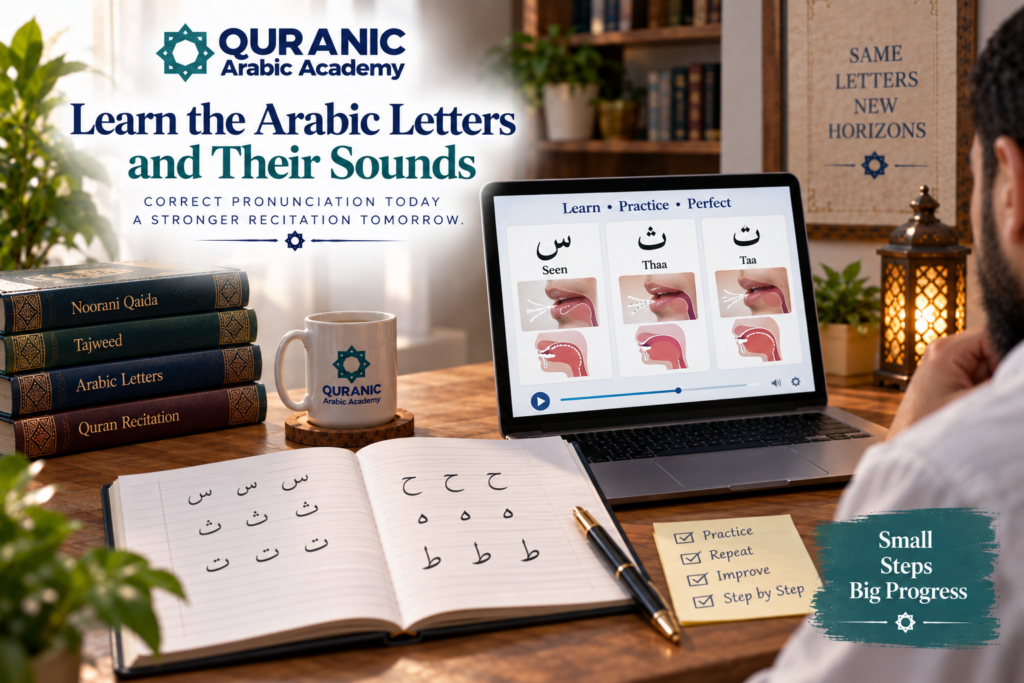
Every Arabic letter has a specific articulation point (makhraj) in the mouth or throat, and learning these points is essential for accurate Quran recitation. Beginners should practice each letter slowly and clearly, paying special attention to similar-sounding letters such as س and ث, ت and ط, or ح and ه.
Repeating the letters individually and then practicing them within simple words helps train the tongue and ear at the same time. Developing correct pronunciation habits from the beginning also makes later Tajweed practice much easier.
Read also : How Adults Can Learn to Read the Quran: Methods and Tips
2. Learn Basic Diacritical Marks
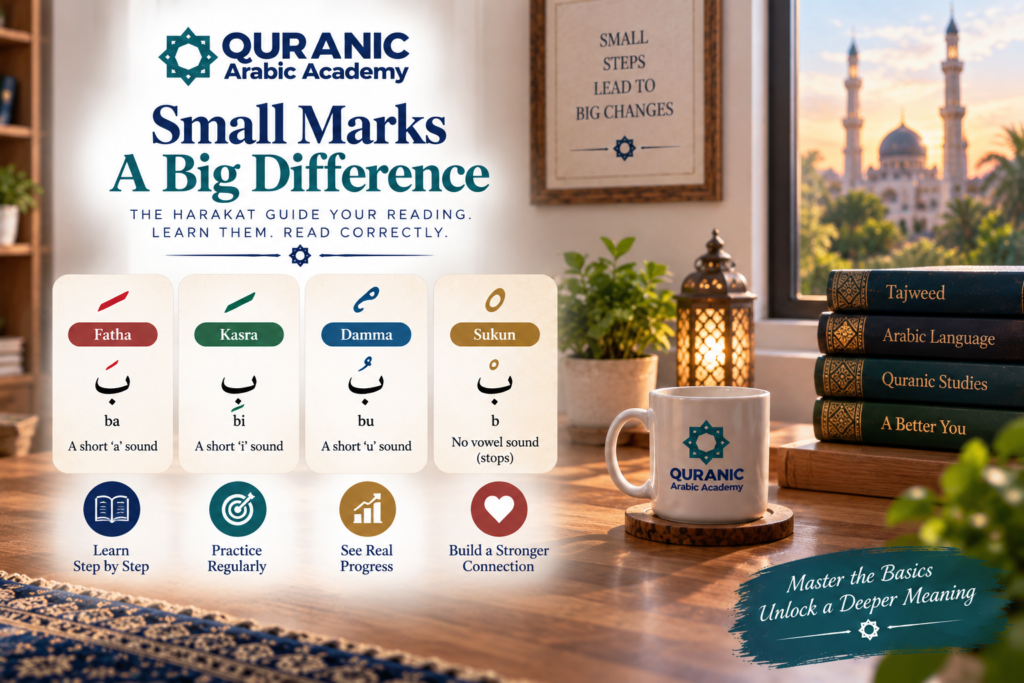
Arabic diacritics (Harakat) are the small marks placed above or below letters that indicate how they should be pronounced. Learning Fatha, Kasra, Damma, Sukoon, Shaddah, and Tanween helps beginners read unfamiliar Quranic words more accurately instead of relying on memorization.
Once these marks become easy to recognize, reading becomes smoother and provides a stronger foundation for Tajweed and fluent Quran recitation.
The Quranic Arabic Academy‘s guide on Quranic Arabic diacritics breaks this down in more depth for beginners who want to strengthen this foundation.
3. Practice Reading Short Words, Then Verses
Once learners are familiar with Arabic letters, their connected forms, and basic diacritics, they can begin practicing short words before moving on to complete verses. This stage helps them recognize letter combinations, apply vowel sounds correctly, and read with fewer pauses.
Starting with short, familiar Quranic words also gives beginners time to focus on accuracy rather than speed.
As their confidence and fluency improve, they can gradually progress to longer verses and passages instead of jumping directly into long Surahs.
Learn Basic Tajweed as Your Quran Reading Improves
Once an adult beginner can recognize Arabic letters, understand basic vowel marks, and read short Quranic words, the next step is to improve how accurately those words are pronounced. This is where Tajweed becomes an important part of the learning process.
Tajweed helps learners move beyond simply recognizing written words toward reciting them with the correct pronunciation, articulation, and sound qualities.
Tajweed teaches you to give each Quranic letter its proper Makhraj (articulation point) and characteristics while also introducing rules that affect how letters interact during recitation.
Beginners will gradually encounter concepts such as Madd (elongation), Ghunnah (nasalization), Qalqalah, Noon Sakinah and Tanween, and Meem Sakinah. Understanding these rules helps make recitation clearer and more accurate.
However, adult beginners do not need to memorize every Tajweed rule before they start reading the Quran. A more practical approach is to learn one or two rules at a time and immediately apply them to familiar words and short verses.
Read also: How to Read the Quran Better: A Practical, Step-by-Step Approach
Start With the Tajweed Rules That Affect Your Reading Most
Begin with the Tajweed rules you will encounter most frequently instead of trying to learn advanced terminology all at once. Focusing on a few practical rules makes it easier to recognize them in real Quranic verses and apply them correctly during recitation.
A qualified teacher may adjust the order according to your pronunciation and weaknesses, but common early areas include:
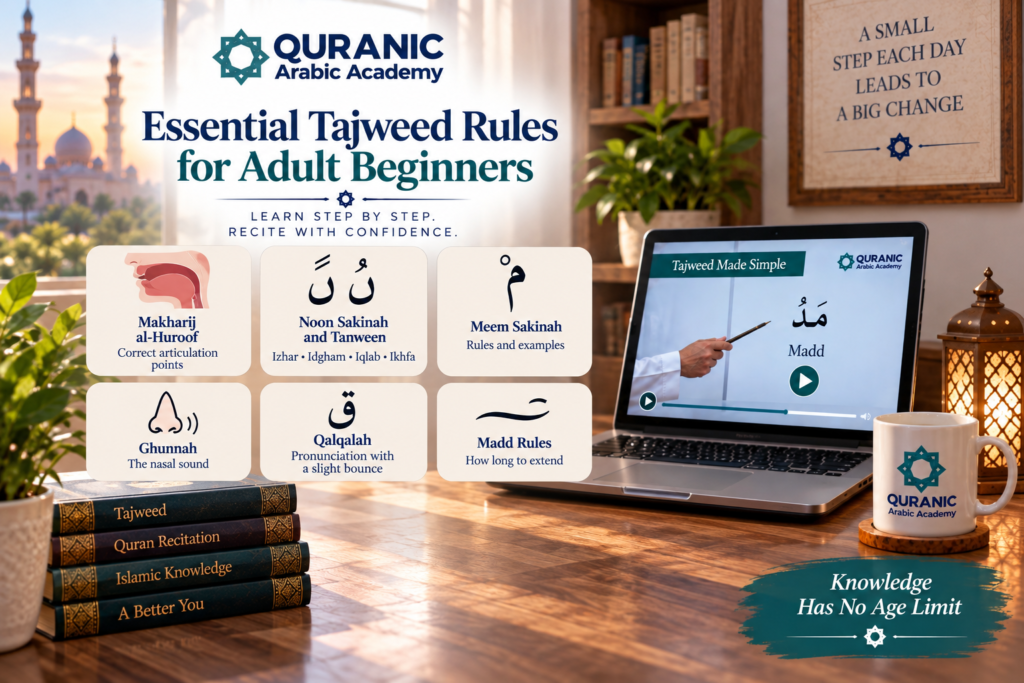
- Makharij al-Huroof: learning where each Arabic letter is articulated so similar sounds such as ح and ه or ت and ط remain distinct.
- Noon Sakinah and Tanween: learning how نْ and tanween change according to the letter that follows, including Izhar, Idgham, Iqlab, and Ikhfa.
- Meem Sakinah: recognizing how مْ is pronounced in different letter combinations.
- Ghunnah: producing the required nasal sound in the appropriate places without exaggerating it.
- Madd: learning when a vowel sound should be lengthened and for how long.
- Qalqalah: producing the controlled echo heard with specific letters when they carry Sukoon.
Do not measure progress by how many Tajweed rules you can name. A more useful test is whether you can recognize a rule in an actual verse and apply it correctly while reading.
Use Teacher Feedback to Correct Tajweed Mistakes Early
Some Quran pronunciation errors are difficult to identify by listening to yourself. An adult learner may understand a rule theoretically but still pronounce the letter from the wrong articulation point, shorten a Madd, or apply Ghunnah incorrectly.
Reading regularly to a qualified Quran teacher provides immediate feedback before these mistakes become habits. Focus on one or two recurring errors at a time, practise the corrected sound inside a word, and then return to the complete verse.
As your Quran reading becomes more fluent, understanding recurring Arabic words can also make the text easier to follow. Familiarity with basic vocabulary and common Quranic Arabic prepositions can support comprehension, but adult beginners do not need to master Arabic grammar before they can learn to read the Quran correctly.
What Does the Quran Say About Learning and Reading It?
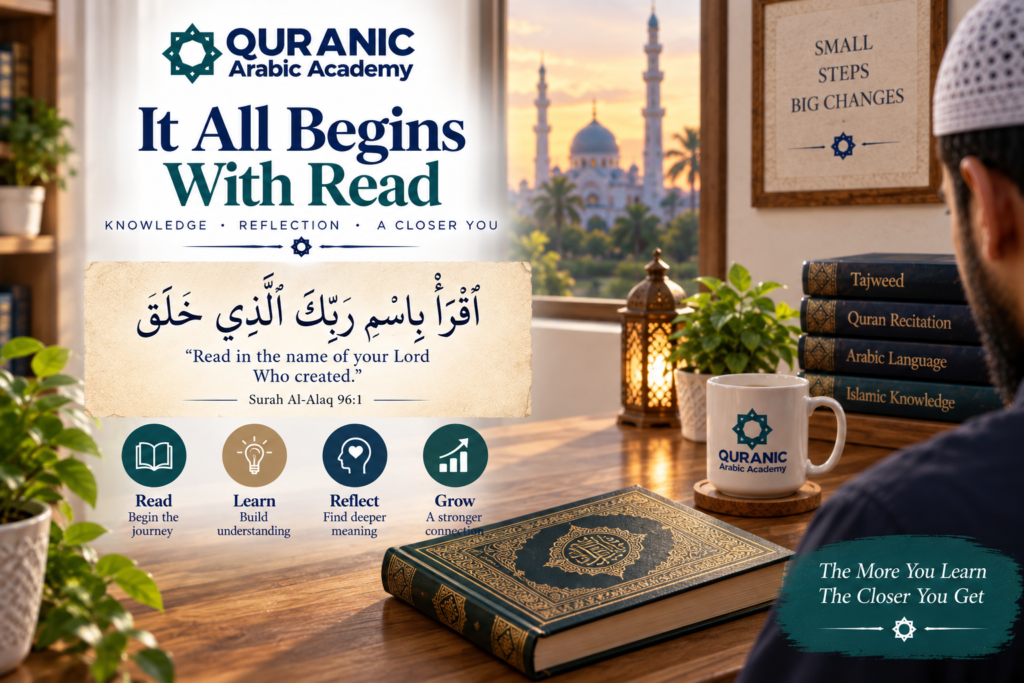
The Quran places great importance on reading, learning, reflection, and seeking beneficial knowledge. Significantly, the first verses revealed to Prophet Muhammad ﷺ begin with the command “Read,” connecting the beginning of revelation itself with learning and awareness.
For someone beginning to read the Quran as an adult, this verse can be especially encouraging. Learning Arabic letters, improving pronunciation, understanding Tajweed, and gradually developing fluency may take time, but progress does not need to happen quickly to be meaningful.
Every consistent effort brings the learner closer to reading the Quran with greater confidence, accuracy, and understanding.
The verse also reminds learners to approach Quran study with the correct intention. The goal is not simply to recognize Arabic words or complete a certain number of pages, but to read, understand, reflect, and gradually apply what is learned.
With patience and regular practice, Quran reading can develop from a new skill into a lasting part of daily worship and spiritual growth.
اقْرَأْ بِاسْمِ رَبِّكَ الَّذِي خَلَقَ
“Read in the name of your Lord who created.”
This verse, the first revealed to Prophet Muhammad ﷺ, begins with the command to “read,” underscoring that engaging with revealed knowledge including learning to read the Quran itself is foundational to the Islamic tradition, regardless of the reader’s age or starting point.
There is also a well-known hadith that highlights the value of learning and teaching the Quran specifically.
«خَيْرُكُمْ مَنْ تَعَلَّمَ الْقُرْآنَ وَعَلَّمَهُ».
“The best among you are those who learn the Quran and teach it.”
This hadith encourages every Muslim, at any stage of life, to see learning the Quran as a meaningful and valued pursuit rather than something reserved only for children.
Practical Tips for Adult Quran Learners
Adult learners can make steady progress by keeping their Quran study simple, focused, and consistent. Learning to read the Quran does not require spending hours studying every day.
What matters more is having a realistic routine that allows you to practice important skills such as Arabic pronunciation, Makharij, Tajweed, and reading fluency regularly.
Instead of trying to cover too much in one session, focus on small and achievable improvements and build your skills gradually. A routine that fits naturally around work, family, and other responsibilities is much easier to maintain and can help turn Quran reading into a consistent part of your daily life.
1. Set a Small, Consistent Daily Habit
Short, regular practice sessions are usually more effective than occasional long ones because consistency helps Quran reading skills develop gradually.
Setting aside just fifteen to twenty minutes each day for reading, pronunciation, or Tajweed practice allows learners to maintain momentum while regularly reinforcing what they have already learned.
A short session might include reviewing difficult Arabic letters, reading a few verses slowly, practicing a specific Tajweed rule, or repeating words that are difficult to pronounce. This focused repetition helps improve accuracy, fluency, and confidence without making the learning process feel overwhelming.

2. Learn With a Qualified Teacher
Self-study can be useful for reviewing lessons and practicing independently, but pronunciation mistakes may easily go unnoticed without direct feedback.
A qualified Quran teacher can listen carefully to your recitation, identify subtle errors in Makharij, letter characteristics, vowel sounds, and Tajweed, and demonstrate the correct pronunciation before those mistakes become established habits.
Regular guidance also gives adult learners a clearer sense of direction. Instead of repeatedly practicing without knowing whether their recitation is accurate, learners can focus on the specific letters, words, or Tajweed rules that need the most attention.
Over time, consistent teacher correction combined with independent daily practice can lead to clearer pronunciation, stronger Tajweed, and greater confidence when reading the Quran aloud. Even learners who study mainly on their own can benefit from regular sessions with a teacher to check their progress and correct recurring mistakes.
3. Use One Consistent Mushaf (Quran Copy)
Using the same physical or digital Mushaf regularly helps your eyes become familiar with its page layout, verse positions, line breaks, and overall visual structure. Instead of adjusting to a different format each time you read, you begin to recognize where particular verses appear and how passages are arranged on the page.
This familiarity can reduce hesitation and allow you to focus more attention on pronunciation, Tajweed, and understanding what you are reading.
Over time, reading from the same Mushaf can make Quran practice feel smoother and help you locate familiar verses or passages more easily. It can be particularly useful if you later begin Quran memorization, because repeatedly seeing an ayah in the same place on the page can create helpful visual associations.
During revision, these visual cues may support recall and make it easier to remember what comes before or after a memorized passage.

4. Reflect on Meaning as You Read
Quran reading becomes more engaging when learners understand at least the general meaning of the verses they are reciting. Taking a few moments to read a reliable translation or short Tafsir can connect pronunciation practice with understanding and reflection.
This helps adult learners move beyond simply sounding out Arabic words and begin recognizing the guidance, lessons, and themes within the verses, making regular Quran reading more meaningful and motivating.
Resources such as the Quranic Arabic Academy’s collection of Quranic reflections can support this habit alongside regular reading practice.
5. Understand The Broader Values Behind The Text
Many adult learners find it easier to stay motivated when they connect individual verses with the Quran’s broader teachings and recurring themes. Learning about concepts such as worship, patience, gratitude, justice, mercy, repentance, and trust in Allah can provide valuable context for daily recitation.
Instead of reading each verse in isolation, learners begin to notice how these themes appear across different Surahs and relate to everyday choices, relationships, and responsibilities.
This connection between recitation, understanding, and practical meaning can make Quran reading more engaging and encourage deeper reflection over time.
A resource such as Quranic principles and foundational values guide can help learners see how these themes appear throughout the Quran.
6. Appreciate the Historical Context
Learning about the preservation and transmission of the Quran can deepen a learner’s appreciation of the text they are reading and provide valuable historical context for their studies. Exploring how the Quran was memorized, taught, written down, and carefully transmitted across generations helps adult learners better understand the long tradition of Quranic learning.
Studying early Quranic manuscripts and the development of written copies can also make the learning journey more meaningful by connecting today’s recitation with centuries of Muslim scholarship, teaching, and preservation.
The Quranic Arabic Academy’s article on early Quranic manuscripts is a useful starting point for learners interested in this subject.

| Start Reading the Quran With Guided SupportIf you are an adult beginner ready to start learning, guided one-on-one classes with the Quranic Arabic Academy can help you build correct pronunciation from day one.Book Your Free Trial → |
Common Obstacles Adults Face — and How to Handle Them
Adult Quran learners often face challenges such as limited time, inconsistent practice, unfamiliar Arabic pronunciation, difficulty applying Tajweed rules, and fear of making mistakes. Work, family responsibilities, and busy schedules can make it difficult to maintain a regular learning routine, while unfamiliar Arabic sounds may require repeated practice before they become comfortable.
These obstacles can usually be managed by setting realistic and achievable goals rather than expecting rapid progress. Short daily practice sessions can be used to review difficult letters, repeat Quranic words, practice a specific Tajweed rule, or slowly read a few verses.
Focusing on gradual improvement helps learners remain consistent without feeling overwhelmed by the amount they still need to learn.
Regular guidance from a qualified Quran teacher can also make the learning process easier and more focused. A teacher can identify pronunciation or Tajweed mistakes that learners may not notice themselves, explain how to correct them, and suggest exercises for weaker areas.
With patience, consistent practice, and regular correction, adult learners can gradually overcome these challenges and develop greater accuracy, fluency, and confidence in Quran reading.
a. “I Feel Too Old to Start”
This feeling is common among adult beginners, especially those who did not have the opportunity to learn Quran reading during childhood. However, age does not prevent someone from learning to read the Quran.
Adults regularly learn new languages, writing systems, and pronunciation patterns, and Quran reading can also be developed gradually with the right guidance and consistent practice.
Starting with Arabic letters, basic vowel marks, Makharij, and simple words before moving to complete verses and Tajweed can make the process feel much more manageable. Rather than comparing your progress with younger learners, focus on small improvements and a realistic routine that fits your life.
With patience, regular practice, and teacher correction, learners can continue improving regardless of the age at which they begin.
b. “I Don’t Have Much Free Time”
A busy schedule does not necessarily mean putting Quran learning aside. For adults balancing work, family, study, and other responsibilities, short and focused daily sessions are often easier to maintain than long, infrequent periods of study.
Even fifteen to twenty minutes of consistent practice can be used to review Arabic letters, improve difficult pronunciation, read a few verses slowly, or practice one Tajweed rule at a time.
Choosing a regular time, such as after Fajr, before work, or in the evening, can make Quran practice easier to turn into a lasting habit. The goal is not to study for hours, but to remain consistent and make gradual progress without overwhelming your daily routine.
c. “I’m Not Sure I’m Pronouncing Letters Correctly”
Arabic contains several sounds that may be unfamiliar to beginners, especially letters that do not have a direct equivalent in their first language. This can make it difficult to judge pronunciation accurately through self-study or audio lessons alone.
A qualified Quran teacher can listen carefully to your recitation, identify subtle mistakes in Makharij, letter characteristics, vowel sounds, and Tajweed, and demonstrate exactly how each sound should be produced. Regular correction also helps learners understand what they are doing incorrectly and gives them specific areas to practice between lessons.
Over time, this direct feedback can prevent repeated mistakes from becoming established habits and help learners develop clearer, more accurate, and more confident Quran recitation.
Learning Options: Self-Study vs. Guided Classes
Adult learners can choose between self-study and guided Quran classes depending on their goals, current level, available time, and preferred learning style. Self-study offers greater flexibility and can be useful for reviewing Arabic letters, practicing vocabulary, listening to Quran recitation, and reinforcing basic Tajweed rules at a convenient pace.
However, guided classes provide something independent study cannot always offer: direct correction and personalized feedback on Makharij, pronunciation, Tajweed, and recurring mistakes.
For many beginners, the most effective approach is to combine both methods by practicing independently for a short period each day while attending regular lessons with a qualified Quran teacher.
This creates a more structured and balanced learning experience while still giving adults the flexibility they need to fit Quran study around their daily responsibilities.
| Approach | Strengths | Limitations |
| Self-study (apps, books, videos) | Flexible schedule, low cost, good for reviewing letters | No real-time correction of pronunciation errors |
| One-on-one guided classes | Immediate feedback, personalized pace, structured tajweed teaching | Requires scheduling a regular session |
| Group classes | Peer motivation, structured curriculum | Less individual correction time per learner |
For many adult beginners, a mix of independent daily practice and periodic guided correction offers the most balanced path forward. Structured programs, such as the Quranic Arabic classes offered in Australia, are designed with working adults’ schedules in mind, while the Academy’s classes for kids show that the same structured teaching model is adapted across age groups, including for the children of adult learners.

Experience Our Teaching Style:
We believe in clarity and engagement. Watch these short highlights from our actual classes to see our teachers’ methodology and student interactions in real-time.
Ready to Begin Your Quranic Journey?
Start learning with professional instructors through our structured curriculum.
Book Your Free TrialLearn to Read the Quran With the Quranic Arabic Academy
If you are an adult ready to move from learning alone to learning with real guidance, the Quranic Arabic Academy offers dedicated one-on-one classes built specifically for adult beginners covering the Arabic alphabet, correct articulation points, and tajweed rules from the very first lesson.
Every class is led by a qualified teacher who listens and corrects your pronunciation in real time, so mistakes are fixed early instead of becoming habits.
You can start with a free trial class to experience this guided approach before committing to a full learning plan.
Our Arabic Courses
- Quranic Arabic Classes
- Quranic Arabic Course for Beginners
- Online Quranic Arabic Courses for Advanced Learners
- Quranic Arabic Grammar Course
- Arabic Courses for Understanding the Quran
- Quranic Arabic Course for Sisters (Female)
- Quranic Arabic Course for Kids
- Online Quranic Arabic Classes for Adults
- Quranic Arabic Course UK
- Quranic Arabic Course London
- Quranic Arabic Course USA
- Quranic Arabic Course Canada
- Quranic Arabic Course Australia
- Quranic Arabic Course UAE
- Quranic Arabic Course Germany
Conclusion
Adults absolutely can learn to read the Quran at any age, and beginning later in life is neither unusual nor a barrier to meaningful progress. Adult learners may even bring useful strengths to the process, including greater focus, patience, self-discipline, and the ability to understand explanations and Tajweed rules more analytically.
What matters most is having a clear starting point and a structured learning path. Beginners should first become comfortable with Arabic letters and their different forms, then work on Makharij al-Huruf (articulation points), Harakat, connected words, and basic Tajweed rules.
Building these skills gradually is usually more manageable than trying to master pronunciation, fluency, and advanced Tajweed at the same time.
Consistent daily practice is equally important. Even a short period of focused reading each day, combined with listening, repetition, and regular correction from a qualified Quran teacher, can produce steady improvement.
With patience and the right guidance, adult beginners can gradually move from unfamiliar letters and hesitant reading toward clearer, more accurate, and confident Quran recitation.
Frequently Asked Questions
Is it too late for an adult to start learning the Quran?
No, it is not too late at any age. Many adults begin learning the Quran later in life and progress well with consistent practice and proper guidance from a qualified teacher.
How long does it take an adult beginner to learn to read the Quran?
The timeline varies by individual, depending on prior familiarity with Arabic script, available study time, and consistency. Regular short sessions with correction from a teacher typically produce steadier progress than irregular self-study.
Do I need to learn tajweed before I can start reading the Quran?
Basic letter recognition and diacritics come first, with tajweed rules introduced progressively as reading develops. Most structured programs teach reading and correct pronunciation together rather than treating tajweed as a separate later stage.
Can I learn to read the Quran without knowing Arabic?
Yes, many adult learners have no prior Arabic background and start by learning the Arabic alphabet and its sounds specifically for Quranic reading, rather than studying Arabic as a full spoken language first.
Is online learning effective for adult Quran beginners?
Online one-on-one classes can be effective because they still allow real-time listening and correction, which is the most important factor for developing accurate pronunciation, regardless of whether lessons happen in person or online.





Leave a Reply