 Quranic Verses
To read the Quran in English, choose a trusted translation such as Saheeh International or The Clear Quran, start with the short surahs, read a few verses every day alongside the Arabic audio, and turn to Tafsir whenever a verse is unclear. That’s the whole method in one sentence. The rest of this guide shows you how to do each part well.
Whether you’re a new Muslim, a Muslim who grew up without learning Arabic, or simply curious about what the Quran says, this guide covers how to read the Quran in English in 7 clear steps.
Step 1: Set Your Intention and Prepare
Before you open the Quran, set your intention (Niyyah). You’re not reading a novel or finishing a task. You’re seeking guidance from Allah, and that intention shapes how carefully you read.
Then prepare your space. Making wudu before handling the Mushaf is the recommended etiquette, and it puts you in the right frame of mind even when you read on a phone.
Choose a quiet place and a fixed time, such as after Fajr or before sleep, so reading becomes a habit rather than something you fit in when you remember.
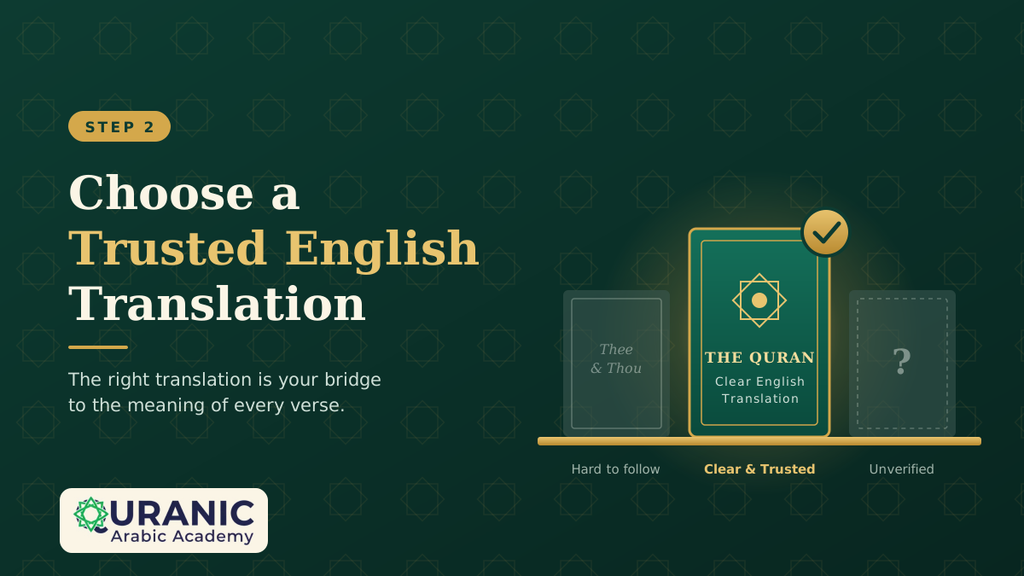
Step 2: Choose a Trusted English Translation
The Quran was revealed in Arabic, a language so rich that a single word can carry layers of meaning. No translation can fully capture that depth, but the right one can bring you remarkably close.
Think of your translation as the bridge between you and the words of Allah. A sturdy, well-built bridge carries you safely to the meaning, while a shaky one can leave you confused, discouraged, or even misled.
That’s why this step matters more than most beginners realize. The translation you choose will shape how you understand every verse, every story, and every command you read. Some translations speak in clear, modern English that feels natural and easy to follow.
Others use old-fashioned language full of “thee” and “thou” that can make the message feel distant. For a beginner, clarity isn’t a luxury.
| Translation | Translator | Style | Difficulty | Best for |
|---|---|---|---|---|
| Saheeh International | Saheeh International team | Accurate, close to the Arabic | Easy–medium | Readers who want precision |
| The Clear Quran | Dr. Mustafa Khattab | Modern, flowing English | Easy | Beginners and new Muslims |
| The Qur’an (Oxford World’s Classics) | M.A.S. Abdel Haleem | Fluent, contemporary, with notes | Medium | Readers who like context |
| The Majestic Quran | Dr. Musharraf Hussain | Plain English with section summaries | Easy | Daily readers |
| The Holy Qur’an / The Meaning of the Glorious Koran | Abdullah Yusuf Ali / Marmaduke Pickthall | Older English (“thee,” “thou”) | Harder | Readers who enjoy classic prose |
Choose one main translation and stay with it. Switching between translations often makes the same idea look different and slows your progress. Later, you can compare a second translation when a verse puzzles you.
Step 3: Understand How the Quran Is Organised
The Quran isn’t arranged chronologically or by topic, so knowing its structure helps you find your way:
- 114 Surahs (chapters) of very different lengths, from 3 verses to 286.
- 6,236 Ayahs (verses) in the most widely used count.
- 30 Juz (equal parts), which make it easy to plan a full reading, such as one Juz per day in Ramadan.
- Makki and Madani surahs: Makki surahs, revealed in Makkah, focus on faith, the Hereafter, and Allah’s oneness. Madani surahs, revealed in Madinah, add laws and guidance for community life.
References are written as Surah:Ayah, so 2:255 means Surah Al-Baqarah, verse 255 (Ayat al-Kursi). To learn how the text was preserved and compiled, read our article on the history of the Quranic text. For memory tips, see how to remember Quran verse numbers.
Step 4: Start with Short Surahs, Not Page One
Most people open a book and start at the beginning. With the Quran, that instinct can work against you. Right after the short opening chapter, Al-Fatiha, comes Surah Al-Baqarah, the longest surah in the entire Quran, with 286 verses covering law, history, faith, and guidance all at once.
For a beginner, diving straight into it can feel like learning to swim by jumping into the deep end of the ocean. Many sincere readers start strong, feel overwhelmed within days, and quietly close the book.
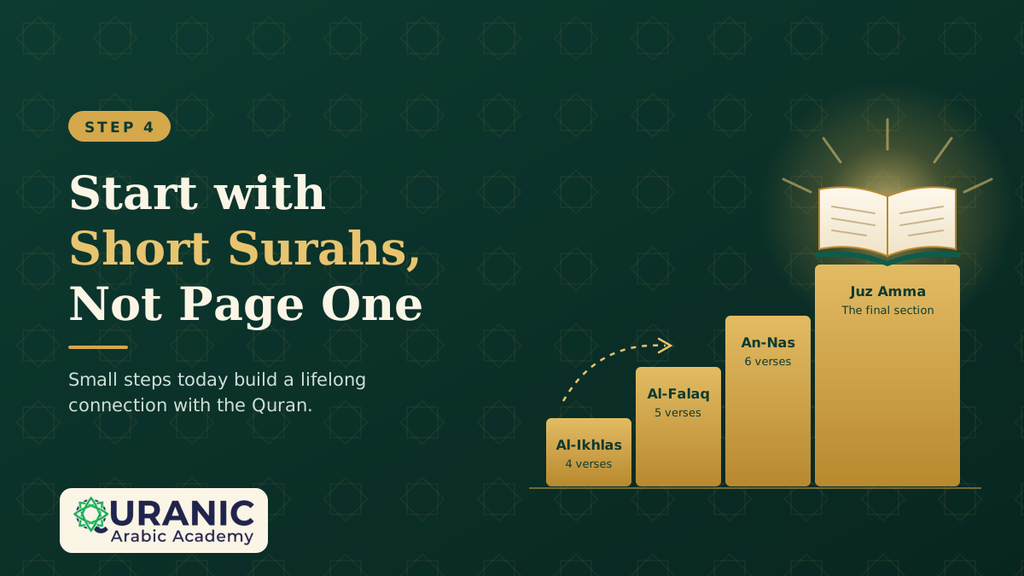
There’s a better way. The Quran isn’t arranged like a novel, so you don’t need to read it from cover to cover to understand it. Its shorter surahs, especially those in the final section known as Juz Amma, are powerful, beautiful, and easy to absorb in a single sitting.
Surahs like Al-Ikhlas, Al-Falaq, and An-Nas are only a few lines long, yet they carry some of the deepest truths of the entire Quran.
| Surah | Verses | Why start here |
|---|---|---|
| Al-Fatiha (1) | 7 | Recited in every unit of prayer |
| Al-Ikhlas (112) | 4 | A short, complete statement of Allah’s oneness |
| Al-Falaq (113) and An-Nas (114) | 5 and 6 | Seeking protection; recited daily |
| The rest of Juz Amma (Juz 30) | Short surahs | Short, powerful, and often memorised |
| Al-Mulk (67) | 30 | A medium-length surah on Allah’s power |
| Ya-Sin (36) | 83 | Faith, resurrection, and the Hereafter |
| Al-Baqarah (2) | 286 | Once you’re ready for longer, detailed reading |
Your action: Read Al-Fatiha in your chosen translation today, then move through Juz Amma.
Step 5: Read Alongside the Arabic and Audio
Reading English alone gives you the meaning but cuts you off from the sound of the revelation. A simple three-layer method connects both:
- Listen to the verses recited by a reciter (Qari).
- Follow the Arabic text with your eyes while you listen.
- Read the English translation of the same verses.
If you want to recite as well, add transliteration as a fourth layer until you learn the Arabic letters. Over time, you’ll begin recognising repeated Arabic words like Rabb (Lord) and Rahman (Most Merciful) without checking the English. Our guide to reading the Quran word by word shows how to build that recognition, and these tips on how to recite with a beautiful voice will help when you start reciting aloud.
Step 6: Reflect on a Few Verses Daily (Tadabbur)
Allah asks: “Then do they not reflect upon the Quran?” (Surah An-Nisa 4:82). Reflection, called Tadabbur, is what turns reading into guidance. You don’t need hours. Try this 15-minute routine:
- Choose 3 to 5 verses.
- Listen, follow the Arabic, and read the English (Step 5).
- Read the English again slowly and ask yourself three questions:
- What does this teach me about Allah?
- What does it ask me to do or avoid?
- How does it apply to my life today?
- Write the verse reference, its main idea in one sentence, and one small action you’ll take today.
A notebook of these entries quickly becomes a personal record of what the Quran has taught you. For a deeper method, read the complete guide to Tadabbur.
Step 7: Use Tafsir and Context When a Verse Is Unclear
Some verses need context. They may respond to a particular event, address a specific group, or use a word with layers of meaning that one English word can’t hold. That’s where Tafsir (scholarly explanation of the Quran) comes in.
For beginners, Tafsir As-Sa’di is concise and accessible, and Tafsir Ibn Kathir is the classic reference. Also look up the Asbab al-Nuzul (reasons for revelation) when you read verses about war, law, or specific historical events. Reading these verses without their context is one of the most common causes of misunderstanding.
You don’t need Tafsir for every verse; use it when something is unclear. Our introduction to Quranic exegesis (Tafsir) lists reliable works, and our article on how scholars interpret the Quran explains the principles behind them.
Can You Read the Quran in English? Translation vs. Transliteration
Yes, you can read the Quran in English, but it helps to know what you’re reading. There are two different ways to read the Quran “in English,” and they do different jobs.
A translation puts the Quran’s meanings into English so you can understand the message. Muslims regard the Quran itself as the Arabic words revealed to Prophet Muhammad ﷺ, so every English version is a human rendering of its meanings, not a replacement for the original. Allah says:
“إِنَّا أَنزَلْنَاهُ قُرْآنًا عَرَبِيًّا لَّعَلَّكُمْ تَعْقِلُونَ”
“Indeed, We have sent it down as an Arabic Quran so that you might understand” (Surah Yusuf 12:2).
A transliteration writes the Arabic sounds in English letters so you can pronounce the words before you can read Arabic script.
| Arabic text | Transliteration | English translation | |
|---|---|---|---|
| Example | بِسْمِ اللَّهِ الرَّحْمَٰنِ الرَّحِيمِ | Bismillahir-Rahmanir-Raheem | In the name of Allah, the Entirely Merciful, the Especially Merciful |
| What it gives you | The original revelation | The Arabic sounds | The meaning |
| Use it to | Recite and reflect on the actual words | Recite before you know the alphabet | Understand the message |
| Limitation | Requires learning the alphabet | Can’t capture sounds like ع, ح, and ض accurately | You read English words, not the Quran’s words |
Experience Our Teaching Style:
We believe in clarity and engagement. Watch these short highlights from our actual classes to see our teachers’ methodology and student interactions in real-time.
Ready to Begin Your Quranic Journey?
Start learning with professional instructors through our structured curriculum.
Book Your Free TrialWhere Can I Read the Quran in English?
If you’re wondering where to read the Quran in English, you have more good options today than ever, and many of them are free. Not long ago, finding a reliable English translation meant visiting a mosque, an Islamic bookstore, or a library and hoping the copy on the shelf was a trustworthy one.
Today, the words of Allah are closer than they have ever been. They’re on the phone in your pocket, a browser tab away, and often given freely to anyone who sincerely asks.
But more options can also mean more confusion. Not every website is accurate, not every app is built with care, and not every translation is one you can rely on. For a beginner, where you read matters almost as much as what you read. A good source does more than show you the text.
It gives you a trusted translation, lets you see the original Arabic alongside the English, and often helps you understand the meaning with commentary and recitation. In this section, we’ll walk you through the best places to read the Quran in English, from free websites and apps to printed copies and guided classes.
| Option | Best for | Free? | Arabic and audio included? |
|---|---|---|---|
| Websites such as Quran.com | Reading on any device, comparing translations | Yes | Yes |
| Mobile apps (the Quran.com app and other reputable Quran apps) | Daily reading on the go, bookmarks | Mostly | Usually |
| Printed bilingual Mushafs (Arabic and English side by side) | Distraction-free reading at home | No (often available from mosques and Islamic centres) | Arabic only |
| Free PDF editions from reputable publishers | Offline reading and printing | Yes | Arabic usually included |
Before you settle on a source, check four things:
- The translator is named, and the translation is widely recognised.
- The Arabic text appears alongside the English, so you stay connected to the original.
- Audio recitation is available, so you can hear the verses.
- The publisher is reputable, such as an established Islamic publisher or organisation.
Many mosques and Islamic centres give out free English translations, especially to new Muslims, so it’s worth asking at your local one. For more tools, see our list of free Quranic Arabic resources.
How Long Does It Take to Read the Quran in English?
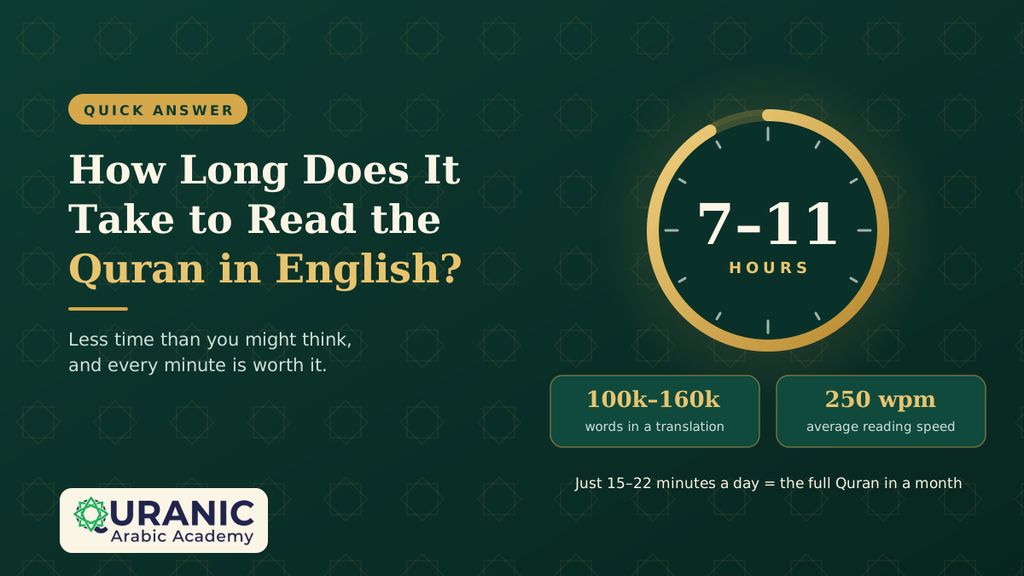
Reading a full English translation of the Quran takes about 7 to 11 hours at an average reading speed of 250 words per minute. English translations run roughly 100,000 to 160,000 words, depending on the edition and how many notes it includes.
Reading with reflection takes longer, often two to three times longer, and that’s a good thing. Here’s what different daily habits look like:
| Daily reading habit | Approximate time to finish |
|---|---|
| 1 Juz per day (about 15–20 minutes of English reading) | 30 days, the classic Ramadan plan |
| 20 minutes per day | About 1 month |
| 10 minutes per day | About 2 months |
| 3–5 verses per day with full reflection | About 3.5 to 6 years |
These figures are estimates. Your time will depend on three things:
- Your translation: editions with footnotes and commentary take longer.
- Your method: reading with Arabic and audio adds time but deepens understanding.
- Your reflection: pausing to think and journal slows your pace and multiplies the benefit.
Finishing quickly isn’t the goal. A steady 10 minutes every day will take you further than an occasional long session that you can’t sustain.
Common Mistakes to Avoid When Reading the Quran in English
Starting to read the Quran in English is a beautiful step, and it deserves to be protected. Many sincere beginners open the Quran with full hearts and real intentions, only to feel confused, discouraged, or overwhelmed a few weeks later. In most cases, the problem isn’t the Quran, and it isn’t the reader. It’s a handful of small, avoidable mistakes that quietly get in the way of understanding.
- Reading verses out of context. A single verse lifted from its passage can seem to say something it doesn’t. Read the surrounding verses and check Tafsir for difficult passages.
- Switching translations constantly. Different word choices can make you feel lost. Stay with one main translation and compare only when needed.
- Starting with Al-Baqarah and burning out. Build momentum with short surahs first, then move to longer ones.
- Treating transliteration as permanent. It’s a useful bridge, but it can’t carry Arabic sounds accurately. Learning the alphabet usually takes weeks, not years.
- Reading alone without ever asking. A teacher or study circle can answer questions that a book can’t, and keeps you accountable.
Why Reading the Quran in Arabic Takes You Deeper
An English translation opens the door to the Quran’s meaning, but some things can’t make the journey into another language: the rhythm and rhyme of the verses, the way related words share a root, and the layers of meaning a single Arabic word can carry.
Take Taqwa, often translated as “piety” or “fear of Allah.” Its root (و ق ي) carries the sense of guarding or protecting, so Taqwa is an awareness of Allah that shields you from what harms your soul. Or Sabr, usually translated as “patience.” Its root (ص ب ر) means to hold back or restrain, so Sabr includes active self-control and steadfastness, not just quiet waiting.
When you understand these words directly, verses you’ve read many times in English take on new depth. That’s why many readers treat the English translation as the first stage of their journey, not the last. Even native Arabic speakers study Quranic Arabic to understand it fully, as we explain in can Arabs understand Quranic Arabic?
See It in Action:
Wondering what our interactive sessions look like? Click below to peek inside a live session and watch how our expert instructors make learning Quranic Arabic accessible and engaging.
Ready to Begin Your Quranic Journey?
Start learning with professional instructors through our structured curriculum.
Book Your Free TrialLearn to Read and Understand the Quran with Quranic Arabic Academy
Reading the Quran in English is a powerful first step. When you’re ready to read and understand the Quran in its own words, Quranic Arabic Academy can guide you through every stage.
Quranic Arabic Academy is an online school with more than 10 years of experience, focused entirely on the classical Arabic of the Quran, not conversational dialects. Our goal is simple: to help you understand what you recite in your prayers and read in the Mushaf.
More than 350 students have already started their journey with Quranic Arabic Academy. Book your free trial lesson and take your first step from reading the Quran’s meaning to understanding its words.
Our Arabic Courses
- Quranic Arabic Classes
- Quranic Arabic Course for Beginners
- Online Quranic Arabic Courses for Advanced Learners
- Quranic Arabic Grammar Course
- Arabic Courses for Understanding the Quran
- Quranic Arabic Course for Sisters (Female)
- Quranic Arabic Course for Kids
- Online Quranic Arabic Classes for Adults
Conclusion
Learning how to read the Quran in English doesn’t require Arabic fluency, years of study, or hours every day. It takes a sincere intention and a few steady habits: choose one trusted translation, start with the short surahs of Juz Amma, read a few verses daily alongside the Arabic and audio, reflect on what Allah is telling you, and turn to Tafsir when a verse needs context.
Whether you finish in 30 days or spend years reflecting verse by verse, what matters most is consistency. Open the Quran today, even if you read just one verse.
And when you’re ready to go beyond the translation and understand the Quran in the language it was revealed in, Quranic Arabic Academy’s qualified tutors will guide you step by step. Book your free trial lesson and begin your journey from reading the Quran’s meaning to understanding its words.
FAQs
Where can I read the Quran in English for free?
You can read the Quran in English for free on websites such as Quran.com, which show the Arabic text, several English translations, and audio recitation side by side. Free Quran apps and PDF editions from reputable publishers are also available, and many mosques give out printed English translations free of charge.
How long does it take to read the Quran in English?
It takes about 7 to 11 hours of total reading time to finish an English translation of the Quran at an average pace. Reading one Juz per day, about 15 to 20 minutes, lets you finish in 30 days. Reading slowly with reflection takes longer but brings deeper understanding.
Is reading the Quran in English rewarded like reading it in Arabic?
Reading the translation to understand Allah’s guidance is a good deed and a form of seeking knowledge, and Muslims hope for reward in it. However, many scholars explain that the specific reward for reciting the Quran’s words applies to reciting the Arabic text. For a detailed ruling, consult a qualified scholar.
Which English translation of the Quran is best for beginners?
The Clear Quran by Dr. Mustafa Khattab is a popular choice for beginners because of its modern, easy-to-read English. Saheeh International is also widely recommended for its accuracy. Whichever you choose, stick with one translation at first so the wording stays consistent.
Should I read the Quran from the beginning or start with short surahs?
Most beginners find it easier to start with short surahs. Begin with Al-Fatiha and the surahs of Juz Amma, the last part of the Quran, then move to medium surahs like Al-Mulk and Ya-Sin before reading Al-Baqarah. When you want structured guidance, explore the best Quranic Arabic classes.
Related Articles
Quranic Verses



Leave a Reply