 Quran
Quran
Every Muslim carries a desire to recite the Quran in a way that moves hearts. Learning how to read the Quran with beautiful voice is not a gift reserved for the few; it is a skill built through deliberate practice, correct technique, and sincere intention.
Whether you are just beginning your recitation journey or refining years of practice, this guide gives you nine concrete, actionable steps. Each one draws from classical Tajweed principles and practical vocal training that applies to any voice type.
By the end, you will know exactly where to start, how to structure your sessions, and how to develop the depth that makes recitation genuinely moving.
1. Master The Rules Of Tajweed To Know How To Read The Quran With Beautiful Voice
Apply Tajweed from the very beginning. Every Arabic letter has a precise point of articulation, and producing it correctly is what gives the reciting voice its natural clarity and beauty.
When letters emerge from their correct makhaarij, the sound becomes cleaner and more resonant. One mispronounced letter can change a word’s meaning entirely, making Tajweed an obligation rather than a stylistic option.
Begin with the core rules: noon sakinah, tanween, meem sakinah, madd, and tafkheem versus tarqeeq. A thorough study of Quranic tajweed rules gives every other vocal improvement a reliable foundation to build on.
Begin Your Quranic Arabic Journey with Confidence

2. Listen To Expert Reciters Daily And Study Their Technique
Choose two or three reciters whose vocal range matches yours. Consistent daily exposure to excellent recitation trains your ear to recognize correct patterns of sound, pause, and breath placement.
Different reciters serve different learning goals. Sheikh al-Hussary suits those focused on Tajweed accuracy; Sheikh Abdul Basit suits those building melodic depth. Select a reciter whose natural tone is close to your own voice type.
Shadow each verse immediately after hearing it. Repeat it aloud within seconds of the reciter finishing. This active technique builds pronunciation memory, correct rhythm, and breath placement all at once.

3. Record Your Voice And Analyze Every Session
Set your phone to record before every practice session. Most learners are genuinely surprised by the gap between how they sound in their own head and how they actually sound in the air.
Play back the recording and focus on three things: madd lengths that are too short or too long, letters that sound unclear, and breathing breaks that interrupt a verse at the wrong moment.
Log what you find and address those exact points in your next session. This self-correction habit delivers precise, honest feedback that no amount of internal self-perception can provide.
See It in Action:
Wondering what our interactive sessions look like? Click below to peek inside a live session and watch how our expert instructors make learning Quranic Arabic accessible and engaging.
Ready to Begin Your Quranic Journey?
Start learning with professional instructors through our structured curriculum.
Book Your Free Trial4. Build Your Vocal Foundation Through Range Control and Breath Support
Learning how to recite Quran beautifully requires deliberate work on the voice as a physical instrument, not study of rules alone. These two techniques, applied consistently alongside Tajweed practice, produce faster and more noticeable results than rules study on its own.
A. Control Your Recitation Pace To Improve Vocal Clarity
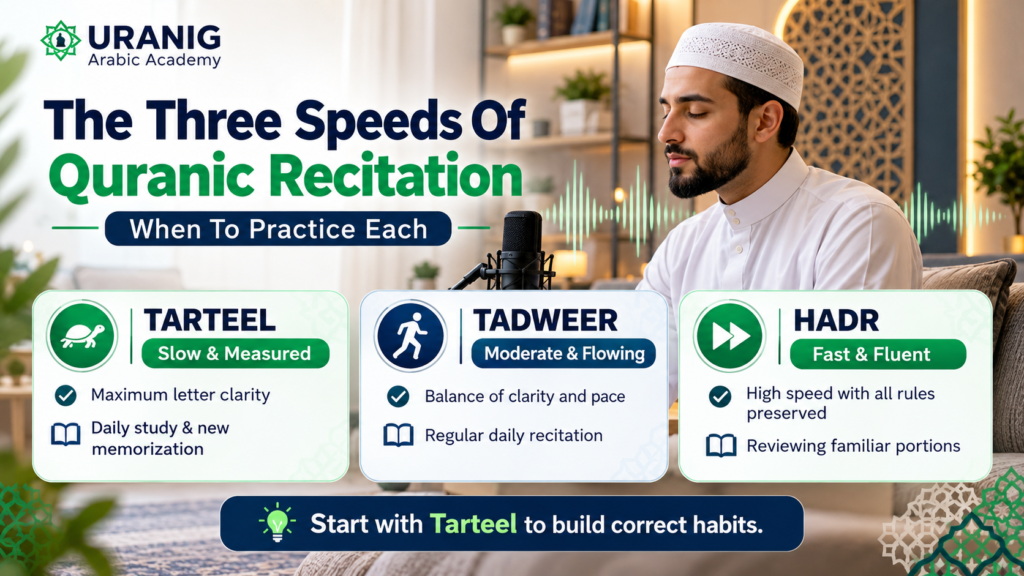
Understanding the accepted pace levels helps you set the right speed for each session goal. The table below covers the three recognized recitation speeds in Islamic scholarship.
| Recitation Speed | Arabic Term | Main Characteristic | Ideal Use Case |
| Slow and measured | Tarteel | Maximum letter clarity; full reflection | Daily study and new memorization |
| Moderate and flowing | Tadweer | Balance of clarity and pace | Regular daily recitation |
| Fast and fluent | Hadr | High speed with all rules preserved | Experienced reciters reviewing known portions |
Starting with tarteel builds correct habits first. Most learners benefit from spending their first six to twelve months almost exclusively in this slower mode before experimenting with tadweer.
B. Strengthen Your Voice Through Breath Control and Vocal Training
Learning how to read the Quran with beautiful voice requires deliberate work on the voice as a physical instrument, not just study of rules alone.
These following techniques, applied alongside Tajweed study, produce noticeably faster results. Tajweed provides the language of correct recitation; voice training develops the instrument that delivers it.
- Identify your natural vocal range: do not force a deeper or higher pitch.
- Warm up the voice before reciting: hum gently or recite short surahs quietly.
- Control your breath output: slow, steady airflow sustains longer madd letters.
- Recite at low volume during practice: quiet recitation builds muscle precision.
- Rest the voice after long sessions: 10–15 minutes of silence between sets preserves quality.
- Stay hydrated: warm water keeps the throat clear.
Read also: 8 Proven Steps To Learn To Read Quran Word By Word
5. Practice Diaphragmatic Breathing Before Every Recitation Session
Breathe from the diaphragm, not the chest. Diaphragmatic breathing fills the lungs completely and provides the sustained air supply needed to carry long verses without awkward, mid-meaning interruptions.
Practice daily: inhale through the nose for four counts, hold for two, then exhale slowly on a vowel sound for eight counts. Repeat ten times before reciting. Verse endurance increases noticeably within weeks.
If a verse exceeds your breath capacity, stop at a valid waqf point, breathe, and continue. Never force a longer verse by holding breath; it tightens the throat and degrades sound quality.
Join our online Quranic Arabic classes for adults and unlock the door to the Quranic sciences

6. Recite Aloud In A Structured Session Every Single Day
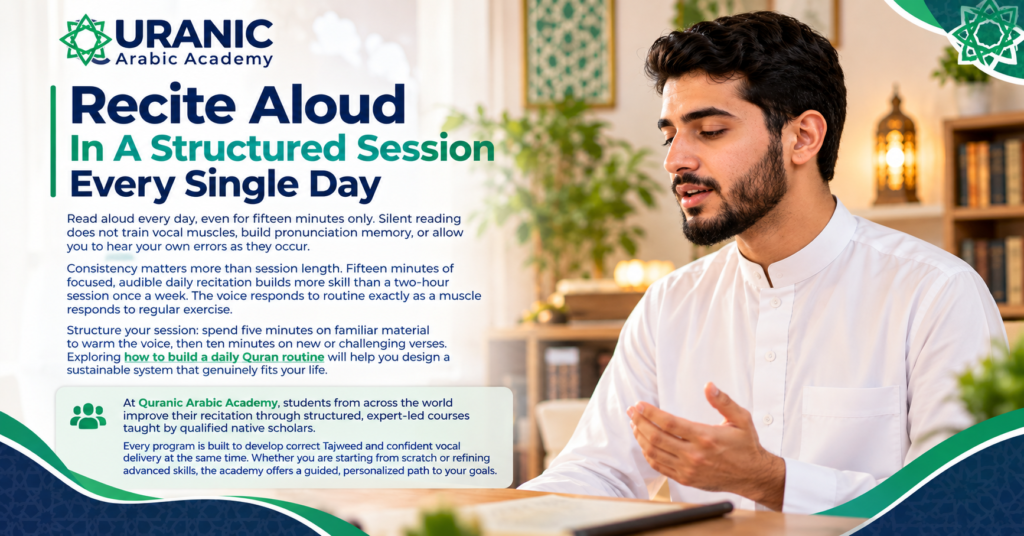
Read aloud every day, even for fifteen minutes only. Silent reading does not train vocal muscles, build pronunciation memory, or allow you to hear your own errors as they occur.
Consistency matters more than session length. Fifteen minutes of focused, audible daily recitation builds more skill than a two-hour session once a week. The voice responds to routine exactly as a muscle responds to regular exercise.
Structure your session: spend five minutes on familiar material to warm the voice, then ten minutes on new or challenging verses. Exploring how to build a daily Quran routine will help you design a sustainable system that genuinely fits your life.
At Quranic Arabic Academy, students from across the world improve their recitation through structured, expert-led courses taught by qualified native scholars.
Every program is built to develop correct Tajweed and confident vocal delivery at the same time.
7. Recite With Khushu And Actively Reflect On Each Verse
Slow down and absorb the meaning of each verse before reading it aloud. Khushu, the state of deep reverence before Allah, is not performed; it emerges naturally when genuine understanding and sincere intention are present.
When a verse speaks of Allah’s mercy, soften your tone with warmth. When a verse carries a warning, let that weight naturally deepen and steady your delivery. Meaning and voice are inseparable in authentic recitation.
Abu Musa al-Ash’ari (RA) was praised by the Prophet (PBUH): “You have been given a mizmar from the mazaamir of the family of Dawud.” What made his recitation extraordinary was the full presence of his heart, not technique alone.
Discover Why Advanced Learners Choose The Quranic Arabic Academy for Online Quranic Arabic Courses?

8. Study The Basics Of Maqamat For Quranic Tonal Depth
Learn one or two foundational maqamat, the tonal modes used naturally in Quranic recitation. No formal music training is required; basic familiarity adds genuine warmth and natural variation to your delivery.
Maqam Bayati is the most widely used mode in recitation, known for its calm, contemplative, and emotionally resonant quality. Practicing a short surah in this mode naturally encourages a slower, more measured pace.
Never force maqamat in a way that distorts Tajweed rules or extends letters beyond their permitted limits. Tonal depth should serve the meaning of the verse; it must never become a performance that overshadows it.
9. Seek Regular Correction From A Qualified Recitation Teacher
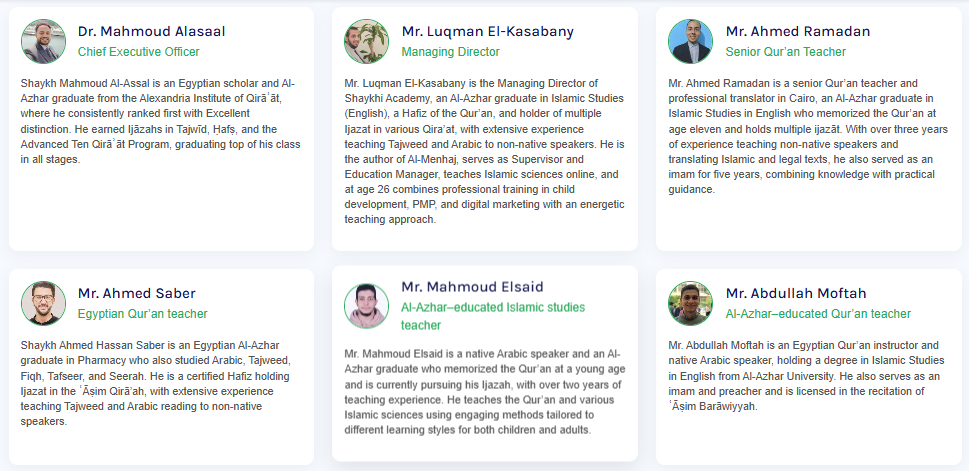
Self-study has real limits. A qualified Tajweed teacher hears errors that the student’s own ear cannot detect; particularly subtle makhaarij issues, incorrect madd lengths, and improper breath placement in long verses.
Enroll in a structured course or join a recitation learning circle. Quranic learning with peers adds accountability, exposes you to corrections given to others, and builds the communal motivation that solo study rarely sustains over months.
The chain of Tajweed transmission has always been oral, teacher to student, generation to generation. Real-time correction from a qualified teacher remains the most direct and efficient path to lasting improvement in recitation quality.
Reciting the Quran with a beautiful voice carries rewards that extend far beyond the moment of recitation itself.
Exploring the full scope of the rewards of reading the Quran can deepen the motivation needed to commit to this practice with consistency and sincerity.
Experience Our Teaching Style:
We believe in clarity and engagement. Watch these short highlights from our actual classes to see our teachers’ methodology and student interactions in real-time.
Ready to Begin Your Quranic Journey?
Start learning with professional instructors through our structured curriculum.
Book Your Free TrialStart Your Recitation Journey With Quranic Arabic Academy Today
Beautiful Quran recitation is not a talent you are born with; it is a skill built through the right guidance, the right teacher, and consistent daily effort.
Quranic Arabic Academy connects you with qualified native scholars who provide personalized Tajweed instruction, voice training, and ongoing correction in structured, flexible online sessions. Every learner receives individual attention and a clear progression plan.
Thousands of students across the UK, USA, Canada, Australia, and beyond have already transformed their recitation through this proven approach. Your journey to a more beautiful, more meaningful recitation starts with one step.
Find the course that fits your recitation and Quranic Arabic learning goals below:
- Quranic Arabic Classes
- Quranic Arabic Grammar Course
- Arabic Courses for Understanding the Quran
- Quranic Arabic Course for Sisters (Female)
- Quranic Arabic Course for Kids
- Quranic Arabic Course UK
- Quranic Arabic Course London
Your first class is completely free, start reciting the Quran with our courses Today.

Conclusion
Reading the Quran with a beautiful voice weaves together correct Tajweed, deliberate vocal training, and genuine spiritual presence. None of the nine steps in this guide require a special gift; each one asks for commitment, patience, and a sincere desire to improve.
Tajweed brings clarity. Daily listening sharpens the ear. Breath control builds endurance. Reflection and khushu add emotional depth. Consistent correction from a qualified teacher accelerates everything.
Start today: record yourself reading Surah Al-Fatiha, listen honestly, and identify one specific point to improve. That single act of self-assessment is where every story of beautiful recitation begins.
Frequently Asked Questions
How Long Does It Take to Develop a Beautiful Recitation Voice?
Most consistent learners notice real improvement within three to six months of daily practice. Reaching a genuinely moving recitation quality typically takes one to two years of guided study combined with consistent daily recitation.
Can Anyone Learn to Read the Quran with a Beautiful Voice?
Yes. A naturally strong voice helps but is not required. Correct pronunciation, proper breath control, and sincere delivery together produce beautiful recitation regardless of your natural vocal starting point.
Is Beautifying Your Voice for Quranic Recitation Permissible in Islam?
Yes, and it is actively encouraged. The Prophet (PBUH) said, “Adorn the Quran with your voices.” Scholars unanimously agree that improving one’s recitation for the sake of Allah is a recommended act, provided the intention remains sincere.
What Should You Fix First If Your Recitation Sounds Flat?
Address breath control first. A flat, lifeless recitation almost always comes from running out of air too quickly, forcing a rushed and unsupported delivery. Diaphragmatic breathing exercises correct this within weeks of consistent practice.
Do You Need to Learn Maqamat to Recite the Quran Beautifully?
Basic knowledge of one or two maqamat is helpful but not required. Correct Tajweed, proper breath, and khushu are the primary elements. Maqamat add tonal depth once those three foundations are firmly in place.







Leave a Reply