 Quranic Resources & Apps
| Key Takeaways |
| Quranic games for kids work best when they reinforce vocabulary, letter recognition, or memorization — not just entertainment. |
| Games built around the most common Quranic words give children a measurable head start in understanding Quranic meaning. |
| Activities should always preserve the sanctity of the Quran — no game should involve physical contact with the Mushaf as a prop. |
| Structured Quranic Arabic instruction alongside games dramatically accelerates a child’s ability to understand what they recite. |
| At The Quranic Arabic Academy, children as young as six have achieved recognizable Quranic vocabulary retention through guided play. |
Your child recites Surah Al-Fatiha perfectly — yet has no idea what a single word means. That feeling of disconnect is one parents describe to us constantly, and it is entirely fixable.
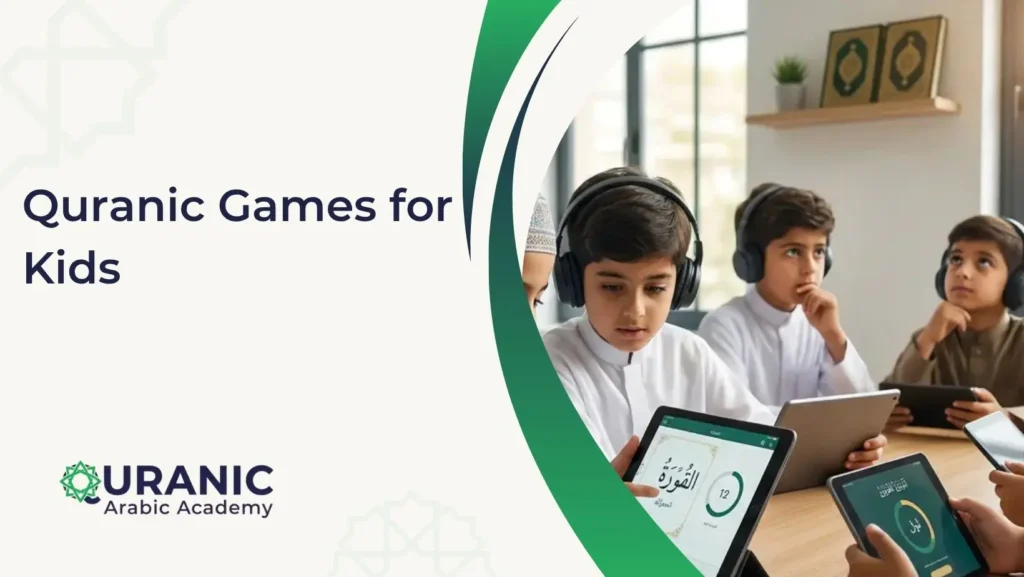
The best Quranic games for kids close that gap by making Arabic letters, vocabulary, and meaning genuinely engaging — without turning the Quran into entertainment. When done correctly, play becomes one of the most powerful tools for Quranic comprehension a parent can use at home.
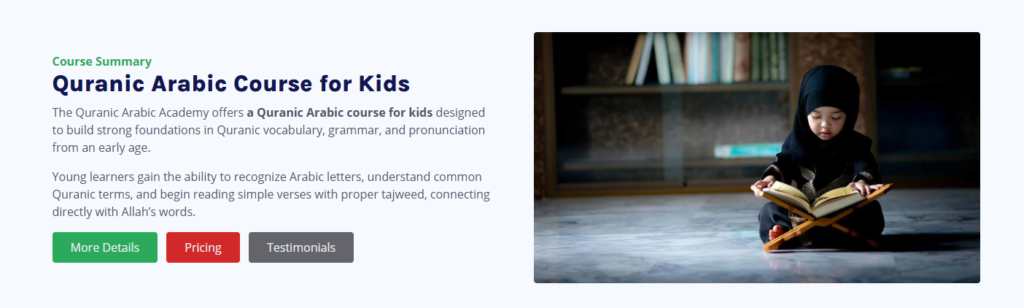
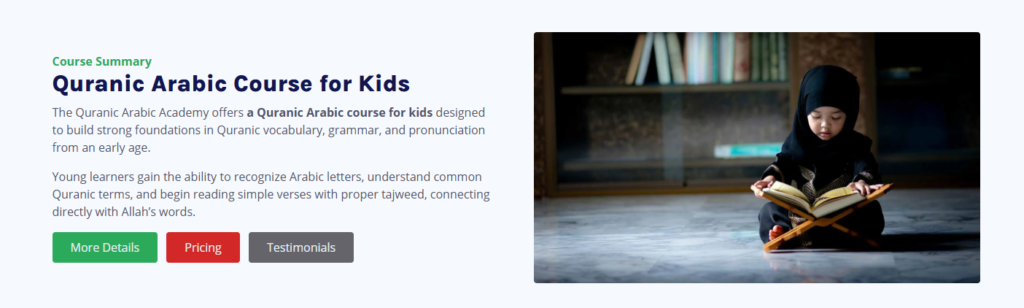
Our Quranic Arabic Course for Kids at The Quranic Arabic Academy pairs exactly this kind of structured, play-enriched learning with certified instruction — giving children both the joy of discovery and the rigour of genuine Arabic language acquisition.
Enroll Your Kid in Our Quranic Arabic Course for Kids with a Free Trial
1. Arabic Letter Flashcard Matching Builds the Foundation Every Child Needs
Letter recognition is the non-negotiable starting point for every young Quranic Arabic learner. In this game, pairs of Arabic letter cards are spread face-down on a table. Children take turns flipping two cards to find matching letters — a classic memory game format applied directly to the Quranic Arabic alphabet.
This game trains visual discrimination between letters that non-Arabic-speaking children consistently confuse.
At The Quranic Arabic Academy, our instructors find that children regularly mix up ب, ت, and ث in early lessons — precisely because these three letters share the same base shape with only dot-count differences.
A dedicated matching game isolates that confusion and resolves it through repetition disguised as play.
How to run it:
- Print or purchase two identical sets of Arabic letter cards
- Include both isolated and word-initial forms as children advance
- Add a simple pronunciation rule: the child must say the letter aloud before the match counts
The table below shows which letter groups to prioritize in early rounds, based on common confusion patterns our instructors observe:
| Confusion Group | Letters | Key Distinguishing Feature |
| Dot-count siblings | ب / ت / ث | 1 dot below / 2 dots above / 3 dots above |
| Looped letters | ج / ح / خ | dot inside / no dot / dot above |
| Tail variations | د / ذ | no dot / one dot above |
| Extended forms | ر / ز | no dot / one dot above |
| Complex pairs | س / ش | no dots / three dots above |
2. Quranic Vocabulary Bingo Turns Word Recognition into Joyful Competition
Vocabulary Bingo uses custom bingo cards printed with common Quranic Arabic words — in Arabic script, transliteration, or English meaning, depending on the child’s level. A caller reads out the Arabic word or its meaning, and children mark their cards accordingly.
This game directly addresses one of the most powerful shortcuts in Quranic comprehension: the most common words in the Quran. Words like اللَّه, رَبّ (Lord), عَلَى (upon), and مِن (from) appear hundreds of times across the Quran.
A child who learns thirty of the highest-frequency Quranic words through repeated Bingo rounds will begin to recognize meaningful portions of every Surah they recite.
Game variations by level:
- Beginners: Cards show Arabic script + English meaning; caller reads meaning only
- Intermediate: Cards show Arabic script only; caller reads meaning only
- Advanced: Cards show English meaning only; caller reads Arabic script aloud
Shots Videos from Our Courses
Ready to Begin Your Quranic Journey?
Start learning with professional instructors through our structured curriculum.
Book Your Free Trial3. Surah Puzzle Reconstruction Strengthens Memorization Without Pressure
In this game, a short Surah — Al-Ikhlas, Al-Falaq, or Al-Asr work beautifully — is printed in large, clear Arabic script and cut into individual ayah (verse) strips. Children receive a shuffled set of strips and race to reassemble the Surah in correct order.
This activity reinforces tarteel awareness — the understanding that Quranic Surahs have a specific, fixed sequence — while building comfort with written Arabic text.
Critical rule: The printed strips are working worksheets, not the Mushaf itself. They are treated with respect — never placed on the floor, stepped over, or treated carelessly.
Our instructors at The Quranic Arabic Academy note that this game is particularly effective for children who have memorized a Surah aurally but cannot yet recognize it in written form. The puzzle format bridges that gap gently, building written-Arabic confidence alongside existing memorization.
Meet our certified Quranic Arabic teachers

4. Arabic Word Roots Sorting Game
This is a more advanced game for children aged nine and above who have developed basic Arabic letter recognition. Root-word cards are created from a single three-letter root — for example ك-ت-ب (related to writing) — and children sort word cards that belong to that root family from those that do not.
Understanding why Quranic Arabic is built on a triliteral root system — where related words share a three-letter core — gives children a powerful mental framework.
When a child recognizes that كَتَبَ (he wrote), كِتَاب (book), and مَكْتُوب (written) all share the same root, Arabic stops feeling like random memorization and starts feeling like a logical system.
The table below shows four beginner-friendly root sets appropriate for children’s sorting games:
| Root | Core Meaning | Sample Words | Quranic Context |
| ك-ت-ب | Writing | كَتَبَ / كِتَاب / كَاتِب | Al-Baqarah 2:2 — الكِتَابُ |
| ع-ل-م | Knowledge | عَلِمَ / عِلْم / عَالِم | Al-Baqarah 2:29 — عَلِيم |
| ر-ح-م | Mercy | رَحِمَ / رَحْمَة / رَحِيم | Al-Fatiha 1:3 — الرَّحِيم |
| ع-ب-د | Worship | عَبَدَ / عِبَادَة / عَبْد | Al-Fatiha 1:5 — نَعْبُدُ |
Read also: Interactive Quranic Quizzes on the Concept of Trials and Tests
5. Quranic Meaning Charades
Charades — the classic acting game — takes on genuine educational value when the vocabulary comes from Quranic words. Children draw a card showing a Quranic word with its meaning and act it out while others guess.
Words like نُور (light), سَمَاء (sky), مَاء (water), and شَمْس (sun) lend themselves naturally to physical expression.
The learning mechanism here is what educational researchers call embodied cognition — attaching physical movement to a word dramatically increases retention.
A child who stands tall and spreads their arms to act out سَمَاء (sky) will not forget that word. This approach aligns with why learning Quranic Arabic matters: children should connect with Quranic meaning in ways that feel personal and vivid.
Words to use with young children (ages 5–8):
- شَمْس — sun
- قَمَر — moon
- نَار — fire
- جَنَّة — garden/paradise
- مَلَك — angel
Ready to Begin Your Quranic Journey?
Start learning with professional instructors through our structured curriculum.
Book Your Free Trial6. Quranic Arabic Spelling Bee Sharpens Letter-by-Letter Accuracy
A structured spelling bee using Quranic vocabulary words trains children to attend to every letter — including short vowel markers (Harakaat) — rather than processing words as rough shapes. The instructor or parent reads the Arabic word aloud; the child spells it letter by letter in Arabic.
This game is more demanding than it appears. Non-Arabic-speaking children habitually process written words holistically — recognizing the general shape rather than attending to each letter. A spelling bee forces letter-by-letter precision, which is exactly the habit required for accurate Quranic recitation and reading.
At The Quranic Arabic Academy, our Quranic Arabic Course for Kids incorporates this kind of precision-training activity within 1-on-1 sessions — because a certified instructor can immediately identify and correct the specific letters a child misreads, something group settings cannot reliably deliver.
Enroll Your Kid in Our Quranic Arabic Course for Kids with a Free Trial
7. Ayah Completion Call-and-Response Games
In this activity, an adult begins an ayah and the child completes it — spoken aloud, never written on disposable materials.
This is among the most time-honoured formats for Quranic memorization across Islamic history, used in traditional kuttab (Quranic schools) for centuries.
اهْدِنَا الصِّرَاطَ الْمُسْتَقِيمَ
Ihdinas-siraatal mustaqeem
“Guide us to the straight path.” (Al-Fatiha 1:6)
A parent says اهْدِنَا الصِّرَاطَ — and waits. The child completes: الْمُسْتَقِيمَ. Simple, reverent, and extraordinarily effective for cementing short Surahs in young memory.
As children advance, combine this with meaning-awareness: ask the child what the completed word means before moving to the next ayah.
8. Arabic Alphabet Hopscotch
Draw Arabic letters in hopscotch squares using chalk outdoors, or use large printed letter mats indoors. Children hop to a square and must name the letter before proceeding. Advanced rounds require the child to name a Quranic word beginning with that letter.
Physical movement paired with letter recall has been shown in educational research to strengthen memory consolidation in children aged four to ten.
This game is particularly effective for kinesthetic learners — children who absorb information better through movement than through seated study.
For families beginning their child’s Arabic learning journey, understanding how to read Quranic Arabic begins exactly here: with individual letter recognition made automatic.
9. Quranic Word Meaning Quiz Bowl
Divide children into two teams. A moderator reads a Quranic word in Arabic; the first team to buzz in and give the correct meaning wins a point. This format works beautifully for groups of four to twelve children at Islamic schools, weekend programmes, or home study groups.
The competitive element activates a different kind of attention than individual study. Children who might disengage during solo review are suddenly fully focused — not wanting to let their team down.
Our instructors have consistently observed that children who participate in team vocabulary games cover three to four times more vocabulary per session than children working through word lists alone.
For parents wondering how long it takes to learn Quranic Arabic, vocabulary acquisition speed is one of the biggest variables — and team games accelerate it measurably.
Ready to Begin Your Quranic Journey?
Start learning with professional instructors through our structured curriculum.
Book Your Free TrialRead Also: Quranic Stories for Kids
10. Listening and Pointing Games with Quranic Audio
Play a short recitation of a Surah the child is memorizing and ask them to point to the correct word on a vocabulary card when they hear it.
This trains the connection between heard Arabic and written Arabic — a critical skill that many children develop late because they learn to recite entirely by ear.
وَقُل رَّبِّ زِدْنِي عِلْمًا
Wa qur rabbi zidnee ‘ilma
“And say, ‘My Lord, increase me in knowledge.'” (Ta-Ha 20:114)
This du’a captures the spirit of every activity on this list — learning Quranic Arabic is an act of seeking knowledge, and every game a child plays in pursuit of understanding Allah’s words carries that intention.
Read Also: Best Quranic Apps
Our Students Reviews
Ready to Begin Your Quranic Journey?
Start learning with professional instructors through our structured curriculum.
Book Your Free TrialGive Your Child Structured Quranic Arabic Learning Alongside These Games
Games build enthusiasm — structured instruction builds mastery. The activities above are most powerful when paired with consistent, qualified teaching that gives children the grammatical and vocabulary framework to understand what they are playing with.
The Quranic Arabic Academy’s Quranic Arabic Course for Kids offers:
- Certified instructors with 25+ years of Arabic teaching experience
- Personalized 1-on-1 sessions tailored to each child’s pace
- Proprietary Al-Menhaj curriculum designed for non-native speakers
- Flexible scheduling available 24/7 for global families
- A Free Trial lesson — no commitment required
Book your child’s free trial today and let them experience Quranic Arabic learning that is both rigorous and joyful.
Check out our top courses to start learning Quranic Arabic today:
- Quranic Arabic Grammar Course
- Arabic Courses for Understanding the Quran
- Quranic Arabic for Beginners
- Online Quranic Arabic Classes for Adults
- Quranic Arabic Course for Kids
- Quranic Arabic Course for Sisters
- Online Quranic Arabic Courses for Advanced Learners
Your first class is completely free. Start Learning Quranic Arabic courses Today.

Conclusion
Every game on this list is a seed. What it grows into depends on the soil — the consistent, structured Arabic language education that surrounds it. Children who play these games and study with qualified instructors do not just memorize Surahs; they begin to understand them.
The benefits of reading the Quran daily multiply when recitation is accompanied by genuine comprehension. A child who understands الرَّحْمَٰنِ الرَّحِيمِ is not just reciting — they are addressing Allah by His attributes.
That understanding, built through patient learning and joyful engagement, is among the greatest gifts a parent can give. May Allah make it easy for every family pursuing it. Ameen.
Read Also: The Main Quranic Teachings
Frequently Asked Questions About Quranic Games for Kids
What Age Is Appropriate to Start Quranic Arabic Games with Children?
Children as young as three can engage with Arabic letter colouring and listening games. Vocabulary-based games suit ages five and above, while root-word sorting and spelling games are appropriate from age eight or nine. The key is matching game complexity to the child’s current Arabic letter recognition level, not just their age.
Can Quranic Games Replace Formal Arabic Instruction for Children?
Quranic games support learning — they cannot replace structured instruction. Games build vocabulary exposure, letter familiarity, and enthusiasm. Formal instruction with a qualified teacher builds the grammatical framework that gives those individual words meaning and context. At The Quranic Arabic Academy, both are used together for the strongest results.
How Do I Ensure These Games Respect the Sanctity of the Quran?
Never use the Mushaf as a game component. Print worksheets for activities, use audio recordings respectfully, and treat all materials containing Quranic text with care at all times. Ensure children understand from the beginning that Quranic words are honoured — the games are in service of understanding Allah’s words, not entertainment at their expense.
Which Quranic Words Should Children Learn First Through Games?
Begin with the highest-frequency words that appear across the most Surahs — اللَّه, رَبّ (Lord), رَحِيم (Most Merciful), عَلَى (upon), and مِن (from). Focusing on the most common words in the Quran gives children maximum comprehension return for their early vocabulary effort.
How Do Quranic Arabic Games Connect to Long-Term Quran Understanding?
Games build the early vocabulary and letter-recognition foundation that formal Quranic grammar study builds upon. A child who enters structured Arabic instruction already knowing thirty high-frequency Quranic words progresses significantly faster than one starting with no vocabulary base at all. Games and formal study are two parts of the same path.
Related Articles
Quranic Resources & Apps





Leave a Reply