 Learn Quranic Arabic

| Key Takeaways |
| Peer-based Quranic Arabic study groups accelerate vocabulary retention because learners actively explain concepts, reinforcing their own understanding simultaneously. |
| Accountability structures in study circles reduce dropout rates significantly — students who study alone abandon structured learning far more often than those in groups. |
| Discussing Quranic grammar rules aloud with peers exposes pronunciation and comprehension gaps that silent, solitary study almost never surfaces. |
| A well-structured peer session should include recitation practice, grammar review, and vocabulary drilling — not informal discussion alone. |
| Combining peer learning with qualified instructor guidance produces the strongest outcomes, as peers cannot reliably correct each other’s Arabic pronunciation errors. |
You open the Quran after Fajr, determined to understand what you’re reciting. You work through a few lines, feel uncertain about a grammatical structure, and close the Mushaf without resolution. Sound familiar? That loop — effort, confusion, isolation, frustration — is exactly where most individual Quranic Arabic learners get stuck.
Quranic learning with peers breaks that cycle at its root. When two or more students engage the same Quranic text together — reviewing vocabulary, testing each other on grammar, discussing verse meaning — the comprehension process shifts from passive absorption to active construction.
That shift is not motivational. It is neurological, pedagogical, and, I would argue, spiritually coherent with how the Companions themselves studied the Quran.
Why Does Quranic Learning with Peers Produce Faster Results Than Studying Alone?
Peer-based Quranic Arabic study accelerates progress because explaining a concept forces the explainer to consolidate their own understanding. When a student teaches the Idafa construction to a classmate, they are not simply repeating information — they are rebuilding it under scrutiny.
Our instructors at The Quranic Arabic Academy consistently observe that students who participate in weekly peer review sessions retain new vocabulary roughly three times longer than those who study from flashcard lists in isolation.
The mechanism here is called retrieval practice — and peer settings trigger it naturally. When your study partner asks, “What is the Fa’il in this verse?” you cannot bluff through it. You either know or you discover you don’t.
That moment of productive struggle — followed by resolution — is where durable learning happens.
At The Quranic Arabic Academy, students enrolled in our online Quranic Arabic classes for adults are actively encouraged to form peer review groups between 1-on-1 sessions. The results speak clearly: those who do consistently arrive at the next session with stronger recall and sharper questions.
Join our Quranic Arabic Courses for Advanced Learners with a Free Trial

What Should a Productive Quranic Arabic Peer Study Session Look Like?
A productive peer session has a clear structure — open it with a short recitation segment, move into vocabulary review, then grammar, and close with a brief comprehension discussion.
Without structure, peer sessions drift into general Islamic conversation, which is valuable but not the same as language acquisition.
The table below outlines a recommended 60-minute session format that our instructors suggest to peer groups at The Quranic Arabic Academy:
Use this framework as your default session blueprint — modify the time allocation based on your group’s current focus area.
| Session Block | Activity | Duration |
| Opening Recitation | Read 3–5 verses aloud; peers listen and note errors | 10 minutes |
| Vocabulary Drilling | Quiz each other on the week’s most common Quranic words | 15 minutes |
| Grammar Review | Work through one grammatical concept together | 20 minutes |
| Verse Analysis | Apply grammar to a specific Quranic passage | 10 minutes |
| Wrap-Up Discussion | Note unresolved questions for the instructor | 5 minutes |
That final block — the unresolved questions list — is one of the most underrated tools in peer learning. It transforms confusion from a dead end into a directed inquiry, which your qualified instructor can then address precisely.
Shots Videos from Our Courses
Ready to Begin Your Quranic Journey?
Start learning with professional instructors through our structured curriculum.
Book Your Free TrialHow Does Peer Discussion Improve Quranic Arabic Grammar Understanding?
Discussing Quranic grammar out loud with a peer forces you to verbalize the grammatical chain you usually process silently. Identifying the Mubtada’ and Khabar in a nominal sentence, or tracing the I’rab (case endings) across a verse, requires a level of articulacy that solitary study rarely demands. When you must explain it, imprecision becomes immediately visible.
One of the most consistent patterns I have observed across years of instruction: students who study Quranic Arabic purely through reading and writing frequently develop what I call “silent grammar knowledge” — they can identify a structure when prompted but cannot articulate why it is correct. Peer explanation forces that knowledge to become explicit.
For example, students who come from English-speaking backgrounds often conflate the Arabic dual form with the sound masculine plural, because both involve a final waw-nun (ون / ان) sequence.
In solo study, this confusion can persist for months. In a peer setting, attempting to explain the distinction to someone else — and encountering their follow-up questions — typically resolves it within a single session.
If your group is working through foundational grammar, our Quranic Arabic grammar course provides the structured framework that makes peer grammar discussions genuinely productive rather than circular.
Your First class is free. Join our Quranic Arabic Grammar Course now

What Are the Spiritual Dimensions of Quranic Learning with Peers?
Peer Quranic study is not a modern pedagogical invention — it is a return to how revelation was transmitted. The Companions, may Allah be pleased with them, studied the Quran in gatherings, revisited verses together, and held each other accountable to what they had memorized and understood. The concept of the halaqah (study circle) is deeply rooted in Islamic tradition.
Allah (SWT) says in Surah Yusuf:
إِنَّا أَنزَلْنَاهُ قُرْآنًا عَرَبِيًّا لَّعَلَّكُمْ تَعْقِلُونَ
Inna anzalnahu Qur’anan ‘Arabiyyan la’allakum ta’qiloon
“Indeed, We have sent it down as an Arabic Qur’an that you might understand.” (Yusuf 12:2)
The purpose stated — that you might understand — is communal in its grammar. The Arabic ta’qiloon addresses a plural audience. The Quran was not revealed for isolated reading; its comprehension was always envisioned as a shared pursuit.
Knowing why learning Quranic Arabic matters gives your peer study group a shared sense of purpose that sustains motivation long past the initial enthusiasm.
What Are the Limits of Peer Learning in Quranic Arabic?
Quranic learning with peers has real limits — and being clear about them is what makes the peer model genuinely useful rather than misleading. Peers can strengthen vocabulary recall, reinforce grammar through discussion, and provide motivation.
Peers cannot reliably correct each other’s Tajweed errors, verify Arabic pronunciation, or resolve genuine scholarly questions about grammatical analysis.
This distinction matters more than most students initially realize. Arabic pronunciation errors in Quranic recitation compound silently when unchecked. A peer who also mispronounces the letter ض (Dad) cannot correct that error in you — they will simply confirm it.
The same applies to case-ending analysis: if both students in a peer group misunderstand a grammatical rule, their agreement with each other produces false confidence, not comprehension.
The table below maps which learning tasks are suited to peer collaboration versus which require qualified instructor oversight:
Understanding this division helps peer groups focus their time where it produces the most value — and know when to defer to a qualified teacher.
| Learning Task | Peer Setting | Qualified Instructor Required |
| Vocabulary memorization drilling | ✅ Highly effective | Optional for reinforcement |
| Grammar concept discussion | ✅ Useful for consolidation | ✅ For initial teaching and error correction |
| Tajweed and pronunciation | ❌ Risk of reinforcing errors | ✅ Essential |
| Verse analysis and I’rab | ✅ With structured method | ✅ For verification |
| Understanding word roots (Sarf) | ✅ Peer drilling works well | ✅ For pattern introduction |
| Scholarly disagreements in grammar | ❌ Beyond peer scope | ✅ Essential |
For Tajweed, pronunciation, and grammatical verification, the 1-on-1 sessions at The Quranic Arabic Academy with our certified linguists and instructors with 25+ years of experience provide precisely what peer study cannot.
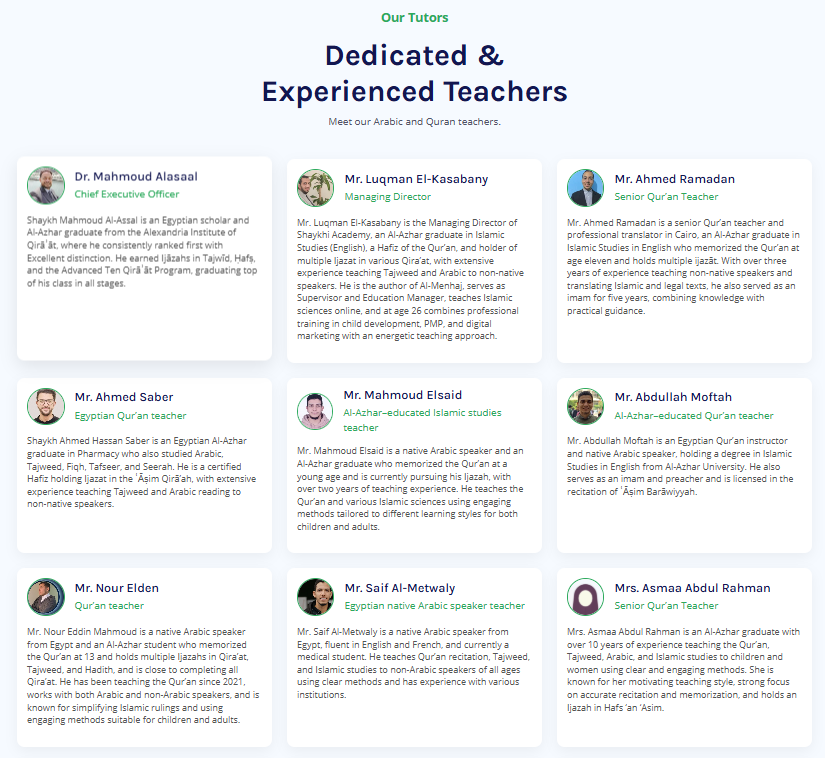
Meet our certified Quranic Arabic teachers
Read Also: Quranic Scientific Miracles
How Can Beginners Use Peer Learning to Build Quranic Arabic from Zero?
Beginners can absolutely engage in peer-based Quranic learning, but the starting point must be correct Arabic reading — not grammar discussion. A peer group built on students who cannot yet read Arabic script fluently will produce confusion, not learning. The foundation comes first.
If your group is at the absolute beginner stage, the priority is learning to read Quranic Arabic script accurately before any grammar or vocabulary work begins.
Our Quranic Arabic for beginners course — built on the Al-Menhaj Book curriculum authored by Luqman ElKasabany — is specifically designed for non-native speakers who need a proper reading foundation before vocabulary and grammar work can begin.
Enroll in Our Quranic Arabic for Beginners with a Free Trial

Once your group can read independently, peer sessions become immediately productive. You can drill the Quranic Arabic alphabet together, test reading fluency on unfamiliar passages, and begin vocabulary work on high-frequency words.
Learning how to read Quranic Arabic fluently is the foundational milestone your peer group needs before deeper comprehension work begins.
Read Also: Fulfilled Quranic Prophecies
How Do You Find and Maintain a Quranic Arabic Study Group?
Finding a peer group for Quranic Arabic learning is more accessible now than it has ever been. Online platforms, local masjid circles, and structured virtual study communities all provide entry points. The more important question is not where to find a group but how to sustain one.
Three principles sustain Quranic study circles long-term.
First, shared level — a group spanning beginner and advanced learners quickly becomes frustrating for both ends.
Second, scheduled consistency — a weekly session at a fixed time produces far better results than irregular meetings whenever schedules align.
Third, a shared curriculum anchor — groups that follow a specific learning progression, such as the Al-Menhaj Book stages, have a clear next step in every session and never run out of structured material.
Groups that drift into open-ended discussion without a curriculum anchor tend to dissolve within two to three months. Groups with a curriculum anchor — and a qualified instructor available for their unresolved questions — tend to sustain indefinitely, and often become the most enriching part of a student’s Quranic Arabic development.
Our Students Reviews
Ready to Begin Your Quranic Journey?
Start learning with professional instructors through our structured curriculum.
Book Your Free TrialRead Also: Quranic Stories in English
Start Deepening Your Quranic Arabic with The Quranic Arabic Academy
Peer study accelerates your Quranic Arabic progress — but only when it is anchored to qualified instruction. The Quranic Arabic Academy offers personalized 1-on-1 sessions with certified Arabic linguists who have 25+ years of experience teaching non-native speakers. Our programs cover:
- Quranic Arabic Grammar Course — structured Nahw and Sarf for real comprehension
- Online Quranic Arabic Classes for Adults — flexible scheduling, 24/7 availability
- Quranic Arabic for Beginners — built on the proprietary Al-Menhaj Book curriculum
- Quranic Arabic Course for Kids — age-appropriate, expert-led instruction
Book your free trial lesson and let your peer learning group have the qualified anchor it needs to grow.
Check out our top courses to start learning Quranic Arabic today:
- Quranic Arabic Grammar Course
- Arabic Courses for Understanding the Quran
- Quranic Arabic for Beginners
- Online Quranic Arabic Classes for Adults
- Quranic Arabic Course for Kids
- Quranic Arabic Course for Sisters
- Online Quranic Arabic Courses for Advanced Learners
Your first class is completely free. Start Learning Quranic Arabic courses Today.

Conclusion
Peer learning does not replace the teacher — it multiplies what the teacher builds. The understanding you consolidate in a study circle, the vocabulary you drill with a friend, the grammar question you wrestle with together: all of it becomes more durable when it is verified by someone who can see exactly what you got right and precisely where you went wrong.
The Companions studied the Quran in gathering and in verification — never in isolation from accountability. That model has not become obsolete. If anything, it is more available to you now than at any point in history.
Begin with one honest peer, one structured session per week, and one qualified instructor to anchor both. The rest builds from there, Insha’Allah.
Ready to Begin Your Quranic Journey?
Start learning with professional instructors through our structured curriculum.
Book Your Free TrialRead Also: Online Quranic Studies
Frequently Asked Questions About Quranic Learning with Peers
Can Quranic Arabic peer study replace formal instruction?
No. Peer study supplements formal instruction — it does not replace it. Peers can drill vocabulary, discuss grammar concepts, and hold each other accountable. However, they cannot reliably correct Tajweed errors, introduce grammatical concepts accurately, or resolve scholarly grammatical disputes. Qualified instructor oversight remains essential for pronunciation accuracy and correct grammatical analysis.
How many people make an ideal Quranic Arabic study group?
Two to four students is the most effective range for Quranic Arabic peer learning. Smaller groups allow each member to engage actively in every session, practice speaking Arabic aloud, and receive attentive peer feedback. Larger groups tend to reduce individual speaking time and allow quieter members to disengage without accountability.
What topics should a beginner peer group focus on first?
A beginner peer group should prioritize Arabic reading fluency before any grammar or vocabulary discussion. Drilling letter recognition, short vowel reading, and basic syllable formation together builds the foundation that all subsequent Quranic Arabic learning depends on. Grammar discussion is premature until all members can read Arabic script confidently and independently.
How long does it take to see results from peer-based Quranic Arabic study?
Most students notice measurable vocabulary improvement within four to six weeks of consistent weekly peer sessions. Grammar consolidation typically takes longer — two to three months of regular peer review, combined with instructor-led instruction. Individual pace varies based on starting level, session frequency, and whether a qualified instructor is providing the initial teaching that peers then reinforce.
Is online peer study for Quranic Arabic as effective as in-person?
Online peer study is highly effective for vocabulary drilling, grammar discussion, and accountability — all of which transfer well to video platforms. The main limitation is pronunciation feedback: it is harder to detect subtle Tajweed errors through audio alone. In-person recitation with a qualified instructor remains preferable for pronunciation correction, but online peer sessions are a practical and productive complement to structured learning.
Related Articles
Learn Quranic Arabic







Leave a Reply