 Quran
Quran
You worry about your child’s grades, screen time, and friends, but how often do you ask whether their heart knows Allah? Muslim parents may focus heavily on Ta’lim, teaching information, while overlooking Quranic Tarbiyah, the deeper process of nurturing faith, character, and a living connection to Allah. This article explores the meaning of tarbiyah in Islam, the lessons of Quranic Tarbiyah from Surah Luqman, and practical ways to apply them at home.
Tarbiyah Meaning in Islam Is Broader Than Education
Most parents use the word tarbiyah to mean “upbringing.” The classical scholars gave it a far richer definition. The Arabic root of tarbiyah, Rabb-Ba-Ya, carries three connected meanings in the language of the Quran:
| Root Meaning | Application in Tarbiyah |
| Al-Tarbiyah (nurturing) | Raising something from its weakest state to its fullest potential |
| Al-Tanmi’yah (growth) | Developing every dimension: body, mind, soul, and character |
| Al-Islah (reform) | Continuously correcting faults and purifying the self |
The scholars of the early generations understood Quranic tarbiyah as something Allah Himself performs with His creation. The name “Al-Rabb” — the Lord and Sustainer — shares the same root as tarbiyah. When the Prophet (PBUH) said “Addabani Rabbi fa ahsana ta’dibi” (My Lord gave me tarbiyah, and He made my tarbiyah excellent), he pointed to the highest source of all true education.
Tarbiyah education in Islam therefore encompasses five inseparable dimensions:
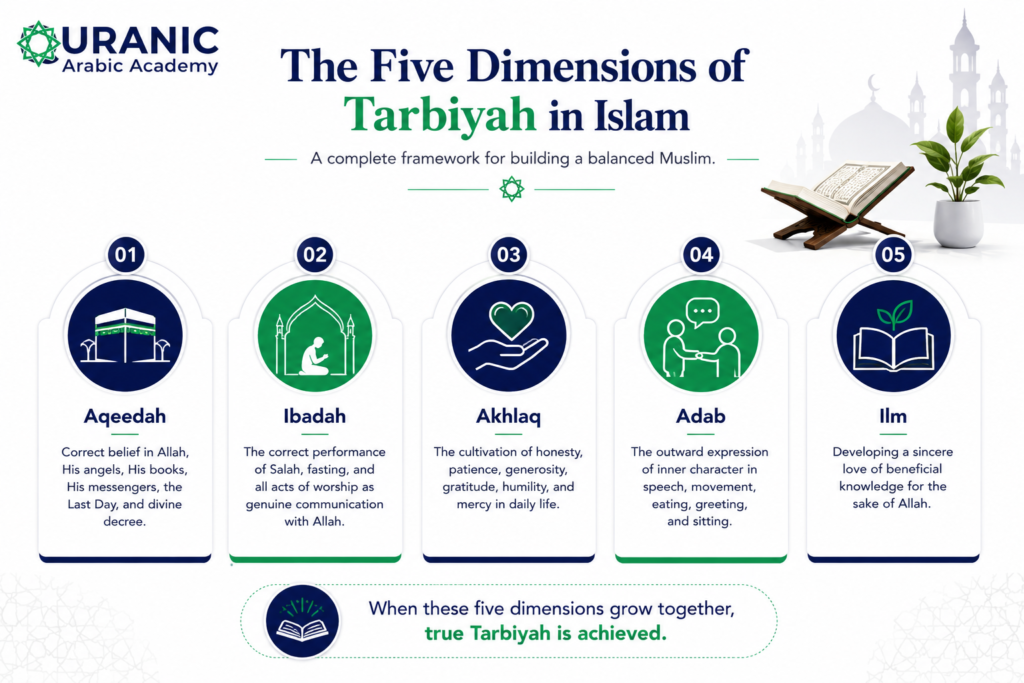
- Aqeedah: correct belief in Allah, His angels, His books, His messengers, the Last Day, and divine decree.
- Ibadah: the correct performance of Salah, fasting, and all acts of worship as genuine communication with Allah.
- Akhlaq: the cultivation of honesty, patience, generosity, gratitude, humility, and mercy in daily life.
- Adab: the outward expression of inner character in speech, movement, eating, greeting, and sitting.
- Ilm: developing a sincere love of beneficial knowledge for the sake of Allah.
Quranic tarbiyah is what holds all five together. Without the Quran at the center, each dimension risks becoming a performance rather than a reality.
Many parents want to give their children Quranic tarbiyah but cannot yet read Arabic fluently themselves. The Quranic Arabic for Beginners course at The Quranic Arabic Academy offers structured, one-on-one live sessions designed specifically for adults reclaiming their connection to the Book of Allah.
Your tarbiyah begins with your own recitation.
Read also: Quranic Revelation: The Complete 3 Stages and 23-Year Timeline
The Divine Command That Makes Quranic Tarbiyah Obligatory
Before any discussion of method, every Muslim parent must understand the foundation. Allah did not make Quranic tarbiyah optional. He made it a direct obligation in the Quran:
“ يَا أَيُّهَا الَّذِينَ آمَنُوا قُوا أَنفُسَكُمْ وَأَهْلِيكُمْ نَارًا وَقُودُهَا النَّاسُ وَالْحِجَارَةُ “
Ya ayyuha alladhina amanu qu anfusakum wa ahleekum naran waqooduha al-nasu wal-hijarah.
“O you who have believed, protect yourselves and your families from a Fire whose fuel is people and stones.”
Ibn Kathir explained in his Tafsir that the word “qoo” — protect — is an urgent active imperative. It is not a suggestion. The scholars of Tafsir, including Imam al-Tabari, stated clearly that protecting the family includes educating them in their religion, correcting their behavior, and instilling the love and fear of Allah in their hearts. This is the foundation of Quranic tarbiyah.
The Prophet (PBUH) reinforced this obligation from a different angle. He said in Sahih al-Bukhari (Hadith 1385):
“كُلُّ مَوْلُودٍ يُولَدُ عَلَى الْفِطْرَةِ، فَأَبَوَاهُ يُهَوِّدَانِهِ أَوْ يُنَصِّرَانِهِ أَوْ يُمَجِّسَانِهِ”
“Every child is born with a true faith of Islam (i.e. to worship none but Allah Alone) and his parents convert him to Judaism or Christianity or Magianism.”
This hadith carries a double message. It is a profound assurance: your child began with pure Fitrah, oriented toward Tawheed. And it is a serious warning: what you do next determines everything. Quranic tarbiyah is how parents protect that Fitrah and develop it into a living, practiced faith.
Read also: Learning Quranic Arabic for Complete Beginners: A Step-by-Step Guide
The Quranic Tarbiyah Syllabus Is Preserved in Surah Luqman
Allah did not leave parents to guess what Quranic tarbiyah looks like in practice. He preserved the most complete practical model in Surah Luqman, verses 13 to 19. Luqman was not a prophet. Ibn Kathir recorded the consensus of the early scholars: he was a righteous wise man, described by many of the Salaf as an Ethiopian slave who was a carpenter, upon whom Allah bestowed Hikmah. Allah chose his words to his son as the eternal model of Quranic tarbiyah for every parent.
The Quranic tarbiyah syllabus from Surah Luqman follows a precise sequence:
| Lesson | Verse | Content |
| 1. Tawheed | 31:13:00 | Never associate anything with Allah in worship |
| 2. Allah’s Awareness | 31:16:00 | Allah sees every deed, however small, wherever it occurs |
| 3. Salah | 31:17:00 | Establish the prayer consistently |
| 4. Amr bil Ma’ruf | 31:17:00 | Command the good in your community |
| 5. Nahy anil Munkar | 31:17:00 | Forbid the evil with conviction |
| 6. Patience | 31:17:00 | Bear whatever befalls you with steadfastness |
| 7. Adab and Akhlaq | 31:18-19 | Walk with humility, lower your voice, avoid arrogance |
Notice the sequence. Luqman did not begin with manners. He began with Aqeedah. He did not begin with rules. He began with the heart’s relationship with Allah. This is the defining feature of adab and akhlaq Quranic tarbiyah: outward character is built on inward faith, not the reverse.
The tone of Luqman’s address is equally instructive. He used the phrase “Ya bunayya” — O my dear little son — a term of profound tenderness in Arabic. Every lesson came wrapped in love, not fear. This is the method of Quranic tarbiyah: correction through mercy, not through harshness.
Learning to recite these verses correctly so you can teach them to your children is itself a form of Quranic tarbiyah. The Quranic Arabic Course for Kids at The Quranic Arabic Academy provides a structured, nurturing environment where young hearts connect with Allah’s Book through certified instructors and live, one-on-one sessions.
Give your child the foundation of Quranic tarbiyah today.
Quranic Tarbiyah Begins With the Parent’s Self-Development
The most important lesson that Surah Luqman teaches is often the most overlooked. Luqman did not lecture his son from a distance. He lived what he taught. Allah describes him first as a man of Hikmah (31:12) before presenting his advice. A parent cannot give what they do not possess.
The Prophet (PBUH) confirmed this in Sahih al-Bukhari and Muslim through his famous hadith on leadership:
“كُلُّكُمْ رَاعٍ وَكُلُّكُمْ مَسْئُولٌ عَنْ رَعِيَّتِهِ”
“Everyone of you is a guardian and is responsible for his charges.”
This hadith places Quranic tarbiyah in the framework of accountability. Every parent is a shepherd. Every parent will be asked. This means the parent’s own tarbiyah education is not separate from the child’s. They run in parallel.
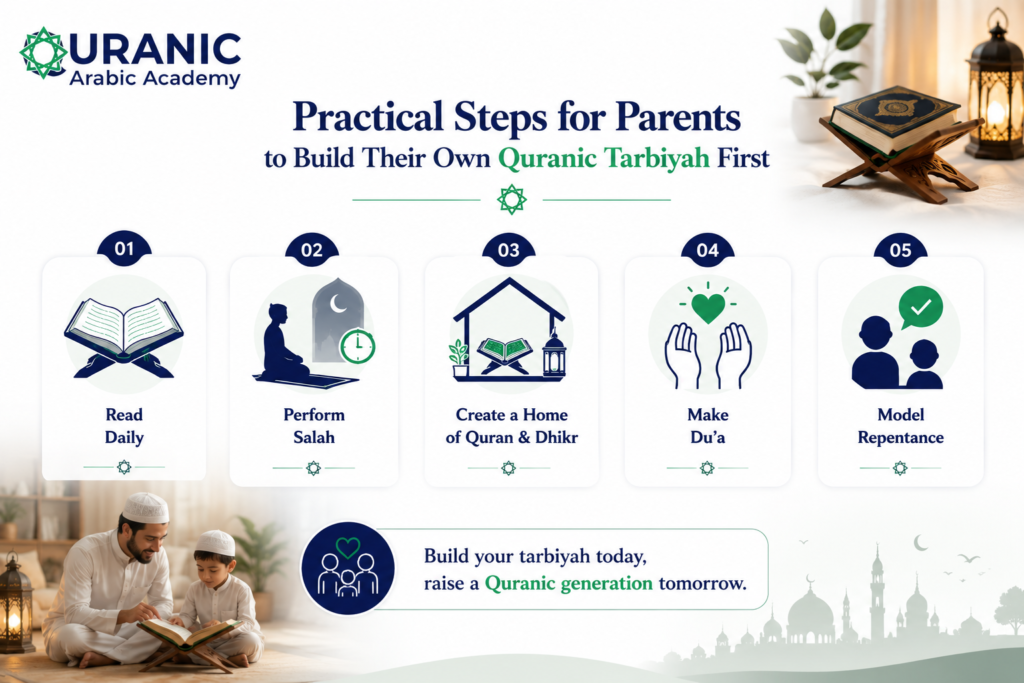
Practical steps for parents to build their own Quranic tarbiyah first:
- Read a portion of the Quran daily with understanding, even one page, not merely for recitation but for reflection.
- Perform the five prayers on time, visibly and consistently, so children absorb Salah as a natural rhythm of life.
- Replace idle entertainment in the home with gatherings of Quran, dhikr, and beneficial conversation.
- Make du’a for your children regularly, starting before they are born as the Prophet (PBUH) directed in authentic narrations.
- Acknowledge mistakes openly in front of children: modeling repentance is itself a lesson in Quranic tarbiyah.
The Prophet (PBUH) said in Sahih al-Bukhari and Muslim: “Nothing is weightier on the Scale of Deeds than good manners.” A parent who models this in the home has already begun the most powerful form of Quranic tarbiyah.
See It in Action:
Wondering what our interactive sessions look like? Click below to peek inside a live session and watch how our expert instructors make learning Quranic Arabic accessible and engaging.
Ready to Begin Your Quranic Journey?
Start learning with professional instructors through our structured curriculum.
Book Your Free TrialApplying the Quranic Tarbiyah Syllabus Lesson by Lesson at Home
Understanding the Quranic tarbiyah syllabus from Surah Luqman is not enough. Each lesson requires a specific daily application. Below is a practical breakdown of how each of Luqman’s seven lessons translates into the home environment.
1- Tawheed (31:13)
Introduce the names and attributes of Allah from the earliest age. When something good happens, say “Alhamdulillah” and explain why. When something difficult happens, say “Allah wills what is best” and explain the meaning. Tawheed in Quranic tarbiyah is not taught through lectures. It is absorbed through the parent’s constant attribution of all affairs to Allah.
2- Allah’s Awareness (31:16)
The verse uses the image of a deed the size of a mustard seed, hidden in a rock or in the heavens or in the earth. Allah will bring it forth. Teach children that behavior in public and in private must be the same, because Allah sees both equally. This is the Quranic foundation of integrity in tarbiyah education.
3- Salah (31:17)
The Prophet (PBUH) commanded in authentic narrations: command your children to pray at seven, and discipline them for it at ten. Salah in Quranic tarbiyah is not presented as a burden. It is presented as a conversation with Allah. Make the prayer corner in the home a place of calm and welcome, not urgency and tension.
4 and 5- Amr bil Ma’ruf and Nahy anil Munkar (31:17)
Teach children to speak up for what is right in their own circle: among siblings, among friends, in school. This begins at home when parents correct each other’s mistakes with gentleness and consistency. Quranic tarbiyah produces morally engaged individuals, not passive observers.
6- Patience (31:17)
Luqman paired patience directly with commanding good and forbidding evil. This is deliberate. Doing right is difficult, and it will meet resistance. Teach children to expect difficulty and to meet it with Sabr, grounded in the understanding that Allah rewards every act of patient obedience.
7- Adab and Akhlaq (31:18-19)
Luqman addressed two specific adab failures: turning the cheek away from people in scorn (arrogance), and raising the voice unnecessarily. The Quran describes the harshest voice as the braying of a donkey. In adab and akhlaq Quranic tarbiyah, good manners are not etiquette: they are acts of worship.
Many families want to pursue Quranic tarbiyah but lack the recitation confidence to lead it at home. The Quranic Arabic Grammar Course at The Quranic Arabic Academy builds the Arabic foundation that gives every parent the confidence to read, understand, and teach the Quran in their home.
Build the recitation foundation your family deserves.
6. The Role of Aisha’s Narration in Understanding Quranic Tarbiyah
One of the most practical insights into the method of Quranic tarbiyah comes from Sayyidah Aisha (may Allah be pleased with her). When asked to describe the character of the Prophet (PBUH), she gave the most precise definition of living Quranic tarbiyah ever recorded. She said, as narrated in Sahih Muslim:
“كَانَ خُلُقُ رَسُولِ اللَّهِ الْقُرْآنُ”
“Allah’s Messenger’s character was the Quran.”
This narration is the definition of Quranic tarbiyah at its highest level. The goal is not to know the Quran. The goal is to become the Quran in character. This is the standard that tarbiyah education in Islam sets for both parent and child.
Sayyidah Aisha also narrated in Sahih al-Bukhari the wisdom behind the gradual nature of Quranic tarbiyah. She explained that if the first revelation had been a prohibition of wine or adultery, the people would have rejected it. Faith had to be rooted first. Only then could law transform behavior. This is the exact same principle that governs Quranic tarbiyah in the home: build Aqeedah and love of Allah first, then introduce rules and structure. Parents who reverse this sequence often produce children who know the rules but feel nothing for Allah.
Read also: Juz Amma Quranic Studies: The Complete Guide
7. Quranic Tarbiyah Books and Resources Parents Can Use
A parent committed to Quranic tarbiyah needs structured support beyond intention. The following resources are drawn from the established tradition of tarbiyah education in Islam:
From the classical tradition, the following works are foundational:
- Surah Luqman (Quran 31:12-19): the primary Quranic tarbiyah syllabus, sufficient for a lifetime of application.
- Riyadh al-Saliheen by Imam al-Nawawi: a curated collection of authentic hadith covering every dimension of character, manners, and worship that forms the backbone of Quranic tarbiyah.
- Al-Adab al-Mufrad by Imam al-Bukhari: a dedicated hadith collection covering adab and akhlaq that every parent engaged in Quranic tarbiyah should study.
Practical Quranic tarbiyah books for daily use include:
- Books on the Names and Attributes of Allah, to teach Aqeedah through love rather than memorization of definitions.
- Age-appropriate Sirah books, since the Prophet’s life is Quranic tarbiyah lived in full.
- Short Tafsir of the Quran’s final Juz, since these Surahs were the first revealed and form the emotional and spiritual foundation of Quranic tarbiyah.
The best Quranic tarbiyah book a family can own is a Quran that is read together, discussed together, and applied together. Everything else supports that center.
Experience Our Teaching Style:
We believe in clarity and engagement. Watch these short highlights from our actual classes to see our teachers’ methodology and student interactions in real-time.
Ready to Begin Your Quranic Journey?
Start learning with professional instructors through our structured curriculum.
Book Your Free TrialStart Building Quranic Tarbiyah With the Right Foundation
Many families want to pursue Quranic tarbiyah but lack the recitation confidence to lead it at home. The Quran Reading Academy offers certified Arab tutors holding Ijazah in recitation, real-time Makharij correction in every session, flexible scheduling across all global time zones, and one-on-one live lessons tailored to each student’s exact level and mistakes.
Whether you are a parent reclaiming your own recitation or enrolling your child for the first time, structured programs serve every need.
Our Arabic Courses
- Quranic Arabic Classes
- Quranic Arabic Course for Beginners
- Online Quranic Arabic Courses for Advanced Learners
- Quranic Arabic Grammar Course
- Arabic Courses for Understanding the Quran
- Quranic Arabic Course for Sisters (Female)
- Quranic Arabic Course for Kids
- Online Quranic Arabic Classes for Adults
- Quranic Arabic Course UK
- Quranic Arabic Course London
- Quranic Arabic Course USA
- Quranic Arabic Course Canada
- Quranic Arabic Course Australia
- Quranic Arabic Course UAE
- Quranic Arabic Course Germany
Start your journey with a free trial today.
Ready to Begin Your Quranic Journey?
Start learning with professional instructors through our structured curriculum.
Book Your Free TrialConclusion
Quranic tarbiyah is not a short-term program but a lifelong journey of guiding the family toward Allah and His Book. Luqman’s advice to his son provides a timeless roadmap: begin with Tawheed, establish Salah, build character, and teach adab with love. Start with the Quran, live its teachings together, and let it shape the character of every person in your home.
Frequently Asked Questions
What does Quranic tarbiyah mean?
Quranic tarbiyah means the holistic nurturing of the self and the family through the Quran and Sunnah, covering faith, worship, character, manners, and knowledge together.
What is tarbiyah meaning in Islam beyond upbringing?
Tarbiyah meaning in Islam includes spiritual formation, intellectual development, moral character (Akhlaq), correct conduct (Adab), and physical care — all rooted in the Quran and the prophetic example.
What is the Quranic tarbiyah syllabus?
The Quranic tarbiyah syllabus is most completely found in Surah Luqman verses 13-19, covering Tawheed, Allah’s awareness, Salah, commanding good, forbidding evil, patience, and humility in character.
How does adab and akhlaq Quranic tarbiyah differ from general manners?
Adab and akhlaq Quranic tarbiyah grounds good manners in Aqeedah and worship, not social convention. It teaches that every act of good character is an act of worship directed to Allah.
What are the best Quranic tarbiyah books for parents?
The most foundational are Surah Luqman itself, Riyadh al-Saliheen by Imam al-Nawawi, and Al-Adab al-Mufrad by Imam al-Bukhari, alongside age-appropriate Sirah and Tafsir resources for children.
Can Quranic tarbiyah be applied to adults nurturing themselves?
Yes. Quranic tarbiyah applies equally to self-development. The Prophet (PBUH) himself received tarbiyah from Allah. Every adult committed to Quran, Salah, and akhlaq is engaged in personal Quranic tarbiyah.




Leave a Reply