 Quran

Learning how to improve Quran recitation is a goal shared by beginners and experienced reciters alike. Correct recitation, known as tilawah, brings together accurate Tajweed rules, clear pronunciation, and a genuine connection to the meaning of the verses. This guide walks you through practical, structured steps you can start using today.
Beautiful recitation is not simply about having a pleasant voice. It is a way of honoring the words of Allah as they were revealed, and of experiencing khushu’ (humility and focus) while reading.
Allah commands measured, deliberate recitation in the Quran itself, and the Prophet Muhammad ﷺ encouraged reciters to beautify their voices when reading the Quran.
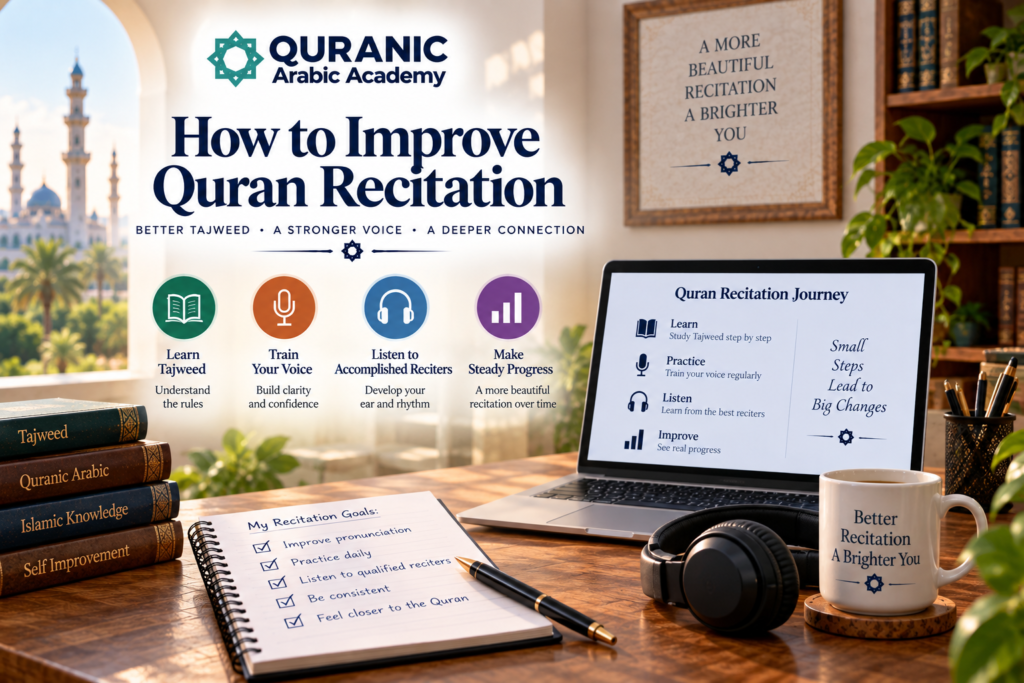
1. Learn the Correct Tajweed Rules First
Tajweed is the set of rules that governs how each Arabic letter of the Quran should be pronounced during recitation. It covers several important areas, including the correct articulation points (Makharij al-Huruf).
the characteristics of individual letters, vowel and elongation sounds, and the way certain letters interact when they appear next to one another. Learning these principles helps you give every letter its proper sound instead of relying only on imitation or guessing from the written text.
Correct Tajweed is particularly important because Arabic contains letters with very similar sounds but different articulation points and characteristics. Confusing letters, shortening or extending a vowel incorrectly, or overlooking features such as Ghunnah, Madd, Qalqalah, or Shaddah can affect the sound of a Quranic word and, in some cases, may alter its meaning.
Developing correct pronunciation from the beginning also prevents repeated mistakes from becoming difficult habits to correct later.
For beginners, this does not mean memorizing every advanced Tajweed rule at once. Start with the rules you encounter most frequently, practice them through short Quranic examples, and listen carefully to how a skilled reciter applies them.
Combining this practice with correction from a qualified Quran teacher can help you recognize mistakes more quickly and gradually develop clearer, more accurate, and more confident Quran recitation.
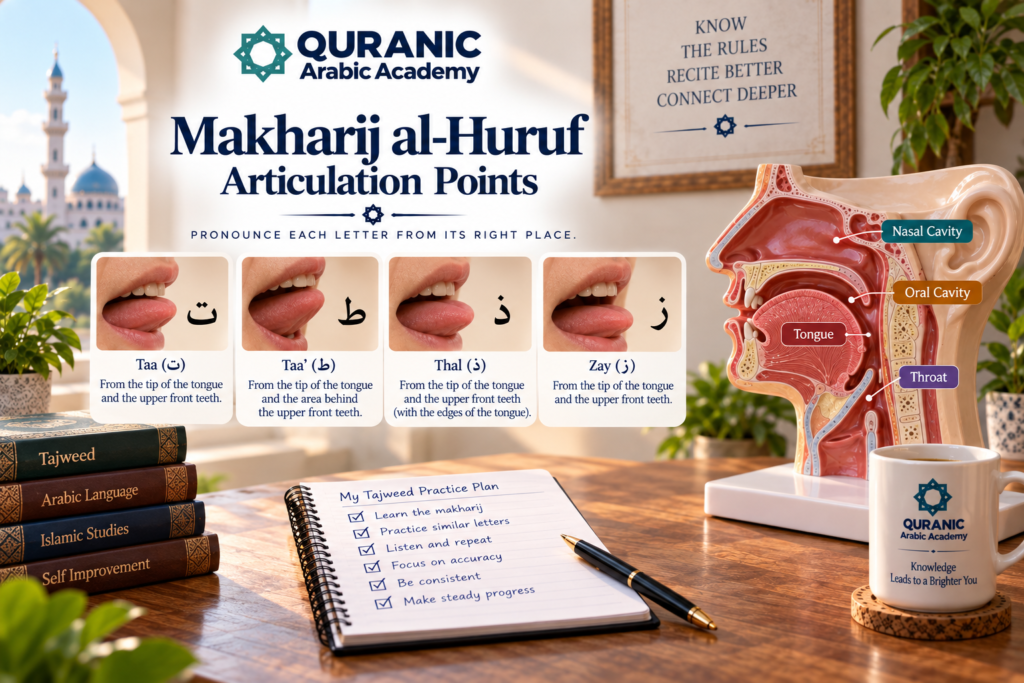
Makharij al-Huruf: Articulation Points
Makharij al-huruf refers to the exact point in the mouth or throat from which each Arabic letter is pronounced.
Letters such as ط (taa’) and ت (taa) or ذ (thal) and ز (zay) sound similar to untrained ears but come from different articulation points and must not be confused.
- Practice minimal pairs of similar-sounding letters slowly and out loud.
- Use a mirror or recording to check that your tongue and lips are positioned correctly.
- Ask a teacher to listen specifically for articulation errors, since these are the hardest to notice in your own voice.
Core Tajweed Rules for Beginners
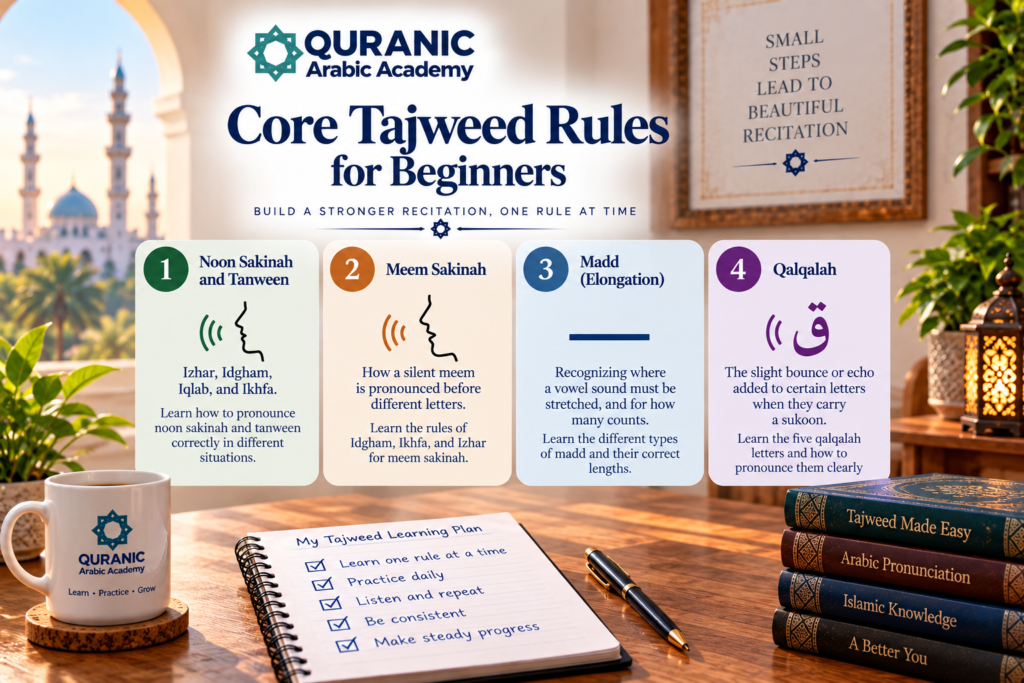
A small group of core Tajweed rules forms the foundation for many of the more detailed topics you will study later. Learning these basics first helps beginners understand how Quranic letters should be pronounced, when sounds should be extended or nasalized, and how certain letters change when they meet one another.
Instead of trying to memorize a large number of rules at once, it is more effective to build a strong foundation and gradually add new rules as your recitation improves.
Beginners generally start with the following:
- Noon Sakinah and Tanween rules: izhar (clear pronunciation), idgham (merging), iqlab (conversion), and ikhfa (concealment).
- Meem Sakinah rules: how a silent meem is pronounced before different letters.
- Madd (elongation): recognizing where a vowel sound must be stretched, and for how many counts.
- Qalqalah: the slight bounce or echo added to certain letters when they carry a sukoon.
Understanding pause and stop marks is equally important, since they affect where a sentence’s meaning naturally ends. Quranic Arabic Academy’s guide on Quranic punctuation and pause marks explains these symbols in detail and is a useful next step once you are comfortable with the basics above.
أَوْ زِدْ عَلَيْهِ وَرَتِّلِ الْقُرْآنَ تَرْتِيلًا“…or add to it, and recite the Qur’an with measured recitation.”Surah Al-Muzzammil (73:4) |
See It in Action:
Wondering what our interactive sessions look like? Click below to peek inside a live session and watch how our expert instructors make learning Quranic Arabic accessible and engaging.
Ready to Begin Your Quranic Journey?
Start learning with professional instructors through our structured curriculum.
Book Your Free Trial2. Listen to Skilled Reciters to Train Your Ear
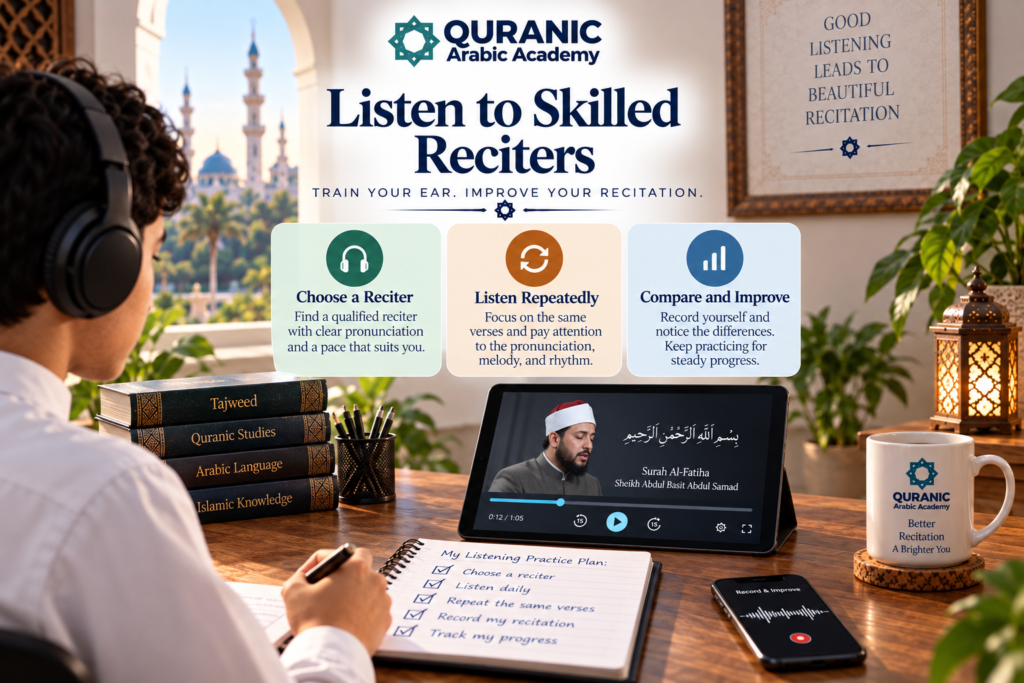
Regularly listening to skilled Quran reciters is one of the most useful ways to train your ear to recognize accurate pronunciation and natural recitation patterns.
Careful listening helps you notice how Arabic letters are articulated, where sounds are extended, how Ghunnah and Madd are applied, and where a reciter pauses or continues within an ayah. Over time, hearing these patterns repeatedly makes it easier to recognize when your own pronunciation or pacing sounds different.
Well-known reciters such as Sheikh Mahmoud Khalil Al-Husary, Sheikh Abdul Basit Abdus Samad, and Sheikh Mishary Rashid Alafasy are often used by learners because their recitations provide clear examples of Tajweed in practice.
Beginners may find slower, measured recordings particularly useful because they make individual letters, vowel sounds, elongations, and stopping points easier to hear.
For better results, turn listening into active practice rather than passive background listening. Choose a short ayah, listen to it several times, pause the recording, and repeat it aloud while trying to match the reciter’s pronunciation and Tajweed.
You can then listen again and compare the two versions, repeating difficult words separately when necessary. This listen-repeat-compare method gradually strengthens your ear and can improve both accuracy and fluency.
Audio practice is most effective when combined with feedback from a qualified Quran teacher. A skilled reciter gives you a reliable model to imitate, while a teacher can identify subtle Makharij or Tajweed mistakes that may be difficult to detect on your own.
- Choose one reciter whose pace and voice register feel closest to your own, and focus on that style first.
- Listen to the same short passage repeatedly before trying to recite it yourself.
- Compare a recording of your own recitation against the reciter’s version to identify differences.
The Prophet Muhammad ﷺ himself encouraged reciting the Quran with a beautiful, unhurried voice, as reflected in the following hadith:
| زَيِّنُوا الْقُرْآنَ بِأَصْوَاتِكُمْ”Beautify the Qur’an with your voices.”Sunan Abi Dawud 1468 |
3. Train Your Voice and Breathing
Voice control and breath support can make Quran recitation smoother, clearer, and more comfortable, particularly when reading longer ayahs. When breath is poorly managed, a learner may rush toward the end of a phrase, weaken the pronunciation of letters, shorten a Madd, or stop in an unsuitable place simply because they have run out of air.
Developing better breath awareness allows you to maintain a steady pace and give each letter and vowel its proper pronunciation.
Practice by taking a comfortable breath before beginning an ayah and reciting at a controlled, natural pace rather than trying to complete as much as possible in one breath.
Pay attention to the stopping signs in the Mushaf and learn appropriate Waqf and Ibtida so that you know where you can pause and where to resume without unnecessarily interrupting the meaning. Longer verses can also be divided into meaningful phrases during practice until your breathing becomes more controlled.
You do not need a powerful or highly melodic voice to recite the Quran well. The priority should remain accuracy, clarity, and correct Tajweed. With regular aloud practice, relaxed breathing, and careful pacing, your voice can become steadier and you can recite longer passages with greater confidence without sacrificing correct pronunciation.
- Practice diaphragmatic breathing: breathe from your abdomen rather than your chest so you can sustain longer verses.
- Try humming exercises for a few minutes before reciting to warm up your vocal cords gently.
- Avoid straining or shouting; find the natural, comfortable pitch of your own voice rather than imitating a reciter’s exact tone.
- Record short passages and listen back to notice where your breath runs out, then plan natural pause points there.

4. Read in Front of a Qualified Teacher
Many Quran recitation mistakes are difficult to recognize in your own voice, especially when you have repeated the same pronunciation for a long time. You may feel that a letter, vowel, or Tajweed rule sounds correct simply because you have become accustomed to hearing yourself pronounce it that way.
This is why direct correction from a qualified Quran teacher remains an important part of developing accurate recitation rather than depending entirely on books, recordings, or self-study.
A teacher can listen closely for subtle problems involving Makharij al-Huruf, letter characteristics, Harakat, Madd, Ghunnah, Qalqalah, and other Tajweed rules. They can also identify pacing and stopping mistakes, demonstrate the correct pronunciation, and ask you to repeat a difficult word or ayah until the difference becomes clear.
Receiving immediate feedback helps you understand not only that a mistake has occurred, but also how to correct it in practice.
Structured Quran programs therefore remain useful even for motivated self-learners. Independent listening, repetition, and daily reading can provide valuable practice between lessons, while a qualified teacher provides the personalized correction and guidance that recordings cannot offer.
Combining both approaches can help you develop more accurate, confident, and consistent Quran recitation over time.

Quranic Arabic Academy offers guided Quran classes for adults with qualified teachers who listen, correct, and track your progress lesson by lesson, which is difficult to replicate through recordings or apps alone.
| Get Personalized Recitation FeedbackBook a free trial lesson with a qualified teacher and get your recitation assessed and corrected in real time.Book Your Free Trial |
5. Reflect on the Meaning While You Recite
Tadabbur, or reflecting deeply on the meaning of Quranic verses, can make recitation more conscious and meaningful rather than simply an exercise in pronunciation. When you understand the general message of what you are reading, it becomes easier to connect your voice with the meaning of the ayah and maintain greater focus and khushu’ during recitation.
This can also help prevent reading from becoming mechanical, especially when repeating familiar Surahs.
Understanding the meaning can naturally influence your tone, pacing, pauses, and emphasis. Verses describing Allah’s mercy, for example, carry a different meaning from verses of warning, supplication, gratitude, or descriptions of the Hereafter.
A learner who understands these differences can recite with greater awareness while still keeping correct Tajweed and pronunciation as the priority rather than deliberately exaggerating emotion.
Reflection can also better support Waqf and Ibtida, because understanding the structure and meaning of an ayah helps you recognize where an idea is complete and where stopping might interrupt an important connection.
Even beginners who do not yet understand Quranic Arabic can develop this habit by reading a reliable translation or a short Tafsir before practicing a passage.
If you want a starting point for this kind of reflection, Quranic Arabic Academy’s guide to Quranic reflections walks through how to approach meaning-focused reading, and its article on foundational Quranic principles explains core values that recur throughout the Quran and can deepen your understanding as you recite.

6. Build a Daily Practice Routine
Quran recitation is a skill that develops through consistent practice, and regular repetition is usually more useful than relying on occasional long sessions.
Reading for a short period every day gives your tongue, ear, and memory repeated exposure to Arabic letters, vowel sounds, Tajweed rules, and Quranic words. Over time, this makes correct pronunciation feel more natural and reduces hesitation when moving from one word or ayah to the next.
A daily routine does not need to be long to be effective. Even 15–20 minutes of focused practice can be useful when the session has a clear purpose.
You might spend a few minutes reviewing difficult Makharij, then read a short passage slowly, repeat challenging words or ayahs, and finish by listening to a skilled reciter or reviewing corrections previously given by your teacher. The goal is to practice actively rather than simply reading as many pages as possible.
As your recitation improves, adjust the routine to focus on your current weaknesses. Beginners may spend more time on Makharij and Harakat, while more confident readers can concentrate on Tajweed, fluency, Waqf and Ibtida, or longer passages.
This gradual and consistent approach helps turn Quran reading into a sustainable habit while steadily improving accuracy and confidence.
- Set aside the same time each day, even if it is only ten to fifteen minutes.
- Start with short surahs you already know well, and only add new material once the current passage is stable.
- Recite out loud rather than silently, since silent reading does not train pronunciation or breath control.
- Review previously learned passages regularly so earlier progress is not lost while you focus on new material.

Common Challenges Beginners Face and How to Overcome Them
Most beginners encounter a similar set of challenges when learning to read the Quran, especially during the first stages of building pronunciation, Tajweed, and fluency.
Some learners struggle to distinguish between similar Arabic letters, while others find it difficult to remember Harakat, apply Tajweed rules while reading, maintain a steady pace, or recognize the correct places to stop and resume.
These difficulties are a normal part of developing several new reading skills at the same time.
Another common challenge is inconsistent practice. Beginners may practice for a long time on one day and then leave several days between sessions, making it harder to retain what they have learned.
Others become discouraged because their recitation remains slow or because the same pronunciation mistakes continue to appear. Trying to progress too quickly can create additional problems, particularly when learners prioritize speed or longer Surahs before establishing accurate reading habits.
- Confusing similar letters: slow down and isolate the specific letters that are causing confusion, then drill them with a teacher.
- Running out of breath mid-verse: work on diaphragmatic breathing and identify natural pause points in advance.
- Losing rhythm (tarteel): practice at a slower pace before trying to match a reciter’s natural speed.
- Feeling self-conscious reciting aloud: start by reciting in front of family or a single trusted teacher before a wider audience.
- Inconsistent practice: anchor recitation to an existing daily habit, such as right after a prayer, so it is easier to remember.
Experience Our Teaching Style:
We believe in clarity and engagement. Watch these short highlights from our actual classes to see our teachers’ methodology and student interactions in real-time.
Ready to Begin Your Quranic Journey?
Start learning with professional instructors through our structured curriculum.
Book Your Free TrialContinue Learning With Guided Quranic Arabic Classes
Once you have mastered the basics, the fastest way to keep improving is to study with a qualified teacher who can correct the mistakes you may not notice on your own.
Quranic Arabic Academy’s advanced Quranic Arabic classes provide structured, teacher-led training for learners who want to refine their pronunciation, strengthen Tajweed, improve pacing, and understand the Quran more deeply.
Don’t let small recitation mistakes become permanent habits. Join Quranic Arabic Academy today and start learning directly with a qualified Quran teacher who can guide your progress, correct your recitation, and help you move toward clearer, more confident Quran reading.

| Deepen Your Recitation SkillsJoin Quranic Arabic Academy’s guided classes and learn Tajweed and recitation directly from qualified teachers.Explore Quranic Arabic Academy |
Our Arabic Courses
- Quranic Arabic Classes
- Quranic Arabic Course for Beginners
- Online Quranic Arabic Courses for Advanced Learners
- Quranic Arabic Grammar Course
- Arabic Courses for Understanding the Quran
- Quranic Arabic Course for Sisters (Female)
- Quranic Arabic Course for Kids
- Online Quranic Arabic Classes for Adults
- Quranic Arabic Course UK
- Quranic Arabic Course London
- Quranic Arabic Course USA
- Quranic Arabic Course Canada
- Quranic Arabic Course Australia
- Quranic Arabic Course UAE
- Quranic Arabic Course Germany
Conclusion
Improving Quran recitation comes down to combining four things consistently: learning correct Tajweed rules, listening closely to qualified reciters, receiving direct correction from a teacher, and practicing daily.
Progress is gradual, but each of these habits reinforces the others, and steady, humble effort is what the Quran and Sunnah both encourage in a reciter.
Whether you are just starting to learn the letters or refining a recitation you have practiced for years, treat this as a lifelong habit rather than a task to finish.
Structured guidance, such as the lessons offered through Quranic Arabic Academy, can shorten the learning curve considerably by catching mistakes early and keeping your practice consistent.
Frequently Asked Questions
How long does it take to improve Quran recitation?
There is no fixed timeline, since progress depends on how consistently you practice and whether you receive regular corrections from a teacher.
Reciters who practice daily and receive feedback typically notice clear improvement within a few months of focused effort.
What is the difference between Tajweed and Tarteel?
Tajweed refers to the technical rules governing correct pronunciation of each letter and its characteristics. Tarteel refers to reciting at a slow, measured, unhurried pace, which is the manner of recitation described in Surah Al-Muzzammil (73:4).
Can I improve my recitation without a teacher?
Self-study through listening and repetition can improve general familiarity with the Quran, but many pronunciation and Tajweed errors are difficult to notice in your own voice. A qualified teacher remains important for catching and correcting these hidden mistakes.
Is a beautiful voice required to recite the Quran well?
A naturally beautiful voice is not a requirement; correct pronunciation and adherence to Tajweed rules are what make a recitation correct.
The Prophet Muhammad ﷺ nonetheless encouraged reciters to beautify their voices within the bounds of proper recitation, as noted in the hadith on beautifying the Quran with one’s voice.
Does understanding Arabic help with recitation?
Yes. Understanding the meaning of the words you are reciting, known as tadabbur, tends to improve pacing, emphasis, and sincerity, since you are no longer only reproducing sounds but engaging with the meaning behind them.
What is the best way to practice Tajweed daily?
A short, consistent daily session focused on a small passage is generally more effective than long, infrequent sessions. Recite the passage aloud, record yourself, compare it to a qualified reciter, and review the same passage again the next day before moving forward.








Leave a Reply