 Quran
Quran
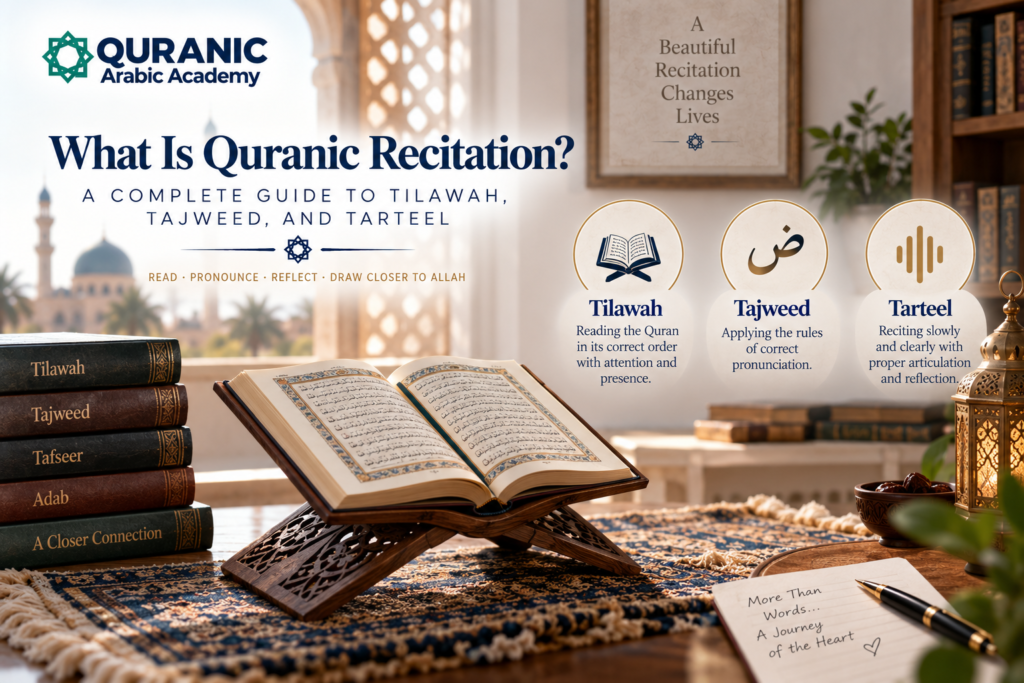
Quranic recitation known in Arabic as tilawah is the act of reading the verses of the Quran in their correct order while applying the rules of tajweed and reflecting on their meaning.
For many new Muslims and lifelong learners alike, understanding what Quranic recitation truly involves is the first step toward reciting with confidence and sincerity.
Whether you are just beginning to learn the Quran or looking to refine your tajweed, this guide will give you a clear and accurate foundation, along with practical next steps for structured learning through Quranic Arabic Academy.
What You Will Learn
- The precise linguistic and technical meaning of Quranic recitation (tilawah).
- The three recognized levels of reciting the Quran: tarteel, tadwir, and hadr.
- Verified Quranic verses that command believers to recite with measured tarteel.
- The etiquette (adab) scholars recommend observing before and during recitation.
- The spiritual and psychological benefits associated with regular Quranic recitation.
What Is Quranic Recitation?
Quranic recitation is the reading of the words of the Quran in continuous sequence, according to their correct order, while observing the rules of tajweed and reflecting on their meaning.
The Arabic word for this act, tilawah (تلاوة), comes from the root talā, meaning “to follow” or “to read after.”
The Linguistic Meaning of Tilawah
Linguistically, tilawah is derived from the verb talā (تلا), meaning that something comes after another or is read in sequence.
In everyday Arabic usage, to “recite” (talā) something is to bring it forth, one part following another.
Tilawah Lafziyyah vs. Tilawah Hukmiyyah
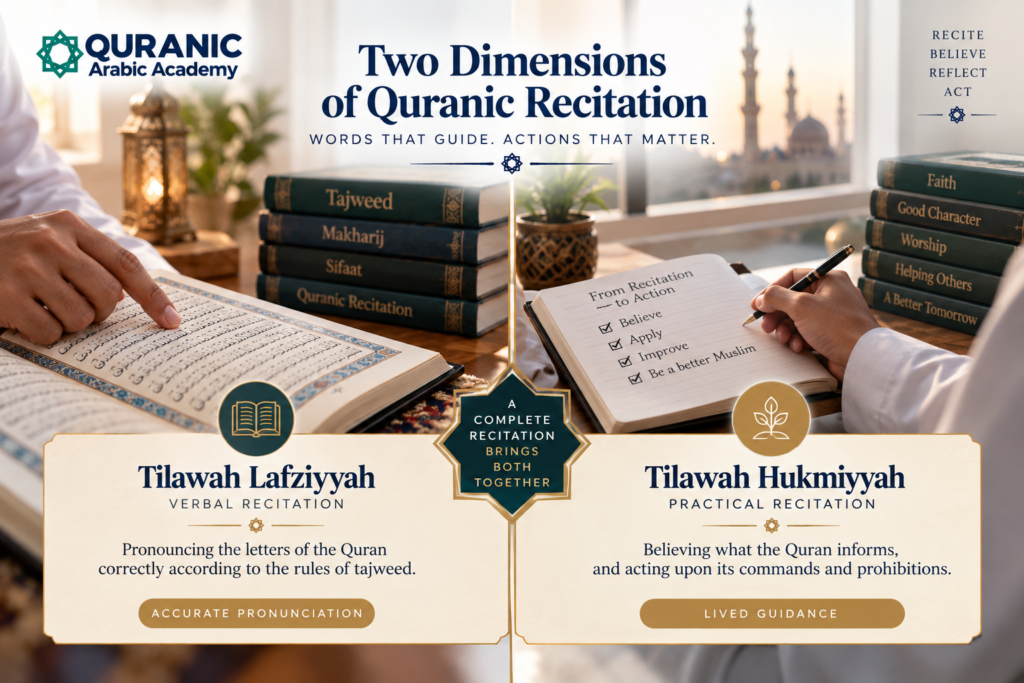
Scholars of Quranic sciences describe two dimensions of recitation. The first is tilawah lafziyyah (verbal recitation): pronouncing the letters of the Quran correctly according to the rules of tajweed.
The second is tilawah hukmiyyah (practical recitation): believing what the Quran informs, and acting upon its commands and prohibitions.
Both dimensions matter. Correct pronunciation without reflection misses the purpose of revelation, while sincere intention without correct pronunciation can distort the sacred text.
A complete understanding of Quranic recitation therefore includes accurate articulation and genuine engagement with meaning.
The Three Levels of Quranic Recitation and Their Differences
Scholars of Tajweed commonly describe three levels of Quranic recitation, based mainly on the speed and style of reading: At-Tahqiq, At-Tadwir, and Al-Hadr. Each level allows a different pace, from slow and deliberate to relatively fast recitation.
Regardless of the level chosen, the reciter should maintain correct pronunciation, articulation of the letters, and the essential rules of Tajweed without allowing speed to distort the words of the Quran.
Read also: Juz Amma Quranic Studies: The Complete Guide
See It in Action:
Wondering what our interactive sessions look like? Click below to peek inside a live session and watch how our expert instructors make learning Quranic Arabic accessible and engaging.
Ready to Begin Your Quranic Journey?
Start learning with professional instructors through our structured curriculum.
Book Your Free Trial1. Tarteel: Slow and Measured Quran Recitation
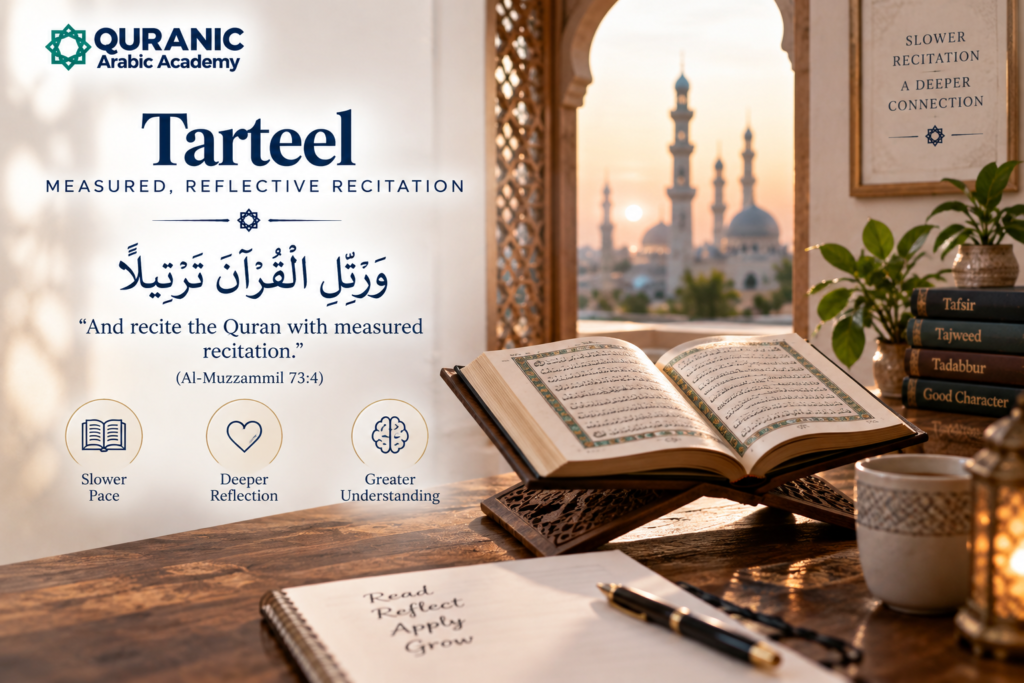
Tarteel is a slow, deliberate style of recitation in which the reciter reflects on the meaning of each verse without rushing. It is considered the most excellent of the three levels, because it is the manner in which the Quran itself was revealed.
وَرَتِّلِ الْقُرْآنَ تَرْتِيلًا
“And recite the Qur’an with measured recitation.”
Companions such as Ali ibn Abi Talib explained tarteel as giving each letter its correct articulation point (makhraj) and knowing where to pause.
This is the standard taught in structured tajweed courses, such as those offered for Quran-focused learners at Quranic Arabic Academy.
2. Tadwir: Quran Recitation at a Moderate Pace
Tadwir is a moderate pace between tarteel and hadr. The reciter neither slows down for extended reflection nor speeds up, while still applying every tajweed rule correctly. Many reciters use tadwir for daily, sustained reading of longer portions of the Quran.
3. Hadr: Fast Recitation While Preserving Tajweed
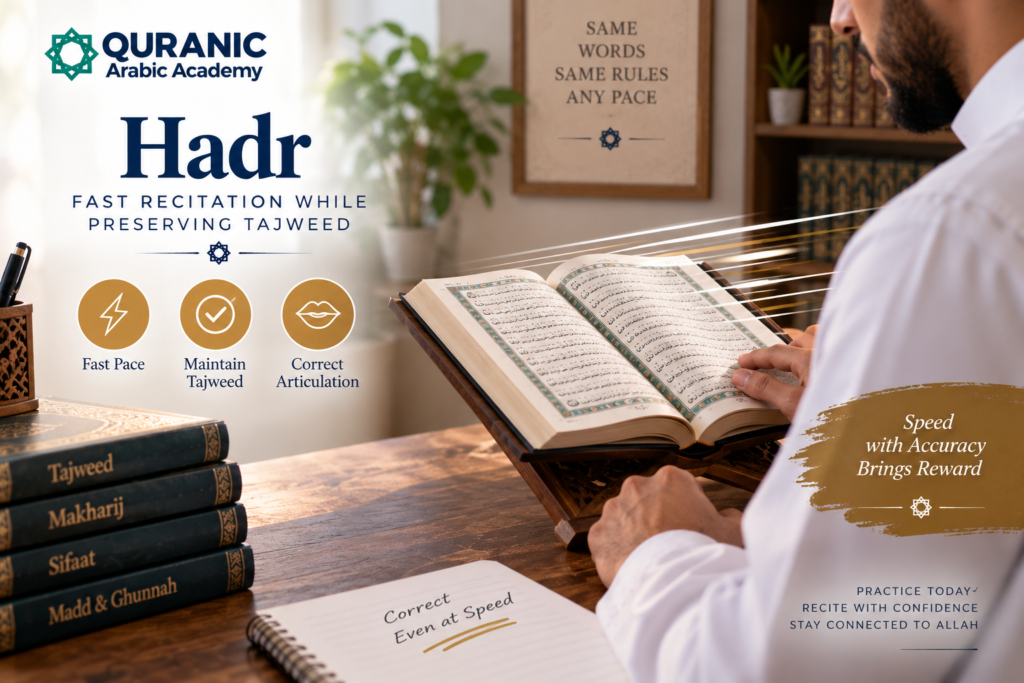
Hadr is the fastest of the three levels. Even at this pace, the letters must still be pronounced from their correct articulation points, and features such as ghunnah (nasalization) and madd (elongation) must not be dropped.
Reciting so quickly that letters are cut short or blurred together is not considered acceptable hadr; it is simply mispronunciation.
What Does the Quran Say About Proper Recitation?
The command to recite the Quran with tarteel is not merely a preference of scholars; it is stated directly in the Quran itself. Several verses instruct believers on how the Quran should be read and understood.
وَقُرْآنًا فَرَقْنَاهُ لِتَقْرَأَهُ عَلَى النَّاسِ عَلَىٰ مُكْثٍ
“And [it is] a Qur’an which We have separated by intervals that you might recite to the people over a prolonged period.”
This verse indicates that the Quran was revealed gradually and was meant to be read at a measured, sustainable pace, rather than rushed through without comprehension.
الَّذِينَ آتَيْنَاهُمُ الْكِتَابَ يَتْلُونَهُ حَقَّ تِلَاوَتِهِ أُولَـٰئِكَ يُؤْمِنُونَ بِهِ
“Those to whom We have given the Book recite it with its true recital. Those [are the ones who] believe in it.”
Early scholars, including Ibn Mas’ud, explained “its true recital” as applying what is lawful, avoiding what is forbidden, and reciting the wording exactly as it was revealed, without distortion.
The Online Quranic Arabic Classes for Adults at The Quranic Arabic Academy are built specifically for adult learners who want to reach exactly this milestone, with one-on-one sessions that apply grammar and vocabulary directly to the surahs recited in daily prayer from the very first lesson.
The Virtues and Rewards of Reciting the Quran
Islamic sources describe recitation of the Quran as one of the most rewarded acts of worship. The reward is tied not to fluency alone, but to sincere effort in reading Allah’s words.
قال رسول الله ﷺ:
«مَن قرأ حرفًا من كتابِ اللهِ فله به حسنة، والحسنةُ بعشر أمثالها، لا أقولُ: الم حرف، ولكن ألفٌ حرف، ولامٌ حرف، وميمٌ حرف».
“Whoever reads a letter from the Book of Allah will have a reward, and that reward will be multiplied by ten. I do not say that Alif-Lam-Meem is one letter, but Alif is a letter, Lam is a letter, and Meem is a letter.”
Beyond reward in the Hereafter, Quranic recitation is also described as a source of light and guidance for the reciter, and as an intercessor that will speak on behalf of the believer on the Day of Judgment.
[Start Learning the Arabic Script with a Qualified Teacher Today]

How Quran Recitation Benefits the Heart and Mind
Regular Quranic recitation is an important act of worship that can also have a meaningful influence on a believer’s heart and mind.
Reciting with reflection can encourage inner calm, spiritual awareness, concentration, and a stronger connection with Allah.
It also gives the reader regular opportunities to reflect on guidance, reassess thoughts and behavior, and find reassurance during periods of difficulty.
These benefits become especially meaningful when recitation is combined with understanding, tadabbur, and consistent practice.
- Inner calm: measured recitation slows the breath and mind, easing anxiety and restlessness.
- Stronger connection to Allah: reflecting on the verses deepens faith and mindfulness of God.
- Better focus and memory: the discipline of tajweed and repetition trains concentration.
- Emotional steadiness: many reciters describe a sense of comfort that carries into daily life.
Read also: How to Better Your Quran Recitation: Practical Tips and Techniques
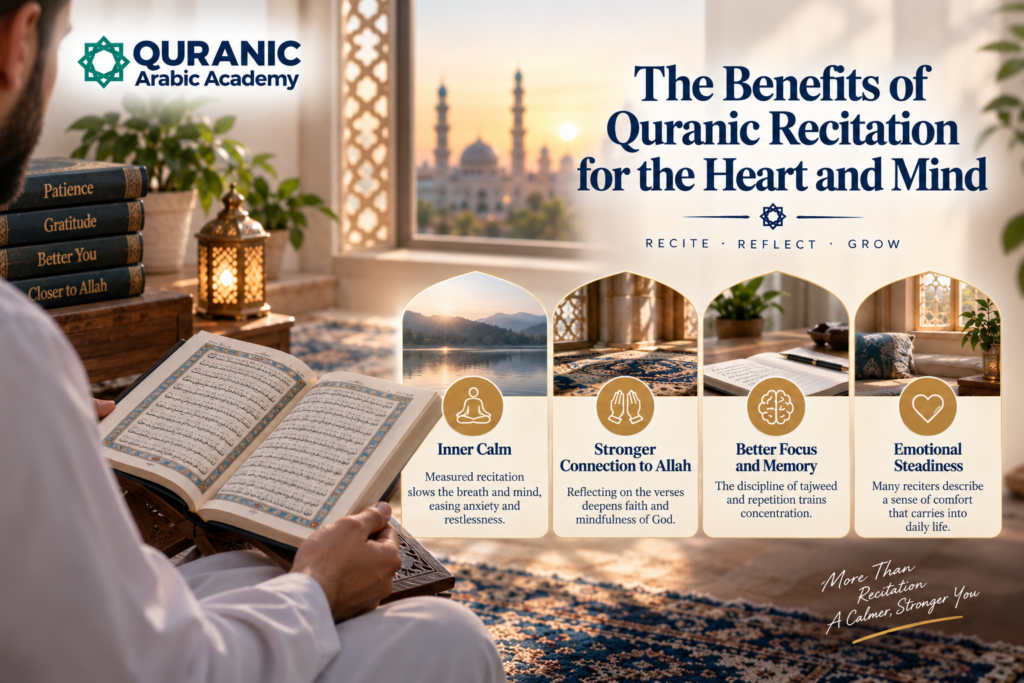
These benefits are strongest when recitation combines correct pronunciation with genuine reflection the very balance between tilawah lafziyyah and tilawah hukmiyyah described earlier.
Essential Etiquette for Reciting the Quran
Reciting the Quran is an act of worship that should be approached with respect, sincerity, and attentiveness. Scholars have therefore discussed a number of adab (etiquettes) that help the reader prepare both outwardly and inwardly for recitation.
These include proper preparation, seeking refuge in Allah, reciting carefully, maintaining humility and presence of heart, and reflecting on the meanings of the verses rather than reading without attention.
Read also: How to Dispose of Quranic Verses the Right Way
Maintain Purity and Choose a Clean Place
It is recommended that a reciter be in a state of ritual purity, since Quranic recitation is considered the finest form of remembrance of Allah.
Reciting in a clean space, such as a mosque, is likewise encouraged out of respect for the sanctity of the words being read.
Recite the Quran With a Sincere Intention
A reciter is encouraged to recite purely for the sake of Allah, without seeking praise, status, or admiration from others. Sincerity of intention is considered foundational to the acceptance of any act of worship, including recitation.
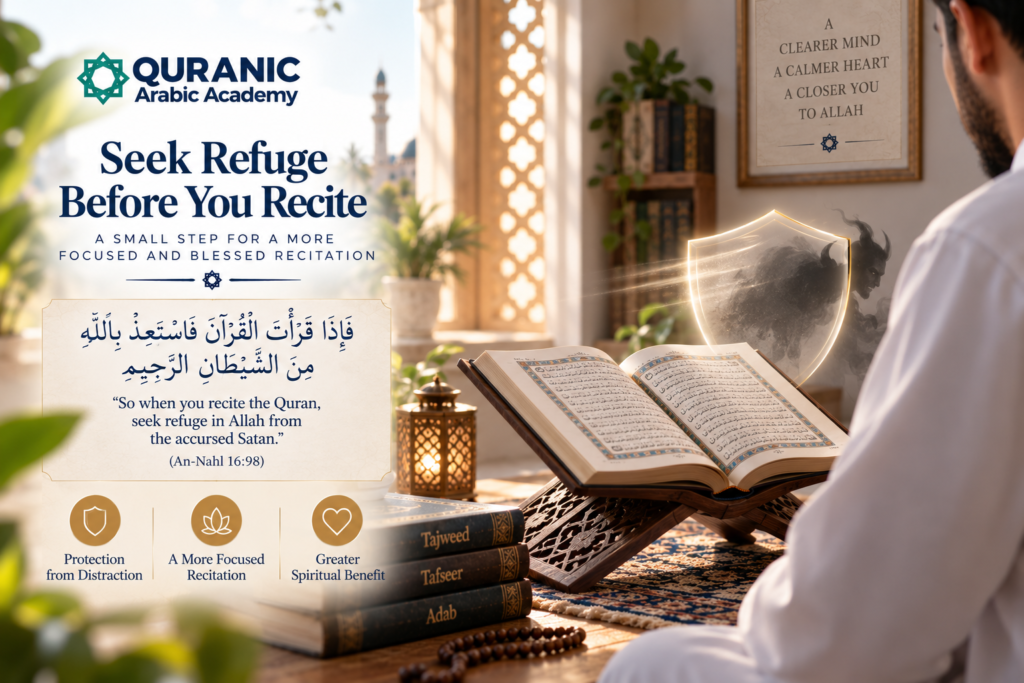
Seek Refuge From Shaytan Before Reciting
Before beginning recitation, it is recommended to say “A’udhu billahi min ash-shaytani r-rajim” (I seek refuge in Allah from the accursed Satan), based on the following verse:
فَإِذَا قَرَأْتَ الْقُرْآنَ فَاسْتَعِذْ بِاللَّهِ مِنَ الشَّيْطَانِ الرَّجِيمِ
“So when you recite the Qur’an, seek refuge in Allah from Satan, the expelled [from His mercy].”
Beautify Your Voice Without Distorting the Recitation
Scholars from the earliest generations agreed that it is recommended to beautify one’s voice while reciting, as this helps the words affect the heart more deeply.
«زَيِّنوا القرآنَ بأصواتِكم».
“Beautify the Qur’an with your voices.”
Beautifying the voice does not mean altering the wording or adding musical embellishments that distort pronunciation; it means reciting the correct text with a pleasant, unhurried delivery.
Conditions for Correct and Respectful Quran Recitation
A correct and respectful recitation of the Quran involves both proper pronunciation and sincere engagement with its meanings.
The reciter should approach the Quran with reverence, prepare appropriately, observe the essential rules of Tajweed, and avoid rushing in a way that affects the words or letters.
At the same time, attentiveness, humility, and reflection help ensure that recitation becomes not only an act of the tongue but also an act of worship that engages the heart and mind.
- Physical purity, such as ablution (wudu), before handling and reciting the Quran.
- A sincere, undivided intention focused on Allah rather than on being seen or heard.
- Mental readiness and freedom from distractions that would break concentration.
- Recitation with tarteel and correct tajweed rather than careless speed.
- Respect for the physical mus-haf, keeping it in a clean, elevated, and dignified place.
- Consistency, returning to recitation regularly rather than only occasionally.
Learning these rules correctly is much easier with a qualified teacher. Structured, one-on-one guidance such as the courses offered through Quranic Arabic Academy helps new reciters apply tajweed rules with real feedback rather than guesswork.
For beginners in particular, starting with a step-by-step, teacher-guided program removes much of the uncertainty around pronunciation and tajweed rules.
Quranic Arabic Academy’s beginner classes are designed specifically for readers who are starting from scratch, while dedicated classes for sisters are also available for those who prefer a female-only learning environment.
| Deepen Your Quranic Recitation SkillsLearn correct tajweed and tarteel with qualified teachers at Quranic Arabic Academy.Book Your Free Trial |
Experience Our Teaching Style:
We believe in clarity and engagement. Watch these short highlights from our actual classes to see our teachers’ methodology and student interactions in real-time.
Ready to Begin Your Quranic Journey?
Start learning with professional instructors through our structured curriculum.
Book Your Free TrialLearn Correct Quranic Recitation with Quranic Arabic Academy
If you would like personalized guidance in mastering tarteel, tajweed, and correct pronunciation, Quranic Arabic Academy offers structured, one-on-one online classes for every level.
Programs are available for those focused specifically on Quran recitation, for absolute beginners, and for sisters seeking a female-only class environment.
You can start with a free trial class to experience the teaching approach before committing to a full course.
Our Arabic Courses
- Quranic Arabic Classes
- Quranic Arabic Course for Beginners
- Online Quranic Arabic Courses for Advanced Learners
- Quranic Arabic Grammar Course
- Arabic Courses for Understanding the Quran
- Quranic Arabic Course for Sisters (Female)
- Quranic Arabic Course for Kids
- Online Quranic Arabic Classes for Adults
- Quranic Arabic Course UK
- Quranic Arabic Course London
- Quranic Arabic Course USA
- Quranic Arabic Course Canada
- Quranic Arabic Course Australia
- Quranic Arabic Course UAE
- Quranic Arabic Course Germany

Conclusion
Quranic recitation is far more than reading words aloud; it is a combination of correct pronunciation, reflection, and sincere intention.
Understanding tilawah’s linguistic meaning, the three levels of tarteel, tadwir, and hadr, the direct Quranic instructions to recite with care, and the etiquette scholars have outlined gives every reader a solid foundation for approaching the Quran with the respect it deserves.
Whether you are a new Muslim or someone looking to refine years of practice, consistent, guided learning remains the most reliable path to reciting the Quran correctly and confidently.
Frequently Asked Questions
What is the difference between tilawah and tarteel?
Tilawah is the general term for reciting or reading the Quran, covering both pronunciation and acting upon its meaning.
Tarteel is one specific level of tilawah, a slow, measured style of recitation, and it is considered the most excellent of the three recognized levels.
What are the three levels of Quranic recitation?
The three levels are tarteel (slow and reflective), tadwir (a balanced middle pace), and hadr (fast, while still preserving every tajweed rule). A reciter may choose the level that suits them, as long as correct pronunciation is maintained.
Why is tajweed important in Quranic recitation?
Tajweed ensures that each letter of the Quran is pronounced from its correct articulation point with its correct characteristics. Without tajweed, meanings can be distorted, which is why scholars consider it essential at every level of recitation.
What should a Muslim do before starting to recite the Quran?
It is recommended to be in a state of ritual purity, to have a sincere intention, and to say “A’udhu billahi min ash-shaytani r-rajim” (I seek refuge in Allah from the accursed Satan) before beginning, based on the instruction in Surah An-Nahl (16:98).
Can beginners learn proper Quranic recitation online?
Yes. Structured online classes with a qualified teacher, such as those offered through Quranic Arabic Academy, allow beginners to receive real-time correction of pronunciation and tajweed, which is difficult to achieve through self-study alone.






Leave a Reply