 Quranic Arabic

Reading the Quran correctly is an act of worship, not just a skill. Many Muslims especially beginners, repeat Quran reading mistakes for years without realizing it, simply because no one has pointed them out.
This article walks through the most common mistakes in Quran recitation, explains why each one matters, and shows practical ways to correct them.
Whether you’re a new Muslim or someone who grew up reciting but never had formal correction, this guide will help you read the Quran with more accuracy and confidence.
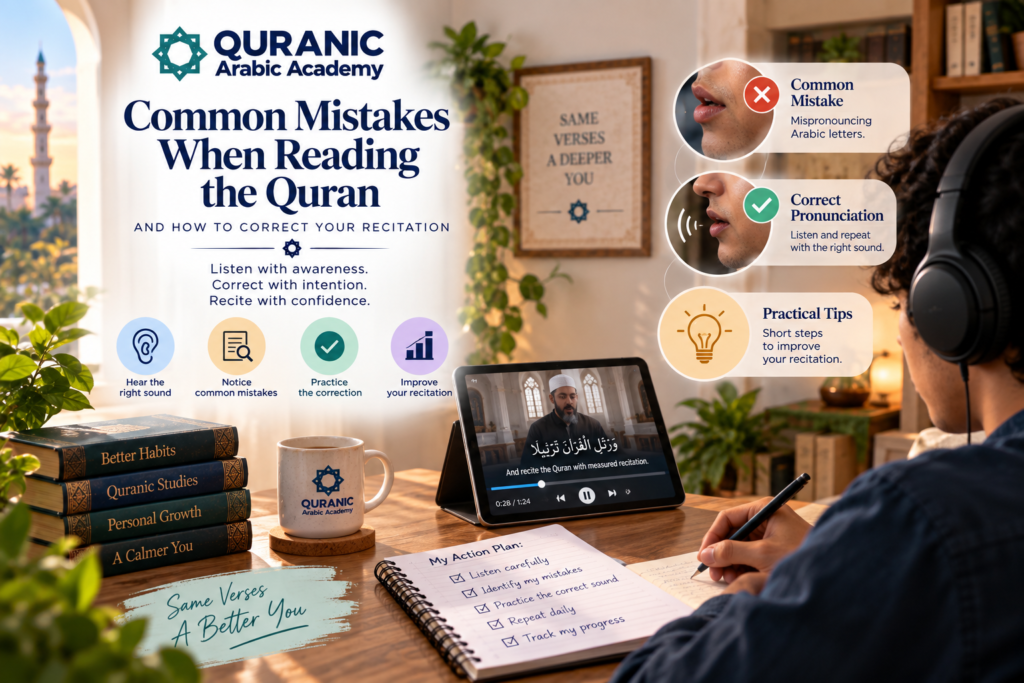
1. Mistakes in Makharij al-Huroof (Articulation Points)
Makharij al-Huroof refers to the precise articulation points from which Arabic letters are pronounced, including specific areas of the throat, tongue, lips, and nasal passage. Correct Makharij are essential in Quran recitation because even letters that sound similar to a beginner may have completely different points of articulation.
When the tongue or lips are positioned incorrectly, one letter may unintentionally sound like another, affecting the accuracy and clarity of the recitation.
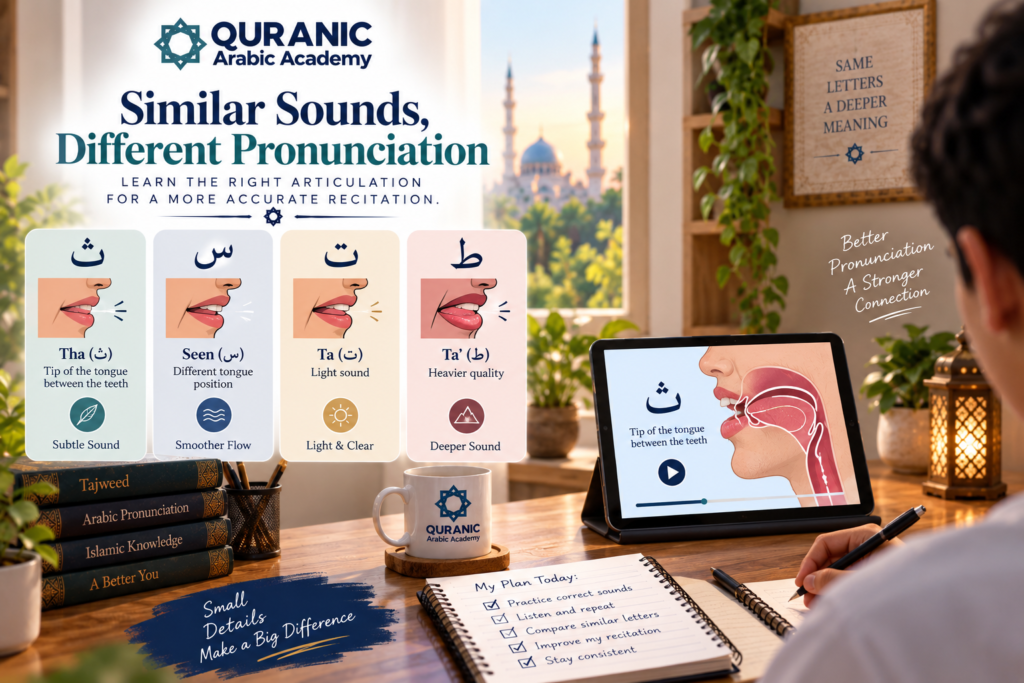
Common examples include confusing tha (ث) with seen (س) or pronouncing ta (ت) like ta’ (ط). Although these pairs may initially sound close, they are produced differently.
For example, ث requires the tip of the tongue to come slightly between the teeth, while س is produced with a different tongue position. Similarly, ط has a heavier quality than ت.
The best way to correct these mistakes is through slow, repeated practice of each letter individually, followed by practice inside Quranic words and verses.
Learning with a qualified teacher is especially helpful because the teacher can hear subtle pronunciation errors and correct the position of the tongue, lips, or throat in real time.
2. Mistakes in Noon Sakinah and Tanween Rules
The rules of Noon Sakinah (نْ) and Tanween (ـً / ـٍ / ـٌ) determine how the noon sound is pronounced according to the letter that follows it. There are four main rules: Izhar (clear pronunciation), Idgham (merging), Iqlab (conversion), and Ikhfa (concealment).
Each rule has its own group of letters and method of pronunciation, so beginners sometimes confuse them or apply the same sound in every situation instead of paying attention to the following letter.
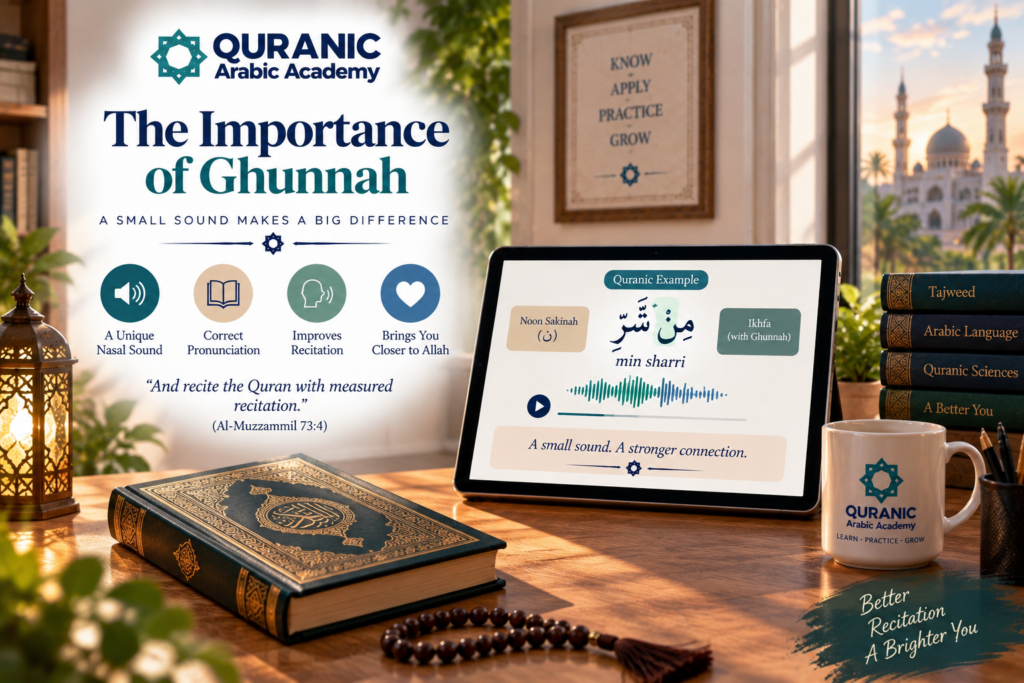
Another common mistake is dropping, shortening, or exaggerating the Ghunnah, the nasal sound required in certain Tajweed cases. Learning to recognize where Ghunnah appears and maintaining it for the appropriate length helps make recitation clearer and more accurate.
For example, in مِنْ شَرِّ, the Noon Sakinah is followed by ش, one of the letters of Ikhfa, so the noon sound is concealed with a Ghunnah of approximately two counts rather than pronounced completely clearly.
The best way to master these rules is to practice them directly from Quranic examples rather than memorizing definitions alone. Highlight examples of each rule, listen to a skilled reciter, repeat the words slowly, and pay attention to how the sound changes depending on the following letter.
See It in Action:
Wondering what our interactive sessions look like? Click below to peek inside a live session and watch how our expert instructors make learning Quranic Arabic accessible and engaging.
Ready to Begin Your Quranic Journey?
Start learning with professional instructors through our structured curriculum.
Book Your Free Trial3. Mistakes in Madd (Elongation) Rules
Madd refers to the elongation of certain vowel sounds during Quran recitation, and applying the correct length is an important part of accurate Tajweed. There are several categories of Madd, beginning with Madd Tabi‘i (natural Madd), which is generally held for two counts, as well as other types of Madd whose length depends on factors such as the presence of a Hamzah or Sukoon.
Learning these differences helps you know when a sound should remain short and when it requires additional elongation.
A frequent mistake is over-elongating a natural Madd beyond its two counts or, in the opposite direction, shortening a longer Madd before completing its required length.
Beginners may also change the duration of the same type of Madd from one verse to another because they are relying on instinct rather than recognizing the Tajweed rule. These inconsistencies can affect the accuracy and natural flow of the recitation.
Correcting this requires learning the main categories of Madd clearly and practicing each one with verified Quranic examples. Listen carefully to a qualified teacher or skilled reciter, count the duration at first when necessary, and repeat the same examples until the timing becomes comfortable.
Read also: How to Recite the Quran Properly: Exploring Tilawah, Tajweed, and Tarteel
4. Mistakes in Tarqeeq and Tafkheem (Light and Heavy Letters)
Tafkheem (heaviness) and Tarqeeq (lightness) describe whether a letter is pronounced with a fuller, heavier quality or a lighter, thinner sound. Learning this distinction is important because using the wrong quality can make Quranic pronunciation sound inaccurate, even when the correct letter itself is being read.
Seven Arabic letters are inherently heavy and are commonly remembered through the phrase خُصَّ ضَغْطٍ قِظْ: خ، ص، ض، غ، ط، ق، ظ. These letters should maintain their characteristic heaviness, although the degree of Tafkheem can vary depending on their vowel and position. Most other Arabic letters are generally pronounced lightly.
Some letters, however, require additional attention because their pronunciation can change according to the surrounding vowels and Tajweed rules. The ر (Raa) and the ل (Laam) in the name of Allah are important examples that may be heavy or light depending on the context.
Practicing these letters with Quranic examples and listening carefully to a qualified teacher can help you develop a clear and natural distinction between Tafkheem and Tarqeeq.

Many readers fail to distinguish between these, applying the same weight to every letter regardless of its category. This flattens the recitation and removes an important layer of correct pronunciation.
Listening closely to skilled reciters and repeating individual letters in isolation helps train the ear and the tongue together.
5. Incorrect Waqf (Stopping) and Ibtida (Starting)
Waqf (stopping) and Ibtida (starting or resuming) are important parts of Quran recitation because pauses should preserve the intended meaning of the verse.
A reciter may pronounce every letter correctly yet still create confusion by stopping at an inappropriate point or restarting from words that are closely connected to what came before. For this reason, learning where to pause is an essential part of developing accurate and meaningful recitation.
For example, stopping after لَا إِلَٰهَ (“There is no deity”) without completing the phrase إِلَّا اللَّهُ (“except Allah”) leaves an incomplete statement and fails to convey the intended meaning. This illustrates why a reciter should not choose stopping points based only on running out of breath.
Whenever possible, the pause should occur where the grammatical structure and meaning allow it.
Learning the Waqf signs printed in a properly marked Mushaf can help you recognize places where stopping is permitted, preferred, discouraged, or where continuing is more appropriate. It is equally important to learn how to resume correctly after a pause, since beginning again from the wrong word can also affect the meaning.
Read also: How to Elevate Your Quran Recitation Skills: A Practical Guide

| Deepen Your Connection With the QuranLearn to read, understand, and reflect on the Quran in its original Arabic with qualified teachers.Book Your Free Trial |
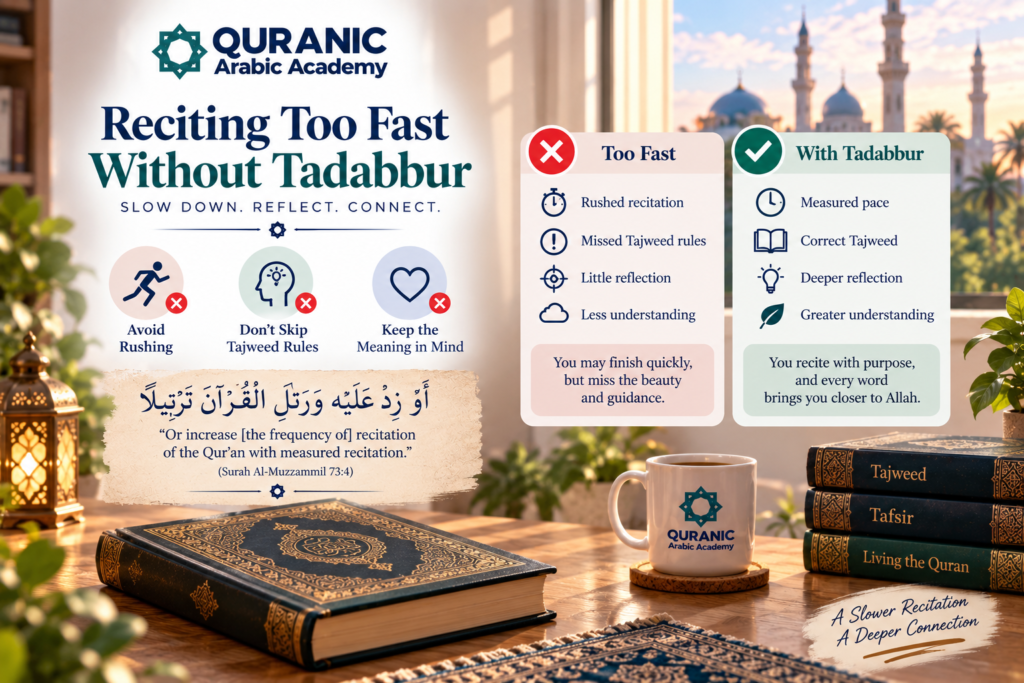
6. Reciting Too Fast Without Tadabbur
Reading quickly just to “finish” the Quran or reach a daily page target, without paying attention to pronunciation or meaning, is one of the most overlooked Quran reading mistakes. While completing the Quran is a valuable goal, speed should not come at the expense of accurate recitation and reflection.
Rushing can cause readers to shorten Madd, miss Ghunnah, overlook Shaddah, blur similar letters, or stop in unsuitable places.
A controlled pace also gives you enough time to understand and reflect on what you are reciting. Instead of measuring every session by how many pages you complete, focus on reading each passage clearly, applying the Tajweed rules you know, and pausing when a verse deserves deeper thought.
Even a smaller amount read with concentration can create a more meaningful and beneficial Quran routine.
Allah instructs believers to recite the Quran with measured, deliberate pacing:
أَوْ زِدْ عَلَيْهِ وَرَتِّلِ الْقُرْآنَ تَرْتِيلًا
“Or add to it, and recite the Qur’an with measured recitation.”
This command to recite with tarteel slow, clear, deliberate pronunciation is the opposite of rushing through the verses. Reflecting on this principle is part of what our Quranic reflections resources explore in more depth.
There is also a well-known Hadith that speaks directly to the reward tied to careful recitation, even when it’s difficult:
«الماهر بالقرآن مع السفرة الكرام البررة، والذي يقرأ القرآن ويتتعتع فيه وهو عليه شاقٌّ له أجران.»
“The one who is skilled in reciting the Quran is with the honorable, obedient angelic scribes, and the one who recites it with difficulty, stammering through it, will have a double reward.”
Sahih al-Bukhari 4937 / Sahih Muslim 798
This Hadith is reassuring for beginners: struggling through correction is not a failure, it’s part of the process, and it’s rewarded.
How to Correct These Common Quran Reading Mistakes
Correcting common Quran reading mistakes starts with slowing down, listening carefully, and practicing consistently.
Focus on one problem at a time, whether it involves pronunciation, Tajweed rules, or incorrect vowel sounds, and repeat difficult words or verses until they become easier.
Reading regularly with a qualified Quran teacher is also helpful because they can identify mistakes you may not notice yourself and guide you toward clearer, more accurate recitation.
- Learn Tajweed rules and systematically build one rule at a time.
- Listen to skilled, verified reciters regularly to train your ear before you train your tongue.
- Practice Makharij and Madd examples out loud, repeating until the sound feels natural.
- Get direct correction from a qualified teacher self-study alone often hides subtle errors (Lahn Khafi) that only a trained ear catches.
Read also: How to Bring Excitement to Your Quran Reading: 12 Effective Methods
Understand the meaning of what you recite, since understanding naturally improves pacing and reduces rushed reading.
This is exactly the gap that structured learning fills. Rather than guessing whether your Tajweed is accurate, working with a teacher who reviews your recitation directly shortens the correction process significantly.
The Quranic Arabic Academy offers exactly this kind of one-on-one, teacher-led correction for students at every level.

For learners who want to build a deeper foundation not just fix pronunciation but understand the values behind the verses, our article on Quranic principles and the 8 foundational values is a useful next step.
And if your goal is long-term character development through the Quran, our piece on Quranic tarbiyah explains how correct recitation connects to spiritual growth.
Experience Our Teaching Style:
We believe in clarity and engagement. Watch these short highlights from our actual classes to see our teachers’ methodology and student interactions in real-time.
Ready to Begin Your Quranic Journey?
Start learning with professional instructors through our structured curriculum.
Book Your Free TrialImprove Your Recitation with The Quranic Arabic Academy
If you recognize yourself in any of the mistakes above, structured, one-on-one correction is the fastest way forward.
The Quranic Arabic Academy provides live, teacher-guided sessions that identify your specific errors and correct them step by step whether you’re just starting out or refining an already strong recitation.
The Academy offers dedicated classes for sisters taught by qualified female instructors, as well as advanced classes for students ready to move beyond the basics into deeper Tajweed and Quranic Arabic mastery.
Our Arabic Courses
- Quranic Arabic Classes
- Quranic Arabic Course for Beginners
- Online Quranic Arabic Courses for Advanced Learners
- Quranic Arabic Grammar Course
- Arabic Courses for Understanding the Quran
- Quranic Arabic Course for Sisters (Female)
- Quranic Arabic Course for Kids
- Online Quranic Arabic Classes for Adults
- Quranic Arabic Course UK
- Quranic Arabic Course London
- Quranic Arabic Course USA
- Quranic Arabic Course Canada
- Quranic Arabic Course Australia
- Quranic Arabic Course UAE
- Quranic Arabic Course Germany

Conclusion
Quran reading mistakes are common, and almost every reciter whether a complete beginner or someone with years of experience will encounter areas that need correction.
Some of the most important categories to watch include errors in Makharij al-Huruf, Noon Sakinah and Tanween rules, Madd, Tafkheem and Tarqeeq, Waqf and Ibtida, and rushing through verses without giving enough attention to Tajweed or meaning.
Recognizing these weaknesses is an important first step because repeated mistakes can gradually become habits when they are left uncorrected.
The good news is that these mistakes do not have to remain permanent. Consistent practice, careful listening, repetition, and direct feedback from a qualified Quran teacher can steadily improve both accuracy and confidence.
This is where structured Quranic education becomes especially valuable. A teacher can hear subtle errors that you may not recognize in your own voice, explain exactly what needs to change, and provide targeted exercises for improvement.
FAQs
What is the difference between Lahn Jali and Lahn Khafi?
Lahn Jali is a clear error that changes a word’s meaning or grammar, such as an incorrect vowel. Lahn Khafi is a subtler mistake in applying Tajweed rules, like a shortened Madd, that doesn’t usually change meaning but affects correctness.
Why is stopping in the wrong place during recitation a serious mistake?
Stopping incorrectly can distort or reverse the intended meaning of a verse, as with pausing after “There is no god” without completing the phrase. Correct Waqf points preserve the verse’s true meaning.
Can I correct Quran reading mistakes on my own?
Self-study helps with obvious mistakes, but subtle Tajweed errors (Lahn Khafi) are hard to detect without trained feedback. A qualified teacher listening to your recitation directly is the most reliable way to catch and fix these.
Does reading the Quran quickly count as a mistake?
Rushing through recitation to finish quickly, without reflecting on meaning or applying Tajweed correctly, is considered a mistake in the etiquette and accuracy of recitation, not merely a stylistic choice.
How long does it take to correct Quran recitation mistakes?
It varies by person and depends on consistency, but regular practice combined with direct teacher correction typically shows steady improvement over weeks to a few months of focused sessions.







Leave a Reply