 Quran
Quran
Knowing how to Read Quran faster is a goal millions of Muslims share, from Hifz students revising memorization to readers pursuing multiple yearly khatms.
The challenge is consistent: most have no structured method for raising pace without compromising accuracy.
Classical Tajweed scholarship solved this problem with precision. A defined recitation tier called Hadr, documented in detail by the foremost Quran scholar Imam Ibn Al-Jazari, establishes exactly what fast, correct recitation requires of every reader.
For anyone looking to increase Quran reading speed, this guide provides ten actionable strategies grounded in Tajweed science and direct reading technique.
1. Master Your Tajweed Foundation To Know How To Read Quran Faster
Build accuracy before building pace. Every pronunciation error present in your slow recitation will be reinforced and compounded the moment you begin reading faster.
Focus first on correct letter articulation points, obligatory nasal sounds, and accurate vowel elongations until your slow reading is genuinely clean. A strong grounding in Quranic tajweed rules gives your entire speed-training process a reliable, stable foundation.
Once your slow recitation is error-free, increasing tempo becomes a conditioning exercise rather than an ongoing correction effort.
Master the Language of the Quran with Quranic Arabic Academy

2. Practice Hadr-Paced Reading On Memorized Surahs First
Unfamiliar text forces your brain to decode each word before your tongue can produce it. That decoding delay creates the hesitation pauses that break speed across every unfamiliar line you encounter.
Memorized text removes the decoding bottleneck entirely. Start all Hadr practice on Surahs you know completely, directing your full attention toward Tajweed compliance and pace rather than word identification simultaneously.
Expand to less familiar sections only after memorized Surahs read smoothly at the faster tier without any degradation in letter accuracy.

Read also: How To Remember Quran Verse Numbers? 8 Proven Methods
3. Apply The Eye-Lead Technique To Remove Hesitation At Its Source
Most readers look directly at the word they are currently pronouncing. Expert fast readers keep their eye one to two words ahead of their voice at all times. This forward gap creates a processing buffer that prevents mid-verse hesitation stops entirely.
Training this habit takes deliberate effort initially, but the improvement in reading fluency is among the most immediately noticeable of any technique in this list.

A. Training Your Eye To Stay Ahead Of Your Voice
Place your finger beneath the word you are currently pronouncing. Fix your eye on the word two positions ahead. Gradually increase this gap across sessions as the habit becomes more natural.
This mirrors what fluent fast readers do automatically and is directly learnable through consistent, focused practice.
B. Building Visual Word Recognition Through Repeated Exposure
Frequent reading from the same Mushaf edition trains your brain to recognize word shapes passively over time. Your eye begins to identify familiar patterns before consciously processing each individual letter.
Switching between different Quran editions or fonts resets the visual familiarity you have built. Understanding Quranic Arabic diacritics also accelerates your eye’s ability to parse vowel marks instantly rather than pausing to analyze each one mid-line.
See It in Action:
Wondering what our interactive sessions look like? Click below to peek inside a live session and watch how our expert instructors make learning Quranic Arabic accessible and engaging.
Ready to Begin Your Quranic Journey?
Start learning with professional instructors through our structured curriculum.
Book Your Free Trial4. Learn Waqf And Ibtida Rules To Sustain Reading Rhythm
Waqf marks the permissible stopping points within the Quran; Ibtida marks the correct resumption points. Readers who do not know these rules either stop at wrong places or hold uncomfortable breaths through awkward mid-verse gaps.
Studying Quranic symbols explained teaches you to read the Waqf markers printed in every standard Mushaf at a glance. This removes the guesswork that interrupts otherwise smooth fast reading.
Correct pause management converts a stop-start reading pattern into a continuous, rhythmic recitation where speed builds naturally between each deliberate, well-placed stop.
Begin Your Quranic Arabic Journey with Confidence

5. Expand Your Quranic Vocabulary To Reduce Reading Hesitation
Every unfamiliar word forces a micro-pause. Across hundreds of unrecognized words per session, those micro-pauses accumulate into significant time loss. Vocabulary building is among the highest-return investments a reader can make for long-term recitation speed.
Learning Quranic root words gives you a structural framework for decoding unfamiliar words faster than rote memorization allows. One Arabic root often unlocks recognition of many derived forms spread across the Quran.
Prioritizing the most common words in the Quran removes the most frequent hesitation triggers first.
At Quranic Arabic Academy, students who pair structured vocabulary study with live instruction consistently reach word-recognition fluency faster than self-study alone allows.

6. Listen Actively To Hadr-Paced Reciters During Daily Practice
Passive listening is helpful, but active listening with an open Mushaf accelerates progress differently. Your eye, ear, and tongue align simultaneously to a tempo higher than your current baseline, internalizing the correct rhythmic pattern at speed.
Choose reciters known for disciplined Hadr-mode recordings and follow each word with your finger as it is recited. Your auditory memory retains the correct Tajweed-compliant rhythm as a reference point for your own practice.
Readers who combine this listening exercise with structured guidance find the transition from Tadweer to Hadr shortens considerably.
Set aside 15 minutes daily for this exercise, entirely separate from your own recitation sessions.
Start Your Quranic Arabic Journey in Germany

7. Control Your Breathing Rhythm To Sustain Faster Recitation
Poor breath timing is a hidden barrier most readers never address directly. Running out of breath mid-verse forces either a rushed finish or an unplanned pause that breaks rhythm and causes letters to drop.
Take a full, controlled breath before beginning each long verse. Breathe only at valid Waqf points rather than wherever breath runs out.
Correct breath management is a foundational element of proper Quranic recitation technique that experienced teachers address explicitly alongside Tajweed rules.
Consistent breath training at your current pace produces noticeable improvements within two to three weeks of daily practice.

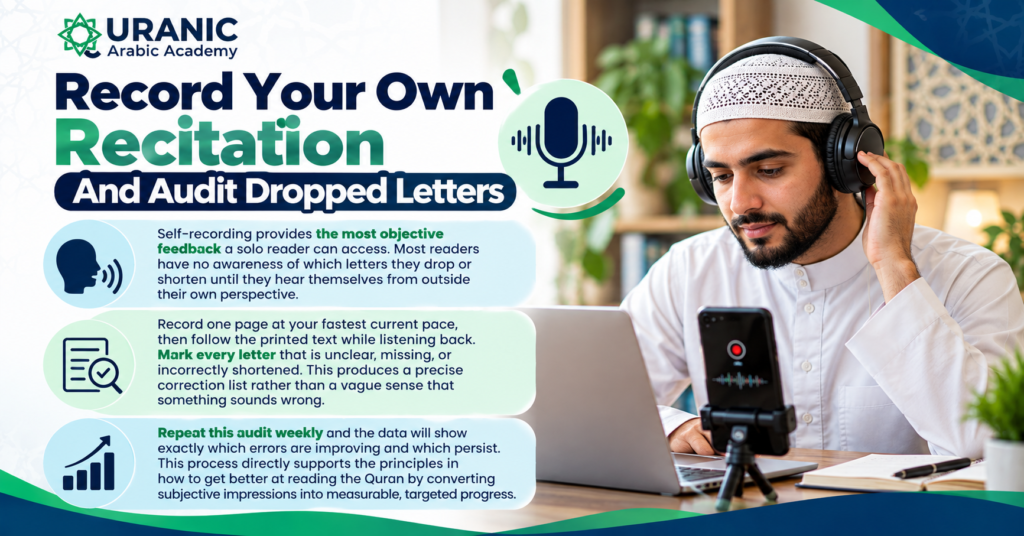
8. Record Your Own Recitation And Audit Dropped Letters
Self-recording provides the most objective feedback a solo reader can access. Most readers have no awareness of which letters they drop or shorten until they hear themselves from outside their own perspective.
Record one page at your fastest current pace, then follow the printed text while listening back. Mark every letter that is unclear, missing, or incorrectly shortened. This produces a precise correction list rather than a vague sense that something sounds wrong.
Repeat this audit weekly and the data will show exactly which errors are improving and which persist. This process directly supports the principles in how to get better at reading the Quran by converting subjective impressions into measurable, targeted progress.
9. Separate Your Speed Sessions From Your Reflection Sessions
Combining speed goals with deep reflection in the same session creates competing intentions that reduce the quality of both. Assigning a clear, singular purpose to each session is what allows both modes to function at their best.
This deliberate separation also resolves a debate that classical scholars addressed directly, and their resolution carries practical weight for every modern reader.
A. Setting Clear Goals For Each Quran Session Type
Use Hadr-paced reading for Hifz review and khatm accumulation. Keep a shorter, separate session for slow Tarteel reading with full attention to meaning and contemplation.
The benefits of reading the Quran daily are fully realized only when both speed and reflection receive their own intentional time, rather than one consistently crowding out the other.
B. Balancing Quantity And Quality In Your Quran Practice
Classical scholars debated which is superior: more recitation through Hadr or less with Tarteel and reflection.
The Hadith of Ibn Masoud (Tirmidhi) confirms that every correctly pronounced letter carries one reward multiplied tenfold, which led some scholars to favor high-volume reading.
However, the majority of early and later scholars concluded that recitation with reflection is superior, citing: “Do they not contemplate the Quran, or are there locks upon their hearts?” (Surah Muhammad: 24).
Imam Mujahid was asked about two men; one recited Surah Al-Baqarah alone in one rak’ah while the other recited Al-Baqarah and Al-Imran in the same rak’ah. He ruled that the reader of Al-Baqarah alone was superior.
The practical resolution is to honor both through intentional session separation, rather than letting one permanently crowd out the other.
Meet our Dedicated & Experienced Arabic and Quran Teachers.

10. Build A Consistent Daily Reading Structure To Compound Progress
Consistency outperforms intensity across almost every measurable learning outcome. Twenty focused minutes daily produces more improvement over three months than two-hour sessions practiced once a week.
Knowing how to build a daily Quran routine that integrates Hadr practice, Tajweed review, and reflective reading maximizes every minute you invest.
A clear structure removes the daily decision of what to focus on, eliminating the most common reason consistent practice quietly fails.
Track which pages you cover each week. Visible progress is one of the strongest motivators for sustaining the consistency that produces real, lasting speed gains.
Experience Our Teaching Style:
We believe in clarity and engagement. Watch these short highlights from our actual classes to see our teachers’ methodology and student interactions in real-time.
Ready to Begin Your Quranic Journey?
Start learning with professional instructors through our structured curriculum.
Book Your Free TrialStart Your Faster Quran Reading Journey With Expert Guidance Today
Self-teaching Tajweed and speed simultaneously is difficult when the errors holding you back are ones you cannot detect in your own recitation. A trained teacher identifies in one session what months of self-review may miss entirely.
At Quranic Arabic Academy, native Arabic-speaking instructors guide students from foundational Tajweed accuracy through advanced Hadr-paced recitation.
Every session is structured around your specific weaknesses, your schedule, and your recitation goals, with live feedback that accelerates progress at every level.
Book your free trial lesson today and receive a clear, qualified assessment of exactly what is limiting your recitation speed.
Check out our top courses to start learning Quranic Arabic today:
- Online Quranic Arabic Courses for Advanced Learners
- Quranic Arabic Grammar Course
- Quranic Arabic Course for Sisters (Female)
- Quranic Arabic Course for Kids
- Quranic Arabic Course UK
- Quranic Arabic Course UAE
Begin Your Quranic Journey with The Canadian Quran Academy with a free trial

Conclusion
How to read Quran faster is a question with a precise, scholarly answer rooted in Tajweed science.
The Hadr recitation tier, defined with precision by Imam Ibn Al-Jazari and transmitted through authentic chains, provides both the permission and the framework for reading at higher speed without sacrificing a single letter.
The ten strategies in this guide address every layer of the challenge: technical accuracy, visual training, vocabulary recognition, breathing control, auditory modeling, and consistent daily structure.
None of them is a shortcut; all produce compounding results when applied progressively. To genuinely know how to increase Quran reading speed in a lasting way, build the Tajweed foundation first, then vocabulary, then technique, then tempo.
When these layers are in place, faster reading becomes a meaningful enhancement to your daily practice and a deepening of your connection to the Quran.
Frequently Asked Questions
Is Fast Quran Recitation Islamically Permissible?
Fast recitation is permitted through the Hadr tier, which maintains full Tajweed compliance at a higher tempo. The forbidden form is Hadhrma, which involves speed so excessive that letters merge or drop entirely.
Classical scholarship documented by Ibn Al-Jazari clearly defines and distinguishes between the two.
How Long Does It Take To Increase Quran Reading Speed Noticeably?
With 20 to 30 minutes of focused daily practice, most consistent readers notice measurable improvement within four to eight weeks. The timeline depends on current Tajweed accuracy and how much Quranic vocabulary is already familiar to the reader.
What Is The Difference Between Hadr And Hadhrma?
Hadr is fast recitation that maintains all obligatory Tajweed rules, with every letter correctly articulated at a compressed tempo.
Hadhrma is an excessive speed that drops or merges letters entirely, making the recitation invalid. Classical scholars prohibited Hadhrma and confirm it carries no reward.
Should Beginners Focus On Reading The Quran Faster?
Beginners should focus entirely on correct pronunciation and foundational Tajweed before targeting speed.
Attempting speed before the foundation is solid reinforces errors that become significantly harder to correct later. Speed is always a second-stage goal, never a first-stage one.
Does Faster Recitation Reduce The Reward Of Reading The Quran?
The Hadith of Ibn Masoud (Tirmidhi) confirms that every correctly pronounced letter carries one reward multiplied tenfold, regardless of pace.
The reward is not reduced by speed, provided the recitation remains technically correct. Errors produced by excessive rushing affect both accuracy and the validity of the reward.
Which Recitation Tier Did The Prophet Use Most Often?
The Prophet (PBUH) primarily recited in Tarteel mode, as commanded in Surah Al-Muzzammil. He received the Quran through Jibreel (AS) with precise pronunciation and observed correct stops and connections.
He also authorized all three transmitted tiers for the Muslim community as valid forms of Quranic Tarteel.







Leave a Reply