 Quranic Verses

Knowing a verse by heart is powerful; learning how to remember Quran verse numbers takes that mastery to a different level entirely. Many hafidhs recite thousands of verses fluently but pause when asked: what number is Ayah Al-Kursi in Al-Baqarah?
Verse number precision is the mark of itqan, the deep mastery that scholars like Imam Ash-Shatbi devoted their careers to. It is not an Islamic obligation, but it separates fluent reciters from those with true command of the Mushaf.
This guide gives you eight clear, practical methods to build that precision; each grounded in how memory works and tested by learners who have memorized the full Quran with verse numbers intact.
1. Learn How To Remember Quran Verse Numbers By Fixing One Mushaf Edition
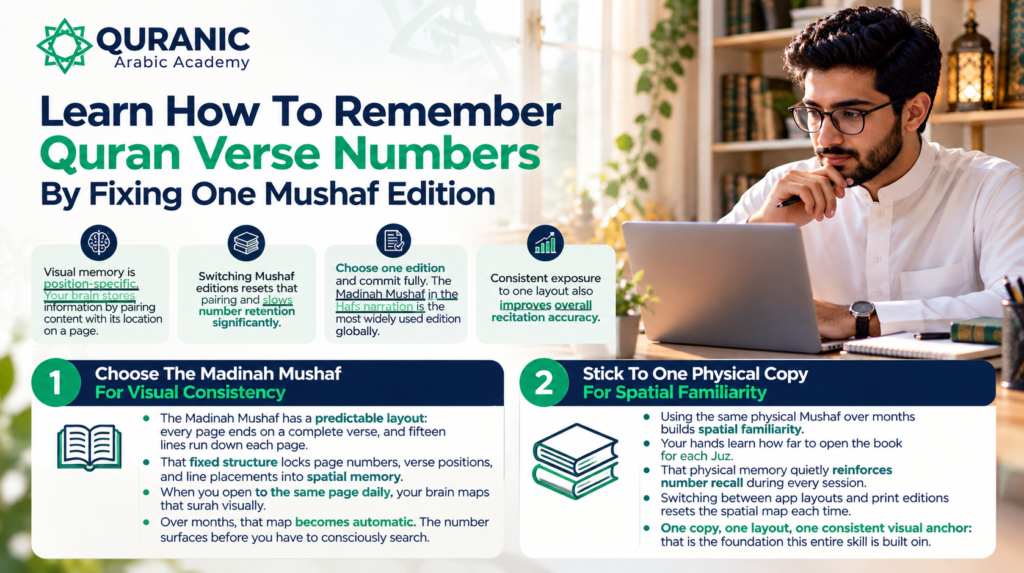
Visual memory is position-specific. Your brain stores information by pairing content with its location on a page. Switching Mushaf editions resets that pairing and slows number retention significantly.
To build reliable verse number recall, choose one edition and commit fully. The Madinah Mushaf in the Hafs narration is the most widely used edition globally and the most consistent starting point for this skill.
Consistent exposure to one layout also improves overall recitation accuracy. How to get better at reading the Quran starts with the same principle: a fixed reference point makes every layer of Quran mastery easier to refine over time.
A. Choose The Madinah Mushaf For Visual Consistency
The Madinah Mushaf has a predictable layout: every page ends on a complete verse, and fifteen lines run down each page. That fixed structure locks page numbers, verse positions, and line placements into spatial memory.
When you open to the same page daily, your brain maps that surah visually. Verse numbers attach to their position on that specific page. No other edition delivers this level of structural and visual consistency.
Over months, that map becomes automatic. The number surfaces before you have to consciously search, because your brain retrieves position and content as a single stored unit.
B. Stick To One Physical Copy For Spatial Familiarity
Using the same physical Mushaf over months builds spatial familiarity. Your hands learn how far to open the book for each Juz. That physical memory quietly reinforces number recall during every session.
Switching between app layouts and print editions resets the spatial map each time. One copy, one layout, one consistent visual anchor: that is the foundation this entire skill is built on.
Check Why Study Quranic Arabic Online at The Quranic Arabic Academy?

2. Start With Juz Start Pages Before Memorizing Individual Verse Numbers
Starting with the Mushaf’s overall structure prevents overwhelm. Before memorizing individual verse numbers, build a map of where each Juz begins on the page.
This Juz gateway technique creates a navigational skeleton for the whole Mushaf. When you know that Juz 2 begins on page 22 and Juz 3 on page 42, individual verse numbers slot naturally into that existing framework.
The table below shows the page start for the first ten Juz in the Madinah Mushaf. Commit these reference points to memory before moving to individual verse numbers within each Juz.
| Juz | Surah, Starting Verse | Page (Madinah Mushaf) |
| 1 | Al-Fatihah, Verse 1 | 1 |
| 2 | Al-Baqarah, Verse 142 | 22 |
| 3 | Al-Baqarah, Verse 253 | 42 |
| 4 | Aal-Imran, Verse 92 | 62 |
| 5 | An-Nisa, Verse 24 | 82 |
| 6 | An-Nisa, Verse 148 | 102 |
| 7 | Al-Ma’idah, Verse 82 | 121 |
| 8 | Al-An’am, Verse 111 | 141 |
| 9 | Al-A’raf, Verse 88 | 161 |
| 10 | Al-Anfal, Verse 41 | 181 |
Juz Amma Quranic studies offers the best entry point for this method. The final Juz contains the shortest surahs, so the page-start numbers are the easiest to map and build confidence before tackling longer sections.
See It in Action:
Wondering what our interactive sessions look like? Click below to peek inside a live session and watch how our expert instructors make learning Quranic Arabic accessible and engaging.
Ready to Begin Your Quranic Journey?
Start learning with professional instructors through our structured curriculum.
Book Your Free Trial3. Vocalize The Verse Number Alongside Every Recitation Cycle
Most learners recite verse text aloud but skip the number entirely. Adding the number to your vocalization creates an audio-mental pairing that memory holds reliably across long review cycles.
Say the number immediately before and after each verse during daily revision: Verse 255
“اللَّهُ لَا إِلَٰهَ إِلَّا هُوَ”
“Allahu la ilaha illa Huwa“
verse 255. That double-framing builds a dual memory trace for each verse.
This technique requires no tools and adds minimal time to each session. It integrates directly into how to build a daily Quran routine without disrupting the existing rhythm or adding extra practice blocks.

4. Segment Long Surahs Into Sections Before Tackling Their Numbers
Attempting to memorize every verse number in Al-Baqarah (286 verses) at once creates confusion and decision fatigue. The smarter approach is to segment the surah first, then master numbers section by section.
Divide long surahs into portions of 30 to 50 verses each. Memorize the number at the start of each section; the numbers within it then become relative and far easier to hold in memory.
Once section-start numbers are firm, any verse can be referenced as “verse 10 of my second section” rather than “verse 51 of Al-Baqarah.” Relative anchoring makes even the longest surahs manageable.
How to stay motivated during hifz becomes easier when each session has a bounded, achievable target. Segmentation gives you that structure, turning a Mushaf-wide goal into a series of completable steps.
Master Advanced Quranic Linguistics Through Structured Online Instruction

5. Link Each Verse Number To Its Physical Position On The Page
Position on the page is a reliable memory cue. Noticing that a verse sits in the top lines of a left-hand page makes that location part of how you recall its number.
The brain encodes location and content together, a process known as spatial encoding. Consciously noting where a verse sits on the page activates this mechanism during every review session.
This positional awareness costs nothing to develop. It only requires the habit of pausing for one second after each verse to observe where on the page that verse and its number appear.
A. Notice The Line Position Of Every Numbered Verse
Before moving past a verse, glance at its number and note its position: top, middle, or bottom of the page; left or right side. Repeat this observation every session without exception.
Over time, the number attaches to the visual location. You will recall, “This verse sits in the top third of a right-hand page in Surah Al-Kahf,” and its number will follow naturally.
Benefits of reading the Quran daily extend beyond spiritual reward. Daily exposure builds the visual map that makes positional encoding automatic; occasional reading never reaches the same depth of memory association.
B. Create Visual Anchors For High-Priority Verse Numbers
Not every verse number needs the same depth of encoding. Prioritize landmark verses: the first verse of each surah, the last verse of each page, and verses you quote most frequently in conversation.
For Ayah Al-Kursi, verse 255 of Al-Baqarah, its visual anchor is its position spanning nearly one full right-hand page. That distinctive placement makes the number 255 practically unforgettable for any serious student.
Assign a simple visual cue to each landmark number you prioritize. The more distinct the visual impression of that page, the faster the number embeds itself into long-term memory.

6. Run Active Recall Drills Targeting Number-Verse Pairs
Passive review builds recognition. Active retrieval, forcing your brain to produce the verse number without looking, converts that recognition into durable long-term recall that survives months without reinforcement.
Run two types of drills daily: forward testing (recite a verse and name its number) and reverse testing (read a number and recite the correct verse). Both directions train the same connection more effectively than either alone.
Drilling with a partner adds accountability and catches errors you miss when reviewing alone.
Quranic learning with peers doubles the effectiveness of number-recall sessions through real-time correction and the natural pressure of being tested by another person.
Read also: 10 Proven Tips Of How To Read Quran Faster With Full Accuracy
7. Leverage Specialized Apps Built For Indexed Quran Memorization
Generic Quran apps display verses but do not train number recall. Look specifically for apps that display verse numbers prominently, include indexed study modes, and allow self-testing by number rather than only by text.
Features to prioritize: number-visible display, custom segmentation by Juz or surah section, and quiz modes that ask for either the verse text or its corresponding number from memory.
The best Quranic apps combine audio recitation with visible number display. Every listening session becomes a training opportunity when the number appears alongside the verse text at all times.
Quranic Arabic Academy offers structured courses in Quran memorization and Quranic Arabic, led by certified instructors who specialize in helping students achieve verse-level precision.
8. Apply Verse Number Knowledge To Distinguish Mutashabihat Verses
The Quran contains many mutashabihat: verses that sound nearly identical but differ in wording, surah, or precise verse number.
Hafidhs who know verse numbers resolve these confusions instantly during revision, without backtracking through entire pages.
When two similar-sounding verses create confusion, their numbers provide a precise location for verification. If one belongs to Al-Baqarah verse 48 and another to An-Nisa verse 123, the number immediately clarifies which is which.
Scholars who mastered Quranic vocabulary typically paired that knowledge with verse-number precision to achieve error-free recitation. Verse number awareness turns mutashabihat from a recurring difficulty into a solved problem with a clear, repeatable solution.
Experience Our Teaching Style:
We believe in clarity and engagement. Watch these short highlights from our actual classes to see our teachers’ methodology and student interactions in real-time.
Ready to Begin Your Quranic Journey?
Start learning with professional instructors through our structured curriculum.
Book Your Free TrialStart Your Verse-Level Quran Mastery At Quranic Arabic Academy
Whether you are beginning hifz or refining verse-number precision after years of memorization, expert guidance shortens the path. Quranic Arabic Academy connects you with certified instructors who know exactly how to teach this skill systematically.
Join students from across the world who have built lasting Quran mastery through personalized, structured online instruction. Your verse-number skills deserve the same dedicated attention as your recitation and Tajweed.
Check out our top courses to start learning Quranic Arabic today:
- Online Quranic Arabic Courses for Advanced Learners
- Quranic Arabic Grammar Course
- Arabic Courses for Understanding the Quran
- Quranic Arabic Course for Sisters (Female)
- Quranic Arabic Course for Kids
- Online Quranic Arabic Classes for Adults
- Quranic Arabic Course Australia
Start your First FREE trial at Quranic Arabic Academy and experience the difference that expert, dedicated instruction makes.

Conclusion
Learning how to remember Quran verse numbers is a structured skill that rewards the right methods, not just more hours of review. The eight techniques above form a complete system, from edition consistency to mutashabihat resolution.
Start with Juz start pages to map the whole Mushaf. Then layer in positional anchors, vocal repetition, and landmark segmentation before pursuing complete verse-number coverage of every surah in sequence.
The standard set by the great Islamic scholars, knowing not just what a verse says but exactly where it stands, is within reach when these methods are applied consistently.
A commitment to Quranic education that includes verse-number mastery places you firmly in that tradition of deep, precision-driven Quran scholarship.
Frequently Asked Questions
Is Memorizing Quran Verse Numbers Religiously Obligatory?
Memorizing verse numbers is not an Islamic obligation. It is an optional precision skill, known as itqan, that deepens mastery and helps resolve similar-sounding verses accurately during recitation and revision.
How Long Does It Take To Learn All Verse Numbers?
The timeline depends on memorization level and the methods applied. Learners who use the Juz gateway technique alongside daily active recall drills typically see solid, measurable progress within six to twelve months.
Which Surah Is Best To Start With For Verse Number Memorization?
Start with surahs you have already memorized, especially the shorter ones in Juz Amma. Fewer verses per surah means faster number coverage and builds real confidence before approaching Al-Baqarah or Aal-Imran.
Do Verse Numbers Differ Between Quran Editions?
Yes, verse numbering varies between counting traditions. The Madinah Mushaf follows the Kufi count, which is the most widely taught. Fixing one edition from the start, as outlined in method one, eliminates this confusion entirely.
Can Verse Number Knowledge Help During Tarawih And Hifz Review?
Yes. Verse numbers provide precise location markers during recitation. If you lose your place, a known number anchors you back to the correct verse and surah immediately, without needing to backtrack through full pages.
Related Articles
Quranic Verses








Leave a Reply