 Quran
Quran

Learning how to get better at reading the Quran is a goal that matters to almost every Muslim, whether you are a complete beginner or someone who has been reciting for years.
Real improvement comes from correct pronunciation, steady practice, and guidance from a qualified teacher, not simply from a pleasant voice.
Many readers already know the Arabic letters but still struggle with specific sounds, hesitate in the middle of a verse, or confuse certain tajweed rules. These are common and fixable challenges. With the right method, they improve gradually and consistently.
you will see where structured courses such as the Quranic Arabic Academy can support your progress with qualified teachers.
1. Assess Your Current Level First
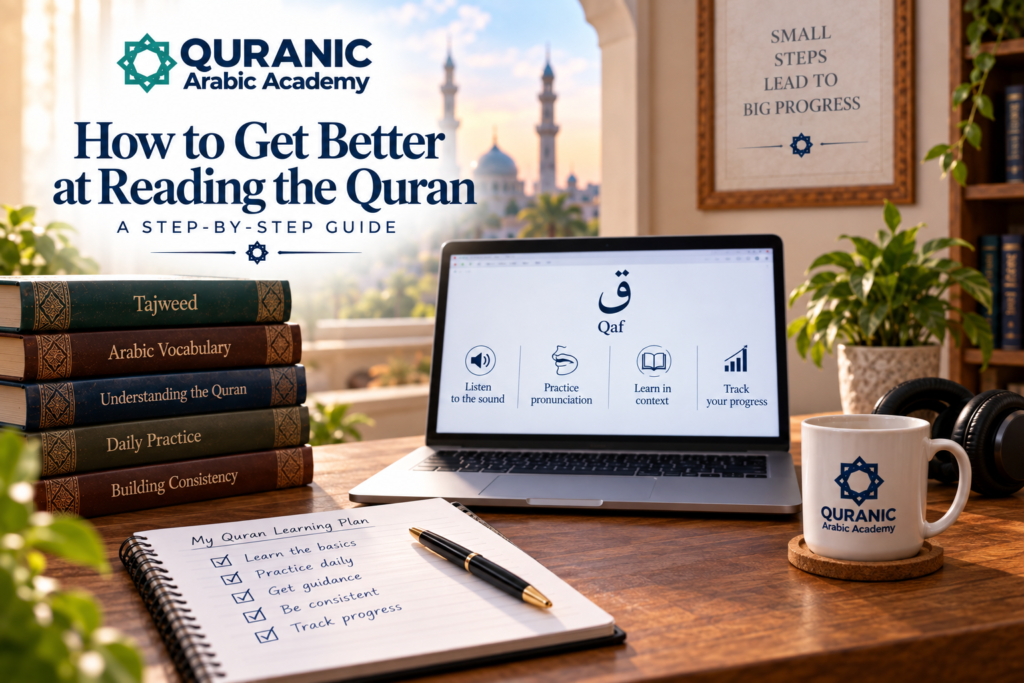
Before working on improving your Quran reading, take some time to assess your current level and identify the mistakes that appear repeatedly. Choose a short Surah that you are reasonably familiar with and read it aloud at a comfortable pace.
Pay attention to whether you rush through certain words, confuse similar Arabic letters, hesitate when reading vowel marks, miss elongations, or struggle to pronounce particular sounds from their correct articulation points. These patterns can give you a clearer picture of which areas need the most attention.
Recording your recitation and listening to it afterward can also be useful because you may notice pauses, unclear pronunciation, or repeated errors that are difficult to recognize while you are actively reading.
If possible, ask a qualified Quran teacher to listen as well, since some Makharij and Tajweed mistakes can be difficult for beginners to identify independently.
Once you understand your specific weaknesses, you can focus your practice on the skills that will make the greatest difference. Instead of simply repeating the same passages, you might spend additional time on letter pronunciation, diacritics, Tajweed rules, or reading fluency depending on what your assessment reveals.
2. Master the Arabic Articulation Points (Makharij al-Huruf)
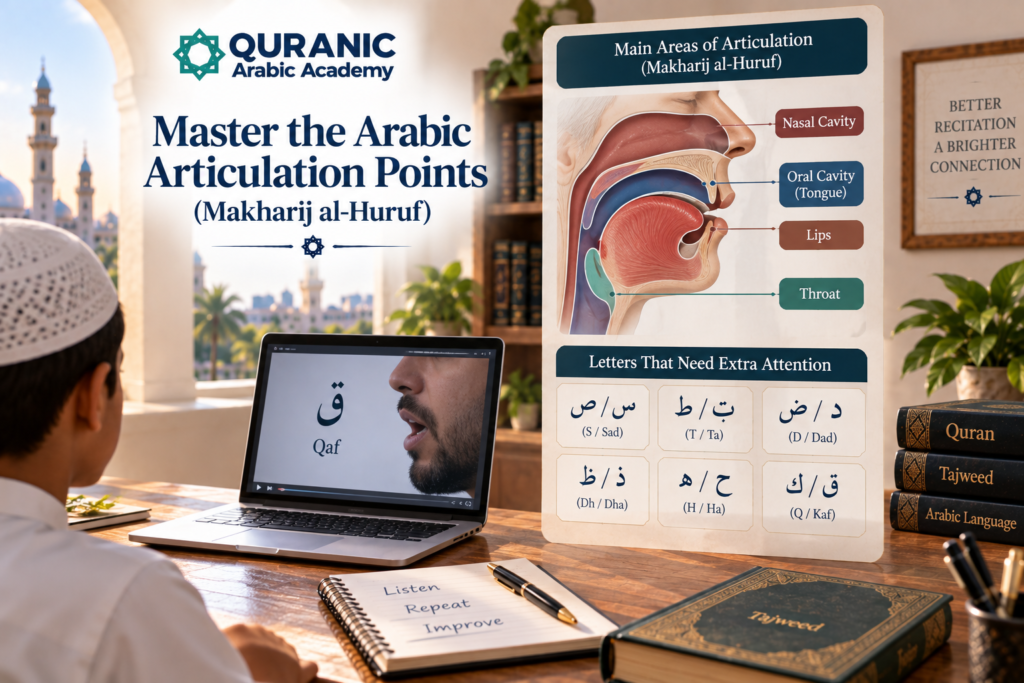
Each Arabic letter has a specific articulation point (makhraj) from which its sound is produced, involving areas such as the throat, tongue, lips, and oral cavity. Learning these articulation points is essential for improving Quran recitation because producing a letter from the wrong place can make it sound similar to another Arabic letter.
In some cases, replacing one letter with another can even change the word being recited, which is why accurate pronunciation should be developed from the beginning.
Certain groups of letters commonly require additional attention from learners, including س/ص, ت/ط, د/ض, ذ/ظ, ح/ه, and ق/ك. Although some of these sounds may initially seem similar, their articulation points and pronunciation characteristics are different.
Practicing them in pairs can help learners hear the contrast more clearly and train the tongue to move to the correct position. Listening carefully to a proficient Quran reciter or qualified teacher and repeating individual letters, short words, and Quranic examples can gradually strengthen both listening and pronunciation skills.
However, direct feedback is particularly valuable because learners may not always recognize their own Makharij mistakes. With regular repetition and correction, difficult sounds can become more natural and help build a stronger foundation for clear, accurate Quran recitation and Tajweed.
3. Learn the Correct Vowel Marks (Harakat)
Some Quran reading difficulties come from uncertainty about the basic Arabic vowel marks (Harakat), including fatha, kasra, damma, sukoon, shaddah, and tanween. These marks provide essential information about how letters and words should be pronounced.
Fatha, kasra, and damma indicate the basic short vowel sounds, while sukoon shows that a letter is pronounced without a following vowel. Shaddah indicates that a consonant is doubled, and tanween adds an ending sound that learners will encounter frequently throughout the Quran.
Adult beginners should aim to recognize these marks quickly and naturally while reading, rather than stopping to identify each one individually. If you regularly hesitate when encountering a shaddah, sukoon, or tanween, spend additional time practicing them through simple Arabic words before moving to longer Quranic passages.
Reading short verses slowly and paying close attention to every vowel mark can also help connect the written symbols with their correct sounds.
A strong understanding of Harakat creates an important bridge between recognizing Arabic letters and reading complete Quranic words fluently. Once these marks become familiar, learners can concentrate more easily on pronunciation, rhythm, and Tajweed instead of using most of their attention to decode individual words.
Strengthening this foundation early can therefore make later Quran reading practice smoother, more accurate, and more confident.
4. Study Tajweed Rules Gradually
Trying to learn every Tajweed rule at the same time can make Quran reading feel unnecessarily complicated, especially for beginners. A better approach is to study the rules gradually, beginning with those that appear frequently throughout the Quran.
Start with essential topics such as Noon Sakinah and Tanween, Meem Sakinah, Madd (elongation), Ghunnah, and Qalqalah, then introduce additional rules as your reading becomes more confident. Focusing on one or two rules at a time gives you enough opportunity to understand how they work and recognize them naturally in Quranic words and verses.
When learning a new rule, do not limit your study to memorizing its name or definition. Look for real examples in the Quran, listen to how a skilled reciter applies the rule, and then practice reading the same examples aloud. Repeating this process helps connect the theoretical rule with the sound you are expected to produce during recitation.
Ultimately, knowing the definition of a Tajweed rule matters less than being able to recognize and apply it correctly while actually reciting. Once a rule becomes comfortable in practice, you can move on to the next one while continuing to review what you have already learned.
This gradual approach prevents learners from becoming overwhelmed and helps Tajweed become a natural part of accurate and fluent Quran recitation.
5. Listen to Skilled Reciters and Repeat After Them
Listening is one of the most effective ways to improve Quran pronunciation and recitation, because Quran reading is a spoken skill that cannot be fully learned through written explanations alone.
Regular listening helps train your ear to recognize the correct sounds of Arabic letters, the length of Madd, the nasal quality of Ghunnah, and the appropriate places to pause or continue. Over time, this makes it easier to notice differences between accurate recitation and common pronunciation mistakes.
Choose a skilled reciter known for clear, slow, and accurate Tajweed, especially while you are still developing your reading skills. Instead of listening to a long Surah at once, select one short verse or even a few words and listen to them several times.
Then pause the recording and repeat the same passage aloud, trying to imitate the pronunciation, elongation, rhythm, and stopping points as closely as possible.
This listen-and-repeat method works best when practiced consistently with small portions of the Quran. You can also record yourself and compare your recitation with the original to identify sounds or words that still need improvement.
However, listening should support rather than completely replace teacher feedback, since a qualified Quran teacher can identify subtle Makharij and Tajweed mistakes that may be difficult to recognize on your own.
See It in Action:
Wondering what our interactive sessions look like? Click below to peek inside a live session and watch how our expert instructors make learning Quranic Arabic accessible and engaging.
Ready to Begin Your Quranic Journey?
Start learning with professional instructors through our structured curriculum.
Book Your Free Trial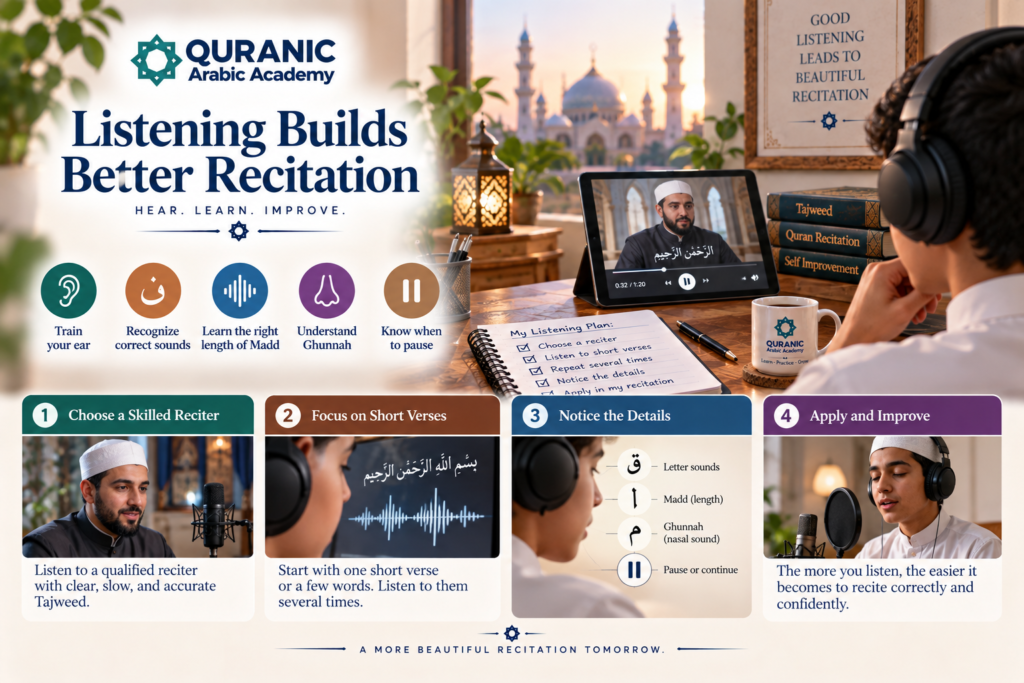
6. Read Aloud Daily
Reading the Quran aloud every day is one of the simplest ways to improve pronunciation, fluency, and confidence in recitation. Silent reading can sometimes hide pronunciation problems because you may recognize a word visually without actually producing each letter correctly.
When you recite aloud, it becomes easier to notice hesitation, unclear letter sounds, incorrect vowel pronunciation, weak articulation, or problems with Madd and Ghunnah. Even a short daily session can help train your tongue to become more comfortable with Arabic sounds and Quranic word patterns.
Try to read at a clear and moderate pace rather than rushing through the verses. Focus first on producing each letter correctly and observing the vowel marks and Tajweed rules you have already learned.
If you repeatedly struggle with a particular word or sound, pause and practice it separately several times before returning to the complete verse. Accuracy should come before speed, especially while you are still strengthening your Quran reading skills.
Recording a short portion of your recitation can also make daily practice more useful. Listen back carefully and compare your reading with a skilled Quran reciter, paying attention to pronunciation, elongation, pauses, and difficult letters.
Over time, this simple habit can help you recognize recurring mistakes, measure your progress, and become more aware of areas that still need correction.
Read also: Learning to Read the Quran Independently: A Beginner’s Roadmap
7. Slow Down Before You Speed Up
Reading the Quran faster does not necessarily mean reading it better. In the early stages of learning, rushing through verses can lead to skipped letters, incorrect vowel sounds, shortened or exaggerated elongations, and poorly applied Tajweed rules.
It may also cause learners to overlook important details such as shaddah, sukoon, or the correct articulation of similar Arabic letters. For this reason, developing accuracy should come before trying to increase reading speed.
Begin by reciting at a slow and controlled pace, giving each letter enough attention to come from its correct articulation point and making sure every word is read with its proper Harakat. When you encounter a difficult word or verse, pause and repeat it several times rather than trying to move through it quickly.
This gives your tongue time to become familiar with unfamiliar Arabic sounds and helps reinforce the Tajweed rules you have already studied.
As correct pronunciation and reading patterns become more familiar, your fluency and speed will gradually improve without being forced. The goal is not simply to finish a page quickly, but to develop a recitation that is clear, accurate, and consistent.
With regular practice, learners usually find that they can read more smoothly while still maintaining correct Makharij, Harakat, and Tajweed.
8. Learn Correct Stopping and Starting Points (Waqf and Ibtida)
Knowing where to pause (Waqf) and where to resume (Ibtida) is an important part of accurate Quran recitation. A pause is not simply a place to take a breath; where you stop can affect how the words and ideas within a verse are connected.
Stopping in an inappropriate place may interrupt a sentence or separate words whose meanings are closely related, which can make the intended meaning less clear.
Begin by paying attention to the stop marks printed in the Mus-haf, as these symbols provide guidance about suitable places to stop, continue, or avoid pausing. Learn their meanings gradually rather than trying to memorize every symbol at once.
When practicing longer verses, plan your breathing and identify appropriate stopping points in advance instead of continuing until you run out of breath.
It is equally important to learn where to begin again after stopping. Restarting from the wrong word can sometimes create an incomplete or misleading phrase, so Waqf and Ibtida should be studied together. Listening to skilled reciters and receiving guidance from a qualified teacher can help learners understand how correct stopping and starting support both fluent recitation and accurate meaning.
Read also:How Adults Can Learn to Read the Quran: The Ultimate Guide
9. Study With a Qualified Quran Teacher
Direct, live correction from a qualified Quran teacher is one of the most effective ways to improve Quran reading. Some recitation mistakes are subtle and may be difficult for learners to hear on their own, even after listening to recordings.
A teacher can identify an unclear articulation point, an incorrectly pronounced letter, a shortened or excessive elongation, an incomplete Ghunnah, or a Tajweed rule that is understood theoretically but not being applied correctly during actual recitation.
Regular lessons also give learners a more structured path for improvement. Instead of repeatedly practicing without knowing which areas need attention, a teacher can identify recurring mistakes and provide specific exercises for Makharij, Harakat, Tajweed, fluency, and Waqf and Ibtida.
Immediate feedback is particularly valuable because correcting a mistake as soon as it occurs can prevent the incorrect pronunciation from becoming a long-term habit.
Learners should also remember that struggling with Quran recitation while continuing to make a sincere effort is not a reason to feel discouraged. The virtue of striving with the Quran, even when reading is difficult, is described in an authentic hadith:
عَنْ عَائِشَةَ رَضِيَ اللَّهُ عَنْهَا قَالَتْ: قَالَ رَسُولُ اللَّهِ ﷺ: «الْمَاهِرُ بِالْقُرْآنِ مَعَ السَّفَرَةِ الْكِرَامِ الْبَرَرَةِ، وَالَّذِي يَقْرَأُ الْقُرْآنَ وَيَتَتَعْتَعُ فِيهِ وَهُوَ عَلَيْهِ شَاقٌّ لَهُ أَجْرَانِ»
“The one who is skilled in reciting the Qur’an is with the noble, obedient scribes (the angels), and the one who recites the Qur’an and struggles with it, finding it difficult, will have a double reward.”
Sahih al-Bukhari 4937 and Sahih Muslim 798

10. Understand the Meaning of What You Recite
Improving Quran recitation is not only about pronouncing letters correctly or applying Tajweed rules. Understanding the general meaning of the verses you read can make recitation more thoughtful and help increase khushu’ (attentiveness and humility).
When you know what a Surah is discussing whether it is describing Allah’s attributes, giving guidance, telling a story, or reminding believers about the Hereafter you can engage with the words more consciously instead of focusing only on their sounds.
Understanding the meaning can also improve the technical side of your recitation. Knowing where a sentence or idea begins and ends makes it easier to choose appropriate stopping and starting points (Waqf and Ibtida) and avoid pausing in places that interrupt the meaning.
This becomes especially useful when reading longer verses where several ideas may appear within the same passage.
You do not need advanced Arabic knowledge to begin developing this understanding. Reading a reliable translation and an accessible Tafsir before or after recitation can provide enough context to understand the main message of a Surah. Starting with Surahs you recite frequently in Salah can make this habit easier to maintain while gradually connecting accurate recitation with understanding and reflection.
Show Proper Respect for the Mus-haf You Practice With
Respect for the Quran also extends to the physical Mus-haf and any pages containing Quranic verses. If pages used for practice become damaged, worn, or no longer usable, they should be handled respectfully rather than treated like ordinary waste.
For practical guidance on appropriate methods, read our guide on how to dispose of Quranic verses.
Common Mistakes That Slow Down Progress
Even with regular Quran practice, certain habits can slow your improvement and make it difficult to develop accurate, fluent recitation. Some learners focus too heavily on reading quickly, practice the same mistakes without correction, move to advanced Tajweed rules before mastering the basics, or study irregularly for long periods instead of maintaining a consistent routine.
Others may depend entirely on listening without reading aloud or avoid asking for correction because they feel uncomfortable making mistakes in front of a teacher.
These habits can make progress feel slower because Quran reading depends on several connected skills, including letter recognition, Makharij, Harakat, Tajweed, fluency, and correct stopping and starting. If a weakness in one of these areas is repeatedly ignored, it may continue to affect the learner’s overall recitation.
Identifying recurring mistakes and working on them individually is often more effective than simply reading more pages without a clear focus. It is also important not to expect immediate perfection. Improving Quran recitation is a gradual process that requires patient repetition, consistent practice, and regular feedback.
By recognizing unhelpful habits early and replacing them with focused practice and proper guidance, learners can gradually strengthen their recitation, correct long-standing mistakes, and become more confident and accurate while reading the Quran.
Read also: Frequent Mistakes in Quran Reading and How to Fix Your Recitation
Focusing on a Beautiful Voice Before Correct Pronunciation
A beautiful voice can enhance recitation and make it pleasant to listen to, but accuracy should always come first. Begin by focusing on pronouncing letters, vowels, and words correctly, while paying attention to the proper articulation points and characteristics of each letter.
Once your pronunciation becomes more accurate and stable, you can gradually spend more time developing your tone, rhythm, and overall performance.
1. Copying the Speed of Professional Reciters
Experienced reciters often reach their speed after years of regular practice, careful correction, and familiarity with the rules of Tajweed. Trying to imitate that pace too early can lead to skipped letters, rushed Tajweed rules, weak pronunciation, and a loss of concentration.
It is better to begin at a comfortable speed that allows you to recite accurately, then increase your pace gradually as your confidence and control improve.
2. Learning Tajweed Only in Theory
Knowing the names and definitions of rules such as Idgham and Ikhfa is useful, but Tajweed is ultimately a practical skill that must be applied during actual recitation. Reading explanations alone is not enough if you do not practice recognizing and applying the rules in Quranic verses.
Try to focus on one rule at a time and repeat examples aloud until its correct application becomes more familiar and natural.
3. Delaying Correction of Known Mistakes
If you already know that you regularly mispronounce a particular letter, word, or phrase, work on correcting it as soon as possible. Repeating the same error during every practice session can turn it into a habit and make it more difficult to change later.
Slow down, isolate the difficult sound or word, listen to a reliable example, and repeat it several times before returning to the full verse.
4. Inconsistent Practice
Long gaps between practice sessions can make it harder to retain the skills you have developed and may cause you to lose confidence. Even when you are busy, a short period of focused Quran reading each day is generally more helpful for building consistency than occasional long sessions.
Regular practice also makes it easier to notice small improvements and maintain the connection between what you learn and how you apply it.
A Simple Daily Practice Routine
You do not need to spend hours practicing every day to make meaningful progress in Quran reading. In many cases, a short, focused routine practiced consistently is more useful than a long session that happens only occasionally.
Setting aside around 20 minutes each day gives you enough time to work on pronunciation, Tajweed, reading fluency, and correction without making Quran practice difficult to fit around work, study, or family responsibilities.
The key is to give each practice session a clear purpose rather than simply reading as many pages as possible. Part of the session might focus on Makharij or difficult letters, another part on reading a short passage slowly, and the remaining time on reviewing mistakes or repeating verses after a skilled reciter.
Read also: Revitalize Your Quran Reading Routine: 12 Practical Tips
If you are working with a teacher, you can also use these daily sessions to practice the specific corrections or Tajweed rules covered in your most recent lesson.
Your routine can be adjusted according to your current level and the areas that need the most improvement. A complete beginner may spend more time on letters, Harakat, and short words, while a more confident reader may focus on Tajweed, Waqf and Ibtida, and smoother recitation.
The following structure provides a simple starting point that can gradually develop alongside your Quran reading skills:
- 5 minutes: review one articulation point or tajweed rule.
- 5 minutes: listen to a short passage from a skilled reciter and repeat after them.
- 10 minutes: read the same verses aloud from the mus-haf, noting any mistakes to revisit.
At the end of each week, recite a passage you have practiced without listening to the recording first. This shows how much you can apply independently. If you would like a teacher to guide this routine and correct you directly, you can contact the Quranic Arabic Academy to arrange a session.

Why Accurate Recitation Has Always Mattered
The emphasis on precise recitation is closely tied to how the Quran has been preserved since it was revealed, both orally and in written form. From the earliest generations of Muslims, the Quran was carefully memorized, recited, and taught from one generation to the next, while its written text was also preserved.
This strong tradition of oral and written transmission helped protect the words of the Quran and maintain the correct manner of reciting them.
For this reason, learning to pronounce the Arabic letters correctly and apply the rules of Tajweed is more than simply improving the sound of recitation. It is part of approaching the Quran with care, respect, and attention to the words being recited.
Understanding this background can deepen your motivation to recite carefully rather than approximately and encourage you to keep improving your pronunciation and Tajweed skills.
You can read more in this overview of the history of the Quranic text to learn more about how the Quran has been preserved and transmitted throughout Islamic history.
Experience Our Teaching Style:
We believe in clarity and engagement. Watch these short highlights from our actual classes to see our teachers’ methodology and student interactions in real-time.
Ready to Begin Your Quranic Journey?
Start learning with professional instructors through our structured curriculum.
Book Your Free Trial
Learn Quran Recitation With Qualified Teachers
If you want direct, personalized correction rather than practicing alone, learning with a qualified Quran teacher can make a significant difference in improving your recitation and Tajweed skills.
A teacher can listen to your recitation, identify mistakes in pronunciation, articulation, elongation, and other Tajweed rules, and guide you through the correct way to recite each verse.
The Quranic Arabic Academy offers structured Quran recitation and Tajweed courses designed to support learners at different levels, from beginners who are taking their first steps in Quranic recitation to advanced learners who want to refine their skills.
With guidance from qualified teachers and a structured learning approach, students can practice consistently, receive personalized feedback, and build greater confidence in their recitation.
You can learn more about the academy or get in touch to start your Quran learning journey.
Our Arabic Courses
- Quranic Arabic Classes
- Quranic Arabic Course for Beginners
- Online Quranic Arabic Courses for Advanced Learners
- Quranic Arabic Grammar Course
- Arabic Courses for Understanding the Quran
- Quranic Arabic Course for Sisters (Female)
- Quranic Arabic Course for Kids
- Online Quranic Arabic Classes for Adults
- Quranic Arabic Course UK
- Quranic Arabic Course London
- Quranic Arabic Course USA
- Quranic Arabic Course Canada
- Quranic Arabic Course Australia
- Quranic Arabic Course UAE
- Quranic Arabic Course Germany

Conclusion
Learning how to get better at reading the Quran begins with understanding your current level and identifying the areas that need the most improvement. Instead of trying to correct everything at once, start by building a strong foundation in Arabic articulation points (Makharij al-Huruf), vowel marks (Harakat), and accurate letter pronunciation.
Once these basics become more comfortable, you can gradually introduce essential Tajweed rules and work on smoother, more fluent recitation. Following this order helps prevent basic pronunciation mistakes from continuing as you move into more advanced reading skills.
Regular practice should combine several methods rather than relying on reading alone. Listening to skilled reciters, repeating short verses, reading aloud every day, practicing at a controlled pace, and recording your recitation can all help you recognize recurring weaknesses.
Studying with a qualified Quran teacher adds another important layer because direct feedback can reveal subtle mistakes in Makharij, Madd, Ghunnah, Tajweed, or stopping points that may be difficult to notice independently.
Most importantly, focus on consistency rather than speed. Set aside a realistic amount of time for the Quran each day, even if it is only a short session, and concentrate on correcting one mistake or strengthening one skill at a time.
Avoid measuring progress only by how many pages you can finish or how quickly you can recite. When accuracy, regular correction, and patient repetition guide your practice, greater confidence and fluency can develop naturally over time.
Frequently Asked Questions
How can I quickly improve my Quran reading?
Focus first on your most frequent mistakes, practice daily, listen to a skilled reciter, and have a teacher check your recitation directly. Faster improvement means reducing errors in an organized way, not reading faster.
Can I improve my Quran reading at home?
Yes, a large part of practice can happen at home using the mus-haf and audio recordings. A qualified teacher, in person or online, remains important for catching mistakes you cannot notice on your own.
Do I need to learn tajweed to read the Quran well?
Learning the rules that support correct recitation is important, alongside practical application. Beginners can start with basic rules and gradually progress to more detailed ones.
Which surah should I start with to improve my recitation?
Short, frequently recited surahs such as Al-Fatihah and other short surahs used in prayer are a practical starting point, since their length makes repetition and correction easier before moving to longer passages.
Does listening to Quran recitation alone improve my reading?
Listening helps significantly with correct pronunciation and rhythm, but it is most effective when combined with active repetition, reading aloud, and correction from a teacher.
Does recording my voice help improve my recitation?
Yes. Recording and replaying your recitation helps you notice hesitation, mispronunciation, and pacing issues, though it does not replace correction from a proficient reciter or teacher for subtler mistakes.







[…] exposure to one layout also improves overall recitation accuracy. How to get better at reading the Quran starts with the same principle: a fixed reference point makes every layer of Quran mastery easier […]
[…] resource like how to get better at reading the Quran confirms what certified instructors see consistently: students who improve fastest follow a fixed […]