 Quranic Verses
A message left unanswered. A family gathering you quietly avoided. A relative you haven’t spoken to in years, not because of one big fight, but because of small misunderstandings that slowly turned into silence.
In today’s fast-paced world, broken family ties have become painfully common. Yet in Islam, the bond between relatives isn’t a social courtesy to keep when it’s convenient. It’s a sacred trust that Allah Himself placed under His protection.
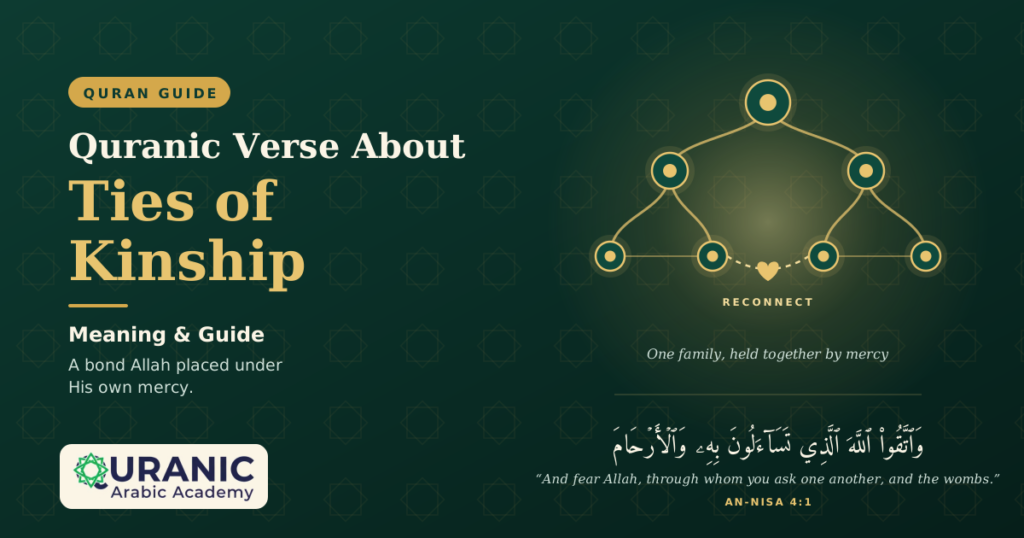
The Quran gives this bond remarkable weight. In the very first verse of Surah An-Nisa, Allah mentions ties of kinship right beside His own name: “And fear Allah, through whom you ask one another, and the wombs” (An-Nisa 4:1).
In this guide, you’ll explore the most important Quranic Verse About Ties of Kinship and what it means, along with other verses that praise those who maintain these ties and warn those who sever them.
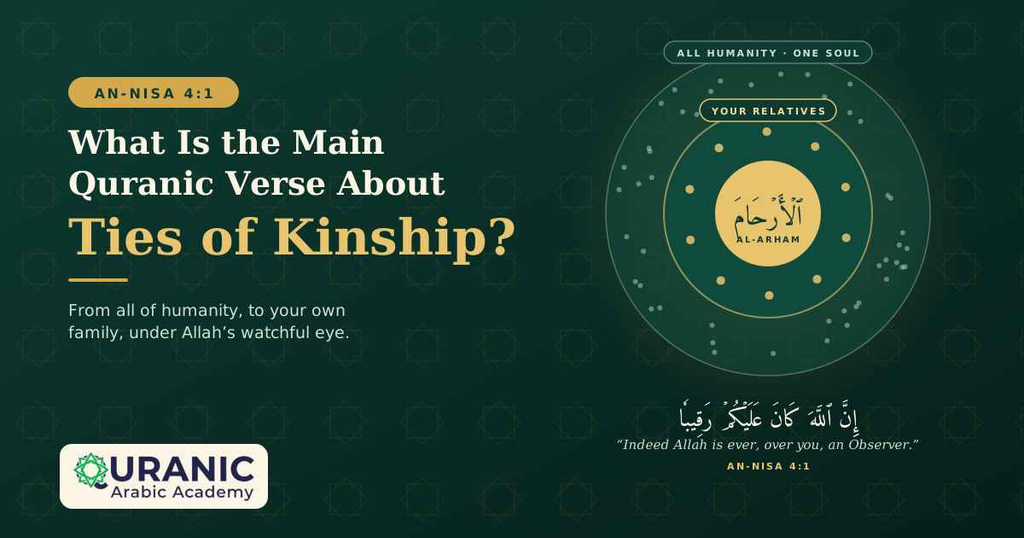
1. What Is the Main Quranic Verse About Ties of Kinship? (Surah An-Nisa 4:1)
If you’ve ever attended a Muslim wedding, you’ve almost certainly heard this verse, even if you didn’t notice it. It’s one of the verses the Prophet ﷺ recited in his well-known opening sermon, Khutbat al-Hajah, which is still read at marriage contracts around the world.
It’s fitting that a verse about family is recited at the very moment a new family is born. That verse is the opening of Surah An-Nisa, and it’s widely regarded as the central Quranic verse on ties of kinship:
يَٰٓأَيُّهَا ٱلنَّاسُ ٱتَّقُواْ رَبَّكُمُ ٱلَّذِي خَلَقَكُم مِّن نَّفۡسٖ وَٰحِدَةٖ وَخَلَقَ مِنۡهَا زَوۡجَهَا وَبَثَّ مِنۡهُمَا رِجَالٗا كَثِيرٗا وَنِسَآءٗۚ وَٱتَّقُواْ ٱللَّهَ ٱلَّذِي تَسَآءَلُونَ بِهِۦ وَٱلۡأَرۡحَامَۚ إِنَّ ٱللَّهَ كَانَ عَلَيۡكُمۡ رَقِيبٗا
“O mankind, fear your Lord, who created you from one soul and created from it its mate and dispersed from both of them many men and women. And fear Allah, through whom you ask one another, and the wombs. Indeed Allah is ever, over you, an Observer.” (An-Nisa 4:1, Sahih International)
What makes this verse so powerful is the journey it takes in just a few lines:
- It begins with all of humanity, reminding us that every person on earth comes from a single soul. Relatives share that origin even more directly, which makes neglecting them a betrayal of the bond Allah Himself created.
- Then it narrows down to the closest circle of all: our own relatives, al-arḥām, mentioned right beside the name of Allah.
- It ends with a gentle but serious reminder: Allah is Raqīb, always watching how we treat one another.
In this section, we’ll unpack the meaning of this verse, why kinship is placed so close to Allah’s name, and what it asks of us in our own families today.
Word-by-Word Meaning of “Wal-Arham” (وَالْأَرْحَامَ)
Sometimes a single word in the Quran holds an entire world of meaning. Wal-arhām is one of them. At first glance, it looks like a simple word at the end of a phrase: “and the wombs.” But look closer, and you’ll find that each part of it carries weight:
- The small letter that links it to Allah’s name.
- The root it comes from.
- Even the vowel on its final letter.
Together, they explain why Islam treats family ties as something sacred rather than merely social.
In this section, we’ll break the word down piece by piece. You’ll see what wa and al add to its meaning, why the Quran uses arḥām, “wombs,” to describe relatives, and how its root, ر – ح – م, connects family directly to Allah’s names Ar-Raḥmān and Ar-Raḥīm. Reading it word by word shows how much meaning it carries.
| Arabic | Transliteration | Meaning |
|---|---|---|
| وَاتَّقُوا | wattaqū | and be mindful of / fear |
| اللَّهَ | Allāha | Allah |
| الَّذِي | alladhī | the One who |
| تَسَاءَلُونَ بِهِ | tasā’alūna bihi | you ask one another by Him |
| وَالْأَرْحَامَ | wal-arḥāma | and the wombs (ties of kinship) |
| رَقِيبًا | raqībā | ever watchful |
Al-arham is the plural of rahm, the womb. In the Quran, it refers to everyone connected to you through birth: parents, children, siblings, aunts, uncles, and their families.
Having one of the academy’s teachers review it before you publish. Relatives share that origin even more directly, which makes neglecting them a betrayal of the bond Allah Himself created. You can explore more in our guide to Quranic tafsir.
2. Other Quranic Verses About Ties of Kinship (Complete List)
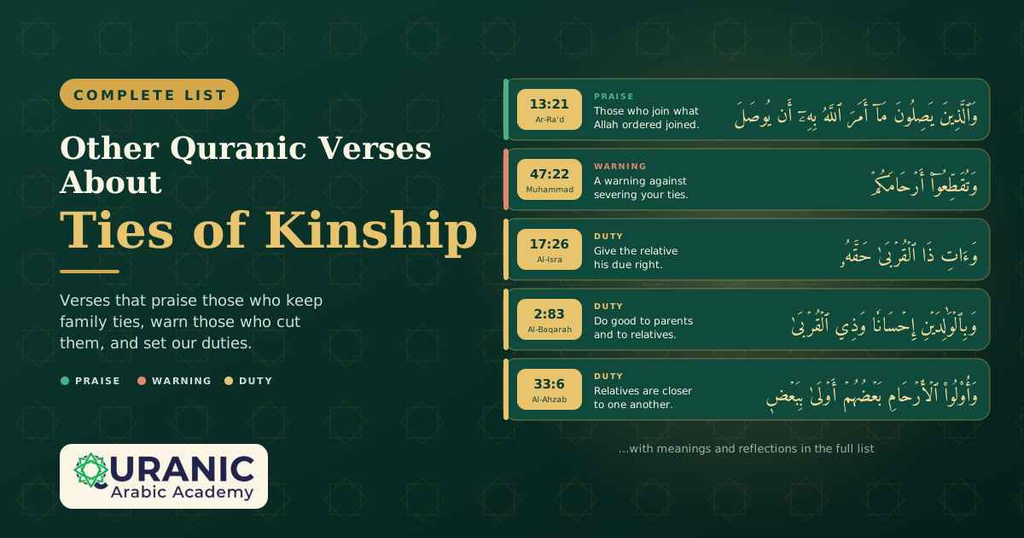
Surah An-Nisa 4:1 may be the best-known verse about family ties, but it’s far from the only one. Throughout the Quran, Allah returns to this theme again and again, in different surahs, settings, and tones:
- Some verses praise those who keep their ties strong and promise them a beautiful reward.
- Others give firm warnings to those who cut what Allah has commanded to be joined.
- And some turn kindness to relatives into a practical duty, listing them by name among those who deserve our care and generosity.
Together, these verses paint a complete picture of how highly Islam values the bond of kinship. In this section, we’ve gathered them into one clear list, each with its meaning and the message it carries. Read them slowly and reflect on what each one asks of you.
You may find that one of them speaks directly to a relationship in your own life that’s waiting to be mended. If you struggle to keep track of references, try these tips to remember Quran verse numbers.
Verses Commanding Kindness to Relatives
In the Quran, kindness to relatives isn’t left as a vague suggestion or a nice extra. It’s a clear command. Again and again, Allah mentions relatives right after parents, and sometimes right after His own worship, among those who deserve our care, generosity, and good treatment.
The verses below show how this kindness is meant to look in real life: giving relatives their rights, supporting them in need, and treating them with gentleness and respect.
1. Surah Al-Baqarah (2:83): Part of the covenant taken from the Children of Israel.
وَبِالْوَالِدَيْنِ إِحْسَانًا وَذِي الْقُرْبَىٰ وَالْيَتَامَىٰ وَالْمَسَاكِينِ
“…and do good to parents, relatives, orphans, and the needy…”
The lesson: kindness to relatives has been part of Allah’s covenant with every nation, not only this one.
2. Surah An-Nisa (4:36): Comes directly after the command to worship Allah alone.
وَاعْبُدُوا اللَّهَ وَلَا تُشْرِكُوا بِهِ شَيْئًا ۖ وَبِالْوَالِدَيْنِ إِحْسَانًا وَبِذِي الْقُرْبَىٰ
“Worship Allah and associate nothing with Him, and do good to parents and to relatives…”
The lesson: good treatment of family is listed immediately after tawheed, showing its rank.
3. Surah An-Nahl (16:90):
إِنَّ اللَّهَ يَأْمُرُ بِالْعَدْلِ وَالْإِحْسَانِ وَإِيتَاءِ ذِي الْقُرْبَىٰ
“Indeed, Allah commands justice, excellence, and giving to relatives…”
The lesson: giving to relatives is one of three pillars of righteous conduct named in a single command.
4. Surah Al-Isra (17:26) and Surah Ar-Rum (30:38):
وَآتِ ذَا الْقُرْبَىٰ حَقَّهُ
“And give the relative his due right…”
The lesson: what you give your relatives is described as their right (haqq), not a favor.
5. Surah Al-Baqarah (2:177) and (2:215): Both name relatives among the first recipients of spending and charity. True righteousness, says 2:177, includes giving wealth “despite loving it” to relatives.
Verses Praising Those Who Keep Ties
Keeping family ties isn’t always easy. It can mean calling first, forgiving old hurts, or making time when life feels too busy. That’s exactly why the Quran honors those who do it.
In these verses, Allah describes the people who join what He commanded to be joined as people of true understanding, and He promises them a beautiful home in the Hereafter. These verses are a reminder that every effort you make to stay connected, however small, is seen and valued by Allah.
6. Surah Ar-Ra’d (13:21):
وَالَّذِينَ يَصِلُونَ مَا أَمَرَ اللَّهُ بِهِ أَن يُوصَلَ وَيَخْشَوْنَ رَبَّهُمْ
“And those who join what Allah has commanded to be joined, and fear their Lord…”
7. Surah An-Nur (24:22):
وَلَا يَأْتَلِ أُولُو الْفَضْلِ مِنكُمْ وَالسَّعَةِ أَن يُؤْتُوا أُولِي الْقُرْبَىٰ … وَلْيَعْفُوا وَلْيَصْفَحُوا ۗ أَلَا تُحِبُّونَ أَن يَغْفِرَ اللَّهُ لَكُمْ
“Let not those of virtue and means among you swear off giving to their relatives… Let them pardon and overlook. Do you not love that Allah should forgive you?”
This verse was revealed about Abu Bakr as-Siddiq. He had supported his poor relative Mistah for years, but Mistah took part in spreading the slander against Aisha.
Abu Bakr swore to stop his support. After this verse, he said, “Yes, I love that Allah forgives me,” and resumed helping Mistah. The lesson: keep giving to relatives even after they wrong you.
Verses Warning Against Severing Ties
8. Surah Muhammad (47:22–23): This is the strongest verse about severing ties of kinship. It places cutting family ties beside spreading corruption on earth.
فَهَلْ عَسَيْتُمْ إِن تَوَلَّيْتُمْ أَن تُفْسِدُوا فِي الْأَرْضِ وَتُقَطِّعُوا أَرْحَامَكُمْ أُولَٰئِكَ الَّذِينَ لَعَنَهُمُ اللَّهُ فَأَصَمَّهُمْ وَأَعْمَىٰ أَبْصَارَهُمْ
“Would you then, if you turned away, spread corruption on earth and sever your ties of kinship? Those are the ones Allah has cursed, so He made them deaf and blinded their sight.”
9. Surah Ar-Ra’d (13:25) and Surah Al-Baqarah (2:27): Both describe those who “cut what Allah has commanded to be joined.” Their outcome is the curse and an evil home in 13:25, and loss in 2:27.
Verses on the Rights of Blood Relatives
In Islam, family isn’t only about emotions and good intentions. It also comes with real, practical rights. The Quran makes clear that blood relatives have a special claim on one another, one that shows up in financial support, inheritance, and care in times of need.
These verses explain who those relatives are, what they’re entitled to, and why Allah gives them priority over others. Understanding these rights helps us move from simply loving our families to truly honoring them.
10. Surah Al-Anfal (8:75) and Surah Al-Ahzab (33:6):
وَأُولُو الْأَرْحَامِ بَعْضُهُمْ أَوْلَىٰ بِبَعْضٍ فِي كِتَابِ اللَّهِ
“And those of blood relationship are more entitled to one another in the decree of Allah.”
The lesson: blood relatives (ulul-arham) have priority in support and inheritance, which is why the law of inheritance follows kinship.
See It in Action:
Wondering what our interactive sessions look like? Click below to peek inside a live session and watch how our expert instructors make learning Quranic Arabic accessible and engaging.
Ready to Begin Your Quranic Journey?
Start learning with professional instructors through our structured curriculum.
Book Your Free Trial3. The Meaning of “Rahm” in Quranic Arabic
Before you ever saw the light of this world, you lived for months in a place of complete protection. You were surrounded, nourished, and cared for without asking for anything and without giving anything in return. In Arabic, that place is called the raḥim, the womb.
And it’s no coincidence that this word shares its root with raḥmah, mercy. Your very first home was, quite literally, a home of mercy. This connection runs deeper than language:
- In a hadith qudsi, Allah says: “I am Ar-Raḥmān. I created the raḥim and derived for it a name from My own name” (Abu Dawud and Tirmidhi).
- The Prophet ﷺ also said: “The raḥim is a branch from Ar-Raḥmān” (Bukhari).
So when the Quran uses this word to describe our relatives, it’s telling us something profound. The people we share a womb with, or share a lineage with, are bound to us by a thread of Allah’s own mercy.
| Word | Arabic | Meaning |
|---|---|---|
| Rahm | رَحِم | womb; kinship |
| Arham | أَرْحَام | wombs; relatives (plural) |
| Rahmah | رَحْمَة | mercy |
| Ar-Rahman | الرَّحْمَٰن | The Most Merciful (mercy that covers all creation) |
| Ar-Rahim | الرَّحِيم | The Especially Merciful (mercy for the believers) |
| Silat ar-rahim | صِلَة الرَّحِم | maintaining ties of kinship |
| Qat’ ar-rahim | قَطْع الرَّحِم | severing ties of kinship |
The womb is the first place a person ever experiences mercy, and family is meant to carry that mercy through life. The Prophet ﷺ made this link explicit in a Hadith Qudsi.
This is why reading the Quran in Arabic changes how you feel these verses. A translation says “relatives”; the Arabic says “those connected to you by mercy.” To explore Quranic roots on your own, see our Quranic Arabic dictionary guide, or study them systematically in our Quranic Arabic grammar course.
Verses Commanding Kindness to Relatives
In the Quran, kindness to relatives isn’t left as a vague suggestion or a nice extra. It’s a clear command. Again and again, Allah mentions relatives right after parents, and sometimes right after His own worship, among those who deserve our care, generosity, and good treatment.
The verses below show how this kindness is meant to look in real life: giving relatives their rights, supporting them in need, and treating them with gentleness and respect.
Surah Al-Baqarah (2:83): Part of the covenant taken from the Children of Israel.
The lesson: kindness to relatives has been part of Allah’s covenant with every nation, not only this one.
وَبِالْوَالِدَيْنِ إِحْسَانًا وَذِي الْقُرْبَىٰ وَالْيَتَامَىٰ وَالْمَسَاكِينِ
“…and do good to parents, relatives, orphans, and the needy…”
Surah An-Nisa (4:36): Comes directly after the command to worship Allah alone.
وَاعْبُدُوا اللَّهَ وَلَا تُشْرِكُوا بِهِ شَيْئًا ۖ وَبِالْوَالِدَيْنِ إِحْسَانًا وَبِذِي الْقُرْبَىٰ
“Worship Allah and associate nothing with Him, and do good to parents and to relatives…”
The lesson: good treatment of family is listed immediately after tawheed, showing its rank.
Surah An-Nahl (16:90):
The lesson: giving to relatives is one of three pillars of righteous conduct named in a single command.
إِنَّ اللَّهَ يَأْمُرُ بِالْعَدْلِ وَالْإِحْسَانِ وَإِيتَاءِ ذِي الْقُرْبَىٰ
“Indeed, Allah commands justice, excellence, and giving to relatives…”
Surah Al-Isra (17:26) and Surah Ar-Rum (30:38):
The lesson: what you give your relatives is described as their right (haqq), not a favor.
وَآتِ ذَا الْقُرْبَىٰ حَقَّهُ
“And give the relative his due right…”
Surah Al-Baqarah (2:177) and (2:215): Both name relatives among the first recipients of spending and charity. True righteousness, says 2:177, includes giving wealth “despite loving it” to relatives.
4.Hadith About Ties of Kinship
The Quran lays the foundation for family ties, and the Sunnah of the Prophet ﷺ brings that foundation to life. Through his words and example, the Prophet ﷺ showed us not only why keeping family ties matters, but also how to do it, especially when it’s difficult. His teachings on this topic are among the most moving and practical in the entire Sunnah.
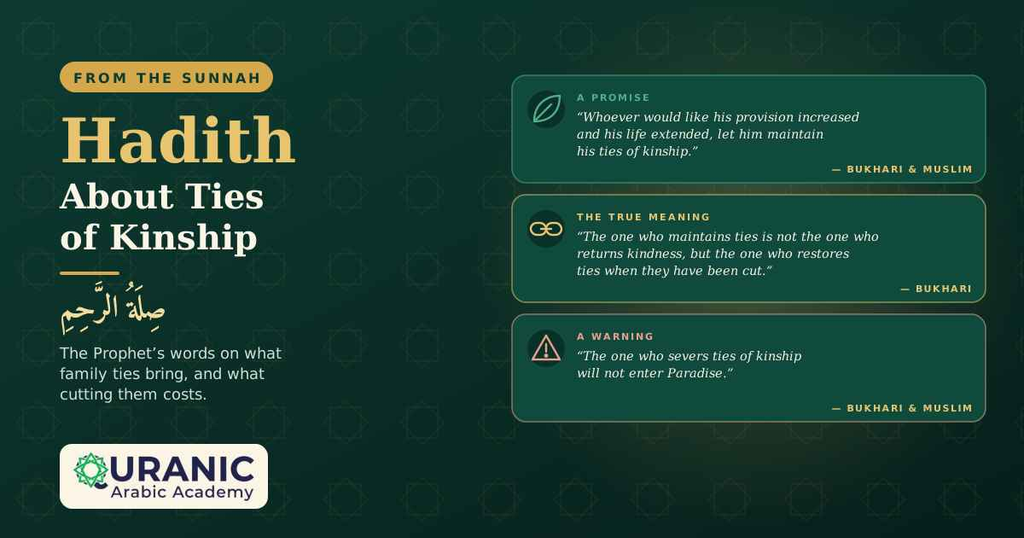
Others carry serious warnings, such as his statement that the one who severs family ties will not enter Paradise (Bukhari and Muslim). Te following six authentic hadith about ties of kinship show how central the duty is to faith, reward, and accountability.
- Kinship is a sign of faith. Abu Hurayrah reported that the Prophet ﷺ said: “Whoever believes in Allah and the Last Day, let him maintain his ties of kinship.” (Sahih al-Bukhari 6138)
- It increases provision and life. Anas ibn Malik reported that the Prophet ﷺ said: “Whoever would love for his provision to be expanded and his life to be extended, let him maintain his ties of kinship.” (Sahih al-Bukhari 5986; Sahih Muslim 2557)
- Severing ties blocks Paradise. Jubayr ibn Mut’im reported that the Prophet ﷺ said: “The one who severs ties of kinship will not enter Paradise.” (Sahih al-Bukhari 5984; Sahih Muslim 2556) Scholars explain that he will not enter it with the first people to enter, unless Allah forgives him.
- Punishment comes quickly in this life. The Prophet ﷺ said: “There is no sin more deserving of having its punishment hastened in this world, along with what is stored for it in the Hereafter, than oppression and severing ties of kinship.” (Sunan Abu Dawud 4902; Jami’ at-Tirmidhi 2511, graded sahih)
- The true maintainer goes first. The Prophet ﷺ said: “The one who maintains ties is not the one who merely reciprocates. The one who maintains ties is the one who, when his relatives cut him off, reconnects with them.” (Sahih al-Bukhari 5991)
- Charity to relatives earns double. The Prophet ﷺ said: “Charity given to a poor person is charity, and charity given to a relative is two things: charity and maintaining ties.” (Jami’ at-Tirmidhi 658; Sunan an-Nasa’i 2582)
5.Who Counts as Your Kin in Islam?
When we hear the command to keep ties of kinship, a natural question follows: who exactly does it include? Is it only parents and siblings? Does it reach aunts, uncles, and cousins? What about the relatives you’ve rarely met, or family on your spouse’s side?
The answer matters, because you can’t fulfill a duty if you aren’t sure who it’s owed to. Many people unknowingly neglect relatives who have a real right over them, simply because they never thought of them as “family.”
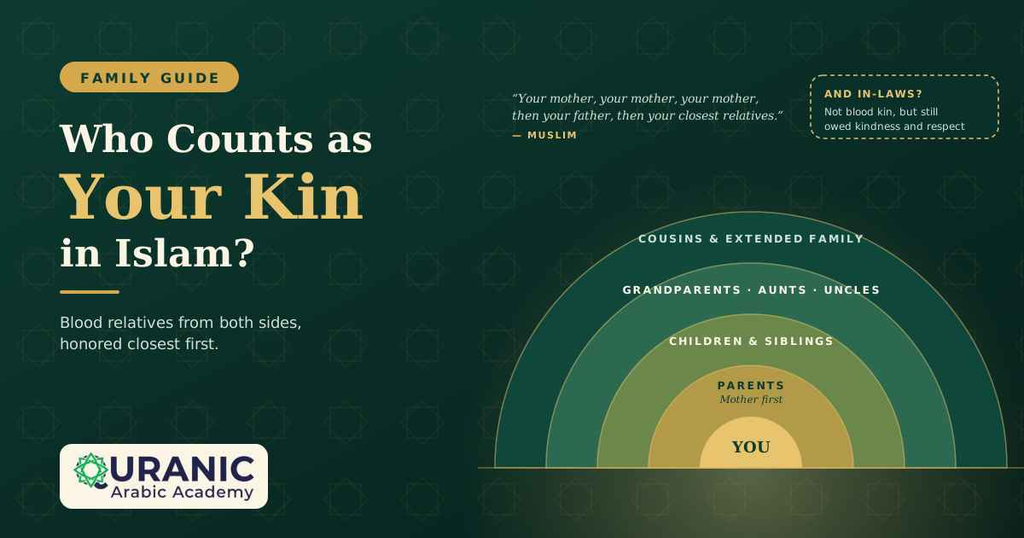
Islam gives this question a clear and thoughtful answer. Your arḥām are, at their core, your blood relatives from both your father’s and your mother’s side, and they aren’t all equal in priority.
A man once asked the Prophet ﷺ who most deserved his good companionship. He answered: “Your mother,” three times, “then your father, then your closest relatives, and then the next closest” (Muslim). In this section, we’ll explore who counts as your kin, how scholars understood the different circles of family, where in-laws fit in, and how to give each relative their rightful share of kindness.
The duty is greatest toward those closest to you. A common order of priority is:
- Parents, whose rights come before everyone else’s.
- Children and siblings.
- Grandparents and grandchildren.
- Paternal and maternal aunts and uncles.
- Cousins and their families.
In-laws are not arham in the technical sense. Still, good treatment of your spouse’s family is part of good character and of honoring your spouse.
6.Rewards of Keeping Ties vs. Consequences of Severing Them
Every relationship with a relative eventually reaches a crossroads. A harsh word is spoken, a favor is forgotten, a visit is never returned, and in that moment you have a choice.
You can reach out, or you can let the distance grow. It may feel like a small, private decision, but in the sight of Allah it’s anything but small. The Quran draws a sharp line between the two paths, and what lies at the end of each could not be more different:
- On one side are those who “join what Allah has ordered to be joined.” Allah promises them “the good consequence of [this] home: Gardens of perpetual residence” (Ar-Ra’d 13:21–23), along with blessings in their provision and their lives here in this world.
- On the other side are those who “sever that which Allah has ordered to be joined”, and of them the very same surah says: “For them is the curse, and they will have the worst home” (Ar-Ra’d 13:25).
The Prophet ﷺ even warned that few sins bring punishment in this world as quickly as oppression and severing family ties (Abu Dawud and Tirmidhi). In this section, we’ll place these two paths side by side, with the rewards of keeping ties and the consequences of cutting them, so you can see clearly what’s at stake in every relationship you choose to mend or neglect.
| Rewards of keeping ties | Consequences of severing ties |
|---|---|
| Expanded provision (rizq) and longer life (Bukhari 5986) | Barred from entering Paradise with the first (Bukhari 5984) |
| Allah keeps connected with you (Hadith Qudsi) | Allah cuts off the one who cuts ties (Hadith Qudsi) |
| Counted among the people of understanding, promised Paradise (13:21) | The curse and an evil home (13:25; 47:23) |
| Double reward for charity to relatives (Tirmidhi 658) | Punishment hastened in this world (Abu Dawud 4902) |
| A sign of true faith (Bukhari 6138) | Du’a may go unanswered if it involves cutting ties (Muslim 2735) |
In short, keeping ties is not only a social virtue. It is an act of worship that shapes your provision, your prayers, and your standing with Allah.
Ready to Begin Your Quranic Journey? Start learning with professional instructors through our structured curriculum. Book Your Free Trial
| Surah & Ayah | Theme | Key lesson |
|---|---|---|
| An-Nisa 4:1 | Command | Honor kinship alongside fear of Allah |
| Al-Baqarah 2:83 | Command | Kindness to relatives is part of every covenant |
| Al-Baqarah 2:177 | Command | Righteousness includes giving to relatives |
| Al-Baqarah 2:215 | Command | Relatives come first in spending |
| An-Nisa 4:36 | Command | Good to relatives follows worship of Allah |
| An-Nahl 16:90 | Command | Giving to relatives is commanded with justice |
| Al-Isra 17:26 | Command | Relatives have a right (haqq) over you |
| Ar-Rum 30:38 | Command | Giving relatives their due brings success |
| Ar-Ra’d 13:21 | Praise | Those who join ties earn Paradise |
| An-Nur 24:22 | Praise | Forgive relatives and keep giving |
| Muhammad 47:22–23 | Warning | Severing ties brings Allah’s curse |
| Ar-Ra’d 13:25 | Warning | Cutters of ties face an evil home |
| Al-Baqarah 2:27 | Warning | Cutters of ties are the losers |
| Al-Anfal 8:75 / Al-Ahzab 33:6 | Rights | Blood relatives have priority |
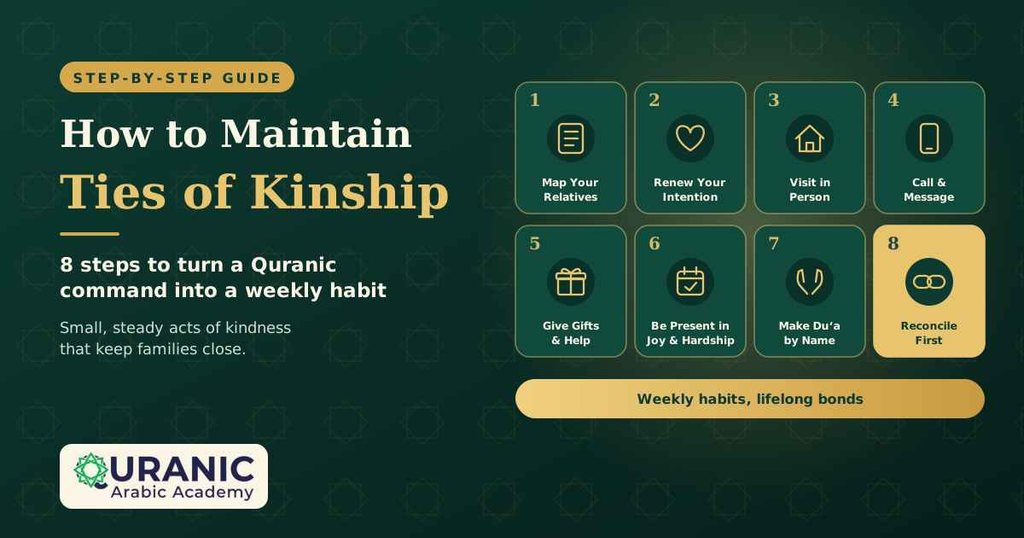
How to Maintain Ties of Kinship – 8 Steps
Knowing the Quranic verse about ties of kinship is the first step; living it is the goal. Most of us don’t cut our relatives off on purpose.
We drift. Weeks turn into months, calls get postponed, and before we know it, a relationship that once felt warm has gone quiet. The solution isn’t a single grand gesture. It’s a set of small, consistent habits. These eight steps turn the Quranic command into a weekly practice that fits into real life.
Step 1: Map Your Relatives
You can’t maintain ties you haven’t thought about. Start by writing down your relatives in order of closeness: parents and siblings first, then grandparents, aunts, uncles, and cousins on both your father’s and mother’s side. This simple exercise often reveals people you’ve unintentionally neglected for years.
Next to each name, set a realistic contact rhythm. For example:
- Call your parents weekly, or daily if you can.
- Check in with siblings and grandparents every week or two.
- Contact aunts and uncles monthly.
- Reach out to distant cousins a few times a year and on special occasions.
Practical tip: Add these rhythms as recurring reminders on your phone. What gets scheduled gets done, and a two-minute reminder can save a relationship.
Step 2: Renew Your Intention
Before you pick up the phone or knock on a door, check your heart. Keep ties for the sake of Allah, not for social appearance, family pressure, or the hope of being repaid. The Prophet ﷺ said: “Actions are judged by intentions” (Bukhari and Muslim). A sincere intention (niyyah) turns every call, visit, and small kindness into an act of worship.
This matters most with difficult relatives. If you keep ties only when they’re returned, you’ll stop the moment someone disappoints you. But when your intention is for Allah, your effort no longer depends on how others respond.
Remember the Prophet’s ﷺ words: “The one who maintains ties is not the one who reciprocates, but the one who, when ties are cut, restores them” (Bukhari). Before each visit or call, quietly say to yourself: “I’m doing this to please Allah.” It takes a second and changes everything.
Step 3: Visit in Person When You Can
A visit is the fullest form of silat ar-rahim. It says something a message never can: you matter enough for me to give you my time. Sitting with an elderly grandparent, sharing a meal with an uncle, or simply drinking tea with a cousin builds a bond that no phone call can replace.
If relatives live nearby, make visits a fixed part of your routine, such as after Jumu’ah or on weekends. Visits don’t need to be long or elaborate.
A short, warm visit done regularly is far better than a long one that happens once a year. Bring your children along. They learn the value of family by watching you, not by hearing lectures about it.
Step 4: Call and Message When You Can’t Visit
Distance is not an excuse to cut ties. Many families today are spread across cities and even continents, but staying connected has never been easier. Al-Azhar’s fatwa confirms that calls, messages, and video chats are valid ways to keep ties when visiting is difficult or would cause harm.
What matters is consistency and warmth. All of these count:
- A short voice note to an elderly aunt.
- A quick video call with a grandparent.
- A “how are you?” message to a cousin.
- A family group chat where you share news and duas.
Practical tip: For elderly relatives, voice and video often mean far more than text. Hearing your voice or seeing your face can brighten their entire day.
Step 5: Give Gifts and Help Within Your Means
Generosity softens hearts and strengthens bonds. The Prophet ﷺ said: “Give gifts to one another, and you will love one another” (Al-Adab Al-Mufrad). Send gifts on Eid and family occasions. They don’t need to be expensive; a thoughtful gift often means more than a costly one.
When relatives are in need, offer financial help to them before others. Remember that charity to a relative earns a double reward. The Prophet ﷺ explained that giving to a relative brings two rewards: “the reward of kinship and the reward of charity” (Bukhari and Muslim).
Helping family is therefore one of the most rewarding forms of giving there is. Help discreetly and with dignity, so your relative never feels embarrassed or indebted.
Step 6: Be Present in Joy and Hardship
Some moments define relationships for a lifetime:
- Attend weddings and celebrations, and share in your relatives’ happiness.
- Visit relatives who are sick, since visiting the sick is among the rights Muslims have over one another.
- Stand with families at funerals and in times of grief, when presence matters more than words.
People rarely remember what you said at a wedding, but they never forget who showed up when they were in the hospital or mourning a loved one. These moments are remembered for years. If you can’t attend in person, call on the day itself. A timely call shows you care in a way a late message can’t.
Step 7: Make Du’a for Them by Name
Du’a is the hidden thread that keeps hearts connected, even when contact is limited. Pray for your relatives’ guidance, health, forgiveness, and wellbeing, mentioning them by name. The Prophet ﷺ said that the du’a of a Muslim for his brother in his absence is answered, and an angel says: “And for you the same” (Muslim).
Du’a also softens your own heart, especially toward relatives you find difficult. It’s very hard to hold a grudge against someone you pray for every day. Choose a few relatives to include in your du’a after each prayer, rotating through your list during the week.
Step 8: Take the First Step to Reconcile
This is often the hardest step, and the most rewarding. If there is a dispute, don’t wait for the other person to come to you. Pride whispers, “They should apologize first.” Islam teaches the opposite. The Prophet ﷺ said a Muslim may not shun his brother for more than three days, and “the better of the two is the one who begins with the greeting of salam” (Sahih al-Bukhari 6077).
Reconciliation doesn’t require pretending nothing happened. Start small: a greeting, a kind message, or a congratulation on a happy occasion.
Even if your effort isn’t returned right away, you’ve done your part. When a man complained to the Prophet ﷺ that his relatives wronged him despite his kindness, the Prophet ﷺ reassured him that he would continue to have a supporter from Allah as long as he kept up his good conduct (Muslim).
What If Your Relatives Are Toxic or Cut You Off?
Islam asks you to keep ties even when relatives don’t return the effort, but it does not ask you to accept harm. Both truths come from authentic sources.
- When relatives cut you off, your reward grows. A man once told the Prophet ﷺ that he kept ties with his relatives while they cut him off, he was good to them while they mistreated him, and he was patient while they were harsh. The Prophet ﷺ replied that if it was as he said, it was as if he were feeding them hot ashes, and Allah would keep supporting him against them as long as he continued (Sahih Muslim 2558). Combined with the hadith that the true maintainer is the one who reconnects after being cut off (Bukhari 5991), the message is clear: your effort counts, whatever their response.
- When contact causes real harm, keep the minimum. Al-Azhar’s fatwa sets the general rule: deliver as much good to relatives as you can and ward off as much harm as you can. If a relative is abusive, you may limit close contact while still keeping the tie alive through:
- A greeting of salam when you meet, and on Eid.
- Short, occasional calls or messages that keep the door open.
- Du’a for their guidance in your private prayers.
- Help in genuine emergencies, if it doesn’t expose you to harm.
- Remember Abu Bakr’s example in Surah An-Nur 24:22: he resumed supporting a relative who had wronged his own daughter. Forgiveness, where it is safe, brings Allah’s forgiveness.
Experience Our Teaching Style:
We believe in clarity and engagement. Watch these short highlights from our actual classes to see our teachers’ methodology and student interactions in real-time.
Ready to Begin Your Quranic Journey?
Start learning with professional instructors through our structured curriculum.
Book Your Free TrialUnderstand These Verses in Their Original Arabic with Quranic Arabic Academy
Throughout this guide, you’ve seen how much meaning can live inside a single Arabic word. You’ve seen raḥim, the womb, sharing its root with Ar-Raḥmān, the Most Merciful. You’ve seen wal-arḥām placed right beside the name of Allah, carrying layers of meaning that scholars have reflected on for centuries.
And you’ve seen verses whose word order, emphasis, and vocabulary reveal lessons that no translation can fully hold. Translations are a valuable bridge, but they can only carry part of the message. The rest stays in the original Arabic, waiting to be discovered.
At Quranic Arabic Academy, our qualified teachers help you understand the Quran directly in its own language, through live one-on-one online classes. Keep your ties with your family strong, and build a living connection with the words of Allah.
Our Arabic Courses
- Quranic Arabic Classes
- Quranic Arabic Course for Beginners
- Online Quranic Arabic Courses for Advanced Learners
- Quranic Arabic Grammar Course
- Arabic Courses for Understanding the Quran
Conclusion
Somewhere in your phone, there’s a name you’ve been meaning to call. Somewhere in your family, there’s a relationship that has quietly gone cold. And somewhere in your heart, there’s a voice telling you: this matters.
It does, more than we often realize. The Quran doesn’t treat family ties as a social nicety. It treats them as a sacred trust that Allah Himself placed under His protection.
The main Quranic verse about ties of kinship, Surah An-Nisa 4:1, makes this unmistakably clear. It places family ties right beside the fear of Allah: “And fear Allah, through whom you ask one another, and the wombs.” Around this verse, many others complete the picture.
They command kindness to relatives and giving them their rights, praise those who forgive, reach out, and join what Allah has commanded to be joined, and warn that severing ties brings Allah’s curse and “the worst home.”
The good news is that you don’t need a grand gesture to begin. Start small this week: call one relative you haven’t spoken to in a while, send one gift, even a simple one, or make one du’a for a family member by name. Each step is an act of worship that keeps you connected to those Allah connected you with, and through them, to Allah Himself.
You could link a separate, clear sentence at the end instead, for example: “Want to understand these verses in their original Arabic? Book your free trial lesson with The Quranic Arabic Academy.”
FAQs
Which surah talks about ties of kinship?
Several surahs do, but the main one is Surah An-Nisa (4:1), which commands mindfulness of Allah and of family ties. Surah Muhammad (47:22–23) and Surah Ar-Ra’d (13:21, 13:25) are the other key passages.
Is cutting family ties a major sin in Islam?
Yes. Scholars count severing ties of kinship among the major sins. The Quran links it to Allah’s curse (47:23), and the Prophet ﷺ said the one who cuts ties will not enter Paradise (Bukhari 5984).
Does a phone call count as keeping ties of kinship?
Yes. Ties can be kept through visits, calls, messages, gifts, and help. Al-Azhar confirms that modern means of communication are valid, especially when visiting is difficult. Visiting remains better when it is possible.
What is the reward for keeping family ties?
The Prophet ﷺ promised expanded provision and a longer life to those who keep ties (Bukhari 5986). Allah also promises to stay connected to them, and charity to relatives earns a double reward.
Can I cut ties with a relative who harms me?
You may reduce close contact to protect yourself, but scholars advise keeping a minimum tie, such as a greeting, an occasional message, and du’a. For serious cases, consult a qualified scholar.
Related Articles
Quranic Verses





Leave a Reply