 Quran
Quran
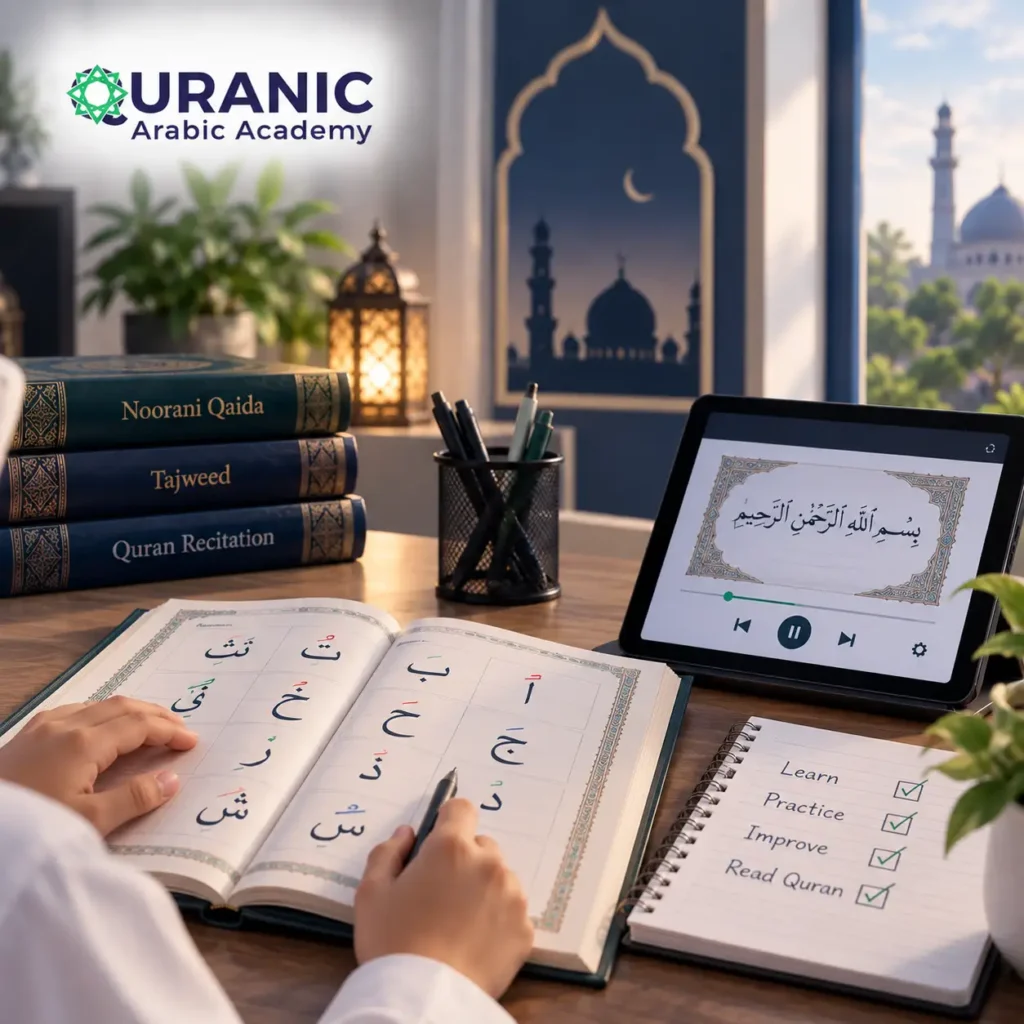
Learning how to learn to read the Quran by yourself is possible when you follow a clear method, practice consistently, and use reliable learning resources. Many beginners want to become comfortable reading directly from the Mushaf on their own, either before starting lessons with a teacher or alongside guided Quran classes.
The key is to build your skills gradually rather than trying to read complete verses before mastering the foundations.
This guide focuses on two connected goals: developing a practical self-study routine and learning how to improve Quran recitation once you can recognize basic Arabic letters and words.
You will move gradually from letter recognition, Harakat, and connected words to pronunciation, Makharij, Tajweed, and smoother recitation. Each stage builds on the previous one, giving complete beginners a realistic path toward reading the Quran with greater accuracy and confidence.
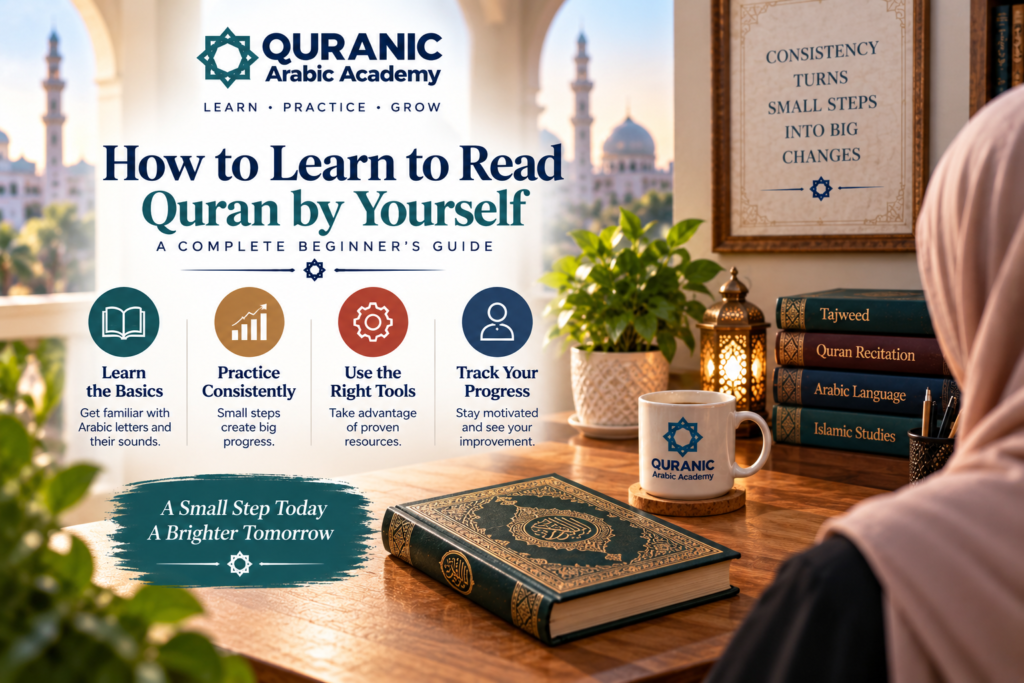
1. Master the Arabic Alphabet and Letter Points (Makharij)
Makharij al-Huruf refers to the precise articulation points in the mouth, throat, tongue, and lips from which Arabic letters are pronounced. Learning these points from the beginning is important because producing a letter from the wrong place can make it sound like another letter and affect the accuracy of Quran recitation.
Before attempting to read complete Surahs, learners should become comfortable recognizing all 28 Arabic letters and understanding how their shapes change when they appear in their isolated, initial, medial, and final forms.
Extra attention should be given to letters that beginners commonly confuse, such as ق and ك, ض and ظ, ح and ه, or و and ص. Practice each difficult letter individually first, then use it in simple combinations and short words so that both the eye and tongue become familiar with it.
Listening to correct pronunciation and receiving feedback from a qualified teacher can also help prevent incorrect articulation from becoming a repeated habit.
A Qaidah Noorania (Noorani Qaida) or a similar beginner’s primer is commonly used at this stage because it introduces Arabic letters and sounds in a gradual, structured way before combining them into words.
Working through these lessons systematically can give beginners a stronger foundation for recognizing Quranic Arabic and prepare them for vowel marks, connected words, and later Tajweed practice.
2. Learn the Basic Vowel Marks (Harakat) and Sukoon
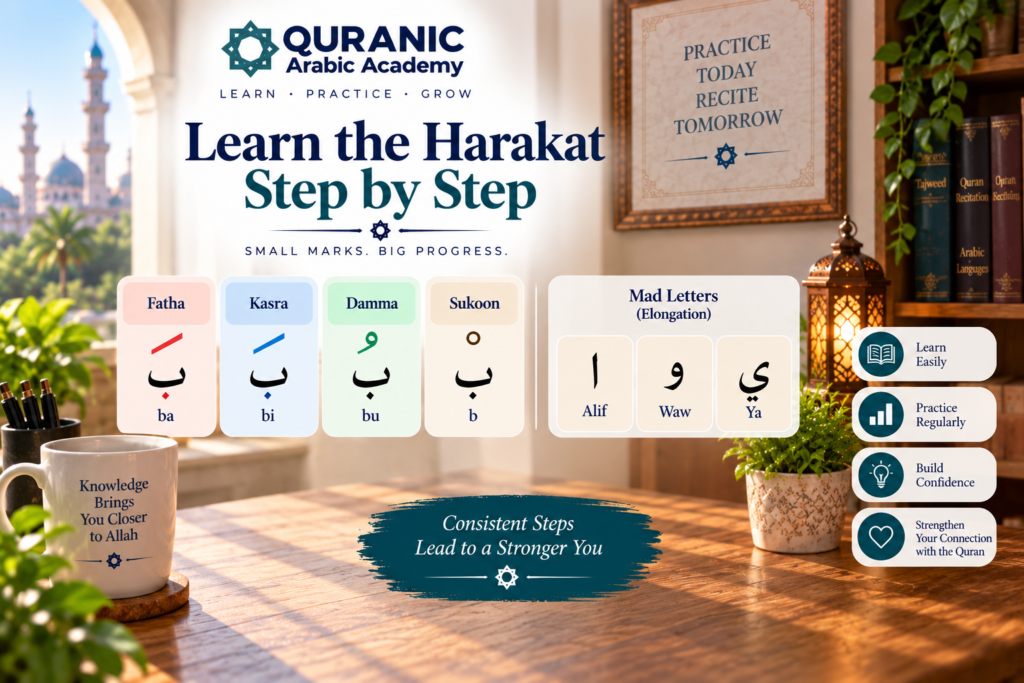
Once you can recognize the Arabic letters comfortably, the next step is learning the basic Harakat: Fatha, Damma, and Kasra. These short vowel marks appear above or below Arabic letters and determine the short vowel sound that accompanies each consonant.
Sukoon, by contrast, indicates that a letter has no following short vowel. Recognizing these marks quickly is essential because hesitation over Harakat can make even simple Quranic words difficult to read smoothly.
Begin by practicing individual letters with different vowel marks until the combinations become familiar. Then move gradually to two-letter combinations, short words, and simple Quranic examples, paying close attention to how each vowel changes the sound of the letter.
At this stage, accuracy is more important than speed, so take enough time to pronounce every sound clearly before attempting to read faster.
Once short vowels and Sukoon feel more automatic, begin practicing the Madd (elongation) letters – Alif, Waw, and Ya – which are used to extend vowel sounds and occur frequently throughout the Quran.
Learning to distinguish between short and elongated sounds prepares you for more accurate recitation and provides an important foundation for studying Tajweed rules, Quranic words, and complete verses later.
3. Use a Talqeen Mushaf and Guided Audio Recitation
Using a Talqeen Mushaf alongside guided audio recitation can be especially helpful for learners who need to connect the written Quranic text with its correct pronunciation.
Slow, clear teaching recitations, such as the Muallim-style recitations of Sheikh Mahmoud Khalil Al-Husary or Sheikh Muhammad Siddiq Al-Minshawi, allow learners to hear letters, words, elongations, and pauses more clearly than they might in faster recitation.
This gives beginners enough time to observe how each word is pronounced and then imitate it without feeling pressured to keep up with a fast pace.
Digital Quran apps can make this type of practice even easier. Look for features that allow you to select a single ayah, slow the recitation when available, and repeat the same verse several times on a loop.
Instead of listening passively to an entire Surah, concentrate on one short portion until you can follow its pronunciation comfortably. Repeated exposure helps train your ear to recognize correct Makharij, vowel sounds, Madd, Ghunnah, and natural stopping points.
The practice method itself is simple: listen to one ayah carefully, pause the audio, recite it aloud yourself, and then listen again to compare your pronunciation with the reciter.
If you notice a difference, isolate the difficult word or phrase and repeat it several times before attempting the complete ayah again. This listen-repeat-check cycle is one of the most practical self-study techniques for developing clearer pronunciation and greater fluency.
However, guided audio should ideally complement rather than completely replace a qualified Quran teacher. A recording provides an accurate model to imitate, but it cannot hear your recitation or point out subtle mistakes you may not recognize yourself.
Combining regular Talqeen practice with teacher feedback can therefore provide a stronger path toward accurate, confident, and consistent Quran recitation.
4. Start With Short Surahs From Juz Amma
Once you are comfortable with Arabic letters, basic vowel marks, and simple word combinations, begin practicing with Surah Al-Fatiha, since it is recited in every rak’ah of Salah and gives you repeated opportunities to strengthen your reading.
Take your time with each ayah, paying attention to Makharij, Harakat, Madd, and correct stopping points rather than trying to finish the Surah quickly. Because you recite Al-Fatiha so frequently, correcting its pronunciation early can also reinforce many of the basic reading skills you are developing.
After that, move into the short Surahs of Juz Amma, beginning with Surah An-Nas and gradually working backward toward slightly longer Surahs. Starting with short passages allows beginners to focus closely on pronunciation and Tajweed without becoming overwhelmed by a long page of unfamiliar Arabic.
You can repeat the same Surah several times, listen to a skilled reciter, and work on difficult words individually before reading the complete passage again.
Short Surahs are also useful for building confidence because you can complete and review an entire Surah in a single practice session. This creates a clear sense of progress and can help maintain motivation during the early stages of learning.
As your accuracy and fluency improve, gradually move toward longer Surahs while continuing to review the shorter ones so that correct pronunciation and Tajweed remain consistent.
| Learn to Read Quran With Guided SupportIf self-study alone feels slow, structured Quranic Arabic Classes can guide you through each stage with a qualified teacher.Explore Quran Reading Classes |
See It in Action:
Wondering what our interactive sessions look like? Click below to peek inside a live session and watch how our expert instructors make learning Quranic Arabic accessible and engaging.
Ready to Begin Your Quranic Journey?
Start learning with professional instructors through our structured curriculum.
Book Your Free Trial5. Learn Basic Tajweed Rules to Improve Quran Recitation
Tajweed is the set of rules that helps you pronounce Quranic letters correctly and give each letter its proper characteristics during recitation. It covers important areas such as Makharij (articulation points), letter qualities, elongation, nasalization, and the way certain letters interact when they appear together.
Learning these rules helps beginners move beyond simply recognizing Arabic words toward reading the Quran more clearly and accurately.
However, you do not need to learn every advanced Tajweed rule before you can improve your Quran recitation. Trying to study too many rules at once can make the process unnecessarily difficult for a beginner.
A better approach is to begin with the rules that appear frequently in everyday Quran reading, understand them one at a time, and immediately practice them using short words and familiar verses.
For beginners, three main categories provide a practical starting point and cover many of the situations you will encounter during regular recitation.
Once you can recognize and apply these rules consistently, you can gradually move on to more detailed Tajweed topics while continuing to review what you have already learned.
Read also: How to Improve Your Quran Reading: A Step-by-Step Practical Guide
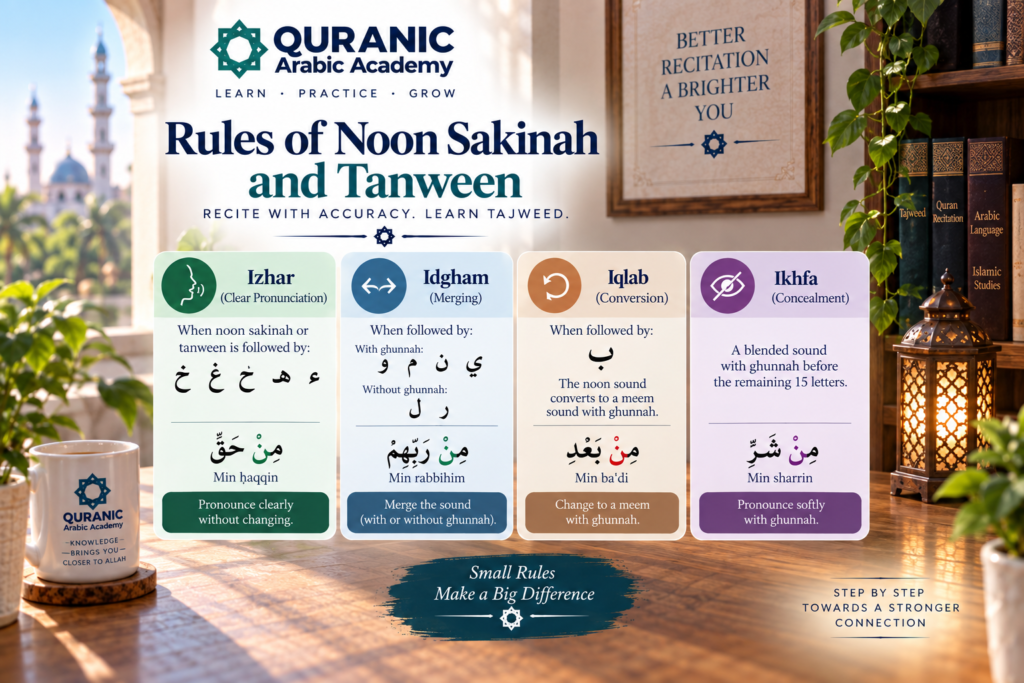
Rules of Noon Sakinah and Tanween
The rules of Noon Sakinah (نْ) and Tanween (ــًــٍــٌ) explain how these sounds should be pronounced depending on the letter that follows them. They are divided into four main rules: Izhar, Idgham, Iqlab, and Ikhfa.
Learning to recognize and apply these rules helps make Quran recitation clearer, more accurate, and consistent with Tajweed.
- Izhar (clear pronunciation): when noon sakinah or tanween is followed by ء، هـ، ع، ح، غ، خ.
- Idgham (merging): when followed by ي، ن، م، و (with ghunnah) or ر، ل (without ghunnah).
- Iqlab (conversion): when followed by ب, the noon sound converts to a meem sound with ghunnah.
- Ikhfa (concealment): a blended sound with ghunnah before the remaining 15 letters.
Rules of Meem Sakinah
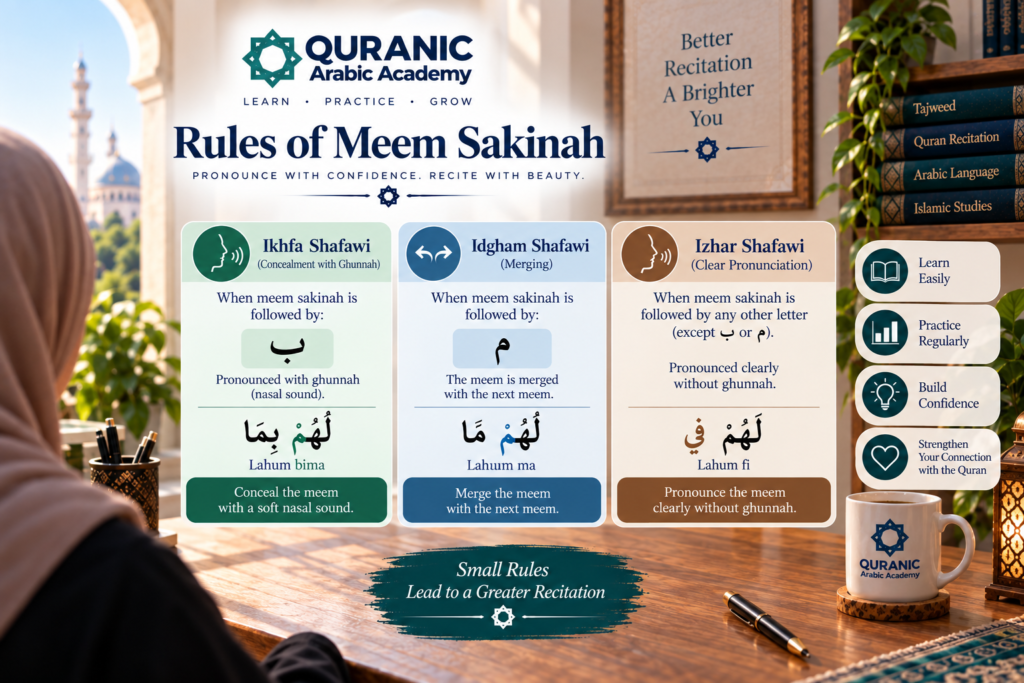
The rules of Meem Sakinah (مْ) determine how a silent Meem is pronounced according to the letter that follows it. There are three main rules: Ikhfa Shafawi, Idgham Shafawi, and Izhar Shafawi.
Learning these rules helps you pronounce Meem Sakinah correctly and improve the accuracy of your Quran recitation.
- Idgham shafawi: when a meem sakinah is followed by another meem.
- Ikhfa shafawi: when meem sakinah is followed by ب, pronounced with ghunnah.
- Izhar shafawi: clear pronunciation before any other letter.
For further reading, the Academy’s blog post on Quranic Tarbiyah and its guide to Learning Quranic Arabic for Complete Beginners both expand on themes covered here.
Rules of Madd (Elongation)
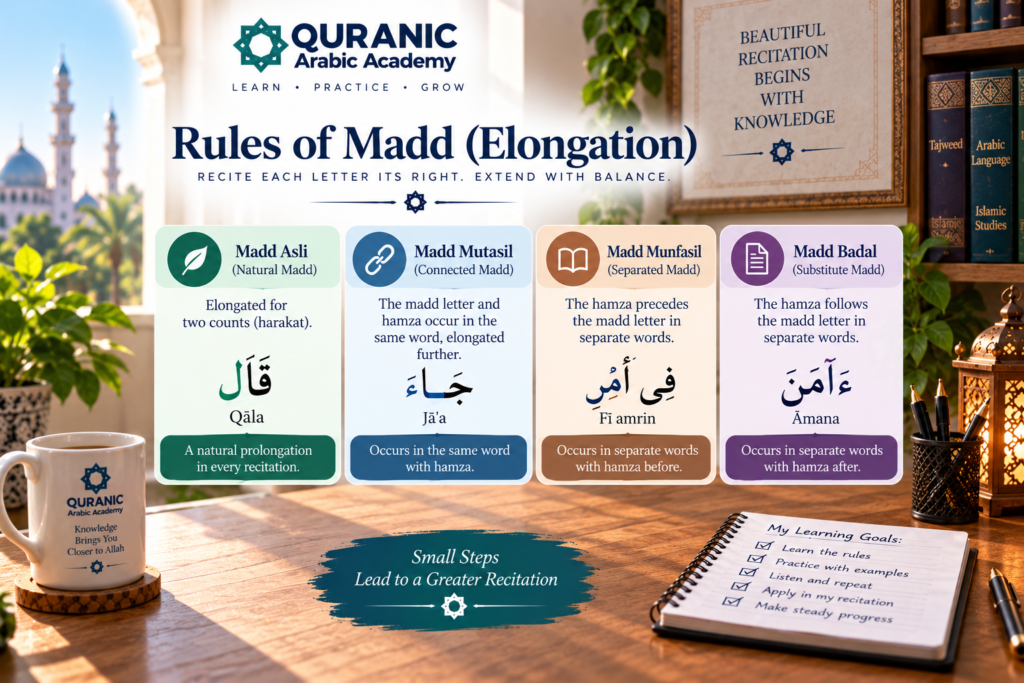
The rules of Madd explain when and how long certain vowel sounds should be extended during Quran recitation. Different types of Madd require different lengths depending on the letters and signs that appear in a word or between words.
Learning these rules helps you avoid shortening or overextending sounds and makes your recitation more accurate and balanced.
- Madd Asli (natural madd): elongated for two counts (harakat).
- Madd Muttasil: the madd letter and hamza occur in the same word, elongated further.
- Madd Munfasil and Madd Badal: variations where the hamza precedes or follows the madd letter in separate words.
6. Use a Colour-Coded Tajweed Mushaf
A colour-coded Tajweed Mushaf marks different Tajweed features with specific colours directly within the Arabic text, helping learners notice where particular pronunciation rules should be applied while they are reading.
Instead of trying to remember every rule from theory alone, beginners can use these visual cues to identify features such as Madd, Ghunnah, Ikhfa, Idgham, and Qalqalah and gradually become more familiar with how they appear in real Quranic verses.
This can be especially useful for adult self-learners who want to begin applying Tajweed without first working through an entire Tajweed textbook. Seeing the rules repeatedly in context helps connect the written Quran with the correct way of reciting it and can make early practice feel less overwhelming.
Over time, learners can study the theory behind each colour and begin recognizing the same rules even without visual highlighting.
However, a colour-coded Mushaf should be treated as a learning aid rather than a replacement for correct instruction.
Listening to accurate recitation and receiving occasional correction from a qualified Quran teacher can help ensure that you are interpreting the colours correctly and producing each sound as intended.
7. Practice Talaqqi With a Qualified Teacher
Talaqqi means learning through direct transmission by reciting to a qualified teacher who listens carefully and corrects your pronunciation in real time.
This oral method reflects the way Quranic recitation has traditionally been taught and transmitted, beginning with the Prophet Muhammad ﷺ receiving the Quran through Jibreel (peace be upon him) and continuing through generations of Quran teachers and students.
For self-learners, regular Talaqqi sessions are particularly valuable because they can reveal subtle mistakes in Makharij, letter characteristics, Madd, Ghunnah, and other Tajweed rules that may be difficult to notice when practicing alone.
Once you can read the Quran comfortably, structured Quranic Arabic grammar classes can add another important layer to your learning. Understanding basic grammar, common sentence structures, and recurring Quranic word patterns can help you recognize how words relate to one another and understand more of what you recite.
This allows recitation and comprehension to develop together, rather than treating accurate reading and understanding the Quran as completely separate skills.

Why Scholars Recommend Learning Alongside a Teacher, Not From a Mushaf Alone
Classical scholars have long emphasized the importance of learning Quran recitation directly from qualified teachers, rather than relying only on the written Mushaf.
Some pronunciation mistakes can be extremely subtle, particularly those involving Makharij, letter characteristics, Madd, Ghunnah, and similar Arabic sounds, and learners may repeat them without realizing anything is wrong.
Because Quran recitation has traditionally been learned through listening, reciting, and receiving correction, written explanations and self-study resources are most effective when supported by direct feedback.
This is why many learners combine daily independent practice with regular sessions with a Quran teacher. Self-study provides the repetition needed to become familiar with letters, words, Tajweed rules, and complete verses, while teacher sessions provide an opportunity to check whether those skills are being applied correctly.
A learner might practice throughout the week, note difficult words or passages, and then recite them to a teacher for correction.
This combination creates a practical balance between independence and accurate guidance. The learner gains confidence and fluency through regular personal practice while reducing the risk of allowing unnoticed pronunciation mistakes to become established habits.
Read also: A Beginner’s Guide to Learning Quran Reading for Adults
Quranic Guidance on Reciting the Quran Correctly
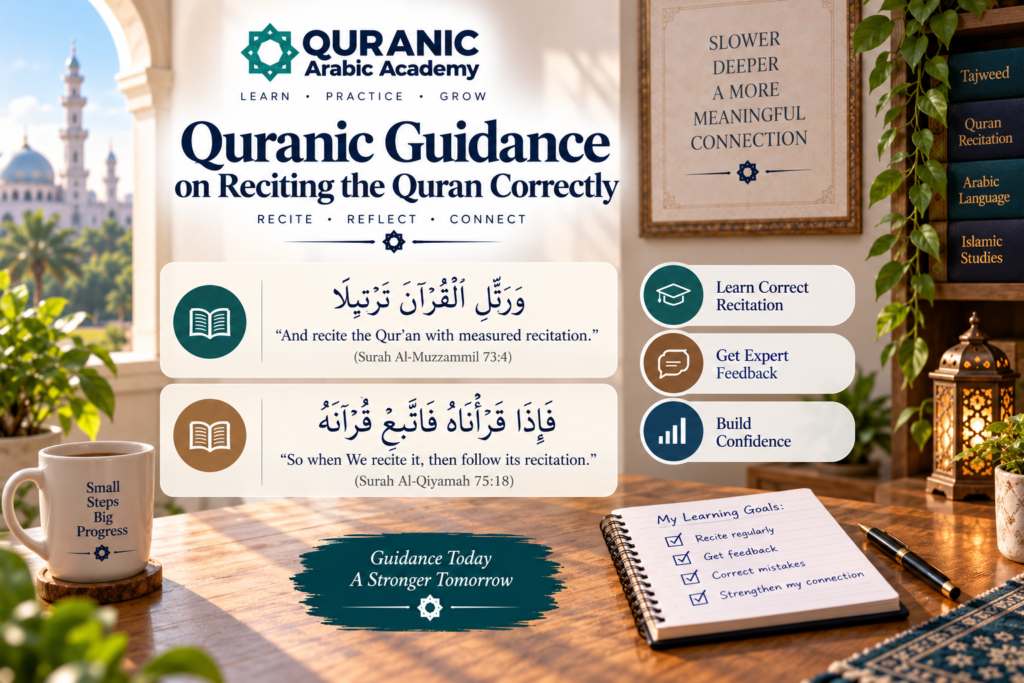
The Quran itself instructs believers to recite with Tarteel, meaning a clear, measured, and deliberate manner of recitation rather than rushing through the words simply to finish more pages.
Reading at a controlled pace gives the reciter enough time to pronounce each letter carefully, observe Makharij and Tajweed rules, and pause appropriately where needed. It also creates more space to think about the meaning of the verses instead of focusing only on completing the passage.
For beginners especially, practicing Tarteel can help develop better pronunciation habits, improve accuracy, and gradually build smoother and more confident Quran recitation.
وَرَتِّلِ الْقُرْآنَ تَرْتِيلًا
“And recite the Qur’an with measured recitation.”
A second verse links correct recitation to the way the Quran was transmitted to the Prophet Muhammad (peace be upon him) through the angel Jibreel, verse by verse, which is the same talaqqi model recommended for students today.
فَإِذَا قَرَأْنَاهُ فَاتَّبِعْ قُرْآنَهُ
“So when We have recited it [through Gabriel], then follow its recitation.”
A Hadith on the Beauty of Quran Recitation
The Prophet Muhammad ﷺ praised the beautiful recitation of Abu Musa al-Ash‘ari (رضي الله عنه) after hearing him recite the Quran, highlighting the value of a pleasant and attentive voice in Quran recitation.
This encourages learners to develop a recitation that is not only accurate but also calm, clear, and naturally expressive.
However, beautifying the voice should never come at the expense of correct pronunciation or Tajweed. The priority remains giving each letter its proper sound, observing rules such as Madd and Ghunnah, and maintaining appropriate pauses.
A learner does not need a powerful or highly melodic voice; even a simple voice can be beautiful when the Quran is recited carefully and sincerely.
For beginners, the best approach is to focus first on accuracy, clarity, and a measured pace, then allow the voice to become more natural and expressive as confidence develops.
Listening to skilled reciters can also help learners understand how beautiful recitation can be combined with proper Tajweed and respect for the words of Allah.
لَوْ رَأَيْتَنِي وَأَنَا أَسْتَمِعُ لِقِرَاءَتِكَ الْبَارِحَةَ، لَقَدْ أُوتِيتَ مِزْمَارًا مِنْ مَزَامِيرِ آلِ دَاوُدَ
“If you had seen me listening to your recitation last night — you would have been given one of the flutes of the family of Dawud (David).”
This hadith is frequently cited to encourage learners that a sincere, well-practiced recitation is valued, not only technical perfection from the very first attempt.
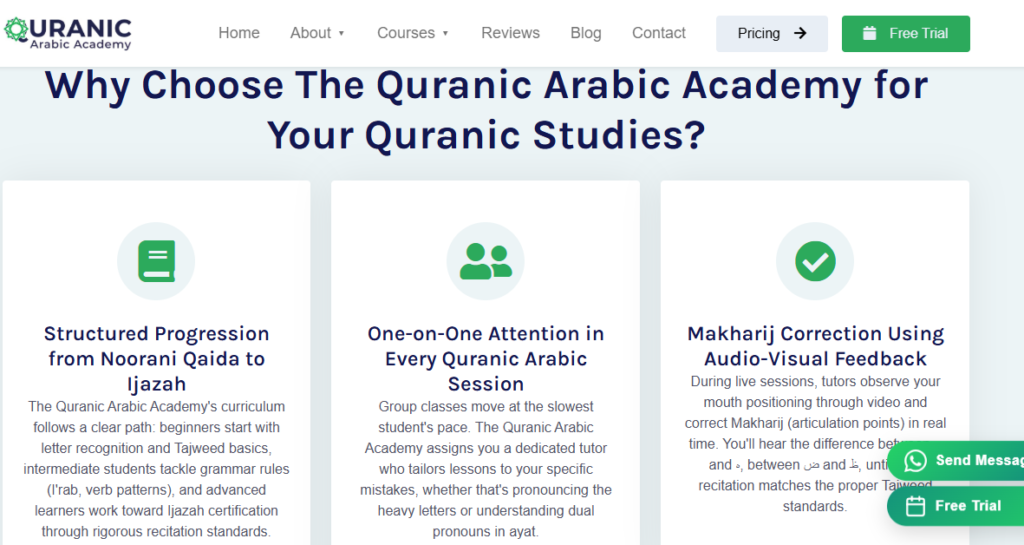
| Get Personal Feedback on Your RecitationA teacher can tell you in minutes what months of guessing on your own cannot. Reach out to the Quranic Arabic Academy team to discuss your current level.Contact the Academy |
Common Mistakes Beginners Make When Learning Quran Recitation Alone
Learning Quran recitation independently can be effective, especially when learners have access to reliable resources and maintain a consistent practice routine.
However, beginners may develop pronunciation or reading mistakes without realizing them, particularly when there is no one listening to their recitation. Some errors may initially seem minor but can become more difficult to correct if they are repeated for weeks or months.
Common problems include reading too quickly, confusing similar Arabic letters, overlooking Tajweed rules, relying too heavily on transliteration, and repeatedly practicing words with incorrect pronunciation.
Learners may also shorten or lengthen sounds incorrectly, miss Shaddah or Ghunnah, or stop at unsuitable places because they are concentrating mainly on completing the verse rather than reading it accurately.
The best way to prevent these habits is to identify and correct mistakes as early as possible. Listen carefully to proficient reciters, record yourself occasionally, repeat difficult words slowly, and compare your reading with accurate examples. Most importantly, have your recitation checked regularly by a qualified Quran teacher whenever possible.
Combining independent practice with direct correction can help you build a stronger foundation and gradually develop clearer, more accurate, and more confident Quran recitation..
- Skipping the alphabet and letter points to jump straight into surahs.
- Reading fast before pronunciation is accurate, which locks in bad habits.
- Ignoring Tajweed rules until “later,” then having to unlearn incorrect habits.
- Never checking recitation against a teacher or a verified reciter.
- Studying inconsistently instead of short, daily practice sessions.
How the Quranic Arabic Academy Can Support Your Self-Study
The Quranic Arabic Academy follows the same combination of self-study and teacher guidance described throughout this article. Its Quranic Arabic Classes for Quran help learners improve reading, pronunciation, and Tajweed while receiving direct correction from qualified teachers.
For students who also want to understand the language behind their recitation, Quranic Arabic Grammar Classes provide structured support in Quranic vocabulary and grammar.
Families learning together can also explore the Quranic Arabic Classes for Kids, where younger learners build their skills gradually through Arabic letters, pronunciation, reading practice, and teacher guidance.
Together, these courses provide a structured way for adults and children to combine regular practice with accurate instruction and feedback.
Start your Quran learning journey with Quranic Arabic Academy today and book your free trial class to experience structured, teacher-guided learning before you enroll.

Experience Our Teaching Style:
We believe in clarity and engagement. Watch these short highlights from our actual classes to see our teachers’ methodology and student interactions in real-time.
Ready to Begin Your Quranic Journey?
Start learning with professional instructors through our structured curriculum.
Book Your Free TrialStart Learning to Recite the Quran With Confidence
You do not have to improve your Quran recitation entirely on your own. With Quranic Arabic Academy, you can follow a structured learning path, practice correct pronunciation and Tajweed, and receive direct feedback on the mistakes that need the most attention.
Qualified teachers can help you strengthen your Makharij, correct recurring recitation errors, and gradually develop greater fluency and confidence.
Start learning today and take your next step toward reciting the Quran more accurately, smoothly, and confidently with expert guidance and consistent practice.
Our Arabic Courses
- Quranic Arabic Classes
- Quranic Arabic Course for Beginners
- Online Quranic Arabic Courses for Advanced Learners
- Quranic Arabic Grammar Course
- Arabic Courses for Understanding the Quran
- Quranic Arabic Course for Sisters (Female)
- Quranic Arabic Course for Kids
- Online Quranic Arabic Classes for Adults
- Quranic Arabic Course UK
- Quranic Arabic Course London
- Quranic Arabic Course USA
- Quranic Arabic Course Canada
- Quranic Arabic Course Australia
- Quranic Arabic Course UAE
- Quranic Arabic Course Germany
| Ready to Move Beyond Self-Study Alone?Book a session with the Quranic Arabic Academy and get direct, personalised feedback on your Quran recitation.Contact the Quranic Arabic Academy |
Conclusion
Learning how to learn to read the Quran by yourself is realistic when you follow a clear progression instead of trying to master everything at once. Begin with Arabic letters and their sounds, then learn the basic vowel marks, practice connected words, and gradually move into short Surahs.
Once these foundations become comfortable, you can begin applying essential Tajweed rules and improving the accuracy, fluency, and rhythm of your recitation. Throughout this process, listening to a reliable reciter and comparing your reading with correct examples can help reinforce what you learn.
The greatest benefit of self-study is that it allows you to build a consistent daily Quran habit. Even short practice sessions can strengthen letter recognition, pronunciation, and reading confidence when they are repeated regularly.
Instead of measuring progress only by how many pages you complete, focus on whether you are reading more accurately, recognizing words more quickly, and correcting mistakes that previously caused difficulty.
At the same time, independent study should be supported by regular correction from a qualified Quran teacher whenever possible. A teacher can identify subtle mistakes in Makharij, Tajweed, Madd, Ghunnah, and other areas that may be difficult to hear on your own.
Use the steps above as a practical checklist, remain patient when progress feels slow, and keep your routine realistic enough to maintain. With consistent practice, careful listening, gradual Tajweed study, and reliable teacher feedback, you can steadily move from recognizing basic Arabic letters to reading the Quran with greater accuracy, fluency, and confidence.

Frequently Asked Questions
Can a beginner learn to read the Quran without any teacher at all?
A beginner can learn the alphabet, vowel marks, and basic word-reading independently, but scholars recommend confirming pronunciation and Tajweed with a qualified teacher, since some errors are hard to notice without outside correction.
What is the best Mushaf for learning Quran recitation alone?
A talqeen Mushaf paired with a slow reciter, or a colour-coded Tajweed Mushaf, are the two most practical choices for self-study, since both make correct pronunciation visible or audible without requiring advanced Tajweed theory first.
How long does it take to learn to read the Quran as a beginner?
Timelines vary widely based on daily practice time and prior familiarity with Arabic letters, so this article does not give a fixed number; consistent short daily sessions generally produce steadier progress than infrequent long ones.
What is Tajweed and why does it matter for recitation?
Tajweed is the set of rules governing correct pronunciation of Quranic letters and their characteristics during recitation. It matters because it preserves the sound of the Quran as it was transmitted, and incorrect application can change the meaning or clarity of specific words.
Where can I get personalized feedback on my Quran recitation?
A qualified Quran teacher, whether local or online, can listen to your recitation directly and correct mistakes in real time. Structured programmes such as those offered through the Quranic Arabic Academy are one option for this kind of guided feedback.







Leave a Reply